
Recent from talks
Wolbachia
Knowledge base stats:
Talk channels stats:
Members stats:
Wolbachia
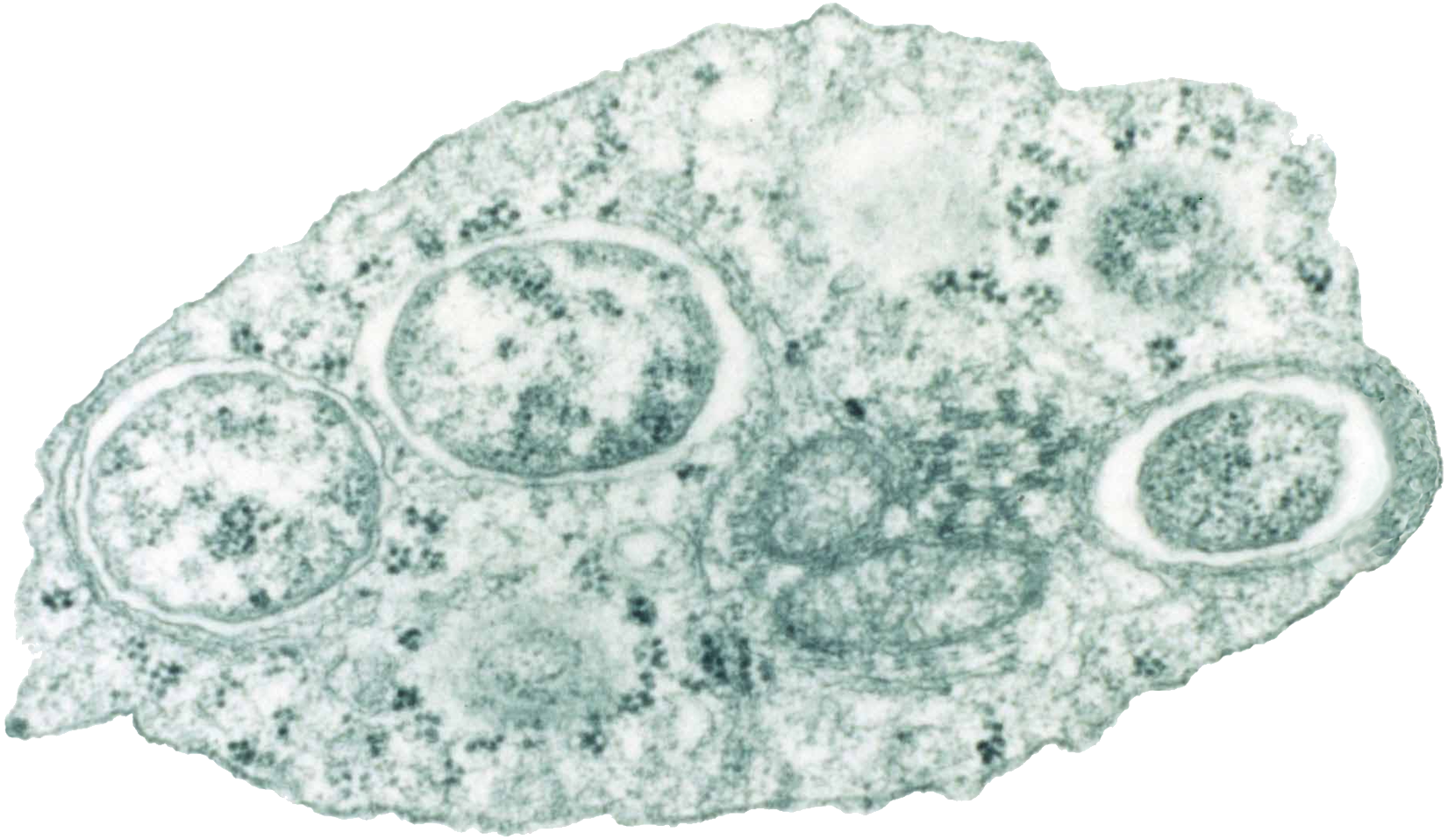
Wolbachia is a genus of gram-negative bacteria infecting many species of arthropods and filarial nematodes. The symbiotic relationship ranges from parasitism to obligate mutualism. It is one of the most common parasitic microbes of arthropods, and is possibly the most widespread reproductive parasite bacterium in the biosphere. Its interactions with hosts are complex and highly diverse across different host species. Some host species cannot reproduce, or even survive, without Wolbachia colonisation. One study concluded that more than 16% of neotropical insect species carry bacteria of this genus, and as many as 25 to 70% of all insect species are estimated to be potential hosts.
The first organism classified as Wolbachia was discovered in 1924 by Marshall Hertig and Simeon Burt Wolbach in the common house mosquito. They described it as "a somewhat pleomorphic, rodlike, Gram-negative, intracellular organism [that] apparently infects only the ovaries and testes". Hertig formally described the species in 1936, and proposed both the generic and specific names: Wolbachia pipientis.
Research on Wolbachia intensified after 1971, when Janice Yen and A. Ralph Barr of UCLA discovered that Culex mosquito eggs were killed by a cytoplasmic incompatibility when the sperm of Wolbachia-infected males fertilized infection-free eggs.
Since, a large number of bacteria with close phylogenetic affinity to the originally detected W. pipientis have been discovered in a variety of hosts spanning over the Arthropoda and Nematoda phyla. The taxonomic classification of the various discovered groups remains a subject of debate, with no consensus on whether these groups of Wolbachia pipientis-like organisms should be categorized as the same or different species. Therefore, the strains are collectively referred to as Wolbachia, with the various groups of phylogenetically closely related strains designated as supergroups rather than distinct species. In general, each supergroup corresponds to a specific host or group of hosts. The genus Wolbachia is of considerable interest today due to its ubiquitous distribution, its many different evolutionary interactions, and its potential use as a biocontrol agent.
Phylogenetic studies have shown that the closest relatives to Wolbachia are the genera Francisella and Bartonella. Unlike Wolbachia, which needs a host cell to multiply, relatives belonging to these genera can be cultured on agar plates.
Wolbachia can infect many different types of organs, but are most notable for the infections of the testes and ovaries of their hosts altering the reproduction abilities of these. Wolbachia species are ubiquitous in mature eggs, but not mature sperm. Only infected females, therefore, pass the infection on to their offspring. Wolbachia bacteria maximize their spread by altering the reproductive capabilities of their hosts, in favour for the infected females. Several different phenotypes have been observed, including:
Several host species, such as those within the genus Trichogramma, are so dependent on sexual differentiation of Wolbachia that they are unable to reproduce effectively without the bacteria in their bodies, and some might even be unable to survive uninfected.
One study on infected woodlice showed the broods of infected organisms had a higher proportion of females than their uninfected counterparts.
Hub AI
Wolbachia AI simulator
(@Wolbachia_simulator)
Wolbachia
Wolbachia is a genus of gram-negative bacteria infecting many species of arthropods and filarial nematodes. The symbiotic relationship ranges from parasitism to obligate mutualism. It is one of the most common parasitic microbes of arthropods, and is possibly the most widespread reproductive parasite bacterium in the biosphere. Its interactions with hosts are complex and highly diverse across different host species. Some host species cannot reproduce, or even survive, without Wolbachia colonisation. One study concluded that more than 16% of neotropical insect species carry bacteria of this genus, and as many as 25 to 70% of all insect species are estimated to be potential hosts.
The first organism classified as Wolbachia was discovered in 1924 by Marshall Hertig and Simeon Burt Wolbach in the common house mosquito. They described it as "a somewhat pleomorphic, rodlike, Gram-negative, intracellular organism [that] apparently infects only the ovaries and testes". Hertig formally described the species in 1936, and proposed both the generic and specific names: Wolbachia pipientis.
Research on Wolbachia intensified after 1971, when Janice Yen and A. Ralph Barr of UCLA discovered that Culex mosquito eggs were killed by a cytoplasmic incompatibility when the sperm of Wolbachia-infected males fertilized infection-free eggs.
Since, a large number of bacteria with close phylogenetic affinity to the originally detected W. pipientis have been discovered in a variety of hosts spanning over the Arthropoda and Nematoda phyla. The taxonomic classification of the various discovered groups remains a subject of debate, with no consensus on whether these groups of Wolbachia pipientis-like organisms should be categorized as the same or different species. Therefore, the strains are collectively referred to as Wolbachia, with the various groups of phylogenetically closely related strains designated as supergroups rather than distinct species. In general, each supergroup corresponds to a specific host or group of hosts. The genus Wolbachia is of considerable interest today due to its ubiquitous distribution, its many different evolutionary interactions, and its potential use as a biocontrol agent.
Phylogenetic studies have shown that the closest relatives to Wolbachia are the genera Francisella and Bartonella. Unlike Wolbachia, which needs a host cell to multiply, relatives belonging to these genera can be cultured on agar plates.
Wolbachia can infect many different types of organs, but are most notable for the infections of the testes and ovaries of their hosts altering the reproduction abilities of these. Wolbachia species are ubiquitous in mature eggs, but not mature sperm. Only infected females, therefore, pass the infection on to their offspring. Wolbachia bacteria maximize their spread by altering the reproductive capabilities of their hosts, in favour for the infected females. Several different phenotypes have been observed, including:
Several host species, such as those within the genus Trichogramma, are so dependent on sexual differentiation of Wolbachia that they are unable to reproduce effectively without the bacteria in their bodies, and some might even be unable to survive uninfected.
One study on infected woodlice showed the broods of infected organisms had a higher proportion of females than their uninfected counterparts.
Recent media