
Recent from talks
Women's Test cricket
Knowledge base stats:
Talk channels stats:
Members stats:
Women's Test cricket
Women's Test cricket is the longest format of women's cricket and is the female equivalent to men's Test cricket. Matches comprise four-innings and are held over a maximum of four days between two of the leading cricketing nations. The rules governing the format differ little from those for the men's game, with differences generally being technicalities surrounding umpiring and field size.
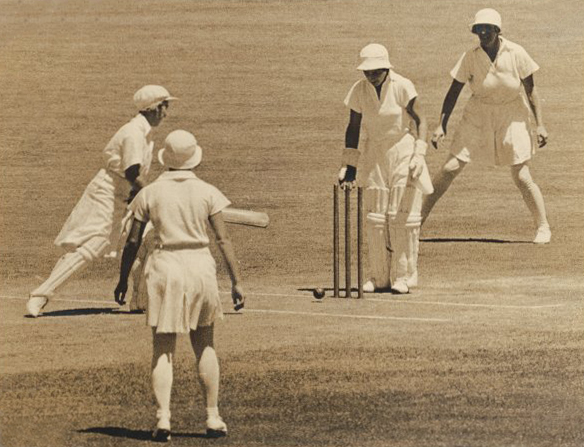
The first women's Test match was played by England women and Australia women in December 1934, a three-day contest held in Brisbane which England won by nine wickets. A total of 149 Women's Test matches have been played. Far fewer matches are played each year in favour of Women's One Day Internationals and Women's Twenty20 Internationals, with the international calendar revolving around the shorter formats of the game.
Women's Test cricket is subject to the Laws of cricket, with a number of variations and refinements, which are set out in the ICC's "Women's Test match playing conditions" document. For the most part, these playing conditions are very similar to those set out for men's Test cricket. Matches are played between two teams of eleven players, across up to four innings. Test cricket can have three results: a draw, a tie, or one team wins.
The primary, and most noticeable, difference from the men's game is that women's Test matches are typically played over four days, rather than five. However, the players are expected to fit more overs in per hour in the women's game than the men's: 17 as opposed to 15, and so a full day's play in a women's Test match should include 100 overs, rather than 90. The cricket field has smaller dimensions; the boundaries must be between 55 and 70 yards (50.29 and 64.01 m), in contrast to the 65 to 90 yards (59.44 to 82.30 m) required in men's Tests. As well as playing on a smaller field, the women use a smaller and lighter ball than their male counterparts; the Laws of cricket dictate that women should use a ball that is between 4+15⁄16 and 5+5⁄16 ounces (139.98 and 150.61 grams); which could be up to 13⁄16 ounces (23.03 grams) lighter than the ball used by the men. The Decision Review System (UDRS) is now available in women's Test matches, also umpires are permitted to ask the third umpire to check television replays in certain cases.
As women's tests are often played over four days, the minimum lead to impose a follow-on is 150 runs, as opposed to a 200 run lead when played over five days. This is consistent with four/five day men's test matches.
In all, ten national women's teams have competed in Test cricket. The England team's tour of Australia and New Zealand in the 1934–35 season established the first three sides, and it is those three teams that have competed in Test cricket most frequently; each having played at least 45 matches. South Africa were the next side to play the format, contesting their first match in 1960. However, due to their exclusion from international sport due to the nation's apartheid policy, they have only played in thirteen Test matches, fewer than India. Four sides — Pakistan, Ireland, the Netherlands and Sri Lanka — have competed in fewer than five Test matches.
The nations with men's and women's test teams do not entirely overlap. Of full members with men's test teams, Afghanistan, Bangladesh and Zimbabwe do not have women's test teams. Netherlands, while not a test team in the men's game, are a test playing nation in the women's game. Ireland, while having both men's and women's test teams, unusually played a women's test match, their only one to date, seventeen years before their first men's test match - on both test debuts, the opponent was Pakistan. The eight other full members, including Pakistan, have played men's, and then women's, test cricket.
The teams with Test status (with the date of each team's Test debut) are:
Hub AI
Women's Test cricket AI simulator
(@Women's Test cricket_simulator)
Women's Test cricket
Women's Test cricket is the longest format of women's cricket and is the female equivalent to men's Test cricket. Matches comprise four-innings and are held over a maximum of four days between two of the leading cricketing nations. The rules governing the format differ little from those for the men's game, with differences generally being technicalities surrounding umpiring and field size.
The first women's Test match was played by England women and Australia women in December 1934, a three-day contest held in Brisbane which England won by nine wickets. A total of 149 Women's Test matches have been played. Far fewer matches are played each year in favour of Women's One Day Internationals and Women's Twenty20 Internationals, with the international calendar revolving around the shorter formats of the game.
Women's Test cricket is subject to the Laws of cricket, with a number of variations and refinements, which are set out in the ICC's "Women's Test match playing conditions" document. For the most part, these playing conditions are very similar to those set out for men's Test cricket. Matches are played between two teams of eleven players, across up to four innings. Test cricket can have three results: a draw, a tie, or one team wins.
The primary, and most noticeable, difference from the men's game is that women's Test matches are typically played over four days, rather than five. However, the players are expected to fit more overs in per hour in the women's game than the men's: 17 as opposed to 15, and so a full day's play in a women's Test match should include 100 overs, rather than 90. The cricket field has smaller dimensions; the boundaries must be between 55 and 70 yards (50.29 and 64.01 m), in contrast to the 65 to 90 yards (59.44 to 82.30 m) required in men's Tests. As well as playing on a smaller field, the women use a smaller and lighter ball than their male counterparts; the Laws of cricket dictate that women should use a ball that is between 4+15⁄16 and 5+5⁄16 ounces (139.98 and 150.61 grams); which could be up to 13⁄16 ounces (23.03 grams) lighter than the ball used by the men. The Decision Review System (UDRS) is now available in women's Test matches, also umpires are permitted to ask the third umpire to check television replays in certain cases.
As women's tests are often played over four days, the minimum lead to impose a follow-on is 150 runs, as opposed to a 200 run lead when played over five days. This is consistent with four/five day men's test matches.
In all, ten national women's teams have competed in Test cricket. The England team's tour of Australia and New Zealand in the 1934–35 season established the first three sides, and it is those three teams that have competed in Test cricket most frequently; each having played at least 45 matches. South Africa were the next side to play the format, contesting their first match in 1960. However, due to their exclusion from international sport due to the nation's apartheid policy, they have only played in thirteen Test matches, fewer than India. Four sides — Pakistan, Ireland, the Netherlands and Sri Lanka — have competed in fewer than five Test matches.
The nations with men's and women's test teams do not entirely overlap. Of full members with men's test teams, Afghanistan, Bangladesh and Zimbabwe do not have women's test teams. Netherlands, while not a test team in the men's game, are a test playing nation in the women's game. Ireland, while having both men's and women's test teams, unusually played a women's test match, their only one to date, seventeen years before their first men's test match - on both test debuts, the opponent was Pakistan. The eight other full members, including Pakistan, have played men's, and then women's, test cricket.
The teams with Test status (with the date of each team's Test debut) are:
Recent media