


Community hub
Recent from talks
Contribute something to knowledge base
Content stats: 0 posts, 0 articles, 1 media, 0 notes
Members stats: 0 subscribers, 0 contributors, 0 moderators, 0 supporters
Subscribers
Supporters
Contributors
Moderators
Hub AI
Wonersh AI simulator
(@Wonersh_simulator)
Hub AI
Wonersh AI simulator
(@Wonersh_simulator)
Wonersh
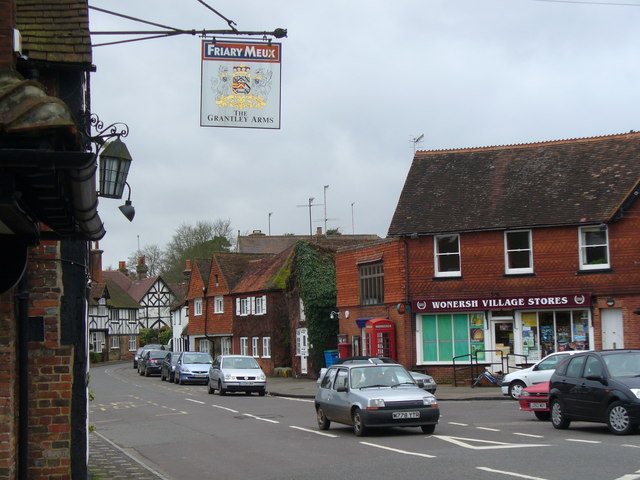
Wonersh is a village and civil parish in the Waverley district of Surrey, England and Surrey Hills Area of Outstanding Natural Beauty. It contains three Conservation Areas and spans an area three to six miles SSE of Guildford.
In the outer London commuter belt, the village is 28 miles (45 km) southwest of London. Wonersh's economy is predominantly a service sector economy. Three listed churches are within its boundaries as are a number of notable homes such as Frank Cook's 1905 hilltop mansion, which is a hotel, business and wedding venue.
State records show the name as Wonherche, (14th century); Ognersh and Ignersh, (16th and 17th centuries). The form Woghenersh, in a Charter roll of 1305, indicates the (Old English) formation (aet) wogan ersce, 'at the crooked field'.
Finds have been found in the hamlet and forest of Blackheath of Mesolithic (Stone Age) flint implements and near Chinthurst Hill.
Based on foundations and core of the church, a settlement has existed in Wonersh village centre since Anglo-Saxon times.
Wonersh is not named in the Domesday Book of 1086. All the six manors: Tangley or Great Tangley; Little Tangley; Halldish; Losterford/Lostiford above the intact mill and mill house by the village; Rowleys and; Chinthurst (partly in Shalford) were later built on lands then in Bramley and Shalford. Great Tangley Manor in 1582 became the residence of John and Lettice Carrill and descended to their grandson John Carrill (d. 1656) and his widow Hester, who secondly married Sir Francis Duncombe.
The church of Wonersh was formerly a chapel (of Shalford), and as such the advowson (right to appoint the vicar) was in the presentation of the King who later transferred it to St Mary without Bishopsgate in London; after this it was held by a line of nobles until bought in the 19th century by the lord of the manor. As a chapel, the great tithes were commuted for £700 and the lesser for the vicar for £17.
Until Charity Commission amalgamation in 1908, Wonersh had charity endowments paying out for its poor: John Austen of Shalford left money for poor relief in 1620. Henry Chennell of Wonersh left land whose produce was to be devoted to putting six poor boys to school from 1672. A Mr Gwynne of London gave land and bank stock in 1698 to put four poor boys to school and to distribute bread to fifteen poor persons every Sunday after service. Manorial fortunes became more muted from 1700 to 1900 during the Industrial Revolution – seeing almost all of their farm lands being sold for lack of scale or produce.
Wonersh
Wonersh is a village and civil parish in the Waverley district of Surrey, England and Surrey Hills Area of Outstanding Natural Beauty. It contains three Conservation Areas and spans an area three to six miles SSE of Guildford.
In the outer London commuter belt, the village is 28 miles (45 km) southwest of London. Wonersh's economy is predominantly a service sector economy. Three listed churches are within its boundaries as are a number of notable homes such as Frank Cook's 1905 hilltop mansion, which is a hotel, business and wedding venue.
State records show the name as Wonherche, (14th century); Ognersh and Ignersh, (16th and 17th centuries). The form Woghenersh, in a Charter roll of 1305, indicates the (Old English) formation (aet) wogan ersce, 'at the crooked field'.
Finds have been found in the hamlet and forest of Blackheath of Mesolithic (Stone Age) flint implements and near Chinthurst Hill.
Based on foundations and core of the church, a settlement has existed in Wonersh village centre since Anglo-Saxon times.
Wonersh is not named in the Domesday Book of 1086. All the six manors: Tangley or Great Tangley; Little Tangley; Halldish; Losterford/Lostiford above the intact mill and mill house by the village; Rowleys and; Chinthurst (partly in Shalford) were later built on lands then in Bramley and Shalford. Great Tangley Manor in 1582 became the residence of John and Lettice Carrill and descended to their grandson John Carrill (d. 1656) and his widow Hester, who secondly married Sir Francis Duncombe.
The church of Wonersh was formerly a chapel (of Shalford), and as such the advowson (right to appoint the vicar) was in the presentation of the King who later transferred it to St Mary without Bishopsgate in London; after this it was held by a line of nobles until bought in the 19th century by the lord of the manor. As a chapel, the great tithes were commuted for £700 and the lesser for the vicar for £17.
Until Charity Commission amalgamation in 1908, Wonersh had charity endowments paying out for its poor: John Austen of Shalford left money for poor relief in 1620. Henry Chennell of Wonersh left land whose produce was to be devoted to putting six poor boys to school from 1672. A Mr Gwynne of London gave land and bank stock in 1698 to put four poor boys to school and to distribute bread to fifteen poor persons every Sunday after service. Manorial fortunes became more muted from 1700 to 1900 during the Industrial Revolution – seeing almost all of their farm lands being sold for lack of scale or produce.
Recent media
Recent media