


Community hub
Recent from talks
Contribute something
Nothing was collected or created yet.
Tithe
View on Wikipedia | This article has multiple issues. Please help improve it or discuss these issues on the talk page. (Learn how and when to remove these messages)
|

| Part of a series on |
| Taxation |
|---|
 |
| An aspect of fiscal policy |


A tithe (/taɪð/; from Old English: teogoþa "tenth") is a one-tenth part of something, paid as a contribution to a religious organization or compulsory tax to government.[1] Modern tithes are normally voluntary and paid in cash, cheques or via online giving, whereas historically tithes were required and paid in kind, such as agricultural produce. Church tax linked to the tax system are used in many countries to support their national church. Donations to the church beyond what is owed in the tithe, or by those attending a congregation who are not members or adherents, are known as offerings, and often are designated for specific purposes such as a building program, debt retirement, or mission work.
Many Christian denominations hold Jesus taught that tithing must be done in conjunction with a deep concern for "justice, mercy and faithfulness" (cf. Matthew 23:23).[2][3][4] Tithing was taught at early Christian church councils, including the Council of Tours in 567, as well as the Third Council of Mâcon in 585. Tithing remains an important doctrine in many Christian denominations, such as the Congregational churches, Methodist Churches and Seventh-day Adventist Church.[2] Some Christian Churches, such as those in the Methodist tradition, teach the concept of Storehouse Tithing, which emphasizes that tithes must be prioritized and given to the local church, before offerings can be made to apostolates or charities.[5][6]
Traditional Jewish law and practice has included various forms of tithing since ancient times. Orthodox Jews commonly practice ma'aser kesafim (tithing 10% of their income to charity). In modern Israel, some religious Jews continue to follow the laws of agricultural tithing, e.g., ma'aser rishon, terumat ma'aser, and ma'aser sheni.
Ancient Near East
[edit]None of the extant extrabiblical laws of the Ancient Near East deal with tithing, although other secondary documents show that it was a widespread practice in the Ancient Near East.[7] William W. Hallo (1996[8]) recognises comparisons for Israel with its ancient Near Eastern environment; however, as regards tithes, comparisons with other ancient Near Eastern evidence is ambiguous,[9] and Ancient Near Eastern literature provides scant evidence for the practice of tithing and the collection of tithes.[10]
-
 Lysias dedicated first-fruits to Athena. Euarchis dedicated a tithe to Athena.
 -
 Cuneiform tablet: account of esru-tithe payments, Ebabbar archive.
 -
 The Famine Stele.
 -
 Brea fondation decree. "and his property shall be confiscated and a tithe given to the Goddess (Athena)."
 -
 "Peikon the potter dedicated this as a tithe to Athena by a vow."
 -
 Statuette of Athena Promachos with dedication: "Meleso dedicated it to Athena as a tithe". 475-470 BC


.jpg)
46-Brea_foundation_decree-1.JPG)


The esretu – "ešretū" the Ugarit and Babylonian one-tenth tax
[edit]Some specific instances of the Mesopotamian tithe, taken from The Assyrian Dictionary of the Oriental Institute of the University of Chicago:[11]
- [Referring to a ten percent tax levied on garments by the local ruler:] "the palace has taken eight garments as your tithe (on 85 garments)"
- "...eleven garments as tithe (on 112 garments)"..
- "...(the sun-god) Shamash demands the tithe..."
- "four minas of silver, the tithe of [the gods] Bel, Nabu, and Nergal..."
- "...he has paid, in addition to the tithe for Ninurta, the tax of the gardiner"
- "...the tithe of the chief accountant, he has delivered it to [the sun-god] Shamash"
- "...why do you not pay the tithe to the Lady-of-Uruk?"
- "...(a man) owes barley and dates as balance of the tithe of the **years three and four"
- "...the tithe of the king on barley of the town..."
- "...with regard to the elders of the city whom (the king) has **summoned to (pay) tithe..."
- "...the collector of the tithe of the country Sumundar..."
- "...(the official Ebabbar in Sippar) who is in charge of the tithe..."
-
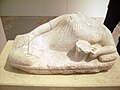 "Hermonax and his son dedicated me as a tithe of their works to Apollo."
 -
 Weight from Didyma.
 -
 Dedanite inscription.
 -
 Apollo of Piombino.
 -
 "Mantiklos donated me as a tithe to the far shooter, the bearer of the Silver Bow. You, Phoebus (Apollo) give something pleasing in return."
 -
 Law against tyranny. "Both he and his descendants, and his estate shall be public property, and a tithe for the goddess."


Tyre and Carthage
[edit]According to Diodorus Siculus, the Carthaginians, who were originally Tyrian colonists, customarily sent Melqart (Heracles in Interpretatio graeca) a tenth of all that was paid into the public revenue.[12]
Hebrew Bible
[edit]Laws
[edit]
The Torah commands the giving of various agricultural tithes in various situations, specifically terumah, terumat hamaaser, the first tithe, second tithe, poor tithe, and animal tithe. Not all these "tithes" actually had the proportion of 1⁄10. These tithes are mentioned in the Books of Leviticus, Numbers and Deuteronomy.
Every year, terumah, first tithe and terumat ma'aser were separated from the grain, wine and oil.[13] (As regards other fruit and produce, the Biblical requirement to tithe is a source of debate.) Terumah did not have a set amount, but the rabbis suggested it be 1⁄50 of the crop. First tithe was 1⁄10 of the crop. Terumah and terumat maaser were given to priests (kohanim); the first tithe was given to Levites. As priests and Levites did not own or inherit a territorial patrimony[14] these tithes were their means of support. The Levites, in turn, separated terumat ma'aser from their tithe (1⁄10 of the tithe, or 1⁄100 of the crop).
The second tithe and poor tithe, both 1⁄10 of the crop, were taken in an alternating basis according to the seven-year shmita cycle. In years 1, 2, 4, and 5 of the cycle, second tithe was taken. In years 3 and 6, poor tithe was taken. (In year 7, private agriculture was prohibited, all crops that grew were deemed ownerless, and no tithes taken.) The second tithe was kept by the owner, but had to be eaten at the site of the Temple.[13] (If this was difficult, the second could be redeemed for money which would be used to buy food at the Temple site.[15]) The poor tithe was given to the strangers, orphans, and widows, and distributed locally "within thy gates"[16] to support the Levites and assist the poor.
An additional tithe, mentioned in Leviticus 27:32–33 is the cattle tithe, which is to be sacrificed as a korban at the Temple in Jerusalem.
Stories
[edit]Tithing is mentioned twice in the stories of the Biblical patriarchs:
- In Genesis 14:18–20, Abraham, after rescuing Lot, met with Melchizedek. After Melchizedek's blessing, Abraham gave him a tenth of everything he has obtained from battle.
- In Genesis 28:16–22, Jacob, after his visionary dream of Jacob's Ladder and receiving a blessing from God, promises God a tenth of his possessions.
Tithing is mentioned several times in the Book of Nehemiah, which chronicles events in the latter half of the 5th century BC. Nehemiah 10 outlines the customs regarding tithing. The Levites were to receive one tenth (the tithe) "in all our farming communities" and a tithe of the tithe were to be brought by them to the temple for storage.[17] Nehemiah 13:4–19 recounts how Eliashib gave Tobiah office space in the temple in a room that had previously been used to store tithes while Nehemaiah was away.[17] When Nehemiah returned he called it an evil thing, threw out all Tobiah's household items and had his rooms purified so that they could once more be used for tithes.[18]
The Book of Malachi has one of the most quoted Biblical passages about tithing. God (according to Malachi) promises that if the Jews begin to keep the laws of tithing, God will "open the windows of heaven for you and pour down for you a blessing until there is no more need".[19]
Deuterocanonical
[edit]The deuterocanonical Book of Tobit provides an example of all three classes of tithes practiced during the Babylonian captivity:
"I would often go by myself to Jerusalem on religious holidays, as the Law commanded for every Israelite for all time. I would hurry off to Jerusalem and take with me the early produce of my crops, a tenth of my flocks, and the first portion of the wool cut from my sheep. I would present these things at the altar to the priests, the descendants of Aaron. I would give the first tenth of my grain, wine, olive oil, pomegranates, figs, and other fruit to the Levites who served in Jerusalem. For six out of seven years, I also brought the cash equivalent of the second tenth of these crops to Jerusalem where I would spend it every year. I gave this to orphans and widows, and to Gentiles who had joined Israel. In the third year, when I brought and gave it to them, we would eat together according to the instruction recorded in Moses' Law, as Deborah my grandmother had taught me..."
Judaism
[edit]Orthodox Jews continue to follow the biblical laws of tithes (see above) to a limited extent. As understood by the rabbis, these laws never applied and do not apply outside the Land of Israel. For produce grown in modern Israel, the tithes are separated but not given, as no Jew can prove they are a priest or Levite and thus entitled to the produce. Instead, a custom has arisen to tithe 10% of one's earnings to charity (ma'aser kesafim).[20][21]
The Mishnah and Talmud contain analysis of the first tithe, second tithe and poor tithe.[22]
Animals are not tithed in the modern era when the Temple is not standing.[23]
Christianity
[edit]
Many churches practiced tithing, as it was taught by the Council of Tours in 567, and in the Third Council of Mâcon in AD 585, a penalty of excommunication was prescribed for those who did not adhere to this ecclesiastical law.[24] Tithes can be given to the Church at once (as is the custom in many Christian countries with a church tax), or distributed throughout the year; during the part of Western Christian liturgies known as the offertory, people often place a portion of their tithes (sometimes along with additional offerings) in the collection plate.[25]
2 Corinthians 9:7 talks about giving cheerfully, 2 Corinthians 8:12 encourages giving what one can afford, 1 Corinthians 16:1–2 discusses giving weekly (although this is a saved amount for Jerusalem), 1 Timothy 5:17–18 exhorts supporting the financial needs of Christian workers, Acts 11:29 promotes feeding the hungry wherever they may be and James 1:27 states that pure religion is to help widows and orphans.[2]
According to a 2018 study by LifeWay Research that interviewed 1,010 Americans, 86% of people with Evangelical beliefs say that tithe is still a biblical commandment.[26] Of those surveyed, 87% of Baptist believers, 86% of Pentecostal believers, 81% of Non-denominational believers share this position.
Denominational positions
[edit]Adventist churches
[edit]The Seventh-day Adventist Church teaches in its Fundamental Beliefs that "We acknowledge God's ownership by faithful service to Him and our fellow men, and by returning tithes and giving offerings for the proclamation of His gospel and the support of His Church."[2]
Anabaptist churches
[edit]The Mennonite Church teaches that "tithing as a minimum baseline is one of the principles on which financial giving in this 'first fruits' system is based":[2]
We depend on God's gracious gifts for food and clothing, for our salvation, and for life itself. We do not need to hold on tightly to money and possessions, but can share what God has given us. The practice of mutual aid is a part of sharing God's gifts so that no one in the family of faith will be without the necessities of life. Whether through community of goods or other forms of financial sharing, mutual aid continues the practice of Israel in giving special care to widows, orphans, aliens, and others in economic need (Deut. 24:17–22). Tithes and first-fruit offerings were also a part of this economic sharing (Deut. 26; compare Matt. 23:23).[2]
Baptist churches
[edit]The Southern Baptist Convention resolved in 2013 to "exhort all Southern Baptists to tithe cheerfully and give sacrificially as good stewards of God's blessings to their local churches."[27] However, Article XIII of the Baptist Faith and Message recognizes a Christian obligation to contribute but does not specifically mention tithing as a requirement.[28] Other Southern Baptists do not observe a tithe, only an offering. Representing Southern Seminary, Professor Tom Schreiner states, "Is a tithe required? [...] I would say no, because a tithe is part of the Mosaic covenant."[29]
The National Baptist Convention of America teaches that "Baptists believe that a proper sense of stewardship begins with the 'tithe'; a presentation of which belongs to Him. 'The tithe is the Lord's.' We have not given as a result of presenting the tithe. Our giving begins with the offering [after we have tithed]."[2]
The Treatise of the National Association of Free Will Baptists, Chapter XVI, specifically states that both the Old and New Testaments "teach tithing as God's financial plan for the support of His work."[30]
Catholic Church
[edit]The Council of Trent, which was held after the Reformation, taught that "tithes are due to God or to religion, and that it is sacrilegious to withhold them",[31] but the Catholic Church no longer requires anyone to give ten percent of income.[32] The Church simply asks Catholics to support the mission of their parish.[33] According to the Catechism of the Catholic Church "The faithful also have the duty of providing for the material needs of the Church, each according to his own abilities"[32][34]
Lutheran churches
[edit]The Lutheran Church–Missouri Synod teaches that "Encourage[s] cheerful, first-fruit, proportionate (including but not limited to tithing) living and giving in all areas of life by Christian stewards".[2]
Methodist churches
[edit]The Discipline of The Allegheny Wesleyan Methodist Connection, which teaches the doctrine of the Storehouse Tithing, holds:[5][35]
That all our people pay to God at least one-tenth of all their increase as a minimum financial obligation, and freewill offerings in addition as God has prospered them. The tenth is figured upon the tither's gross income in salary or net increase when operating a business.[35]
The Book of Discipline of the United Methodist Church states that it is the responsibility of ecclesiastics to "educate the local church that tithing is the minimum goal of giving in The United Methodist Church."[2]
The Church of the Nazarene teaches Storehouse Tithing, in which members are asked to donate one-tenth of their income to their local church—this is to be prioritized before giving an offering to apostolates or charities.[36]
Moravian Church
[edit]The Moravian Church encourages its members to "financially support the ministry of the Church toward the goal of tithing."[2] It "deem[s] it a sacred responsibility and genuine opportunity to be faithful stewards of all God has entrusted to us: our time, our talents, [and] our financial resources".[2]
Orthodox churches
[edit]Tithing in medieval Eastern Christianity did not spread so widely as in the West. A Constitution of the Emperors Leo I (reigned 457–474) and Anthemius (reigned 467–472) apparently expected believers to make voluntary payments and forbade compulsion.[37]
The Greek Orthodox Archdiocese of America teaches "proportionate giving and tithing as normal practices of Christian giving."[2]
Pentecostal churches
[edit]The Pentecostal Church of God teaches that "We recognize the scriptural duty of all our people, as well as ministers, to pay tithes as unto the Lord. Tithes should be used for the support of active ministry and for the propagation of the Gospel and the work of the Lord in general."[2]
The International Pentecostal Holiness Church likewise instructs the faithful that:[2]
Our commitment to Jesus Christ includes stewardship. According to the Bible everything belongs to God. We are stewards of His resources. Our stewardship of possessions begins with the tithe. All our members are expected to return a tenth of all their income to the Lord.[2]
Reformed churches
[edit]The Book of Order of the Presbyterian Church (USA) states, with respect to the obligation to tithe:[38]
Giving has always been a mark of Christian commitment and discipleship. The ways in which a believer uses God's gifts of material goods, personal abilities, and time should reflect a faithful response to God's self-giving in Jesus Christ and Christ's call to minister to and share with others in the world. Tithing is a primary expression of the Christian discipline of stewardship.[38]
The United Church of Christ, a denomination in the Congregationalist tradition, teaches that:[2]
When we tithe we place God as our first priority. We trust in God's abundance instead of worrying about not having enough. Tithing churches live out a vision of abundance rather than a mentality of scarcity.[2]
The Church of Jesus Christ of Latter-day Saints
[edit]
The Church of Jesus Christ of Latter-day Saints (LDS Church) bases its tithing on the additional scriptures:[39]
And this shall be the beginning of the tithing of my people. And after that, those who have thus been tithed shall pay one-tenth of all their interest annually; and this shall be a standing law unto them forever, for my holy priesthood, saith the Lord.
— Doctrine and Covenants 119:3–4 (see also Doctrine and Covenants 64:23–24)
And it was this same Melchizedek to whom Abraham paid tithes; yea, even our father Abraham paid tithes of one-tenth part of all he possessed.


Tithing is defined by the church as payment of one-tenth of one's annual income. Many church leaders have made statements in support of tithing.[40] Every Latter-day Saint has an opportunity once a year to meet with their bishop for tithing declaration. The payment of tithes is mandatory for members to receive the priesthood or obtain a temple recommend for admission to temples.
The Church of Jesus Christ of Latter-day Saints is a lay ministry.[41] The money that is given is used to construct and maintain its buildings as well as to further the work of the church.[42] None of the funds collected from tithing is paid to local church officials or those who serve in the church. Those serving in full-time church leadership do receive stipends for living expenses, but they are paid from non-tithing resources, such as investments.[citation needed] Brigham Young University, a church-sponsored institution, also receives "a significant portion"[citation needed] of its maintenance and operating costs from tithes of the church's members.
Church collection of religious offerings and taxes
[edit]England and Wales
[edit]
The right to receive tithes was granted to the English churches by King Ethelwulf in 855. The Saladin tithe was a royal tax, but assessed using ecclesiastical boundaries, in 1188. The legal validity of the tithe system was affirmed under the Statute of Westminster of 1285. The Dissolution of the Monasteries led to the transfer of many rights to tithe to secular landowners and the Crown – and tithes could be extinguished until 1577 under an Act of the 37th year of Henry VIII's reign (Tithes in London Act 1545).[43] Adam Smith criticized the system in The Wealth of Nations (1776), arguing that a fixed rent would encourage peasants to work far more efficiently.
.jpg)
.jpg)
Dissenters
[edit]In the seventeenth century various dissenting groups objected to paying tithes to Church of England. Quakers were prominent among these, objecting to 'forced payments for the maintenance of a professional ministry'.[44] In 1659 guidance was issued for a national system for recording the fines, impropriations and imprisonments for non-payment of tithes as seen in the following extract from a document.[45]
Clause 9. Sufferings of Friends to be gathered up and recorded, the sufferes to report to a recorder in each meeting who is to report to the next General Meeting for the county for record by a county recorder.
— From Register Book of a Monthly Meeting in Hampshire, 1659
These records were eventually collated and published in 1753 by Joseph Besse, documenting widespread persecution throughout the British Isles and further abroad. This only abated in the 1680s, due in no small measure to the efforts of William Penn who, through his father's earlier connections at court, was friendly with Charles I and James, Duke of York and interceded with them in behalf of Quakers in England and on the Continent, respectively.[46]
See below for a fuller description and history, until the reforms of the 19th century, written by Sir William Blackstone and edited by other learned lawyers of the period.[47]
End of the tithing system
[edit]The system gradually ended with the Tithe Commutation Act 1836, whose long-lasting Tithe Commission replaced them with a commutation payment, land award and/or rentcharges to those paying the commutation payment and took the opportunity to map out (apportion) residual chancel repair liability where the rectory had been appropriated during the medieval period by a religious house or college. Its records giving a snapshot of land ownership in most parishes, the Tithe Files, are a socio-economic history resource. The rolled-up payment of several years' tithe would be divided between the tithe-owners as at the date of their extinction.[48]
This commutation reduced problems to the ultimate payers by effectively folding tithes in with rents however, it could cause transitional money supply problems by raising the transaction demand for money. Later the decline of large landowners led tenants to become freeholders and again have to pay directly; this also led to renewed objections of principle by non-Anglicans.[49] It also kept intact a system of chancel repair liability affecting the minority of parishes where the rectory had been lay-appropriated. The precise land affected in such places hinged on the content of documents such as the content of deeds of merger and apportionment maps.[48]
Tithe redemption
[edit]| Tithe Act 1936 | |
|---|---|
| Act of Parliament | |
 | |
| Long title | An Act to extinguish tithe rentcharge and extraordinary tithe rentcharge, and to make provision with respect to the compensation of the owners thereof and rating authorities and to the liabilities of the owners of land charged therewith in respect of the extinguishment thereof; to reduce the rate at which tithe rentcharge is to be payable pending its extinguishment and to make provision with respect to the recovery of arrears thereof; to make provision for the redemption and extinguishment of corn rents and similar payments; and for purposes connected with the matters aforesaid. |
| Citation | 26 Geo. 5 & 1 Edw. 8. c. 43 |
| Dates | |
| Royal assent | 31 July 1936 |
| Other legislation | |
| Repeals/revokes | |
Status: Amended | |
| Text of statute as originally enacted | |
| Text of the Tithe Act 1936 as in force today (including any amendments) within the United Kingdom, from legislation.gov.uk. | |
| Tithe Act 1951 | |
|---|---|
| Act of Parliament | |
| |
| Long title | An Act to provide, in lieu of the obligation imposed by the Tithe Act, 1936, to register all annuities charged thereby, for registration in selected districts, to amend and to repeal certain provisions of that Act, and to make further provision with respect to certain matters connected therewith. |
| Citation | 14 & 15 Geo. 6. c. 62 |
| Dates | |
| Royal assent | 1 August 1951 |
Status: Amended | |
| Text of statute as originally enacted | |
| Text of the Tithe Act 1951 as in force today (including any amendments) within the United Kingdom, from legislation.gov.uk. | |
Rent charges in lieu of abolished English tithes paid by landowners were converted by a public outlay of money under the Tithe Act 1936 (26 Geo. 5 & 1 Edw. 8. c. 43) into annuities paid to the state through the Tithe Redemption Commission. Such payments were transferred in 1960 to the Board of Inland Revenue, and those remaining were terminated by the Finance Act 1977.
The Tithe Act 1951 (14 & 15 Geo. 6. c. 62) established the compulsory redemption of English tithes by landowners where the annual amounts payable were less than £1, so abolishing the bureaucracy and costs of collecting small sums of money.
Greece
[edit]There has never been a separate church tax or mandatory tithe on Greek citizens. The state pays the salaries of the clergy of the established Church of Greece, in return for use of real estate, mainly forestry, owned by the church. The remainder of church income comes from voluntary, tax-deductible donations from the faithful. These are handled by each diocese independently.[citation needed]
Ireland
[edit] |
From the English Reformation in the 16th century, most Irish people chose to remain Roman Catholic and had by now to pay tithes valued at about 10 per cent of an area's agricultural produce, to maintain and fund the established state church, the Anglican Church of Ireland, to which only a small minority of the population converted. Irish Presbyterians and other minorities like the Quakers and Jews were in the same situation.
The collection of tithes was resisted in the period 1831–36, known as the Tithe War. Thereafter, tithes were reduced and added to rents with the passing of the Tithe Commutation Act 1838. With the disestablishment of the Church of Ireland by the Irish Church Act 1869, tithes were abolished.
United States
[edit]While the federal government has never collected a church tax or mandatory tithe on its citizens, states collected a tithe into the early 19th century. The United States and its governmental subdivisions also exempt most churches from payment of income tax (under Section 501(c)(3) of the Internal Revenue Code and similar state statutes, which also allows donors to claim the donations as an income tax itemized deduction). Also, churches may be permitted exemption from other state and local taxes such as sales and property taxes, either in whole or in part. Clergy, such as ministers and members of religious orders (who have taken a vow of poverty) may be exempt from federal self-employment tax on income from ministerial services. Income from non-ministerial services are taxable and churches are required to withhold Federal and state income tax from this non-exempt income. They are also required to withhold employee's share of Social Security and Medicare taxes under FICA, and pay the employer's share for the non-exempt income.[50]
Spain and Latin America
[edit] |

Both the tithe (diezmo), a levy of 10 per cent on all agricultural production, and "first fruits" (primicias), an additional harvest levy, were collected in Spain throughout the medieval and early modern periods for the support of local Catholic parishes.
The tithe crossed the Atlantic with the Spanish Empire; however, the Indians who made up the vast majority of the population in colonial Spanish America were exempted from paying tithes on native crops such as corn and potatoes that they raised for their own subsistence. After some debate, Indians in colonial Spanish America were forced to pay tithes on their production of European agricultural products, including wheat, silk, cows, pigs, and sheep.
The tithe was abolished in several Latin American countries, including Mexico, soon after independence from Spain (which started in 1810). The tithe was abolished in Argentina in 1826, and in Spain itself in 1841.
Governmental collection of Christian religious offerings and taxes
[edit]Austria
[edit]In Austria a colloquially called church tax (Kirchensteuer, officially called Kirchenbeitrag, i. e. church contribution) has to be paid by members of the Catholic and Protestant Church[which?]. It is levied by the churches themselves and not by the government. The obligation to pay church tax can just be evaded by an official declaration to cease church membership. The tax is calculated on the basis of personal income. It amounts to about 1.1 per cent (Catholic church) and 1.5 per cent (Protestant church).[citation needed]
Denmark
[edit]All members of the Church of Denmark pay a church tax, which varies between municipalities.[51] The tax is generally around 1% of the taxable income.[52]
Finland
[edit]Members of state churches pay a church tax of between 1% and 2% of income, depending on the municipality. In addition, 2.55 per cent of corporate taxes are distributed to the state churches. Church taxes are integrated into the common national taxation system.[53]
Germany
[edit]Germany levies a church tax, on all persons declaring themselves to be Christians, of roughly 8–9% of their income tax, which is effectively (very much depending on the social and financial situation) typically between 0.2% and 1.5% of the total income. The proceeds are shared among Catholic, Lutheran, and other Protestant Churches.[54]
The church tax (Kirchensteuer) traces its roots back as far as the Reichsdeputationshauptschluss of 1803. It was reaffirmed in the Concordat of 1933 between Nazi Germany and the Catholic Church. Its legal basis is article 140 of the Grundgesetz (the German constitution) in connection with article 137 of the Weimar Constitution. These laws originally merely allowed the churches themselves to tax their members, but in Nazi Germany, collection of church taxes was transferred to the German government. As a result, both the German government and the employer are notified of the religious affiliation of every taxpayer. This system is still in effect. Mandatory disclosure of religious affiliation to government agencies or employers constituted a violation of the original European data protection directives but is now permitted after the German government obtained an exemption.[54]
Church tax (Kirchensteuer) is compulsory in Germany for those confessing members of a particular religious group. It is deducted at the PAYE level. The duty to pay this tax theoretically starts on the day one is christened. Anyone who wants to stop paying it has to declare in writing, at their local court of law (Amtsgericht) or registry office, that they are leaving the Church. They are then crossed off the Church registers and can no longer receive the sacraments, confession and certain services; a Roman Catholic church may deny such a person a burial plot.[54] In addition to the government, the taxpayer also must notify his employer of his religious affiliation (or lack thereof) in order to ensure proper tax withholding.[55]
This opt-out is also used by members of "free churches" (e.g. Baptists) (non-affiliated to the scheme) to stop paying the church tax, from which the free churches do not benefit, in order to support their own church directly.
Italy
[edit] |
Originally the Italian government of Benito Mussolini, under the Lateran treaties of 1929 with the Holy See, paid a monthly salary to Catholic clergymen. This salary was called the congrua. The eight-per-thousand law was created as a result of an agreement, in 1984, between the Italian Republic and the Holy See.
Under this law Italian taxpayers are able to vote how to partition the 0.8% ('eight per thousand') of the total income tax IRPEF levied by Italy among some specific religious confessions or, alternatively, to a social assistance program run by the Italian State. This declaration is made on the IRPEF form. This vote is not compulsory; the whole amount levied by the IRPEF tax is distributed in proportion to explicit declarations.
The last official statement of Italian Ministry of Finance made in respect of the year 2000 singles out seven beneficiaries: the Italian State, the Catholic Church, the Waldenses, the Jewish Communities, the Lutherans, the Seventh-day Adventist Church and the Assemblies of God in Italy.
The tax was divided up as follows:
- 87.17% Catholic Church
- 10.35% Italian state
- 1.21% Waldenses
- 0.46% Jewish communities
- 0.32% Lutherans
- 0.28% Adventists of the Seventh Day
- 0.21% Assemblies of God in Italy
In 2000, the Catholic Church raised almost a billion euros, while the Italian state received about €100 million.
Scotland
[edit]In Scotland teinds were the tenths of certain produce of the land appropriated to the maintenance of the Church and clergy. At the Reformation most of the Church property was acquired by the Crown, nobles and landowners. In 1567 the Privy Council of Scotland provided that a third of the revenues of lands should be applied to paying the clergy of the reformed Church of Scotland. In 1925 the system was recast by statute[56] and provision was made for the standardisation of stipends at a fixed value in money. The Court of Session acted as the Teind Court. Teinds were finally abolished by section 56 of the Abolition of Feudal Tenure etc. (Scotland) Act 2000.
Switzerland
[edit]There is no official state church in Switzerland; however, all the 26 cantons (states) financially support at least one of the three traditional denominations — Roman Catholic, Old Catholic, or Protestant — with funds collected through taxation. Each canton has its own regulations regarding the relationship between church and state. In some cantons, the church tax (up to 2.3 per cent) is voluntary but in others an individual who chooses not to contribute to church tax may formally have to leave the church. In some cantons private companies are unable to avoid payment of the church tax.[citation needed]
Tithes and tithe law in England before reform
[edit]Excerpts from Sir William Blackstone, Commentaries on the Laws of England:
Definition and classification and those liable to pay tithes
[edit]. . . tithes; which are defined to be the tenth part of the increase, yearly arising and renewing from the profits of lands, the stock upon lands, and the personal industry of the inhabitants:
- the first species being usually called predial,[57] as of corn, grass, hops, and wood;
- the second mixed, as of wool, milk, pigs, &c, consisting of natural products, but nurtured and preserved in part by the care of man; and of these the tenth must be paid in gross:
- the third personal, as of manual occupations, trades, fisheries, and the like; and of these only the tenth part of the clear gains and profits is due.
...
in general, tithes are to be paid for every thing that yields an annual increase, as corn, hay, fruit, cattle, poultry, and the like; but not for any thing that is of the substance of the earth, or is not of annual increase, as stone, lime, chalk, and the like; nor for creatures that are of a wild nature, or ferae naturae, as deer, hawks, &c, whose increase, so as to profit the owner, is not annual, but casual.[58]: 24
History
[edit]We cannot precisely ascertain the time when tithes were first introduced into this country. Possibly they were contemporary with the planting of Christianity among the Saxons, by Augustin the monk, about the end of the fifth century. But the first mention of them, which I have met with in any written English law, is in a constitutional decree, made in a synod held A.D. 786, wherein the payment of tithes in general is strongly enjoined. This canon, or decree, which at first bound not the laity, was effectually confirmed by two kingdoms of the heptarchy, in their parliamentary conventions of estates, respectively consisting of the kings of Mercia and Northumberland, the bishops, dukes, senators, and people. Which was a few years later than the time that Charlemagne established the payment of them in France, and made that famous division of them into four parts; one to maintain the edifice of the church, the second to support the poor, the third the bishop, and the fourth the parochial clergy.[58]: 25
Beneficiaries
[edit]And upon their first introduction (as hath formerly been observed), though every man was obliged to pay tithes in general, yet he might give them to what priests he pleased; which were called arbitrary consecrations of tithes: or he might pay them into the hands of the bishop, who distributed among his diocesan clergy the revenues of the church, which were then in common. But, when dioceses were divided into parishes, the tithes of each parish were allotted to its own particular minister; first by common consent, or the appointment of lords of manors, and afterwards by the written law of the land.[58]: 26 ...It is now universally held, that tithes are due, of common right, to the parson of the parish, unless there be a special exemption. This parson of the parish, we have formerly seen, may be either the actual incumbent, or else the appropriator of the benefice: appropriations being a method of endowing monasteries, which seems to have been devised by the regular clergy, by way of substitution to arbitrary consecrations of tithes.[58]: 28
Exemptions
[edit]We observed that tithes are due to the parson of common right, unless by special exemption: let us therefore see, thirdly, who may be exempted from the payment of tithes ... either in part or totally, first, by a real composition; or secondly, by custom or prescription.
First, a real composition is when an agreement is made between the owner of the lands, and the parson or vicar, with the consent of the ordinary and the patron, that such lands shall for the future be discharged from payment of tithes, by reason of some land or other real recompence given to the parson, in lieu and satisfaction thereof.
Secondly, a discharge by custom or prescription, is where time out of mind such persons or such lands have been, either partially or totally, discharged from the payment of tithes. And this immemorial usage is binding upon all parties, as it is in its nature an evidence of universal consent and acquiescence; and with reason supposes a real composition to have been formerly made. This custom or prescription is either de modo decimandi, or de non-decimando.
A modus decimandi, commonly called by the simple name of a modus only, is where there is by custom a particular manner of tithing allowed, different from the general law of taking tithes in kind, which are the actual tenth part of the annual increase. This is sometimes a pecuniary compensation, as twopence an acre for the tithe of land : sometimes it is a compensation in work and labour, as that the parson shall have only the twelfth cock of hay, and not the tenth, in consideration of the owner's making it for him: sometimes, in lieu of a large quantity of crude or imperfect tithe, the parson shall have a less quantity, when arrived to greater maturity, as a couple of fowls in lieu of tithe eggs; and the like. Any means, in short, whereby the general law of tithing is altered, and a new method of taking them is introduced, is called a modus decimandi, or special manner of tithing.[58]: 28–29
A prescription de non-decimando is a claim to be entirely discharged of tithes, and to pay no compensation in lieu of them. Thus the king by his prerogative is discharged from all tithes. So a vicar shall pay no tithes to the rector, nor the rector to the vicar, for ecclesia decimas non-folvit ecclesiae. But these personal to both the king and the clergy; for their tenant or lessee shall pay tithes of the same land, though in their own occupation it is not tithable. And, generally speaking, it is an established rule, that in lay hands, modus de non-decimando non-valet. But spiritual persons or corporations, as monasteries, abbots, bishops, and the like, were always capable of having their lands totally discharged of tithes, by various ways: as
- By real composition :
- By the pope's bull of exemption :
- By unity of possession; as when the rectory of a parish, and lands in the same parish, both belonged to a religious house, those lands were discharged of tithes by this unity of possession :
- By prescription; having never been liable to tithes, by being always in spiritual hands :
- By virtue of their order; as the knights templars, cistercians, and others, whose lands were privileged by the pope with a discharge of tithes. Though, upon the dissolution of abbeys by Henry VIII, most of these exemptions from tithes would have fallen with them, and the lands become tithable again; had they not been supported and upheld by the Suppression of Religious Houses Act 1539 (31 Hen. 8. c. 13) which enacted, that all persons who should come to the possession of the lands of any abbey then dissolved, should hold them free and discharged of tithes, in as large and ample a manner as the abbeys themselves formerly held them.
And from this original have sprung all the lands, which, being in lay hands, do at present claim to be tithe-free: for, if a man can shew his lands to have been such abbey lands, and also immemorially discharged of tithes by any of the means before-mentioned, this is now a good prescription de non-decimando. But he must shew both these requisites; for abbey lands, without a special ground of discharge, are not discharged of course; neither will any prescription de non-decimando avail in total discharge of tithes, unless it relates to such abbeylands.[58]: 31–32
-
 The Tithe Barn, Abbotsbury, Dorset (scene of the sheep-shearing in Thomas Hardy's Far from the Madding Crowd)
 -
 Tithe barn at Bradford on Avon, West Wiltshire
 -
 Interior of the medieval tithe barn at Pilton, Somerset
 -
 Grange Barn, Coggeshall, Essex; the timber has been dated to between 1130 and 1270.


Islam
[edit]Zakāt (Arabic: زكاة [zækæːh]) or "alms giving", one of the Five Pillars of Islam, is the giving of a small percentage of one's assets to charity. It serves principally as the welfare contribution to poor and deprived Muslims, although others may have a rightful share. It is the duty of an Islamic state not just to collect zakat but to distribute it fairly as well.
Zakat is payable on three kinds of assets: wealth, production, and animals. The more well-known zakat on wealth is 2.5 per cent of accumulated wealth, beyond one's personal needs. Production (agricultural, industrial, renting, etc.), is subject to a 10 per cent or 5 per cent zakat (also known as Ushur (عُشر), or "one-tenth"), using the rule that if both labor and capital are involved, 5% rate is applied, if only one of the two are used for production, then the rate is 10 per cent. For any earnings that require neither labor nor capital, like finding underground treasure, the rate is 20 per cent. The rules for zakat on animal holdings are specified by the type of animal group and tend to be fairly detailed.[59]
Muslims fulfill this religious obligation by giving a fixed percentage of their surplus wealth. Zakat has been paired with such a high sense of righteousness that it is often placed on the same level of importance as performing the five-daily repetitive ritualised prayer (salat).[60] Muslims see this process also as a way of purifying themselves from their greed and selfishness and also safeguarding future business.[60] In addition, Zakat purifies the person who receives it because it saves him from the humiliation of begging and prevents him from envying the rich.[61] Because it holds such a high level of importance the "punishment" for not paying when able is very severe. In the 2nd edition of the Encyclopaedia of Islam it states, "...the prayers of those who do not pay zakat will not be accepted".[60] This is because without Zakat a tremendous hardship is placed on the poor which otherwise would not be there. Besides the fear of their prayers not getting heard, those who are able should be practicing this third pillar of Islam because the Quran states that this is what believers should do.[62]
Non-Muslims (able-bodied adult males of military age) living in an Islamic state are required to pay Jizya, this exempts them from military service and they do not pay Zakat.
Ismaili Muslims pay tithes to their spiritual leader the Aga Khan, known by the Gujarati language term dasond, which in turn refers to one-eighth of the earned income of the community member.
Sikhism
[edit]Daswandh (Punjabi: ਦਸਵੰਧ), sometimes spelled Dasvandh, is the one-tenth part (or 10 per cent) of one's income that should be donated in the name of the God, according to Sikh principles.[63][64]
Non-religious
[edit]Outside religion, there are also organizations that encourage secular tithing.
Giving What We Can promotes a public commitment to donate at least 10% of one's income to the most effective charities.[65]
See also
[edit]
- Alms, giving to others as an act of virtue
- Charity
- Church of the Tithes in Kyiv
- Council on the Disposition of the Tithes
- Peter's Pence
- Pittance
- Freedom of religion by country
- Tithe: A Modern Faerie Tale novel by Holly Black
- Tithe dispute
- Tithing, historic English legal, administrative or territorial unit
- Zakat, form of alms-giving treated in Islam as a religious obligation or tax
Notes
[edit]- ^ David F. Burg (2004). A World History of Tax Rebellions. Taylor & Francis. p. viii. ISBN 9780203500897.
- ^ a b c d e f g h i j k l m n o p q Smith, Christian; Emerson, Michael O; Snell, Patricia (29 September 2008). Passing the Plate: Why American Christians Don't Give Away More Money. Oxford University Press. pp. 215–227. ISBN 9780199714117.
- ^ Greg L. Bahnsen; Walter C. Kaiser, Jr.; Douglas J. Moo; Wayne G. Strickland; Willem A. VanGemeren (21 September 2010). Five Views on Law and Gospel. Zondervan. p. 354.
- ^ Stanley E. Porter; Cynthia Long Westfall (January 2011). Empire in the New Testament. Wipf and Stock. p. 116.
- ^ a b Black, E. W. (1960). The Storehouse Plan. West Asheville, North Carolina: Allegheny Wesleyan Methodist Connection.
- ^ "Recognizing the importance of storehouse tithing". Church of the Nazarene. 18 April 2019. Retrieved 18 July 2019.
- ^ D. L. Baker, Tight fists or open hands?: wealth and poverty in Old Testament law (2009) p. 239. "This was provided by means of a tithe of agricultural produce. a. Tithes in the Ancient Near East None of the extant laws deal with tithing, though other documents show that it was a widespread practice in the ancient Near East."
- ^ WW Hallo, Origins: The Ancient Near Eastern Background of Some Modern Western Institutions (Studies in the History and Culture of the Ancient Near East VI; Leiden/New York/Köln)
- ^ Menahem Herman Tithe as gift: the institution in the Pentateuch and in light of ... 1992 p. 127 "Hallo recognizes comparisons for Israel with its ancient Near Eastern environment. However, in the instance of the tithe, comparisons with other ancient Near Eastern evidence has already been shown to be ambiguous, given the lack of ..."
- ^ Bertil Albrektson, Remembering all the way: a collection of Old Testament studies (1981) p. 116. "The Tithes in the Old Testament." H. Jagersma Brussels I. Introduction "In the Old Testament as well as in other Ancient Near Eastern literature, we find only scant evidence for the practice of tithing and the collection of tithes."
- ^ Vol. 4 "E" p. 369 "The Assyrian Dictionary of the Oriental Institute of the University of Chicago" (PDF). 1958. Archived from the original (PDF) on 12 March 2017. Retrieved 29 June 2022.
- ^ Diodorus Siculus, Bibliotheca historica 20.14.1–20.14.2 (see in C. H. Oldfather translation: [1])
- ^ a b Deuteronomy 14:23
- ^ Numbers 18:21–28
- ^ Deuteronomy 14:24–26
- ^ Deuteronomy 14:28
- ^ a b James D. Quiggle (1 August 2009). Why Christians Should Not Tithe: A History of Tithing and a Biblical Paradigm for Christian Giving. Wipf and Stock Publishers. pp. 52–3. ISBN 978-1-60608-926-2.
- ^ Dallas Theological Seminary (1985). The Bible Knowledge Commentary: An Exposition of the Scriptures. David C Cook. pp. 695–. ISBN 978-0-88207-813-7.
- ^ Malachi 3:6–12
- ^ Norman Solomon, Historical Dictionary of Judaism, Rowman & Littlefield, USA, 2015, p. 459
- ^ Sara E. Karesh, Mitchell M. Hurvitz, Encyclopedia of Judaism, Infobase Publishing, USA, 2005, p. 521
- ^ See Singer, Isidore; et al., eds. (1901–1906). "MA'ASEROT". The Jewish Encyclopedia. New York: Funk & Wagnalls.
- ^ Maimonides. "Mishneh Torah, Sefer Korbanot: Bechorot, Perek 6, Halacha 2". Chabad.org.
- ^ Babbs, Arthur Vergil (1912). The Law of the Tithe as Set Forth in the Old Testament. Fleming H. Revell Company. p. 140.
Tithes were recommended by the Second Council of Tours, AD 567; and excommunication was added to the command to observe the tithing law, by the Third Council of Mâcon, which met in 585.
- ^ Rogers, Mark (2009). "Passing the Plate". Christianity Today. Retrieved 20 April 2018.
After America ended state support of churches in the early 19th century, the collection of "tithes and offerings" became a standard feature of Sunday morning worship.
- ^ Bob Smietana, Churchgoers Say They Tithe, But Not Always to the Church, lifewayresearch.com, USA, 10 May 2018
- ^ "On Tithing, Stewardship, And The Cooperative Program". www.sbc.net/. Retrieved 9 March 2024.
- ^ "The Baptist Faith and Message". Sbc.net. XIII. Stewardship.
- ^ Schreiner, Thomas R. (6 September 2017). "Is tithing required today?". Southern Equip. Retrieved 9 March 2024.
- ^ "A TREATISE of the Faith and Practices of the National Association of Free Will Baptists, Inc" (PDF). Nafwb.org. Retrieved 29 June 2022.
- ^ Croly, David O. (1834). An Essay Religious and Political on Ecclesiastical Finance, as regards the Roman Catholic Church in Ireland, etc. John Bolster. p. 72.
The Council of Trent – the last general Council – declares that "tithes are due to God or to religion, and that it is sacrilegious to withold them." And one of the six precepts of the Church commands the faithful "to pay tithes to their pastors."
- ^ a b "Catechism of the Catholic Church #2043". Vatican.ca. Retrieved 29 June 2022.
- ^ Grondin, Charles. "What Did Trent Mean By "Tithes"?". Catholic.com.
- ^ "Code of Canon Law: Table of Contents". Vatican.va. Retrieved 29 June 2022.
- ^ a b The Discipline of the Allegheny Wesleyan Methodist Connection (Original Allegheny Conference). Salem: Allegheny Wesleyan Methodist Connection. 2014. pp. 133–166.
- ^ "The Tithing Tradition" (PDF). The Church of the Nazarene. Archived from the original (PDF) on 10 May 2017. Retrieved 23 September 2016.
- ^
Сильвестрова, Е. В. (24 March 2012). "ДЕСЯТИНА" [Tithe]. In Gundyayev, Vladimir Mikhailovich (ed.). Православная энциклопедия [Orthodox encyclopedia] (in Russian). Vol. 14 (Electronic version ed.). Церковно-научный центр «Православная Энциклопедия». pp. 450–452. Retrieved 23 January 2015.
На Востоке Д[есятина] не получила такого распространения, как на Западе. Известна, в частности, конституция императоров Льва и Антемия, в которой священнослужителям запрещалось принуждать верующих к выплатам в пользу Церкви под угрозой различных прещений. Хотя в конституции не употребляется термин decima, речь идет о начатках и, по всей видимости, о выплатах, аналогичных Д., к-рые, по мнению императоров, верующие должны совершать добровольно, без всякого принуждения [...].
- ^ a b "Presbyterian Mission Agency Stewardship". Presbyterian Mission Agency. 1997. Retrieved 20 April 2018.
- ^ "Lesson 44: Malachi Teaches about Tithes and Offerings", Primary 6: Old Testament, LDS Church, 1996, pp. 196–201, archived from the original on 24 February 2015
- ^ "Gospel Topics – What the Church Teaches about Tithing". lds.org. Archived from the original on 24 February 2015.
- ^ Russell M. Nelson. "Combatting Spiritual Drift – Our Global Pandemic". lds.org.
- ^ The Church of Jesus Christ of Latter-Day Saints. "FAQ – Mormon.org". mormon.org.
- ^ "Middlesex: London City without the Walls: St Botolph without Aldgate, parish". The National Archives Collection IR 18/5462.
- ^ Braithwaite, William C.; Cadbury, Henry J. (1970). The Beginnings of Quakerism (2nd ed.). York, England: William Sessions Ltd. p. 136.
- ^ Braithwaite, William C.; Cadbury, Henry J. (1970). The Beginnings of Quakerism (2nd ed.). York, England: William Sessions Ltd. p. 315.
- ^ Dunn, Richard; Dunn, Mary Maples (1982). The Papers of William Penn (1st ed.). Philadelphia: University of Pennsylvania Press. p. 21. ISBN 0-8122-7852-6.
- ^ .Alan Wharham, "Tithes in Country Life," History Today (June 1972), Vol. 22 Issue 6, pp 426-433.
- ^ a b How to look for records of Tithes – The History of Tithes The National Archives
- ^ One account of the objections in the 1920s and 1930s appears in the book The Tithe War by Doreen Wallace (London: Gollancz, 1934).
- ^ Publication 517, Social Security and Other Information for Members of the Clergy and Religious Workers (2015), Internal Revenue Service, U.S. Dep't of the Treasury. Retrieved 23 September 2016
- ^ "Chapter 7 – The Evangelical-Lutheran Church of Denmark". Folketinget. 23 August 2013. Archived from the original on 31 March 2017. Retrieved 30 March 2017.
- ^ "Kirkeskat" (in Danish). April 2020.
- ^ "Verot ja muut tulot". EVL.fi (in Finnish). Suomen evankelisluterilainen kirkko. Retrieved 17 May 2013.
- ^ a b c "Excommunication for German Catholics who refuse church tax". The Times. 21 September 2012.
- ^ "BBC News German Catholics lose church rights for unpaid tax 2012-09-24". BBC News. 24 September 2012.
- ^ Church of Scotland (Property and Endowments) Act 1925, Part I.
- ^ from praedium, a farm
- ^ a b c d e f Blackstone, William (1766). Commentaries on the Laws of England vol II. Oxford: Clarendon Press.
- ^ The book Meezan, by Javed Ahmed Ghamidi, published by Al-Mawrid, 2002, Lahore, Pakistan
- ^ a b c Zysow, A. Zakāt (2009), P. Bearman; Th. Bianquis; C.E. Bosworth; E. van Donzel; W.P. Heinrichs (eds.), Encyclopaedia of Islam (Second ed.), Brill.[page needed] Available from Brill Online (subscription).
- ^ Robinson, Neal. Islam; A Concise Introduction. Richmond; Curzon Press. 1999
- ^ Chapter 2 verse 155, "be sure we shall test you with something of fear and hunger, some loss on goods, lives, and fruits. But give glad tidings to those who patiently persevere."
- ^ "Daswandh". Encyclopedia.com. Retrieved 20 January 2012.
- ^ "Daswandh – Gateway to Sikhism". www.allaboutsikhs.com. Retrieved 20 January 2012.
- ^ "We Should Tithe More! (and where I'm personally giving 20% of my income)". medium.com. 7 March 2019. Retrieved 17 March 2021.
References
[edit]- Albright, W. F. and Mann, C. S. Matthew, The Anchor Bible, Vol. 26. Garden City, New York, 1971.
- The Assyrian Dictionary of the Oriental Institute of the University of Chicago, Vol. 4 "E." Chicago, 1958.
- Fitzmyer, Joseph A. The Gospel According to Luke, X-XXIV, The Anchor Bible, Vol. 28A. New York, 1985.
- Grena, G.M. (2004). LMLK—A Mystery Belonging to the King vol. 1. Redondo Beach, California: 4000 Years of Writing History. ISBN 0-9748786-0-X.
- Speiser, E. A. Genesis, The Anchor Bible, Vol.1. Garden City, New York, 1964.
- Kelly, Russell Earl, "Should the Church Teach Tithing? A Theologian's Conclusions about a Taboo Doctrine," IUniverse, 2001.
- Matthew E. Narramore, "Tithing: Low-Realm, Obsolete & Defunct" – April 2004 – (ISBN 0-9745587-02)
- Croteau, David A. "You Mean I Don't Have to Tithe?: A Deconstruction of Tithing and a Reconstruction of Post-Tithe Giving" (McMaster Theological Studies)
Further reading
[edit]- Dallmann, Robert W. (2020). To Tithe or Not To Tithe? That is the Question. Niagara Falls, NY: ChristLife. ISBN 9780991489138.
- Gower, Granville William Gresham Leveson- (1883). . Rochester: Rochester Diocese.
External links
[edit]


Tithe
View on GrokipediaDefinition and Etymology
Linguistic Origins
The English term tithe derives from Old English teogoþa or tēoþa, denoting "a tenth" or "tenth part," with the earliest attestations appearing in texts from the late 10th century, such as ecclesiastical records referencing portions of agricultural produce.[6] This noun form evolved from the ordinal numeral tēnþa ("tenth"), itself rooted in Proto-Germanic *tehunþô, traceable to the Proto-Indo-European *déḱm̥t ("tenth"), emphasizing the literal numerical fraction of one-tenth central to the word's semantic core.[6] [7] The verb "to tithe," meaning to exact or pay a tenth, stems from Old English tēoþian ("to take a tenth"), which transitioned into Middle English tiþen or tythen by the 12th century, often in legal and religious contexts for levying produce shares on laity for clerical support.[6] This Germanic lineage distinguishes the English term from unrelated ancient Semitic equivalents for the concept, such as Hebrew maʿăśēr (from ʿāśar, "to take a tenth"), Akkadian ešrētu (from ešru, "ten"), or Ugaritic ešretū, which denoted similar tenth-based temple taxes but lacked direct phonetic or morphological influence on Indo-European "tithe."[6] Cognates in other Indo-European languages include Old Norse tíund and Gothic tai-hunda, reinforcing the shared decimal etymon across Germanic tongues without borrowing from classical Greek dekátē ("tithe," from déka, "ten"), despite conceptual parallels in ancient Mediterranean practices.[6]Conceptual Scope and Distinctions from Other Offerings
The tithe denotes a sacred contribution precisely calibrated at one-tenth of agricultural produce, herd increments, war spoils, or analogous gains, functioning as a institutionalized levy to provision priesthoods, temples, or deities across ancient civilizations. This fixed proportionality, traceable to numerical conventions in base-10 reckoning symbolizing totality, demarcates the tithe as a recurrent economic mechanism for ecclesiastical upkeep rather than sporadic or discretionary largesse. In Near Eastern precedents, such as Mesopotamian esretu levies documented circa 2500 BCE, tithes integrated fiscal obligation with ritual propriety, applying uniformly to subjects' yields post-harvest or calving, thereby instituting a causal nexus between material bounty and divine or royal prerogative.[8] Distinguishing the tithe from firstfruits underscores its aggregate application versus inaugural specificity: firstfruits comprised the earliest ripened crops or unblemished firstborn livestock, yielded symbolically to affirm theocratic ownership prior to full reaping, often in minimal quantities irrespective of overall abundance, as stipulated in Exodus 23:19 and Leviticus 23:10-11. By contrast, tithes abstracted a decuple from the comprehensive residue after such primaries, enforcing distributive equity for Levitical subsistence per Numbers 18:21-24. Freewill offerings, enumerated in Leviticus 22:18-23, emanated voluntarily from personal resolve or vows, unbound by percentage and variable in scale, whereas tithes incurred legal compulsion under Deuteronomy 14:22-29, precluding exemption absent redemption equivalents. Votive dedications similarly hinged on conditional pledges, rendering them episodic, not the tithe's periodic cadence. Further delineations separate tithes from alms, which channeled resources directly to indigent relief without proportional mandate or clerical intermediation, as in Deuteronomy 15:11's imperatives for poverty aid; from corban vows in Mark 7:11, privatizing assets to sacred use yet evading familial duty; and from sin or peace sacrifices in Leviticus 1-7, which consumed portions ritually for purification or fellowship, yielding no sustained institutional revenue. Secular taxes, though functionally akin in extraction, lacked the tithe's theocentric rationale, deriving authority from sovereign fiat sans eschatological reciprocity, as evidenced in Ugaritic and Assyrian analogs where tenth-portions blended tribute with cultic homage but prioritized palatial aggrandizement over priestly parity.[9][10][11]Ancient and Pre-Biblical Practices
Near Eastern Tax Systems
In ancient Mesopotamian taxation systems, the esretu (or ešretū) represented a compulsory one-tenth levy on agricultural yields, functioning as a tax collected for temples and state purposes. This tithe-like payment was documented in Old Babylonian texts, where it was assessed on fields and paid in various commodities, including grain, by diverse taxpayers such as farmers and merchants. The esretu contributed to the maintenance of temple economies, which were central to Mesopotamian society, and was distinct from other levies like the miksu but similarly enforced as a standard fiscal obligation.[12] Similar tenth-based taxes appeared in Ugarit, a Late Bronze Age city-state in the northern Levant, where communities paid grain tithes to royal authorities as part of broader village obligations. These payments, recorded in administrative texts, supported the palace and cultic institutions, reflecting a pattern of sacral taxation common in Semitic-speaking regions. In Sumerian city-states like Lagash around the 3rd millennium BCE, taxes typically remained low but could escalate to 10% of goods during crises or wars, underscoring the flexibility of tithe rates tied to economic pressures.[13][14] Among the Hittites in Anatolia, tithes often took the form of tribute from vassal states to the empire's suzerain, approximating a tenth of resources or spoils to affirm loyalty and fund military endeavors. This practice paralleled Mesopotamian models but emphasized hierarchical political extraction over purely agricultural yields. While Egyptian records indicate temple-supported taxation from the Old Kingdom onward (circa 2686–2181 BCE), explicit tenth levies are less consistently attested, though produce offerings to deities mirrored tithe functions in sustaining priesthoods.[15][16]Phoenician and Carthaginian Contexts
In ancient Phoenicia, the practice of tithing aligned with broader Near Eastern customs of dedicating a tenth of produce, livestock, or war spoils to deities or temples as a form of sacral tax or tribute. This is evidenced by the cultural continuity from Canaanite predecessors, such as Ugarit in the 14th century BCE, where texts record mʿašartu—a term denoting a tenth paid to royal or divine authorities, often approximating rather than strictly quantifying the offering.[17] Phoenician city-states like Tyre, Sidon, and Byblos supported elaborate temple complexes dedicated to gods such as Melqart (chief deity of Tyre, equated by Greeks with Hercules) through various offerings, including portions of trade revenues, agricultural yields, and military booty, though direct epigraphic evidence for a mandatory tenth is limited compared to Mesopotamian or biblical records.[18] These contributions sustained priestly classes and temple economies, reflecting a causal link between economic prosperity—driven by maritime trade—and religious reciprocity to ensure divine favor for commerce and protection. Carthage, founded as a Phoenician colony around 814 BCE, extended these practices while maintaining ties to the Tyrian mother-city. Carthaginians dispatched an annual tithe to the Temple of Melqart in Tyre, comprising one-tenth of their revenues or spoils, as a ritual affirmation of colonial loyalty and ancestral piety.[19] This obligation, documented by Diodorus Siculus (Bibliotheca historica 20.14) and Justinus (Epitome of Pompeius Trogus 18.7), persisted until disruptions like Alexander the Great's siege of Tyre in 332 BCE, after which payments reportedly ceased.[20] Locally, Carthaginian temples to Baal Hammon, Tanit, and imported Phoenician deities received similar tithe-like dedications from agricultural output and mercantile gains, funding sacrifices, votive statues, and tophet rituals, though archaeological finds emphasize variable offerings over fixed percentages. Such practices underscore tithing's role in reinforcing political-religious hierarchies, with Carthage's wealth from trans-Saharan and Mediterranean trade enabling substantial remittances that symbolized subordination to Tyre's sacred authority.[21]Biblical Foundations
Hebrew Bible Laws and Narratives
The earliest narratives of tithing in the Hebrew Bible appear in Genesis, predating the Mosaic covenant. After defeating a coalition of kings and rescuing his nephew Lot, Abram (later Abraham) presented a tenth of the recovered spoils to Melchizedek, king of Salem and priest of God Most High, who had blessed him. Similarly, during his flight from Esau, Jacob vowed at Bethel that if God provided for him and returned him safely, he would give God a tenth of all that God gave him, establishing this as a conditional offering of gratitude. Mosaic legislation formalized tithing as an obligation on agricultural produce and livestock. Leviticus 27:30-33 declares that every tenth part of the seed of the land, fruit of the tree, and increase of the herd or flock belongs to the Lord and is holy; these could be redeemed by adding one-fifth of their value, but unclean animals passing under the rod were irrevocably dedicated.[22] Numbers 18:21-32 assigns the full tithe of Israel—encompassing grain, wine, oil, and herd produce—as an inheritance to the Levites for their service at the tabernacle in place of land allotment, with the Levites required to offer a tenth of this tithe to the priests as their portion.[23] Deuteronomy expands these provisions with instructions tied to centralized worship and social welfare. Annually, Israelites were to set aside a tithe of grain, wine, oil, firstborn flocks, and herds to consume before the Lord at the chosen sanctuary, or convert it to money if the distance was too great, purchasing equivalent items there to rejoice with family and Levites.[24] Every third year, this tithe was instead stored locally for Levites, resident aliens, orphans, and widows, ensuring their sustenance and affirming obedience to God's commands.[25] Deuteronomy 26:12-15 prescribes a declaration after discharging this "holy tithe," invoking divine favor on the land and its people.[26] Later narratives illustrate tithing's role in covenant renewal. During King Hezekiah's reforms circa 715 BCE, Judah's inhabitants brought tithes of produce so abundantly that storehouses overflowed, supporting priests and Levites who had consecrated themselves.[27] Post-exilic commitments in Nehemiah 10:37-39 and 12:44 mandated delivering tithes to temple chambers for priestly and Levitical use, restoring pre-exile practices amid renewed dedication to the law.[28]Deuterocanonical and Intertestamental References
In the Book of Tobit, the protagonist describes his adherence to tithing practices during his residence in Nineveh, specifying three distinct tithes: the first tithe of grain, wine, olive oil, pomegranates, figs, and other produce given annually to the Levites ministering in Jerusalem; a second tithe converted to money and brought to Jerusalem for festival offerings; and a third tithe every third year allocated to orphans, widows, and converts, shared in communal meals.[29] This portrayal reflects an extension of Mosaic ordinances into the diaspora context, emphasizing personal piety and covenantal fidelity amid Assyrian exile.[30] The Book of Sirach exhorts cheerful dedication of tithes alongside other gifts, framing it as an act of generosity mirroring divine provision: "With every gift show a cheerful face, and dedicate your tithe with all your heart."[31] This wisdom literature passage integrates tithing into broader ethical instructions on almsgiving and worship, portraying it as a joyful obligation that honors God without resentment.[32] In 1 Maccabees, tithes appear in cultic preparations during the Maccabean Revolt; Judas Maccabeus and his forces gather priestly garments, first fruits, and tithes before battle, signaling restoration of temple practices amid Hellenistic oppression.[33] Similarly, 1 Maccabees 11:35 records Seleucid king Alexander granting Jonathan the right to collect tithes in Judea, affirming Jewish fiscal autonomy under foreign rule.[34] These references underscore tithing's role in sustaining priestly functions and national identity during internecine conflicts. Among intertestamental writings, the Book of Jubilees elaborates on patriarchal tithes, portraying Abraham's offering to Melchizedek as an eternal ordinance for firstfruits and tenths, binding descendants to divine law from creation's outset.[35] In Jubilees 32, Jacob tithes clean animals and persons born that year, designating portions for Levitical priesthood and affirming all animal tithes as holy to the Lord for priestly consumption.[36] This pseudepigraphal text, dated to the mid-second century BCE, retrojects tithing into primeval history to enforce strict halakhic observance, including sabbatical and jubilee cycles, against perceived Hellenistic encroachments.[37]Tithe in Judaism
Scriptural and Rabbinic Mandates
The Torah prescribes tithing primarily on agricultural produce cultivated in the Land of Israel, establishing a system to support the Levites, priests, and the needy while fostering communal religious observance. The first tithe (ma'aser rishon) requires separating one-tenth of grain, wine, and oil for the Levites, who receive it in exchange for their Temple service and lack of territorial inheritance, as commanded in Numbers 18:21–24. Levites must then allocate one-tenth of this tithe (terumat ma'aser) to the priests (Numbers 18:26–28). A separate heave-offering (terumah) precedes tithing, allocated to priests from the produce, though its biblical quantity is unspecified and rabbinically fixed later at between one-fortieth and one-sixtieth depending on crop quality (Numbers 18:8–12).[38][39] Deuteronomy further mandates an annual second tithe (ma'aser sheni) of one-tenth from remaining produce after the first tithe and terumah, to be consumed by the owner, family, and servants in Jerusalem during the three pilgrimage festivals, promoting joy and sanctity at the central sanctuary (Deuteronomy 14:22–27; Deuteronomy 26:12). This tithe could be redeemed for its monetary value plus one-fifth, allowing portability for non-perishables. Every third and sixth year of the seven-year sabbatical cycle, the second tithe is replaced by the poor tithe (ma'aser ani), directing the portion to Levites, resident aliens, orphans, and widows within local communities to address immediate welfare needs (Deuteronomy 14:28–29; Deuteronomy 26:12). These obligations apply post-harvest and exclude fruits from trees in their first three years (orlah) or produce from non-Israelite lands.[38][39] Rabbinic authorities in the Mishnah and Talmud elaborate these biblical imperatives into procedural halakha, specifying liable produce (e.g., the five grains, wine, oil, and certain vegetables like cucumbers and leeks, but excluding figs and olives until processed) and the point of obligation—typically upon actions like winnowing for grains or gathering for vegetables, rendering untithed produce (tevel) biblically prohibited for consumption (Mishnah Ma'aserot 1:1–10). Tractate Ma'aser Sheni details redemption mechanics, redemption declarations, and disposal of unredeemable portions via burning to avoid sacrilege. The Jerusalem Talmud and Babylonian Talmud extend discussions to edge cases, such as tithing imported produce (demai, presumed partially untithed, requiring lighter obligations) and exemptions for minimal quantities or uncertain ownership, while affirming penalties like ritual uncleanness or fines for negligence (Mishnah Demai; Babylonian Talmud Ma'aserot). Post-Temple destruction in 70 CE, rabbis ruled biblical produce tithes inapplicable outside Israel due to sanctity requirements, shifting emphasis to interpretive customs like monetary tithing (ma'aser kesafim) derived from Jacob's vow to give a tenth of all acquisitions to God (Genesis 28:22), though not strictly mandated as Torah law.[39][38]Historical Enforcement and Exemptions
In ancient Israel, the enforcement of tithes relied primarily on religious obligation and communal norms rather than centralized coercive mechanisms, as no biblical authority was explicitly granted to human officials for collection or punishment of non-payment.[40] The Torah mandated separation of tithes from agricultural produce and livestock prior to consumption or sale, with violations incurring ritual impurity or divine disfavor, but practical oversight fell to individuals, priests, and Levites who received the tithes.[41] During the Second Temple period (c. 516 BCE–70 CE), tithes sustained the Temple economy and personnel, with evidence from texts like the Mishnah indicating disputes over demai (produce of uncertain tithing status from unobservant farmers), resolved through rabbinic customs requiring additional safeguards rather than state enforcement.[42] Rabbinic literature, compiling oral traditions from the Second Temple era onward, emphasized strict separation of tithes (terumah and ma'aser) before use, treating non-tithed food as forbidden and subject to spiritual penalties, though civil courts rarely intervened except in cases of fraud or oath violations related to produce sales.[41] Enforcement waned after the Temple's destruction in 70 CE, as agricultural tithes lost their primary recipients (Levites and priests), shifting focus to voluntary monetary equivalents (ma'aser kesafim) or charity, with no mandatory collection outside the Land of Israel.[39] Exemptions from biblical tithes applied geographically to produce grown outside Eretz Israel, as the laws targeted yields from the holy land to support its Levitical residents.[39] Certain non-agricultural workers, such as fishermen, miners, artisans, and soldiers, were exempt from produce tithes, as the commandments centered on harvests of grain, wine, oil, and fruit, with a separate but parallel tithe on livestock every tenth animal passing under the rod.[43] The sabbatical year (shemitah, every seventh year) suspended tithe obligations due to the land's fallow status and release of debts, aligning with broader agricultural remission laws in Leviticus 25.[41] Rabbinic expansions exempted young fruit trees (under four years) and some imported goods, while the poor were generally not required to tithe their minimal sustenance, prioritizing sustenance over obligation.[44] Levites tithed a portion (terumat ma'aser) of their received first tithe to priests but were exempt from the full agricultural cycle as non-landowners.[41]Contemporary Jewish Practice
In contemporary Judaism, the biblical agricultural tithes (ma'aser) required for produce grown in the Land of Israel are observed only rabbinically by observant Jews, primarily through symbolic separation before consumption or sale, as the absence of the Temple and qualified priests renders full ritual invalid since 70 CE.[38] This practice applies mainly to fruits and vegetables cultivated by Jews in Israel, where portions are designated as terumah for priests and ma'aser rishon for Levites, often nullified via a symbolic procedure to permit use.[45] Outside Israel or for non-agricultural income, these tithes hold no halakhic force, leading to a focus on monetary equivalents. The custom of ma'aser kesafim—tithing one's income—has emerged as a widespread voluntary practice, particularly among Orthodox Jews, entailing donation of roughly 10% of net earnings to tzedakah (charity).[46] This obligation, rooted in medieval rabbinic interpretations extending biblical principles to cash, prioritizes funding Torah education, synagogues, and religious scholars before direct poor relief, with deductions calculated after taxes and essential expenses like housing.[44] Adherents, such as those following Chabad or other Orthodox authorities, view it as a binding custom (minhag) promising material and spiritual blessings, with historical endorsement from figures like Rabbi Yair Hayyim Bacharach in the 17th century.[47] In Conservative Judaism, ma'aser kesafim is encouraged but not deemed obligatory under halakha, integrated into broader tzedakah duties without strict percentages, reflecting a balance between tradition and adaptability.[47] Reform Judaism largely disregards tithing as an obsolete Temple-era rite, emphasizing instead proportional giving based on personal capacity and social justice imperatives over fixed ritual amounts.[48] Across denominations, actual compliance varies, with surveys indicating Orthodox households averaging higher charitable outflows—often exceeding 10%—compared to more nominal participation elsewhere, though empirical data on exact figures remains limited to self-reported studies.[44]Tithe in Christianity
New Testament Interpretations
The New Testament mentions tithing four times, always in reference to pre-Christian Jewish practice rather than as a directive for the church. In Matthew 23:23 and its parallel in Luke 11:42, Jesus rebukes the Pharisees and scribes for tithing minute portions of herbs like mint, dill, and cumin while ignoring "the weightier matters of the law: justice and mercy and faithfulness," instructing them to do both without neglect.[49][50] These statements occur during Jesus' earthly ministry to Israel under the Mosaic covenant, where tithing remained operative until its fulfillment in his death and resurrection.[51] In Luke 18:9-14, the parable of the Pharisee and tax collector depicts the former boasting, "I give tithes of all that I get," as an example of self-righteous hypocrisy contrasted with genuine repentance.[52] Hebrews 7:1-10 invokes Abraham's tithe to Melchizedek (Genesis 14:20) to illustrate the superiority of Christ's eternal priesthood over the temporary Levitical order, noting that even Levi, through Abraham, indirectly paid tithes to one greater than himself.[53] This typological argument underscores a shift from old covenant institutions, including priestly tithe recipients, to Christ's unmediated mediation, without prescribing tithing for believers.[54] No New Testament epistle mandates a tenth for Christians; instead, instructions emphasize voluntary, proportional, and cheerful giving. Paul directs believers to set aside offerings "on the first day of every week... as he may prosper" (1 Corinthians 16:2) and to give "not reluctantly or under compulsion, for God loves a cheerful giver" (2 Corinthians 9:7), prioritizing sacrificial generosity over fixed percentages.[55] Early church support for ministers relied on freewill contributions, not tithes, as seen in provisions for apostles and elders from communal resources (Acts 4:34-35; 1 Timothy 5:17-18).[56] Interpretations diverge on tithing's applicability. Some evangelical scholars, citing Jesus' endorsement of tithing alongside moral priorities, view the tenth as a timeless principle of firstfruits giving adapted for the church, though not legally binding.[57] However, the prevailing exegetical consensus among biblical theologians holds that tithing, as an agricultural and theocratic tax tied to Israel's temple system, was fulfilled and superseded by the new covenant's grace-based stewardship, rendering a mandatory tenth incompatible with teachings on liberty from law (Galatians 3:10-14; Romans 10:4).[58][59] This view aligns with the absence of tithing commands post-resurrection and the epistles' focus on exceeding old patterns through love-motivated abundance (2 Corinthians 8:3-7).[60] Critics of mandatory tithing in contemporary settings argue it risks legalism, echoing Pharisaic errors Jesus condemned.[54]Patristic and Medieval Developments
In the patristic period, tithing transitioned from voluntary almsgiving in the early church to a recommended practice among several Church Fathers, though not enforced as a universal obligation akin to Old Testament law. Cyprian of Carthage (c. 200–258 AD), in his treatise on the Lord's Prayer, referenced the Pharisee's boast of tithing all possessions as an example of external piety contrasted with internal humility, implying tithing as a commendable but insufficient act without repentance.[61] Later figures like Ambrose of Milan (c. 340–397 AD) urged believers to render tithes to avoid divine judgment, viewing them as a debt owed to God for ecclesiastical support.[62] Augustine of Hippo (354–430 AD) similarly described tithes as a required matter of debt, equating refusal to give them with robbery against God, while emphasizing almsgiving's role in spiritual enrichment.[63] These exhortations drew from Old Testament precedents but adapted them to Christian contexts of freewill offerings, without New Testament mandate for a fixed tenth; evidence remains mixed, as not all Fathers addressed tithing explicitly, and practices varied by region.[64] By the sixth century, ecclesiastical councils began formalizing tithing recommendations. The Council of Tours in 567 AD instructed the faithful to pay tithes from produce and livestock to sustain clergy and the poor, marking an early institutional push amid post-Roman fragmentation.[65] The Third Council of Mâcon in 585 AD extended this, requiring tithes from all Christians under episcopal oversight, reflecting growing church needs for stability.[65] Medieval developments solidified tithing as compulsory under secular authority intertwined with ecclesiastical reform. Charlemagne's capitulary of 779 AD mandated annual tithes of one-tenth of harvests, flocks, and other increases across the Frankish realm, enforced as civil law to fund churches, monasteries, and poor relief, thereby linking imperial unity to Christian obligation.[66] This Carolingian innovation, supported by clerics like Alcuin, regularized collection and aimed to curb lay appropriation of church lands, though enforcement varied and often sparked disputes over valuation and exemptions.[67] Subsequent popes and councils, such as the Fourth Lateran Council in 1215 AD, reinforced tithes as binding under pain of excommunication, expanding them to include monetary equivalents and personal labor in some locales, while canon law delineated predial (from land/produce) and personal (from income) types.[68] These measures sustained the medieval church's vast infrastructure but fueled tensions, as tithes comprised up to one-third of peasant output in some areas when combined with feudal dues, prompting periodic revolts like the English Peasants' Revolt of 1381 AD.[69]Reformation and Post-Reformation Views
During the Protestant Reformation, reformers generally repudiated the compulsory tithe as a perpetual divine mandate, interpreting it as part of the ceremonial law abrogated by Christ's fulfillment of the Old Testament, and favoring instead New Testament exhortations to generous, voluntary contributions proportionate to one's means. Martin Luther, in his 1525 treatise How Christians Should Regard Moses, explicitly rejected tithing as unbiblical for Christians, classifying it among Mosaic civil laws not binding under the gospel, while acknowledging its utility as a civil tax to sovereigns that imposed a lighter burden than prevailing fiscal exactions.[70] [71] John Calvin, commenting on Deuteronomy 14 in his Harmony of the Law (1563), described tithing as instituted to inculcate recognition of God's ownership over all possessions, per Malachi 3:10, but derived Christian ministerial support from 1 Corinthians 9:13–14 rather than a rigid tenth, emphasizing sacrificial giving without legal compulsion.[72] [73] This Reformation consensus prioritized 2 Corinthians 9:7's principle of cheerful, non-coerced giving over fixed percentages, viewing mandatory tithing as incompatible with gospel liberty and prone to clerical abuse, though some retained it pragmatically for church maintenance where state structures permitted. No major reformer mandated the tithe for believers, marking a departure from medieval Catholic enforcement and influencing subsequent Protestant emphasis on stewardship as an outflow of faith rather than obligation.[74] [75] Post-Reformation, tithes endured as a statutory levy in England under the established Church, decoupled from papal claims but upheld by acts like the 1536 Act for the Abolition of Pluralities and subsequent statutes, funding parochial clergy amid lay resistance that fueled Puritan critiques and agrarian unrest.[3] Disputes over tithe valuation and exemptions persisted, culminating in the 1836 Tithe Commutation Act, which converted in-kind payments into redeemable rent-charges fixed at £784,453 annually by 1837 schedules, easing enforcement while preserving revenue streams.[76] In continental Reformed churches and dissenting English groups like Presbyterians and Independents, as well as in colonial America where no national church enforced collections, post-Reformation practice solidified voluntary offerings, with confessions such as the Westminster (1647) enjoining liberality without referencing tithes.[77] This model, rooted in reformers' causal prioritization of internal conviction over external coercion, prevailed in evangelical traditions, where giving supported missions and pastors through pledges rather than quotas, though sporadic revivals occasionally invoked tithing rhetoric for emphasis without legal force.[71]Denominational Positions
The Catholic Church teaches that the Old Testament obligation of tithing ten percent has been fulfilled in Christ and is not binding on Christians, though the duty to support the Church through generous contributions remains.[78] The Code of Canon Law emphasizes stewardship, requiring the faithful to contribute according to their means for the Church's needs, without specifying a percentage.[79] This position reflects a shift from mandatory agrarian tithes to voluntary, sacrificial giving aligned with New Testament principles of charity. In the Eastern Orthodox Church, tithing is viewed as an Old Testament practice not formally mandated, with emphasis instead on offering the "first fruits" of one's labor proportionally to God and the Church.[80] Official guidance encourages systematic giving as an act of worship, but without enforcing a strict ten percent, prioritizing spiritual disposition over legalism.[81] Mainline Protestant denominations, such as Lutheran and Anglican bodies, generally reject mandatory tithing as incompatible with New Testament freedom from Mosaic law, advocating cheerful and proportional giving instead. Lutheran confessions, like those of the Lutheran Church–Missouri Synod, affirm that offerings should flow from faith rather than compulsion, with surveys indicating low embrace of tithing as doctrine.[82] [83] Anglicans often promote tithing as an aspirational benchmark—such as five percent to the parish and additional to wider ministries—but stress principles of justice and need over fixed percentages.[84] [85] Reformed and Presbyterian traditions similarly interpret tithing as prefiguring New Testament generosity, not a perpetual command, though some encourage it as a baseline for disciplined stewardship. The Presbyterian Church in America holds that while ten percent reflects biblical precedent, Christian giving exceeds this through grace-enabled liberality.[86] Among Baptists, positions vary by association, but many, including Southern Baptists, present tithing as a biblical principle of firstfruits giving, urging members to aim for ten percent as an act of obedience, despite acknowledging widespread non-compliance.[87] [88] Pentecostal and charismatic denominations frequently uphold tithing as essential for spiritual blessings and church support, integrating it into doctrines of faith and prosperity, with tenets in groups like the Church of Pentecost explicitly affirming it alongside freewill offerings.[89] [90] The Church of Jesus Christ of Latter-day Saints mandates tithing as a modern revelation requiring ten percent of annual income for full participation, including temple ordinances, positioning it as a covenantal law of consecration.[91] [92] This requirement, outlined in Doctrine and Covenants section 119 since 1838, distinguishes LDS practice from broader Christian views.Association with Prosperity Theology
Prosperity theology, also known as the prosperity gospel, integrates tithing as a central mechanism for invoking divine financial blessings, asserting that systematic giving of ten percent of income to one's church acts as a "seed" that yields multiplied material returns through God's reciprocal favor. This interpretation draws selectively from Old Testament passages like Malachi 3:10, which promises open "windows of heaven" for tithe payers, but extends it to a formulaic expectation of wealth accumulation absent in New Testament teachings on voluntary generosity. Proponents frame tithing not merely as obedience but as an investment in supernatural economics, where faith-activated giving purportedly overrides economic realities to produce prosperity.[93] The doctrine gained prominence in the mid-20th century within American Pentecostal and Word of Faith movements, with figures like Kenneth E. Hagin, often credited as a foundational influence, emphasizing tithing alongside positive confession for health and wealth. Hagin's teachings, disseminated through Rhema Bible Training Center established in 1974, trained leaders who propagated the idea that withholding tithes invites curses while faithful payment ensures abundance, influencing global networks including in South Africa via Rhema Ministries founded in the 1980s. Subsequent televangelists such as Oral Roberts, who in 1954 launched a healing ministry that evolved to stress seed-faith giving, and Kenneth Copeland, who by the 1980s built a media empire promoting tithing as key to debt cancellation and luxury, amplified this linkage, amassing personal fortunes estimated in hundreds of millions.[94][93] Empirical assessments reveal limited causal support for promised outcomes, with studies indicating that prosperity gospel exposure correlates with heightened optimistic bias and riskier financial behaviors, such as gambling or speculative investments, rather than sustained wealth gains. For instance, experimental research from 2018 found participants primed with prosperity messages reported inflated expectations of personal financial success compared to peers, accompanied by elevated positive emotions that may encourage imprudent decisions without corresponding evidence of improved economic results. Surveys of American churchgoers show rising adherence, with 76% in 2023 believing God desires their financial prosperity, yet no rigorous data links tithing adherence to verifiable prosperity after controlling for confounders like income levels or selection effects among adherents.[95][96] Critics, including evangelical theologians, contend that this tithing emphasis constitutes theological distortion and exploitation, prioritizing greed over scriptural warnings against loving money, as in 1 Timothy 6:10, and preying on economically vulnerable congregants in developing regions where promises of escape from poverty drive disproportionate giving. Instances of leaders soliciting tithes for private jets or opulent lifestyles, as documented in investigations of figures like Creflo Dollar, underscore accusations of manipulative fundraising that burdens low-income followers without delivering claimed blessings, potentially exacerbating financial distress. While proponents cite anecdotal testimonies, the absence of falsifiable mechanisms and reliance on post-hoc rationalizations highlight causal weaknesses, aligning more with behavioral incentives than divine causation.[97][98]Tithe in Other Religions
Islamic Zakat and Similar Obligations
Zakat, an obligatory form of almsgiving in Islam and one of its Five Pillars, requires eligible Muslims to donate a specified portion of their wealth to designated beneficiaries, serving to purify assets and support the community.[99] The standard rate is 2.5% (one-fortieth) applied to surplus wealth exceeding the nisab threshold—equivalent to approximately 85 grams of gold or 595 grams of silver—held for one lunar year (hawl), encompassing cash, investments, livestock, and merchandise but excluding primary residence and personal effects.[99] This obligation derives from Quranic injunctions, such as Surah Al-Baqarah 2:177 mandating spending wealth on kin, orphans, the needy, and wayfarers, and detailed rates from prophetic Hadith, including Sahih Muslim's stipulation of zakat on accumulated wealth after a year. Recipients, enumerated in Quran 9:60, include the poor, needy, administrators of zakat, those whose hearts are reconciled to Islam, freeing captives, debtors, and striving in Allah's cause. While zakat al-mal on general wealth differs from the biblical tithe's typical 10% on annual produce or income, Islam's zakat on agriculture—termed ushr (meaning "tithe" or one-tenth)—closely parallels it, levying 10% on crops nourished by natural rainfall or rivers and 5% on those irrigated through human or mechanical means, due upon harvest once reaching nisab.[100] This practice traces to the Prophet Muhammad's directives, as recorded in Hadith collections like Sunan Abi Dawud, where he assessed 10% on rain-irrigated yields from conquered lands in Khaybar in 628 CE. Ushr functions as a direct levy on output to fund communal welfare, akin to ancient tithes, though integrated into broader zakat without separate institutional enforcement in most modern contexts.[101] In Shia Islam, khums represents another mandatory levy, requiring 20% (one-fifth) of annual surplus profits from earnings, mining, treasure troves, and certain mixed assets, after deducting essential expenses.[102] Half of khums supports the Prophet's impoverished descendants (sayyids), with the other half allocated to orphans, poor, and wayfarers under clerical oversight, based on Quranic verse 8:41 and Hadith from Imams like Ja'far al-Sadiq (d. 765 CE).[103] Unlike zakat's wealth purification focus, khums emphasizes lineage preservation and leadership sustenance, though both systems promote economic redistribution without state compulsion in contemporary practice outside historical caliphates.[104] These obligations underscore Islam's emphasis on proportional giving for social equity, distinct from voluntary sadaqah yet structurally similar to tithes in mandating fixed religious contributions from productivity.[105]Sikh Dasvandh
Dasvandh, literally meaning "tenth part" in Punjabi, constitutes the Sikh practice of allocating one-tenth of one's income or earnings toward charitable, communal, and religious purposes, such as funding langar (community kitchens), gurdwaras, and aid for the needy.[106] This contribution aligns with the Sikh ethical imperative of vand chakko (to share one's bounty), which complements the foundational principles of kirat karo (earn through honest work) and naam japo (contemplate the divine name).[107] Unlike compulsory tithes in some traditions, dasvandh emphasizes voluntary seva (selfless service), reflecting a recognition that all wealth derives from the divine and thus merits redistribution to foster equality and humility.[108] The concept originates implicitly in the teachings of Guru Nanak Dev (1469–1539), the founder of Sikhism, as exemplified in his verse: "ghali khai kichhu hathh dei, Nānak rahu pa-chhāṇahi sei," which translates to "earn through toil, give from your hand, Nanak, only then are you recognized."[107] This line underscores sharing as essential to spiritual authenticity, though it does not specify a precise percentage. The formalized 10% guideline emerged later, codified in rehitnamas (codes of conduct) composed during or shortly after the era of Guru Gobind Singh (1666–1708), the tenth Guru, who institutionalized Sikh organizational structures including collection via masands (regional representatives) for communal welfare.[106] These texts, such as those attributed to Bhai Nand Lal and Bhai Chaupa Singh, prescribe dasvandh as a dutiful practice without scriptural mandate in the Guru Granth Sahib, Sikhism's central scripture, where giving is praised broadly but not quantified.[108] Historical evidence from Sikh janamsakhis (biographical narratives) and early community records indicates practical implementation through earnings set aside in a dedicated golak (collection box) for the Guru's causes, predating British colonial disruptions in the 19th century.[107] In practice, dasvandh encompasses both monetary donations and non-financial contributions like time or labor, directed toward sustaining Sikh institutions and alleviating suffering, as seen in the tradition's role in funding free community meals that serve millions annually worldwide.[109] While not legally enforceable or tied to salvation in Sikh theology—lacking the punitive mechanisms of historical Christian tithes—it functions as a moral benchmark for devout Sikhs, with rehit maryada (Sikh code) literature urging adherence as a marker of commitment.[108] Contemporary observance varies, with surveys of Sikh diaspora communities reporting participation rates from 20–50% among regular gurdwara attendees, often prioritized for disaster relief and education initiatives by organizations like Khalsa Aid, though dilution occurs in secularized households.[107] Scholarly analyses frame it as a mechanism for economic egalitarianism, countering materialism without institutional coercion, distinguishing it from obligatory alms like Islamic zakat.[110]Analogues in Other Traditions
In ancient Greek religion, practitioners offered the dekate (δεκάτη), a tenth portion of agricultural produce, profits, or war spoils to deities as a form of first-fruits or votive dedication, a practice attested in inscriptions from the Archaic period onward. These offerings, often vowed in advance for divine assistance in endeavors like trade or battle, were dedicated primarily to gods such as Athena and Apollo at sanctuaries like the Athenian Acropolis or Delphi, manifesting as statues, tripods, or other artifacts inscribed with phrases like "as a tithe" (dekate). Scholarly analysis of over 200 such epigraphic examples indicates the dekate functioned to reciprocate perceived divine intervention, distinct from voluntary gifts (anathema) by its obligatory tenth-share structure tied to specific gains.[111][112] In Mesopotamian temple economies, particularly among Babylonians and Ugaritians, the ešrētu (esretu) denoted a one-tenth tax or levy on goods, livestock, or income directed to divine institutions, recorded in administrative cuneiform tablets from archives like Ebabbar, the temple of Shamash in Sippar dating to the Neo-Babylonian period (circa 626–539 BCE). These payments supported priestly maintenance and ritual offerings, reflecting a sacral taxation system where temples acted as economic hubs collecting standardized tenths from tenants and traders under royal oversight. Evidence from lexical lists and economic documents in the Chicago Assyrian Dictionary confirms the term's consistent use for this tenth-share obligation across Sumerian, Assyrian, and Babylonian contexts from the third millennium BCE.[113][17] Ancient Egyptian practices featured analogous offerings of produce shares to temples, though not strictly formalized as a universal tenth; royal decrees, such as those in the Famine Stela attributed to Djoser (Third Dynasty, circa 2700 BCE), mandated allocations of grain and goods to deities like Khnum for Nile fertility and famine aversion, with temple estates receiving proportional yields from state-controlled lands. While less rigidly decimal than Semitic or Greek systems, these contributions paralleled tithes in sustaining priestly classes and divine cults, as inferred from New Kingdom (circa 1550–1070 BCE) harvest records emphasizing obligatory divine portions over voluntary gifts.[20][15] Similar tenth-based dedications appear in other Near Eastern traditions, such as Ugaritic and Hittite texts referencing tribute-like shares to temples or kings framed as divine dues, underscoring a regional pattern where such practices reinforced socio-religious hierarchies predating Israelite codification.[113]Legal and Governmental Enforcement
Tithe as Compulsory Tax in Europe
In medieval Europe, the tithe transitioned from a voluntary ecclesiastical offering to a compulsory tax enforced by both church and state authorities, supporting clerical maintenance and church infrastructure. This compulsion originated in the Carolingian Empire, where a synod convened by Charlemagne at Herstal in 779 decreed tithing mandatory for all Christians, requiring one-tenth of produce, livestock, and income to be rendered annually. [67] [66] Civil enforcement followed through royal capitularies, integrating tithes into the fiscal system of the Holy Roman Empire's predecessor states, with non-payment punishable by fines, excommunication, or seizure of goods. [66] By the 10th century, similar legal mandates appeared in England, with the law-code I Æthelstan establishing tithes as an obligation enforceable via secular courts, alongside ecclesiastical penalties. [114] [4] Collection methods distinguished greater tithes—typically 10% of grain, hay, and wood—from lesser tithes on items like flour, fish, and young animals, and personal tithes on wages or trade profits, often gathered in kind post-harvest and stored in tithe barns. [4] Enforcement relied on church courts for disputes, with distress warrants allowing seizure of property, though resistance persisted, manifesting in peasant withholdings and legal challenges documented from the 12th century onward. [115] [4] Across continental Europe, tithes remained a cornerstone of church revenue into the early modern period, varying by region: in France, they constituted up to 10% of agrarian output until the National Assembly's decrees of August 4, 1789, abolished them amid the Revolution, effective January 1, 1791, without compensating incumbents and redirecting lands to national use. [116] [117] In England, ongoing conflicts over in-kind payments prompted the Tithe Commutation Act of 1836, which converted tithes to fixed monetary rentcharges based on average grain prices, reducing coercion but preserving the obligation until the Tithe Act of 1936 phased out remaining charges via redemption annuities, fully extinguishing them by 1977. [118] [119] These reforms reflected broader secularization, transforming tithes from direct compulsory levies into negotiated or redeemed fiscal relics, though echoes persisted in some German states as voluntary church taxes. [66]Colonial and American Experiences
In the Southern colonies, particularly Virginia, the established Anglican Church relied on a system of tithes collected through "tithables," defined as taxable individuals including free white males aged 16 and older, enslaved males of the same age, and later enslaved females.[120] The 1643 Act for Parishes and Tithes empowered vestries to levy these poll taxes, with proceeds allocated to ministerial salaries, church maintenance, and poor relief, often paid in tobacco due to currency shortages.[121] This compulsory mechanism generated resentment among colonists, as vestries could impose variable rates, and non-Anglicans were still obligated to contribute, fueling early critiques of religious taxation.[122] In New England colonies such as Massachusetts, Connecticut, and New Hampshire, Puritan Congregationalism enforced ministerial support via property-based "rates" rather than strict agricultural tithes, assessed annually by towns to fund settled ministers and meetinghouses.[123] Tithingmen, elected officials, collected these taxes, enforced Sabbath observance, and ensured church attendance under penalty of fines, reflecting a theocratic integration of civil and ecclesiastical authority.[124] These levies, while not always precisely 10 percent, functioned analogously to tithes, sustaining established churches amid diverse Protestant dissenters who sought exemptions but often faced limited relief.[122] The American Revolution accelerated challenges to compulsory tithes, with patriot legislatures in Virginia redirecting tithable revenues toward wartime needs while debates over religious liberty intensified.[122] Post-independence, Virginia's 1786 Statute for Religious Freedom ended Anglican establishment and tithe mandates, prohibiting any tax for ecclesiastical support.[125] Northern states followed: New Hampshire disestablished in 1819, Connecticut in 1818, and Massachusetts in 1833, replacing rates with voluntary contributions amid growing Baptist and Methodist influence opposing coerced giving.[123] By the 1830s, all states had abolished taxpayer-funded religion, shifting tithing to denominational encouragement without legal enforcement, a principle reinforced by the First Amendment's non-establishment clause.[125] This transition marked a causal break from European precedents, prioritizing individual conscience over state-church fiscal interdependence, though voluntary tithing persisted in evangelical circles as a moral imperative rather than civil duty.[126]Abolition Movements and Modern Reforms
![Tithe redemption map][float-right] Compulsory tithes were abolished in France on August 4, 1789, during the National Assembly's session known as the Night of the Fourth, when feudal dues including tithes were eliminated without compensation as part of broader reforms against ecclesiastical privileges.[116] This decree, formalized in the August Decrees, declared in Article 5 that "any kind of tithes, as well as any substitution for them, were abolished," reflecting peasant grievances listed in cahiers de doléances that demanded revision or elimination of the tithe due to its burden on agricultural produce.[127] The abolition aligned with confiscation of church lands and aimed to redirect resources toward national needs, though implementation faced resistance from clergy reliant on these revenues.[128] In England and Wales, opposition to tithes intensified in the early 19th century amid agricultural distress and nonconformist resentment toward payments supporting the established Church of England. Farmers and dissenters agitated against the system, culminating in the Tithe Commutation Act 1836, which replaced in-kind tithe payments with fixed monetary rent-charges based on average grain prices over seven years, calculated via tithe surveys and maps to apportion liabilities across landholdings.[129] This reform addressed inefficiencies and disputes by standardizing payments, with three Tithe Commissioners appointed to oversee agreements or arbitrations in parishes; by 1850, over 80% of tithes had been commuted.[130] Further reforms followed, including the Tithe Act 1936 allowing redemption of rent-charges through lump-sum payments to the state, and the Finance Act 1977, which extinguished remaining tithe obligations entirely.[131] Parallel movements emerged in Ireland, where the Tithe War (1831–1836) involved widespread nonviolent resistance and sporadic violence by Catholic farmers refusing to pay tithes to the Protestant Church of Ireland, exacerbated by post-famine poverty and sectarian tensions.[132] The conflict pressured legislative change, leading to the Tithe Commutation Act's extension and eventual integration of tithes into landowner rents by 1838, reducing direct farmer burdens but preserving church revenues until disestablishment in 1869. In Wales, a later Tithe War (1886–1891) saw similar protests by nonconformist farmers against reduced tithe values amid agricultural depression, involving mass refusals and auctions disrupted by crowds, which accelerated commutation and highlighted rural discontent with ecclesiastical endowments.[133] Modern reforms have shifted tithes from legal compulsion to voluntary practice in most jurisdictions, with surviving rent-charges redeemed or phased out; for instance, Germany's Kirchensteuer remains an opt-in income tax allocated to religious bodies but differs from historical tithes by tying to self-declared affiliation rather than land ownership. Globally, where compulsory systems persisted into the 20th century—such as in parts of Scandinavia until secularization—reforms emphasized separation of church and state, converting obligations to optional donations amid declining religious adherence and fiscal modernization. Empirical assessments of these transitions note reduced administrative costs and disputes, though church finances adapted variably through endowments or alternative funding.[134]Current Global Legal Status
In most countries, the historical practice of legally enforcing tithe payments—a tenth of agricultural produce or income to ecclesiastical authorities—has been abolished through secular reforms, commutation to fixed annuities, or redemption schemes, with no jurisdiction imposing it as a mandatory obligation as of 2025.[126] For instance, in the United Kingdom, the Tithe Act 1936 commuted tithe rentcharges into redeemable annuities, which expired by 1996, leaving only rare legacy payments that do not constitute ongoing compulsory tithe and are not enforceable against new income or produce. Similar abolitions occurred in France during the Revolution (1789), across Latin American nations post-independence from Spain (early 19th century), and in Protestant Europe by the mid-20th century, shifting church funding to voluntary donations or state allocations.[126] Several European countries maintain compulsory church taxes for registered members of state-recognized religious communities, functioning as modern analogues to tithe by deducting a percentage of income via tax authorities to support churches, though these are not denominated as "tithe" and typically fall below 10%. In Germany, the Kirchensteuer—established in 1919—requires approximately 8-9% of an individual's assessed income tax to be allocated to Catholic, Protestant, or other qualifying churches for members who have not formally deregistered; opt-out involves leaving the church, affecting eligibility for certain rites.[135][136] Austria levies a 1.1% surcharge on income tax for Catholic and Protestant adherents, collected similarly and refundable only upon church exit.[137] Switzerland's system varies by canton, mandating up to 2% of taxable income for members of reformed, Catholic, or Old Catholic churches in most regions.[135] Finland imposes a church tax of 1-2% on earned income for Evangelical Lutheran and Orthodox Church members, deducted at source and adjustable based on municipal rates, with exemption available via resignation from the church.[135] Denmark and Iceland retain elements of mandatory contributions tied to church membership, though Denmark has transitioned toward broader tax funding since 2020, reducing direct member levies.[138] Outside Europe, no legal equivalents exist; in the United States, tithe has never been statutorily required, remaining a voluntary practice among denominations like Latter-day Saints and Seventh-day Adventists.[126] Proposals for mandatory tithing, such as in Uganda's Catholic community, have not materialized into enforceable law.[139]| Country | Church Tax Rate | Applicable Churches | Opt-Out Mechanism |
|---|---|---|---|
| Germany | 8-9% of income tax | Catholic, Protestant, others | Formal church deregistration |
| Austria | 1.1% of income tax | Catholic, Protestant | Church exit |
| Switzerland | Up to 2% of taxable income (cantonal) | Reformed, Catholic, Old Catholic | Varies by canton; often deregistration |
| Finland | 1-2% of earned income | Evangelical Lutheran, Orthodox | Resignation from church |