


Community hub
Recent from talks
Contribute something to knowledge base
Content stats: 0 posts, 0 articles, 1 media, 0 notes
Members stats: 0 subscribers, 0 contributors, 0 moderators, 0 supporters
Subscribers
Supporters
Contributors
Moderators
Hub AI
Woodhead line AI simulator
(@Woodhead line_simulator)
Hub AI
Woodhead line AI simulator
(@Woodhead line_simulator)
Woodhead line
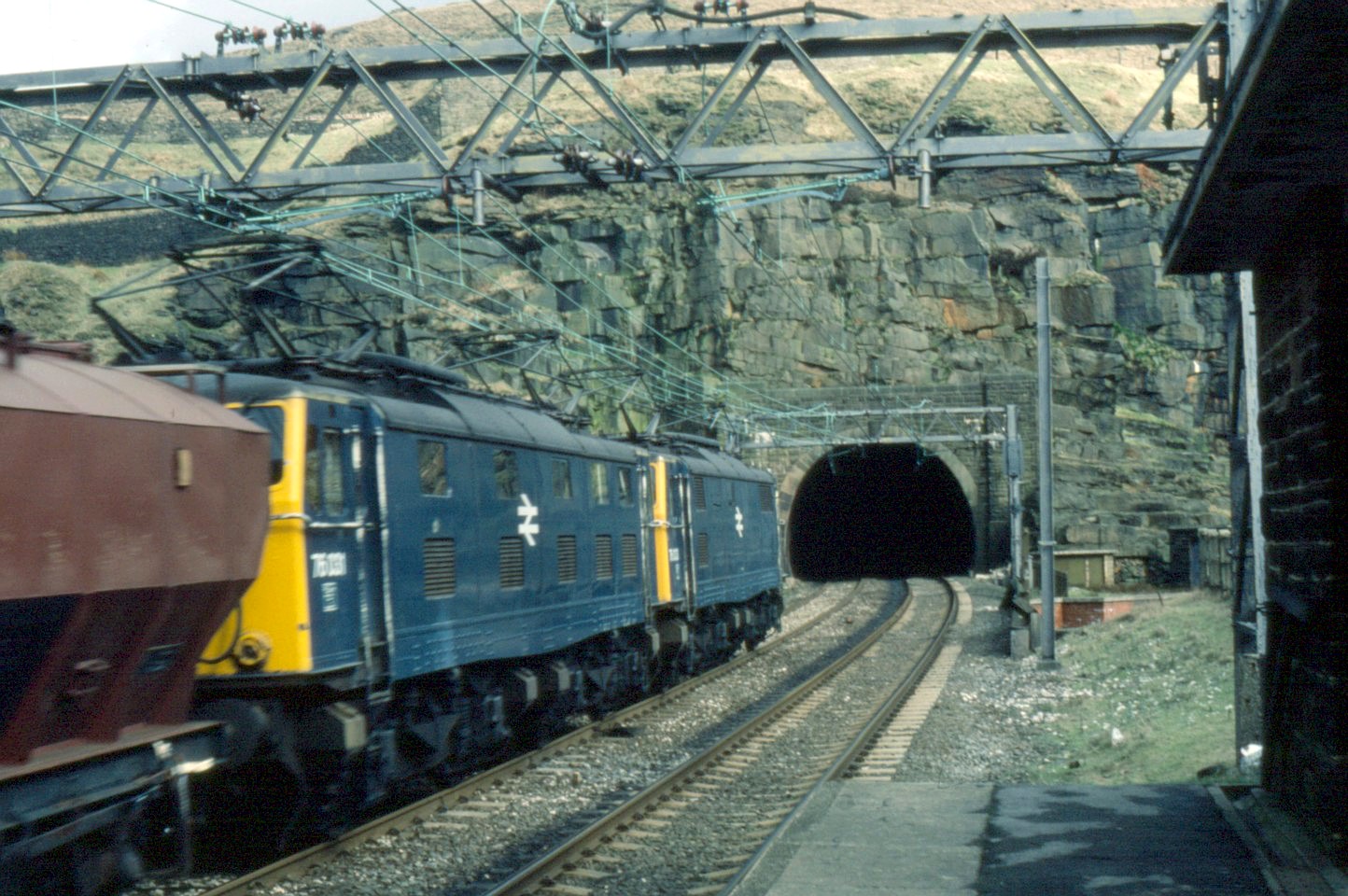
The Woodhead line was a railway line linking Sheffield, Penistone and Manchester in the north of England. A key feature of the route is the passage under the high moorlands of the northern Peak District through the Woodhead Tunnels. The line was electrified in 1953 and closed between Hadfield and Penistone in 1981.
The Manchester to Glossop/Hadfield section is still in operation; east of the Pennines, the vicinity of Penistone is still in operation and until 2024 the Sheffield to Deepcar section was still open, although for freight only. The track has been lifted on other sections and much of the trackbed now forms part of the Trans-Pennine Trail and National Cycle Route 62.
The route from Manchester to Sheffield was 41+1⁄2 miles (66.8 km) with stops at Gorton, Guide Bridge, Newton, Godley Junction, Broadbottom, Glossop and Dinting, Glossop Central, Hadfield, Crowden, Woodhead, Dunford Bridge, Hazlehead Bridge, Penistone, Wortley, Deepcar, Oughtibridge, Wadsley Bridge and Neepsend. Services still run from Manchester to Glossop and Hadfield; trains also run from Sheffield to Penistone (via a different route), continuing onwards to Huddersfield. The section from Deepcar to Sheffield is currently used for goods.
The line opened in 1845. It was built by the Sheffield, Ashton-under-Lyne and Manchester Railway with Joseph Locke as its engineer. In 1847, the railway merged with the Sheffield and Lincolnshire Junction Railway, the Great Grimsby and Sheffield Junction Railway and the Grimsby Docks Company to form the Manchester, Sheffield and Lincolnshire Railway; it changed its name to the Great Central Railway (GCR) in 1897. Ownership passed to the LNER in 1923 and, finally, to British Railways Eastern Region in 1948.
The original eastern terminus of the line was at Bridgehouses railway station. By the time of the creation of the Manchester, Sheffield and Lincolnshire Railway in 1847, the railway station at Bridgehouses had been outgrown. A 0.6-mile (1 km) extension including the Wicker Arches viaduct, engineered by John Fowler, was constructed to the new Sheffield Victoria station, which opened in 1851.
Both goods and passenger traffic were very heavy; therefore, some sections of the line were quadrupled.
Electrification was first mooted by the Great Central Railway, owing to the difficulties of operating heavy steam-hauled coal trains on the Penistone–Wath section (the Worsborough branch); a line with steep gradients and several tunnels. Definitive plans were drawn up by the LNER in 1936; many of the gantries for the catenary were erected before the Second World War.
The Second World War prevented progress on electrification, but the plans were restarted immediately after the war; however, this time with plans for a new double-track Woodhead Tunnel. This third Woodhead Tunnel was constructed to replace the twin single-bore Victorian tunnels, which had been damaged by years of smoke from steam engines. A second Thurgoland Tunnel was also required, as the existing tunnel had inadequate clearance for twin electrified lines.
Woodhead line
The Woodhead line was a railway line linking Sheffield, Penistone and Manchester in the north of England. A key feature of the route is the passage under the high moorlands of the northern Peak District through the Woodhead Tunnels. The line was electrified in 1953 and closed between Hadfield and Penistone in 1981.
The Manchester to Glossop/Hadfield section is still in operation; east of the Pennines, the vicinity of Penistone is still in operation and until 2024 the Sheffield to Deepcar section was still open, although for freight only. The track has been lifted on other sections and much of the trackbed now forms part of the Trans-Pennine Trail and National Cycle Route 62.
The route from Manchester to Sheffield was 41+1⁄2 miles (66.8 km) with stops at Gorton, Guide Bridge, Newton, Godley Junction, Broadbottom, Glossop and Dinting, Glossop Central, Hadfield, Crowden, Woodhead, Dunford Bridge, Hazlehead Bridge, Penistone, Wortley, Deepcar, Oughtibridge, Wadsley Bridge and Neepsend. Services still run from Manchester to Glossop and Hadfield; trains also run from Sheffield to Penistone (via a different route), continuing onwards to Huddersfield. The section from Deepcar to Sheffield is currently used for goods.
The line opened in 1845. It was built by the Sheffield, Ashton-under-Lyne and Manchester Railway with Joseph Locke as its engineer. In 1847, the railway merged with the Sheffield and Lincolnshire Junction Railway, the Great Grimsby and Sheffield Junction Railway and the Grimsby Docks Company to form the Manchester, Sheffield and Lincolnshire Railway; it changed its name to the Great Central Railway (GCR) in 1897. Ownership passed to the LNER in 1923 and, finally, to British Railways Eastern Region in 1948.
The original eastern terminus of the line was at Bridgehouses railway station. By the time of the creation of the Manchester, Sheffield and Lincolnshire Railway in 1847, the railway station at Bridgehouses had been outgrown. A 0.6-mile (1 km) extension including the Wicker Arches viaduct, engineered by John Fowler, was constructed to the new Sheffield Victoria station, which opened in 1851.
Both goods and passenger traffic were very heavy; therefore, some sections of the line were quadrupled.
Electrification was first mooted by the Great Central Railway, owing to the difficulties of operating heavy steam-hauled coal trains on the Penistone–Wath section (the Worsborough branch); a line with steep gradients and several tunnels. Definitive plans were drawn up by the LNER in 1936; many of the gantries for the catenary were erected before the Second World War.
The Second World War prevented progress on electrification, but the plans were restarted immediately after the war; however, this time with plans for a new double-track Woodhead Tunnel. This third Woodhead Tunnel was constructed to replace the twin single-bore Victorian tunnels, which had been damaged by years of smoke from steam engines. A second Thurgoland Tunnel was also required, as the existing tunnel had inadequate clearance for twin electrified lines.
Recent media
Recent media