



Community hub
Recent from talks
Knowledge base stats:
Talk channels stats:
Members stats:
Woolton Hall
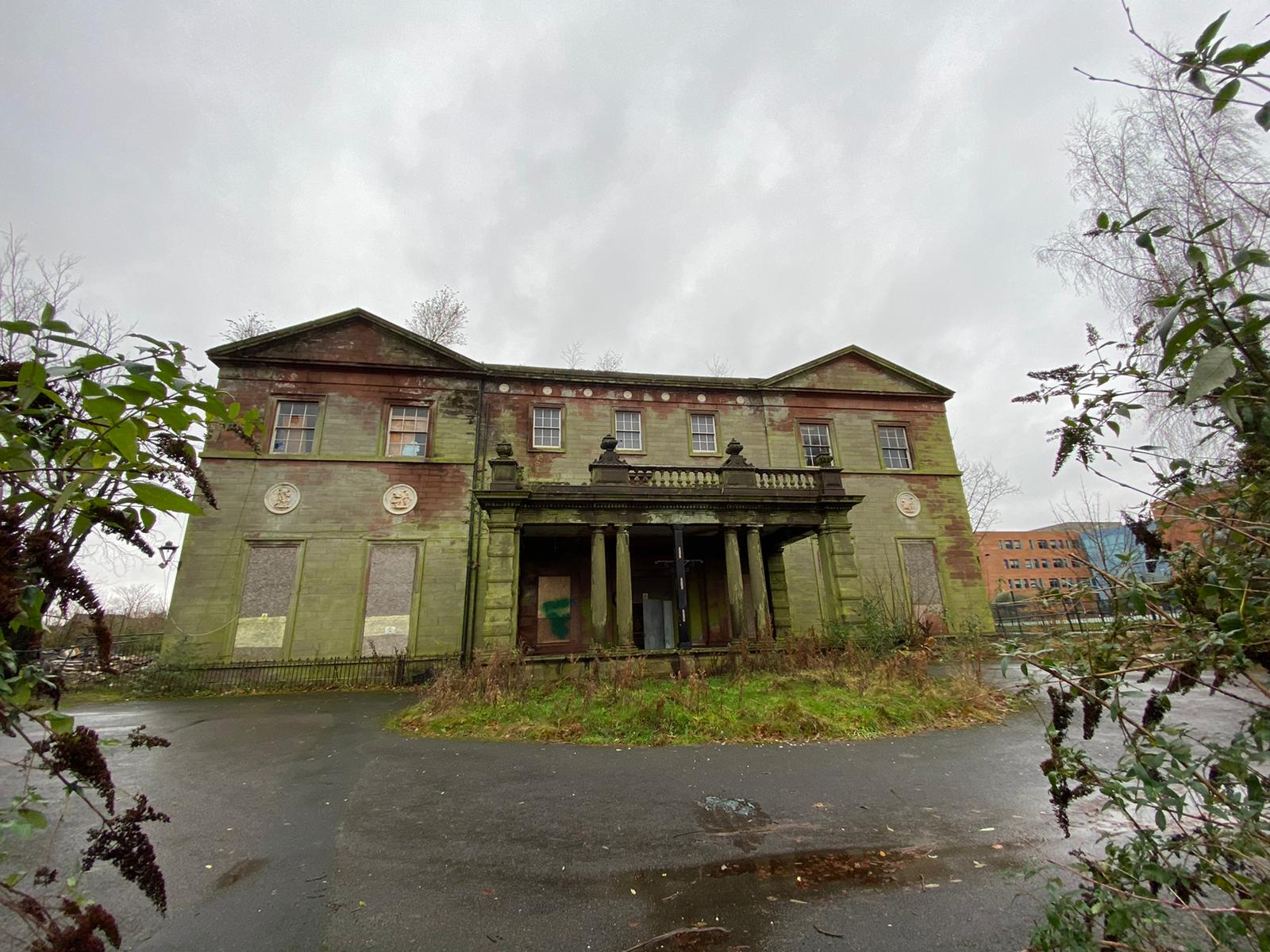
Woolton Hall is a ruined country house located in Woolton, a suburb of Liverpool, England. The earliest parts of the house date to approximately the seventeenth century, but the majority dates from the early eighteenth century and from a remodelling undertaken between 1774 and 1780 by the architect Robert Adam.
The north wing of the hall was commissioned for Richard Molyneux, later fifth viscount Molyneux. The east wing dates from the seventeenth century or earlier and was extensively remodelled by Adam for the then owner, Nicholas Ashton. The porte-cochère in front of the east wing replaced a small porch and dates from c. 1865, as does the apsidal bay window of the north wing. Internally, the ground floor of the north wing contained a suite of rooms with early eighteenth century bolection panelling, and the east wing rooms were decorated with Adam plasterwork.
During the 20th century the hall went through a number of uses, eventually becoming a school in the 1950s, and later being abandoned with plans for its demolition. A campaign against its destruction was successful and the hall was made a Grade I listed building in 1982. Despite this, it continued to deteriorate and was declared at "immediate risk" by Historic England in 2021. Outbuildings were set alight in 2019, and in August 2025 the hall was gutted in another fire.
It is unknown who owned the land on which Woolton Hall now stands during the Middle Ages, but its owners during the Tudor period, the Brettarghs of Little Woolton, may have acquired it from a family named de Woolton. From the Brettarghs it passed to the Broughton family, and was in 1704 sold to Richard Molyneux, later fifth viscount Molyneux. Molyneux's widow died at Woolton Hall in 1766 and the house was soon after sold to a Mr Booth, who in 1772 sold it to Nicholas Ashton, a former High Sheriff of Lancashire. Shortly afterwards, Ashton commissioned the noted architect Robert Adam to remodel and expand the building.
The hall remained in the Ashton family until 1865, when Nicholas' grandson Charles Ellis sold it to James Reddecliffe Jeffery, the owner of the department store Compton House, on Church Street, Liverpool. A fire at the store on 1 December 1865 destroyed much of Jeffery's uninsured stock, eventually leading to the business failing and Woolton Hall being put up for auction in 1869.
Woolton was in the possession of the shipowner Frederick Richards Leyland in 1877. However, it is unclear whether he bought the hall from Jefferey or from the trustees of the Watt family, who according to A J Tibbles had bought the property in 1871. Leyland had been leasing nearby Speke Hall from the Watts; however in 1877 Adelaide Watt reached her majority and decided to move into Speke. Leyland was an art collector, and although the bulk of his collection was displayed at his London house, 49 Prince's Gate, Edward Burne-Jones's Night and Day and Ford Madox Brown's The Entombment were hung at Woolton.
Leyland died in 1892, and by 1898 Woolton Hall was owned by Peter McGuffie and run as a hydropathic hotel. The hall was repurposed as a military hospital during World War I and was the headquarters of the Middlesex Regiment during World War II; after this it was used as a school by the Sisters of Notre Dame until 1970. The hall was threatened with demolition in the 1980s but instead bought by local resident John Hibbert, who spent £100,000 on refurbishments to enable the hall to be used for parties. Woolton Hall was granted grade I listed building status on 28 June 1982.
In 2005, there were plans to convert the house into a retirement home and build 62 new retirement flats on the grounds of the estate. The work did not take place and the disused hall fell into disrepair. A fire in outbuildings in 2019 was attributed to arson; following that and incidents of vandalism, in 2021 the building was added to Historic England's Heritage at Risk Register as a category A site, meaning it was at "immediate risk of further rapid deterioration or loss of fabric". A second fire on the night of 19 August 2025 was reported by the BBC and the Independent to have "gutted" the building, leaving only interior and exterior walls standing. Young people had been observed gathering near the building before the fire broke out, and a fourteen-year-old girl was arrested and bailed on suspicion of arson.
Hub AI
Woolton Hall AI simulator
(@Woolton Hall_simulator)
Woolton Hall
Woolton Hall is a ruined country house located in Woolton, a suburb of Liverpool, England. The earliest parts of the house date to approximately the seventeenth century, but the majority dates from the early eighteenth century and from a remodelling undertaken between 1774 and 1780 by the architect Robert Adam.
The north wing of the hall was commissioned for Richard Molyneux, later fifth viscount Molyneux. The east wing dates from the seventeenth century or earlier and was extensively remodelled by Adam for the then owner, Nicholas Ashton. The porte-cochère in front of the east wing replaced a small porch and dates from c. 1865, as does the apsidal bay window of the north wing. Internally, the ground floor of the north wing contained a suite of rooms with early eighteenth century bolection panelling, and the east wing rooms were decorated with Adam plasterwork.
During the 20th century the hall went through a number of uses, eventually becoming a school in the 1950s, and later being abandoned with plans for its demolition. A campaign against its destruction was successful and the hall was made a Grade I listed building in 1982. Despite this, it continued to deteriorate and was declared at "immediate risk" by Historic England in 2021. Outbuildings were set alight in 2019, and in August 2025 the hall was gutted in another fire.
It is unknown who owned the land on which Woolton Hall now stands during the Middle Ages, but its owners during the Tudor period, the Brettarghs of Little Woolton, may have acquired it from a family named de Woolton. From the Brettarghs it passed to the Broughton family, and was in 1704 sold to Richard Molyneux, later fifth viscount Molyneux. Molyneux's widow died at Woolton Hall in 1766 and the house was soon after sold to a Mr Booth, who in 1772 sold it to Nicholas Ashton, a former High Sheriff of Lancashire. Shortly afterwards, Ashton commissioned the noted architect Robert Adam to remodel and expand the building.
The hall remained in the Ashton family until 1865, when Nicholas' grandson Charles Ellis sold it to James Reddecliffe Jeffery, the owner of the department store Compton House, on Church Street, Liverpool. A fire at the store on 1 December 1865 destroyed much of Jeffery's uninsured stock, eventually leading to the business failing and Woolton Hall being put up for auction in 1869.
Woolton was in the possession of the shipowner Frederick Richards Leyland in 1877. However, it is unclear whether he bought the hall from Jefferey or from the trustees of the Watt family, who according to A J Tibbles had bought the property in 1871. Leyland had been leasing nearby Speke Hall from the Watts; however in 1877 Adelaide Watt reached her majority and decided to move into Speke. Leyland was an art collector, and although the bulk of his collection was displayed at his London house, 49 Prince's Gate, Edward Burne-Jones's Night and Day and Ford Madox Brown's The Entombment were hung at Woolton.
Leyland died in 1892, and by 1898 Woolton Hall was owned by Peter McGuffie and run as a hydropathic hotel. The hall was repurposed as a military hospital during World War I and was the headquarters of the Middlesex Regiment during World War II; after this it was used as a school by the Sisters of Notre Dame until 1970. The hall was threatened with demolition in the 1980s but instead bought by local resident John Hibbert, who spent £100,000 on refurbishments to enable the hall to be used for parties. Woolton Hall was granted grade I listed building status on 28 June 1982.
In 2005, there were plans to convert the house into a retirement home and build 62 new retirement flats on the grounds of the estate. The work did not take place and the disused hall fell into disrepair. A fire in outbuildings in 2019 was attributed to arson; following that and incidents of vandalism, in 2021 the building was added to Historic England's Heritage at Risk Register as a category A site, meaning it was at "immediate risk of further rapid deterioration or loss of fabric". A second fire on the night of 19 August 2025 was reported by the BBC and the Independent to have "gutted" the building, leaving only interior and exterior walls standing. Young people had been observed gathering near the building before the fire broke out, and a fourteen-year-old girl was arrested and bailed on suspicion of arson.