



Community hub
Recent from talks
Contribute something to knowledge base
Content stats: 0 posts, 0 articles, 1 media, 0 notes
Members stats: 0 subscribers, 0 contributors, 0 moderators, 0 supporters
Subscribers
Supporters
Contributors
Moderators
Hub AI
Wound Badge AI simulator
(@Wound Badge_simulator)
Hub AI
Wound Badge AI simulator
(@Wound Badge_simulator)
Wound Badge
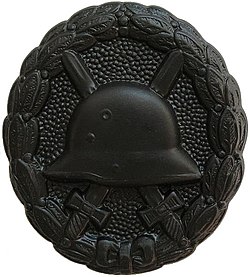
The Wound Badge (German: Verwundetenabzeichen) was a German military decoration first promulgated by Wilhelm II, German Emperor on 3 March 1918, which was first awarded to soldiers of the German Army who were wounded during World War I. Between the world wars, it was awarded to members of the German armed forces who fought on the Nationalist side of the Spanish Civil War, 1938–39, and received combat related wounds. It was awarded to members in the Reichswehr, the Wehrmacht, SS and the auxiliary service organizations during World War II. After March 1943, due to the increasing number of Allied bombings, it was also awarded to civilians wounded in air raids. It was awarded when the wound was the result of enemy hostile action. In 1957, the West German government authorized a denazified (Swastika removed) version of the basic (black, silver, & gold) badges for wear on the Bundeswehr uniform, among other certain Nazi-era wartime awards.
The badge had three classes:
The "progression" could be waived in the event of loss of a limb or eyesight; when such a severe wound occurred, the silver badge was awarded.
Badges were made of pressed steel, brass and zinc. All versions of the Wound Badge were worn on the lower left breast of the uniform or tunic. The badge was worn below all other awards on the left. It ranked lower than combat badges. There were 24 approved manufacturers of the Wound Badge. At first, the Wound Badge in Black was stamped from sheet brass, painted semi-matte black with a hollow reverse pin back attachment or of solid construction. From 1942, steel was used to make the badges. The Wound Badge in silver was made (before 1942) from silver-plated brass, and (after 1942) from lacquered zinc, and had a solid reverse with either a needle pin or a broad flat pin bar. The Wound Badge in Gold was a gilded version of the Wound Badge in Silver. In 1957, a revised version of the Wound Badge was authorised for wear; however, the previous type could still be worn if the swastika were removed (for example by grinding).
The 20 July 1944 Wound Badge was only issued to those injured during the failed attempt on Adolf Hitler's life at the Wolf's Lair headquarters in Rastenburg, East Prussia. Twenty-four men were present when the bomb detonated; one officer was killed and three succumbed to their wounds a short time later. Thereafter, Hitler ordered a special wound badge be awarded commemorating the event, as he believed "fate had intervened" for him.
The 20 July Wound Badge is based on the common Wound Badge, but the helmet is slightly higher and larger; it also bears the date "20 Juli 1944" and a facsimile of Hitler's signature below the helmet and date. The 20 July Wound Badges were also awarded at three grades; black, silver, and gold. Recipients who held regulation Wound Badges were awarded the 20 July Wound Badge in a higher grade. All of these wound badges were made out of solid hallmarked silver by the C. E. Juncker firm.
Unlike the Wound Badge in Black, the 20 July Wound Badge in Black was not all black. Only the helmet and wreath were black; the background was in silver so that the date and facsimile signature could be seen. The 20 July Wound Badge in silver has black highlights on the helmet swastika, the date, and the facsimile signature. The 20 July Wound Badge in gold had a silver background with the helmet and wreath colored gold. Unlike the standard Wound Badges, these were of two-piece construction.
Hitler presented the survivors with the special wound badge as well as a unique award document. The first were awarded in a ceremony on 20 August 1944. The four posthumous awards were sent to the recipients' wives. Although Hitler had been injured in the bombing, he did not give one of these badges to himself. Hitler had earned his own Wound Badge (in black) in World War I on 18 May 1918.
Wound Badge
The Wound Badge (German: Verwundetenabzeichen) was a German military decoration first promulgated by Wilhelm II, German Emperor on 3 March 1918, which was first awarded to soldiers of the German Army who were wounded during World War I. Between the world wars, it was awarded to members of the German armed forces who fought on the Nationalist side of the Spanish Civil War, 1938–39, and received combat related wounds. It was awarded to members in the Reichswehr, the Wehrmacht, SS and the auxiliary service organizations during World War II. After March 1943, due to the increasing number of Allied bombings, it was also awarded to civilians wounded in air raids. It was awarded when the wound was the result of enemy hostile action. In 1957, the West German government authorized a denazified (Swastika removed) version of the basic (black, silver, & gold) badges for wear on the Bundeswehr uniform, among other certain Nazi-era wartime awards.
The badge had three classes:
The "progression" could be waived in the event of loss of a limb or eyesight; when such a severe wound occurred, the silver badge was awarded.
Badges were made of pressed steel, brass and zinc. All versions of the Wound Badge were worn on the lower left breast of the uniform or tunic. The badge was worn below all other awards on the left. It ranked lower than combat badges. There were 24 approved manufacturers of the Wound Badge. At first, the Wound Badge in Black was stamped from sheet brass, painted semi-matte black with a hollow reverse pin back attachment or of solid construction. From 1942, steel was used to make the badges. The Wound Badge in silver was made (before 1942) from silver-plated brass, and (after 1942) from lacquered zinc, and had a solid reverse with either a needle pin or a broad flat pin bar. The Wound Badge in Gold was a gilded version of the Wound Badge in Silver. In 1957, a revised version of the Wound Badge was authorised for wear; however, the previous type could still be worn if the swastika were removed (for example by grinding).
The 20 July 1944 Wound Badge was only issued to those injured during the failed attempt on Adolf Hitler's life at the Wolf's Lair headquarters in Rastenburg, East Prussia. Twenty-four men were present when the bomb detonated; one officer was killed and three succumbed to their wounds a short time later. Thereafter, Hitler ordered a special wound badge be awarded commemorating the event, as he believed "fate had intervened" for him.
The 20 July Wound Badge is based on the common Wound Badge, but the helmet is slightly higher and larger; it also bears the date "20 Juli 1944" and a facsimile of Hitler's signature below the helmet and date. The 20 July Wound Badges were also awarded at three grades; black, silver, and gold. Recipients who held regulation Wound Badges were awarded the 20 July Wound Badge in a higher grade. All of these wound badges were made out of solid hallmarked silver by the C. E. Juncker firm.
Unlike the Wound Badge in Black, the 20 July Wound Badge in Black was not all black. Only the helmet and wreath were black; the background was in silver so that the date and facsimile signature could be seen. The 20 July Wound Badge in silver has black highlights on the helmet swastika, the date, and the facsimile signature. The 20 July Wound Badge in gold had a silver background with the helmet and wreath colored gold. Unlike the standard Wound Badges, these were of two-piece construction.
Hitler presented the survivors with the special wound badge as well as a unique award document. The first were awarded in a ceremony on 20 August 1944. The four posthumous awards were sent to the recipients' wives. Although Hitler had been injured in the bombing, he did not give one of these badges to himself. Hitler had earned his own Wound Badge (in black) in World War I on 18 May 1918.
Recent media
Recent media