
Recent from talks
Wright Brothers National Memorial
Knowledge base stats:
Talk channels stats:
Members stats:
Wright Brothers National Memorial
Wright Brothers National Memorial (originally the Kill Devil Hill Monument), located in Kill Devil Hills, North Carolina, commemorates Wright Flyer; the first successful, sustained, powered flights in a heavier-than-air machine. From 1900 to 1903, Wilbur and Orville Wright came to North Carolina from Dayton, Ohio, based on information from the U.S. Weather Bureau about the area's steady winds. They also valued the privacy provided by this location, which in the early twentieth century was remote from major population centers.
Authorized as Kill Devil Hill Monument on March 2, 1927, it was transferred from the War Department to the National Park Service on August 10, 1933. Congress renamed it and designated it a national memorial on December 4, 1953. As with all historic areas administered by the National Park Service, the national memorial was listed on the National Register of Historic Places on October 15, 1966. The memorial's visitor center, designed by Ehrman Mitchell and Romaldo Giurgola, was designated a National Historic Landmark on January 3, 2001. The memorial is co-managed with two other Outer Banks parks, Fort Raleigh National Historic Site and Cape Hatteras National Seashore.
The Wrights made four flights from level ground near the base of the hill on December 17, 1903, in the Wright Flyer, following three years of gliding experiments from atop this and other nearby sand dunes. The starts and finishes of the routes of the four flights are marked with small monuments. Two wooden sheds, based on historic photographs, recreate the world's first airplane hangar and the brothers' living quarters.
The Visitor Center is home to a museum featuring models and the tools and machines used by the Wright brothers during their flight experiments, including a reproduction of the wind tunnel used to test wing shapes and a portion of the engine used in the first flight. In one wing of the Visitor Center is a life-sized replica of the Wright brothers' 1903 Wright Flyer, the first powered heavier-than-air aircraft to achieve controlled flight (the original being displayed at the National Air and Space Museum in Washington D.C.). A full-scale model of the brothers' 1902 glider is also present, having been constructed under the direction of Orville Wright. On the walls of the glider room are portraits and photographs of other flight pioneers throughout history.
The visitor center's modern design was a departure from the National Park Service's earlier, more traditional buildings, and was built as part of its "Mission 66" modernization and expansion program. As the first major building of that effort, it was a high-profile success, bringing critical notice for its modern design and launching the careers of its designers.[peacock prose] It was designated a National Historic Landmark in 1975 for its architecture and its importance to the Park Service's program.
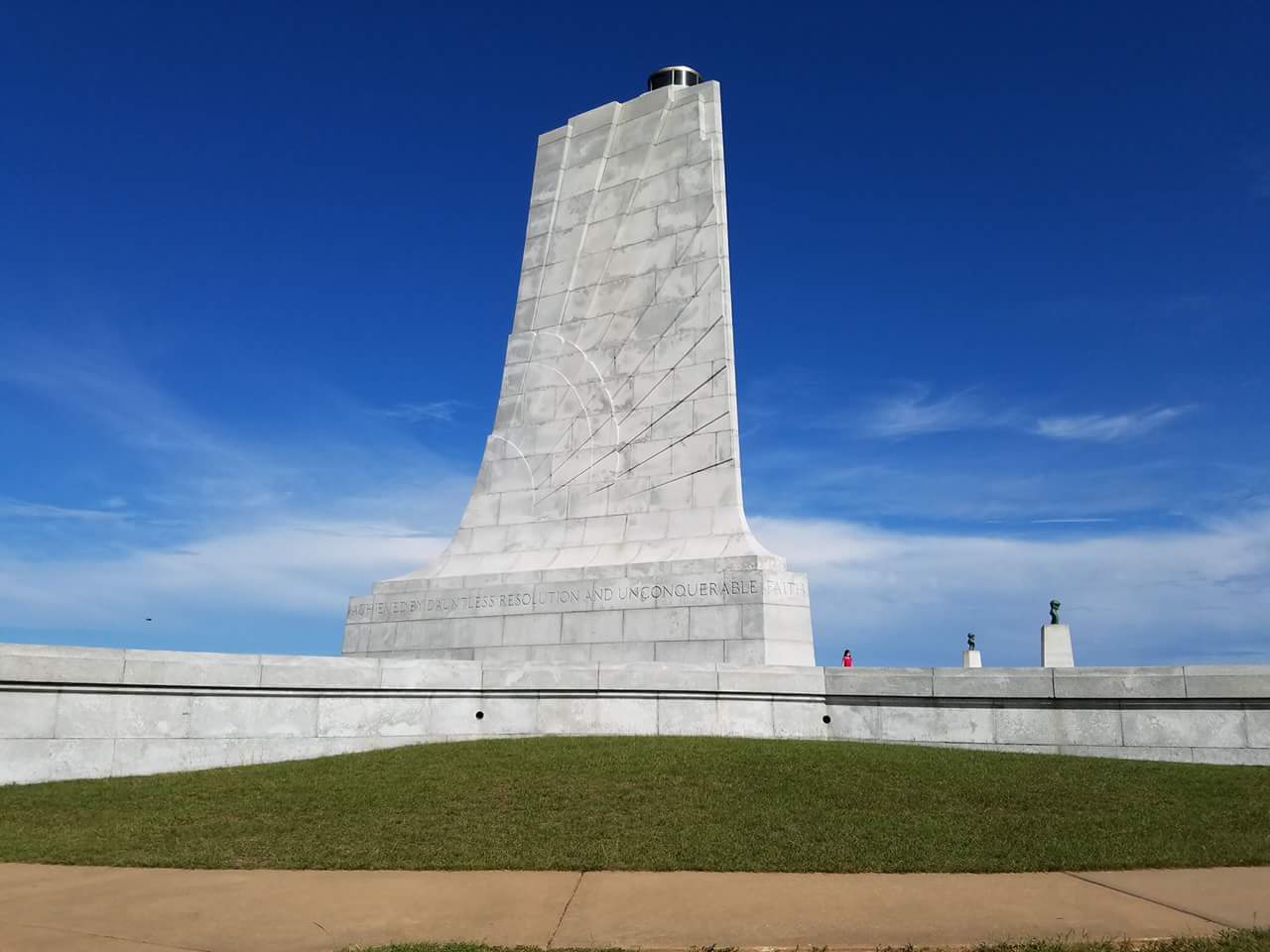
A 60 feet (18.29 m) granite monument, dedicated in 1932, is perched atop 90-foot-tall (27 m) Kill Devil Hill, commemorating the achievement of the Wright brothers. They conducted many of their glider tests on the large shifting dune that was later stabilized to form Kill Devil Hill. Inscribed in capital letters along the base of the memorial tower is the phrase "In commemoration of the conquest of the air by the brothers Wilbur and Orville Wright conceived by genius achieved by dauntless resolution and unconquerable faith." Atop the tower is a marine beacon, similar to one found in a lighthouse.
The doors of the tower are stainless steel over nickel, with a price of $3,000 in 1928 (equivalent to $43,170 in 2024). The six relief panels represent the conquest of the air:[citation needed]
The tower was designed by Robert Rodgers and Alfred Easton Poor, a New York City architectural firm; the design was officially selected on February 14, 1930. Prior to the memorial's construction, the War Department selected Captain William H. Kindervater of the Quartermaster Corps to prepare the site for construction and to manage the area landscaping. To secure the sandy foundation, Captain Kindervater selected Bermuda grass to be planted on Kill Devil Hill and the surrounding area. He also ordered a special fertilizer to be spread throughout the area to promote grass and shrubbery growth and decided to build a fence to prevent animal grazing. With a strong foundation in place, the Office of the Quartermaster selected Marine Captain John A. Gilman to preside over the construction project. Construction began in October 1931 and with a budget of $213,000 (equivalent to $3.53 million in 2024), the memorial was completed in November 1932. In the end, 1,200 tons (1.1 million kg) of granite, more than 2,000 tons (1.8 million kg) of gravel, more than 800 tons (730,000 kg) of sand and almost 400 tons (360,000 kg) of cement were used to build the structure, along with numerous other materials. It is constructed of granite mined at the North Carolina Granite Corporation Quarry Complex.
Hub AI
Wright Brothers National Memorial AI simulator
(@Wright Brothers National Memorial_simulator)
Wright Brothers National Memorial
Wright Brothers National Memorial (originally the Kill Devil Hill Monument), located in Kill Devil Hills, North Carolina, commemorates Wright Flyer; the first successful, sustained, powered flights in a heavier-than-air machine. From 1900 to 1903, Wilbur and Orville Wright came to North Carolina from Dayton, Ohio, based on information from the U.S. Weather Bureau about the area's steady winds. They also valued the privacy provided by this location, which in the early twentieth century was remote from major population centers.
Authorized as Kill Devil Hill Monument on March 2, 1927, it was transferred from the War Department to the National Park Service on August 10, 1933. Congress renamed it and designated it a national memorial on December 4, 1953. As with all historic areas administered by the National Park Service, the national memorial was listed on the National Register of Historic Places on October 15, 1966. The memorial's visitor center, designed by Ehrman Mitchell and Romaldo Giurgola, was designated a National Historic Landmark on January 3, 2001. The memorial is co-managed with two other Outer Banks parks, Fort Raleigh National Historic Site and Cape Hatteras National Seashore.
The Wrights made four flights from level ground near the base of the hill on December 17, 1903, in the Wright Flyer, following three years of gliding experiments from atop this and other nearby sand dunes. The starts and finishes of the routes of the four flights are marked with small monuments. Two wooden sheds, based on historic photographs, recreate the world's first airplane hangar and the brothers' living quarters.
The Visitor Center is home to a museum featuring models and the tools and machines used by the Wright brothers during their flight experiments, including a reproduction of the wind tunnel used to test wing shapes and a portion of the engine used in the first flight. In one wing of the Visitor Center is a life-sized replica of the Wright brothers' 1903 Wright Flyer, the first powered heavier-than-air aircraft to achieve controlled flight (the original being displayed at the National Air and Space Museum in Washington D.C.). A full-scale model of the brothers' 1902 glider is also present, having been constructed under the direction of Orville Wright. On the walls of the glider room are portraits and photographs of other flight pioneers throughout history.
The visitor center's modern design was a departure from the National Park Service's earlier, more traditional buildings, and was built as part of its "Mission 66" modernization and expansion program. As the first major building of that effort, it was a high-profile success, bringing critical notice for its modern design and launching the careers of its designers.[peacock prose] It was designated a National Historic Landmark in 1975 for its architecture and its importance to the Park Service's program.
A 60 feet (18.29 m) granite monument, dedicated in 1932, is perched atop 90-foot-tall (27 m) Kill Devil Hill, commemorating the achievement of the Wright brothers. They conducted many of their glider tests on the large shifting dune that was later stabilized to form Kill Devil Hill. Inscribed in capital letters along the base of the memorial tower is the phrase "In commemoration of the conquest of the air by the brothers Wilbur and Orville Wright conceived by genius achieved by dauntless resolution and unconquerable faith." Atop the tower is a marine beacon, similar to one found in a lighthouse.
The doors of the tower are stainless steel over nickel, with a price of $3,000 in 1928 (equivalent to $43,170 in 2024). The six relief panels represent the conquest of the air:[citation needed]
The tower was designed by Robert Rodgers and Alfred Easton Poor, a New York City architectural firm; the design was officially selected on February 14, 1930. Prior to the memorial's construction, the War Department selected Captain William H. Kindervater of the Quartermaster Corps to prepare the site for construction and to manage the area landscaping. To secure the sandy foundation, Captain Kindervater selected Bermuda grass to be planted on Kill Devil Hill and the surrounding area. He also ordered a special fertilizer to be spread throughout the area to promote grass and shrubbery growth and decided to build a fence to prevent animal grazing. With a strong foundation in place, the Office of the Quartermaster selected Marine Captain John A. Gilman to preside over the construction project. Construction began in October 1931 and with a budget of $213,000 (equivalent to $3.53 million in 2024), the memorial was completed in November 1932. In the end, 1,200 tons (1.1 million kg) of granite, more than 2,000 tons (1.8 million kg) of gravel, more than 800 tons (730,000 kg) of sand and almost 400 tons (360,000 kg) of cement were used to build the structure, along with numerous other materials. It is constructed of granite mined at the North Carolina Granite Corporation Quarry Complex.
Recent media