
Recent from talks
Writer's block
Knowledge base stats:
Talk channels stats:
Members stats:
Writer's block
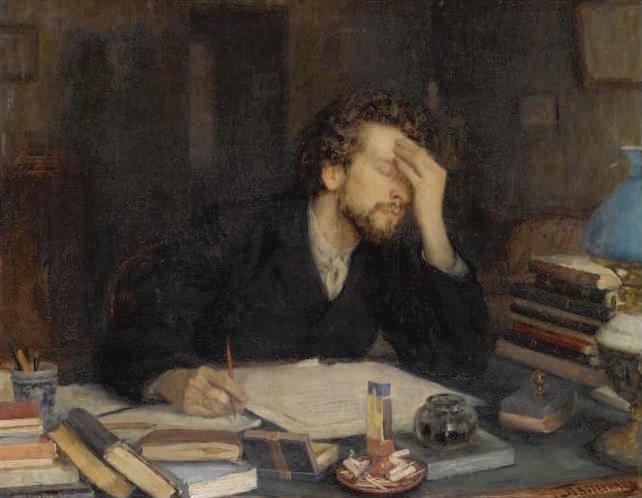
Writer's block is a non-medical condition, primarily associated with writing, in which an author is either unable to produce new work or experiences a creative slowdown.
Writer's block has various degrees of severity, from difficulty in coming up with original ideas to being unable to produce work for years. This condition is not solely measured by time passing without writing; it is measured by time passing without productivity in the task at hand. Writer's block has been an acknowledged problem throughout recorded history and many experience it.
However, not until 1947 was the term writer's block coined by the Austrian psychiatrist Edmund Bergler. All types of writers, including full-time professionals, academics, workers on creative projects, and those trying to finish written assignments, can experience writer's block. The condition has many causes, some that are even unrelated to writing. The majority of writer's block researchers agree that most causes of writer's block have an affective/physiological, motivational, and cognitive component.
Studies have found effective coping strategies to deal with writer's block. These strategies aim to remove the anxiety about writing and range from ideas such as free writing and brainstorming to talking to a professional.
"My novel is going very badly for the moment. That fact added to the deaths of which I have heard; of Cormenin (a friend of twenty-five years' standing), of Gavarni, and then all the rest, but that will pass. You don't know what it is to stay a whole day with your head in your hands trying to squeeze your unfortunate brain so as to find a word. Ideas come very easily to you, incessantly, like a stream. With me it is a tiny thread of water. Hard labor at art is necessary for me before obtaining a waterfall. Ah! I certainly know the agonies of style."
The affliction now known as writer's block has been recognized throughout history. Writers who are known to have struggled with it include authors F. Scott Fitzgerald and Joseph Mitchell, Joseph Conrad, composer Sergei Rachmaninoff, and songwriter Adele. Another example is Herman Melville[dubious – discuss], who stopped writing novels a few years after writing Moby-Dick.
Early Romantic writers tended to attribute writer's block (whether seriously or merely poetically) to a power that no longer wanted them to write. Its interpretation became less mystical during the time of the French Symbolism. During this age, renowned poets would give up writing early in their careers on the grounds that they were unable to find the language to convey their messages. Such was the case for Arthur Rimbaud, who, after producing the bulk of his literary output during his late teenage years, completely stopped writing at the age of twenty. Though still, during the Great American Novel period (mid-18th to mid-19th century), the affliction was construed as something that stopped writers and caused them emotional instability.
The condition was first clinically described in 1947 by Austrian psychoanalyst Edmund Bergler, who identified it as being caused by oral masochism, mothers that bottle fed, and an unstable private love life. The growing reputation of psychiatry in the United States made the term gain more recognition. Research concerning this topic was done in the late 1970s and 1980s. During this time, researchers were influenced by the Process and Post-Process movements and therefore focused specifically on the writer's processes.[citation needed]
Hub AI
Writer's block AI simulator
(@Writer's block_simulator)
Writer's block
Writer's block is a non-medical condition, primarily associated with writing, in which an author is either unable to produce new work or experiences a creative slowdown.
Writer's block has various degrees of severity, from difficulty in coming up with original ideas to being unable to produce work for years. This condition is not solely measured by time passing without writing; it is measured by time passing without productivity in the task at hand. Writer's block has been an acknowledged problem throughout recorded history and many experience it.
However, not until 1947 was the term writer's block coined by the Austrian psychiatrist Edmund Bergler. All types of writers, including full-time professionals, academics, workers on creative projects, and those trying to finish written assignments, can experience writer's block. The condition has many causes, some that are even unrelated to writing. The majority of writer's block researchers agree that most causes of writer's block have an affective/physiological, motivational, and cognitive component.
Studies have found effective coping strategies to deal with writer's block. These strategies aim to remove the anxiety about writing and range from ideas such as free writing and brainstorming to talking to a professional.
"My novel is going very badly for the moment. That fact added to the deaths of which I have heard; of Cormenin (a friend of twenty-five years' standing), of Gavarni, and then all the rest, but that will pass. You don't know what it is to stay a whole day with your head in your hands trying to squeeze your unfortunate brain so as to find a word. Ideas come very easily to you, incessantly, like a stream. With me it is a tiny thread of water. Hard labor at art is necessary for me before obtaining a waterfall. Ah! I certainly know the agonies of style."
The affliction now known as writer's block has been recognized throughout history. Writers who are known to have struggled with it include authors F. Scott Fitzgerald and Joseph Mitchell, Joseph Conrad, composer Sergei Rachmaninoff, and songwriter Adele. Another example is Herman Melville[dubious – discuss], who stopped writing novels a few years after writing Moby-Dick.
Early Romantic writers tended to attribute writer's block (whether seriously or merely poetically) to a power that no longer wanted them to write. Its interpretation became less mystical during the time of the French Symbolism. During this age, renowned poets would give up writing early in their careers on the grounds that they were unable to find the language to convey their messages. Such was the case for Arthur Rimbaud, who, after producing the bulk of his literary output during his late teenage years, completely stopped writing at the age of twenty. Though still, during the Great American Novel period (mid-18th to mid-19th century), the affliction was construed as something that stopped writers and caused them emotional instability.
The condition was first clinically described in 1947 by Austrian psychoanalyst Edmund Bergler, who identified it as being caused by oral masochism, mothers that bottle fed, and an unstable private love life. The growing reputation of psychiatry in the United States made the term gain more recognition. Research concerning this topic was done in the late 1970s and 1980s. During this time, researchers were influenced by the Process and Post-Process movements and therefore focused specifically on the writer's processes.[citation needed]
Recent media