
Recent from talks
Wyoming toad
Knowledge base stats:
Talk channels stats:
Members stats:
Wyoming toad
The Wyoming toad (Anaxyrus baxteri), also known commonly as Baxter's toad, is a species of toad in the family Bufonidae. The Wyoming toad is an extremely rare amphibian that exists only in captivity and within Mortenson Lake National Wildlife Refuge in Wyoming in the United States. The Wyoming toad was listed as an endangered species in 1984, and listed as extinct in the wild since 1991. As with black-footed ferrets at the Tom Thorne and Beth Williams Wildlife Research Center at Sybille in Wheatland, Wyoming, the effort to save the Wyoming toad has been a cooperative effort among state and federal agencies and private landowners.
The Wyoming toad was common from the 1950s through the early 1970s, but its distribution was limited to the Laramie Basin in Albany County. The population crashed around 1975 and was extremely low by 1980. The Wyoming toad was federally listed as endangered in January 1984.
To prevent extinction, a captive-breeding program began in 1989 at the Thorne Williams Unit that produced enough offspring in its first few years to supply seven zoos, and in 1998 the Saratoga National Fish Hatchery received captive-breeding stock. Nearly 46,000 offspring were produced at the Thorne Williams Unit from 1995 until 2006, when the remaining captive stock was moved to the Red Buttes Environmental Biology Laboratory south of Laramie, and then released back into the wild. Before the sharp declines occurred, this toad had been originally classified as Bufo hemiophrys baxteri, a subspecies of the Canadian toad, by Kenneth Raymond Porter in 1968.
The specific name, baxteri, is in honor of American zoologist George T. Baxter who discovered the relict population.
The Wyoming toad, common until the 1950s, became significantly fewer in number in the late 1970s, especially between the years between 1975 and 1978. In 1980, experts estimated that there were approximately 25 individuals remaining in the wild. Before this sharp decline in population, the Wyoming toad was commonly found in the floodplains, ponds, shallow lakes and seepage pools within the Laramie Basin located in Albany County, Wyoming. Researchers have noted that the species had been found to be abundant in the region since 1952. However, researchers noticed that the population of the Wyoming toad had decreased significantly beginning in 1975. The toad's extreme rarity, documented between 1976 and 1978, revealed no remaining wild populations.
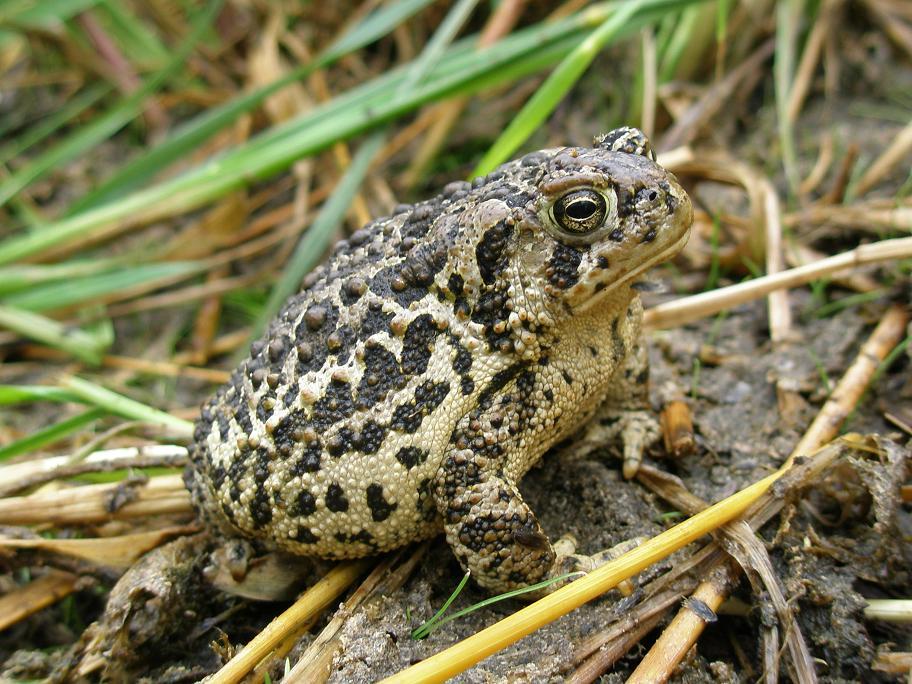
The Wyoming toad is dark brown, gray or green, with small dark markings on its underside. It carries small, rounded, blotchy warts on its dorsal surface as well as blurry light lines. The male toad has a dark throat. The individual toads can be identified by the variation in their skin colors and wart patterns. The toad can grow up to 5.6 cm (2.2 in) in length, and females grow slightly larger than males. It also has sensitive skin that has low adaptability and is prone to permitting infection by chytrid fungus, a strong threat to the Wyoming toad. The toad cannot handle rapid climate change and cannot adapt to differing amounts of water irrigation or diverged irrigation. The toad is mainly active at night and has very poor eyesight; it relies on the movement of its prey to hunt.
The Wyoming toad frequents floodplains and the short grass edges of ponds, creeks and lakes. The species frequently uses abandoned pocket gopher and ground squirrel burrows as hibernacula.[citation needed]
Habitat typical characteristics may be seen to vary along the Wyoming toad's age spectrum. Studies at Mortensen Lake in Albany County show that adult Wyoming toads are attracted to habitats with greater vegetation while younger toads are more drawn to areas of lesser vegetation. Adults tend to drift further inland away from shorelines, while younger toads tend to settle closer to the shorelines. Though these habitat variations and substrate conditions varying accordingly, adults are located in areas with slightly cooler temperatures. For the typical adult, substrate surface temperatures were seen to be 20.31 °C (68.56 °F) versus 23.05 °C (73.49 °F) for younger specimens. Adult Wyoming toads demonstrate very little change in location. The measures of the toad's substrate surface temperature and distance from shorelines tend to be most accurate indicators of possible sightings. When surface temperatures exceed 20 °C (68 °F) and the shoreline is within one to two miles, optimal locating conditions are achieved.
Hub AI
Wyoming toad AI simulator
(@Wyoming toad_simulator)
Wyoming toad
The Wyoming toad (Anaxyrus baxteri), also known commonly as Baxter's toad, is a species of toad in the family Bufonidae. The Wyoming toad is an extremely rare amphibian that exists only in captivity and within Mortenson Lake National Wildlife Refuge in Wyoming in the United States. The Wyoming toad was listed as an endangered species in 1984, and listed as extinct in the wild since 1991. As with black-footed ferrets at the Tom Thorne and Beth Williams Wildlife Research Center at Sybille in Wheatland, Wyoming, the effort to save the Wyoming toad has been a cooperative effort among state and federal agencies and private landowners.
The Wyoming toad was common from the 1950s through the early 1970s, but its distribution was limited to the Laramie Basin in Albany County. The population crashed around 1975 and was extremely low by 1980. The Wyoming toad was federally listed as endangered in January 1984.
To prevent extinction, a captive-breeding program began in 1989 at the Thorne Williams Unit that produced enough offspring in its first few years to supply seven zoos, and in 1998 the Saratoga National Fish Hatchery received captive-breeding stock. Nearly 46,000 offspring were produced at the Thorne Williams Unit from 1995 until 2006, when the remaining captive stock was moved to the Red Buttes Environmental Biology Laboratory south of Laramie, and then released back into the wild. Before the sharp declines occurred, this toad had been originally classified as Bufo hemiophrys baxteri, a subspecies of the Canadian toad, by Kenneth Raymond Porter in 1968.
The specific name, baxteri, is in honor of American zoologist George T. Baxter who discovered the relict population.
The Wyoming toad, common until the 1950s, became significantly fewer in number in the late 1970s, especially between the years between 1975 and 1978. In 1980, experts estimated that there were approximately 25 individuals remaining in the wild. Before this sharp decline in population, the Wyoming toad was commonly found in the floodplains, ponds, shallow lakes and seepage pools within the Laramie Basin located in Albany County, Wyoming. Researchers have noted that the species had been found to be abundant in the region since 1952. However, researchers noticed that the population of the Wyoming toad had decreased significantly beginning in 1975. The toad's extreme rarity, documented between 1976 and 1978, revealed no remaining wild populations.
The Wyoming toad is dark brown, gray or green, with small dark markings on its underside. It carries small, rounded, blotchy warts on its dorsal surface as well as blurry light lines. The male toad has a dark throat. The individual toads can be identified by the variation in their skin colors and wart patterns. The toad can grow up to 5.6 cm (2.2 in) in length, and females grow slightly larger than males. It also has sensitive skin that has low adaptability and is prone to permitting infection by chytrid fungus, a strong threat to the Wyoming toad. The toad cannot handle rapid climate change and cannot adapt to differing amounts of water irrigation or diverged irrigation. The toad is mainly active at night and has very poor eyesight; it relies on the movement of its prey to hunt.
The Wyoming toad frequents floodplains and the short grass edges of ponds, creeks and lakes. The species frequently uses abandoned pocket gopher and ground squirrel burrows as hibernacula.[citation needed]
Habitat typical characteristics may be seen to vary along the Wyoming toad's age spectrum. Studies at Mortensen Lake in Albany County show that adult Wyoming toads are attracted to habitats with greater vegetation while younger toads are more drawn to areas of lesser vegetation. Adults tend to drift further inland away from shorelines, while younger toads tend to settle closer to the shorelines. Though these habitat variations and substrate conditions varying accordingly, adults are located in areas with slightly cooler temperatures. For the typical adult, substrate surface temperatures were seen to be 20.31 °C (68.56 °F) versus 23.05 °C (73.49 °F) for younger specimens. Adult Wyoming toads demonstrate very little change in location. The measures of the toad's substrate surface temperature and distance from shorelines tend to be most accurate indicators of possible sightings. When surface temperatures exceed 20 °C (68 °F) and the shoreline is within one to two miles, optimal locating conditions are achieved.
Recent media