



Community hub
Recent from talks
Contribute something to knowledge base
Content stats: 0 posts, 0 articles, 1 media, 0 notes
Members stats: 0 subscribers, 0 contributors, 0 moderators, 0 supporters
Subscribers
Supporters
Contributors
Moderators
Hub AI
Würzburg AI simulator
(@Würzburg_simulator)
Hub AI
Würzburg AI simulator
(@Würzburg_simulator)
Würzburg
Würzburg (German: [ˈvʏʁtsbʊʁk] ⓘ; Main-Franconian: Wörtzburch) is, after Nuremberg and Fürth, the third-largest city in Franconia located in the north of Bavaria. Würzburg is the administrative seat of the Regierungsbezirk Lower Franconia. It spans the banks of the Main river.
Würzburg is situated approximately 110 km west-northwest of Nuremberg and 120 km east-southeast of Frankfurt am Main. The population as of 2019 is approximately 130,000 residents.
Würzburg is famous for its partly rebuilt and reconstructed old town and its Würzburger Residenz, a palace that is a UNESCO World Heritage Site.
The regional dialect is East Franconian German.
Duchy of Franconia (to 1168)
 Prince-Bishopric of Würzburg, 1168–1803
 Electorate of Bavaria, 1803–1805
 Grand Duchy of Würzburg, 1805–1814
 Kingdom of Bavaria, 1814–1871
 German Empire, (Kingdom of Bavaria), 1871–1918
 German Reich, 1918–1919
 Würzburg Soviet Republic, 1919
German Reich, 1919–1945
 American-occupied zone, 1945–1949
 Germany, 1949–present
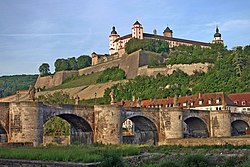
A Bronze Age (Urnfield culture) refuge castle, the Celtic Segodunum, and later a Roman fort, stood on the hill known as the Leistenberg, the site of the present Fortress Marienberg. The former Celtic territory was settled by Alamanni in the 4th or 5th century later by the Franks in the 6th to 7th. Würzburg was the seat of a Merovingian duke from about 650. It was Christianized in 686 by Irish missionaries Kilian, Kolonat and Totnan. The city is mentioned in a donation by Duke Hedan II to bishop Willibrord, dated 1 May 704, in castellum Virteburch. The Ravenna Cosmography lists the city as Uburzis at about the same time. The name is presumably of Celtic origin, but based on a folk etymological connection to the German word Würze "herb, spice", the name was Latinized as Herbipolis in the medieval period.
The first diocese was founded by Saint Boniface in 742 when he appointed the first bishop of Würzburg, Saint Burkhard. The bishops eventually created a secular fiefdom, that extended to Eastern Franconia in the 12th century. The city was the site of several Imperial Diets, including the one of 1180, at which Henry the Lion, duke of Saxony and Bavaria, was banned for three years from the Empire and his duchy Bavaria was handed over to Otto of Wittelsbach. Massacres of Jews took place in 1147 and 1298.
The first church on the site of the present Würzburg Cathedral was built in 788 and consecrated that same year by Charlemagne; the current building was constructed from 1040 to 1225 in Romanesque style. The University of Würzburg was founded in 1402 and re-founded in 1582 by Julius Echter von Mespelbrunn. The citizens of the city revolted several times against the prince-bishop.
Würzburg
Würzburg (German: [ˈvʏʁtsbʊʁk] ⓘ; Main-Franconian: Wörtzburch) is, after Nuremberg and Fürth, the third-largest city in Franconia located in the north of Bavaria. Würzburg is the administrative seat of the Regierungsbezirk Lower Franconia. It spans the banks of the Main river.
Würzburg is situated approximately 110 km west-northwest of Nuremberg and 120 km east-southeast of Frankfurt am Main. The population as of 2019 is approximately 130,000 residents.
Würzburg is famous for its partly rebuilt and reconstructed old town and its Würzburger Residenz, a palace that is a UNESCO World Heritage Site.
The regional dialect is East Franconian German.
Duchy of Franconia (to 1168)
Prince-Bishopric of Würzburg, 1168–1803
Electorate of Bavaria, 1803–1805
Grand Duchy of Würzburg, 1805–1814
Kingdom of Bavaria, 1814–1871
German Empire, (Kingdom of Bavaria), 1871–1918
German Reich, 1918–1919
Würzburg Soviet Republic, 1919
German Reich, 1919–1945
American-occupied zone, 1945–1949
Germany, 1949–present
A Bronze Age (Urnfield culture) refuge castle, the Celtic Segodunum, and later a Roman fort, stood on the hill known as the Leistenberg, the site of the present Fortress Marienberg. The former Celtic territory was settled by Alamanni in the 4th or 5th century later by the Franks in the 6th to 7th. Würzburg was the seat of a Merovingian duke from about 650. It was Christianized in 686 by Irish missionaries Kilian, Kolonat and Totnan. The city is mentioned in a donation by Duke Hedan II to bishop Willibrord, dated 1 May 704, in castellum Virteburch. The Ravenna Cosmography lists the city as Uburzis at about the same time. The name is presumably of Celtic origin, but based on a folk etymological connection to the German word Würze "herb, spice", the name was Latinized as Herbipolis in the medieval period.
The first diocese was founded by Saint Boniface in 742 when he appointed the first bishop of Würzburg, Saint Burkhard. The bishops eventually created a secular fiefdom, that extended to Eastern Franconia in the 12th century. The city was the site of several Imperial Diets, including the one of 1180, at which Henry the Lion, duke of Saxony and Bavaria, was banned for three years from the Empire and his duchy Bavaria was handed over to Otto of Wittelsbach. Massacres of Jews took place in 1147 and 1298.
The first church on the site of the present Würzburg Cathedral was built in 788 and consecrated that same year by Charlemagne; the current building was constructed from 1040 to 1225 in Romanesque style. The University of Würzburg was founded in 1402 and re-founded in 1582 by Julius Echter von Mespelbrunn. The citizens of the city revolted several times against the prince-bishop.
Recent media
Recent media