


Community hub
Recent from talks
Contribute something to knowledge base
Content stats: 0 posts, 0 articles, 1 media, 0 notes
Members stats: 0 subscribers, 0 contributors, 0 moderators, 0 supporters
Subscribers
Supporters
Contributors
Moderators
Hub AI
Heckler & Koch XM8 AI simulator
(@Heckler & Koch XM8_simulator)
Hub AI
Heckler & Koch XM8 AI simulator
(@Heckler & Koch XM8_simulator)
Heckler & Koch XM8
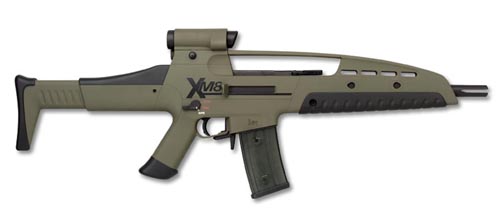
The Heckler & Koch XM8 is a lightweight assault rifle system developed from the late 1990s to early 2000s. The rifle was designed by German small arms manufacturer Heckler & Koch (H&K), and shares design and engineering with their G36 rifle.
The XM8 design was originally part of the Objective Individual Combat Weapon program (OICW), which was developing a "smart" grenade launcher system with an underslung carbine rifle. The system was unable to meet performance and weight requirements and was eventually canceled. In the aftermath, the two portions of the OICW were separated, resulting in the XM8 and XM25 projects.
While the XM8 was being considered by the United States Army as a potential standard infantry rifle, to replace the M4 carbine, this project was put on hold in April 2005, and was formally canceled on October 31 of that year. The weapon was adopted by the Royal Malaysian Navy for its PASKAL special forces.
The U.S. Army's purpose in contracting for this prototype weapon was to provide replacement options for the M16 rifle after the XM29 program ran into problems.[clarification needed] The goal was a weapon that was cheaper, lighter, and more effective than the M16 and M4 series of weapons. The XM8 was not just one weapon but a system which could be reconfigured with appropriate parts to be any one of several variants from a short-barreled personal defense weapon to a bipod-equipped support weapon. It also included an integrated optical sight and IR laser aiming module/illuminator.
The XM8 was based on the rifle module of Alliant Techsystems's XM29 OICW project, of which the weapon mechanisms were the responsibility of H&K. Following the indefinite delay of the Objective Individual Combat Weapon program, the U.S. Army requested that the contractors design stand-alone weapons from the XM29's kinetic energy and high explosive modules.
The first 30 XM8 prototypes were delivered by November 2003 for preliminary testing. Later, at least 200 developmental prototypes were procured. Among the complaints during testing was that the battery life was too low for the weapon's powered sight system and some ergonomics issues. Two other key issues were reducing the weapon's weight and increasing the heat resistance of the handguard, which would start to melt after firing too many rounds. The main testing was largely completed, and the army pushed for funding for a large field test. However, in 2004 Congress denied $26 million funding for 7,000 rifles to do a wide scale test fielding of the XM8 in 2005. At that time, the rifle still had developmental goals that were incomplete, primarily associated with the weapon's weight; the battery life had been extended, and a more heat-resistant plastic handguard added. The earliest product brochure lists the target weight for the carbine variant at 2.6 kg (5.7 lb) with the then current prototype at 2.8 kg (6.2 lb). The weight of the carbine prototype had since grown to 3.4 kg (7.5 lb) according to a brochure released by HK and General Dynamics in January 2005.
During the same period, the Army came under pressure from other arms makers[who?] to open up the XM8 to competition. The main argument was that the weapon that was being adopted was a substantially different system than for the original competition that ATK and H&K had actually won (see XM29). Other issues were that the army has a legislated obligation to prefer U.S.-based manufacturers, and that a previous agreement with Colt Defense required the army to involve Colt in certain small-arms programs. The XM8 program was put on hold in 2004. The exact reason why this happened is a matter of debate; some combination of the aforementioned technical issues, funding restrictions, and outside pressure being involved.
In 2005, the Army issued a formal Request for Proposals (RFP) for the OICW Increment One family of weapons. This RFP gave manufacturers six months to develop and deliver prototype weapons with requirements very similar to the XM8 capabilities, but with the addition of a squad automatic weapon (SAW) configuration. No XM8 prototypes have been shown that actually match the capabilities of the M249 (e.g. fast barrel replacement, high sustained rate of fire, belt feed). The OICW Increment One requirement for the SAW includes fast barrel replacement and high sustained rate of fire, but leaves the ammunition feed choice up to the manufacturer.
Heckler & Koch XM8
The Heckler & Koch XM8 is a lightweight assault rifle system developed from the late 1990s to early 2000s. The rifle was designed by German small arms manufacturer Heckler & Koch (H&K), and shares design and engineering with their G36 rifle.
The XM8 design was originally part of the Objective Individual Combat Weapon program (OICW), which was developing a "smart" grenade launcher system with an underslung carbine rifle. The system was unable to meet performance and weight requirements and was eventually canceled. In the aftermath, the two portions of the OICW were separated, resulting in the XM8 and XM25 projects.
While the XM8 was being considered by the United States Army as a potential standard infantry rifle, to replace the M4 carbine, this project was put on hold in April 2005, and was formally canceled on October 31 of that year. The weapon was adopted by the Royal Malaysian Navy for its PASKAL special forces.
The U.S. Army's purpose in contracting for this prototype weapon was to provide replacement options for the M16 rifle after the XM29 program ran into problems.[clarification needed] The goal was a weapon that was cheaper, lighter, and more effective than the M16 and M4 series of weapons. The XM8 was not just one weapon but a system which could be reconfigured with appropriate parts to be any one of several variants from a short-barreled personal defense weapon to a bipod-equipped support weapon. It also included an integrated optical sight and IR laser aiming module/illuminator.
The XM8 was based on the rifle module of Alliant Techsystems's XM29 OICW project, of which the weapon mechanisms were the responsibility of H&K. Following the indefinite delay of the Objective Individual Combat Weapon program, the U.S. Army requested that the contractors design stand-alone weapons from the XM29's kinetic energy and high explosive modules.
The first 30 XM8 prototypes were delivered by November 2003 for preliminary testing. Later, at least 200 developmental prototypes were procured. Among the complaints during testing was that the battery life was too low for the weapon's powered sight system and some ergonomics issues. Two other key issues were reducing the weapon's weight and increasing the heat resistance of the handguard, which would start to melt after firing too many rounds. The main testing was largely completed, and the army pushed for funding for a large field test. However, in 2004 Congress denied $26 million funding for 7,000 rifles to do a wide scale test fielding of the XM8 in 2005. At that time, the rifle still had developmental goals that were incomplete, primarily associated with the weapon's weight; the battery life had been extended, and a more heat-resistant plastic handguard added. The earliest product brochure lists the target weight for the carbine variant at 2.6 kg (5.7 lb) with the then current prototype at 2.8 kg (6.2 lb). The weight of the carbine prototype had since grown to 3.4 kg (7.5 lb) according to a brochure released by HK and General Dynamics in January 2005.
During the same period, the Army came under pressure from other arms makers[who?] to open up the XM8 to competition. The main argument was that the weapon that was being adopted was a substantially different system than for the original competition that ATK and H&K had actually won (see XM29). Other issues were that the army has a legislated obligation to prefer U.S.-based manufacturers, and that a previous agreement with Colt Defense required the army to involve Colt in certain small-arms programs. The XM8 program was put on hold in 2004. The exact reason why this happened is a matter of debate; some combination of the aforementioned technical issues, funding restrictions, and outside pressure being involved.
In 2005, the Army issued a formal Request for Proposals (RFP) for the OICW Increment One family of weapons. This RFP gave manufacturers six months to develop and deliver prototype weapons with requirements very similar to the XM8 capabilities, but with the addition of a squad automatic weapon (SAW) configuration. No XM8 prototypes have been shown that actually match the capabilities of the M249 (e.g. fast barrel replacement, high sustained rate of fire, belt feed). The OICW Increment One requirement for the SAW includes fast barrel replacement and high sustained rate of fire, but leaves the ammunition feed choice up to the manufacturer.
Recent media
Recent media