


Community hub
Recent from talks
Contribute something
Nothing was collected or created yet.
XGBoost
View on Wikipedia| XGBoost | |
|---|---|
 | |
| Developer | The XGBoost Contributors |
| Initial release | March 27, 2014 |
| Stable release | 3.0.0[1]  / 15 March 2025
 |
| Repository | |
| Written in | C++ |
| Operating system | Linux, macOS, Microsoft Windows |
| Type | Machine learning |
| License | Apache License 2.0 |
| Website | xgboost |
XGBoost[2] (eXtreme Gradient Boosting) is an open-source software library which provides a regularizing gradient boosting framework for C++, Java, Python,[3] R,[4] Julia,[5] Perl,[6] and Scala. It works on Linux, Microsoft Windows,[7] and macOS.[8] From the project description, it aims to provide a "Scalable, Portable and Distributed Gradient Boosting (GBM, GBRT, GBDT) Library". It runs on a single machine, as well as the distributed processing frameworks Apache Hadoop, Apache Spark, Apache Flink, and Dask.[9][10]
XGBoost gained much popularity and attention in the mid-2010s as the algorithm of choice for many winning teams of machine learning competitions.[11]
History
[edit]XGBoost initially started as a research project by Tianqi Chen[12] as part of the Distributed (Deep) Machine Learning Community (DMLC) group at the University of Washington. Initially, it began as a terminal application which could be configured using a libsvm configuration file. It became well known in the ML competition circles after its use in the winning solution of the Higgs Machine Learning Challenge. Soon after, the Python and R packages were built, and XGBoost now has package implementations for Java, Scala, Julia, Perl, and other languages. This brought the library to more developers and contributed to its popularity among the Kaggle community, where it has been used for a large number of competitions.[11]
It was soon integrated with a number of other packages making it easier to use in their respective communities. It has now been integrated with scikit-learn for Python users and with the caret package for R users. It can also be integrated into Data Flow frameworks like Apache Spark, Apache Hadoop, and Apache Flink using the abstracted Rabit[13] and XGBoost4J.[14] XGBoost is also available on OpenCL for FPGAs.[15] An efficient, scalable implementation of XGBoost has been published by Tianqi Chen and Carlos Guestrin.[16]
While the XGBoost model often achieves higher accuracy than a single decision tree, it sacrifices the intrinsic interpretability of decision trees. For example, following the path that a decision tree takes to make its decision is trivial and self-explained, but following the paths of hundreds or thousands of trees is much harder.
Features
[edit]Salient features of XGBoost which make it different from other gradient boosting algorithms include:[17][18][16]
- Clever penalization of trees
- A proportional shrinking of leaf nodes
- Newton Boosting
- Extra randomization parameter
- Implementation on single, distributed systems and out-of-core computation
- Automatic feature selection [citation needed]
- Theoretically justified weighted quantile sketching for efficient computation
- Parallel tree structure boosting with sparsity
- Efficient cacheable block structure for decision tree training
The algorithm
[edit]XGBoost works as Newton–Raphson in function space unlike gradient boosting that works as gradient descent in function space, a second order Taylor approximation is used in the loss function to make the connection to Newton–Raphson method.
A generic unregularized XGBoost algorithm is:
Input: training set , a differentiable loss function , a number of weak learners and a learning rate .


Algorithm:
- Initialize model with a constant value:[further explanation needed]
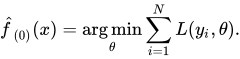
- Note that this is the initialization of the model and therefore we set a constant value for all inputs. So even if in later iterations we use optimization to find new functions, in step 0 we have to find the value, equals for all inputs, that minimizes the loss functions.
- For m = 1 to M:
- Compute the 'gradients' and 'hessians':[clarification needed]
- Fit a base learner (or weak learner, e.g. tree) using the training set
[clarification needed] by solving the optimization problem below: [clarification needed] - Update the model:
- Output
![{\displaystyle {\begin{aligned}{\hat {g}}_{m}(x_{i})&=\left[{\frac {\partial L(y_{i},f(x_{i}))}{\partial f(x_{i})}}\right]_{f(x)={\hat {f}}_{(m-1)}(x)}.\\{\hat {h}}_{m}(x_{i})&=\left[{\frac {\partial ^{2}L(y_{i},f(x_{i}))}{\partial f(x_{i})^{2}}}\right]_{f(x)={\hat {f}}_{(m-1)}(x)}.\end{aligned}}}](https://wikimedia.org/api/rest_v1/media/math/render/svg/d6910d303a248e157ba40a2c68755b29e084e19e)

![{\displaystyle {\hat {\phi }}_{m}={\underset {\phi \in \mathbf {\Phi } }{\arg \min }}\sum _{i=1}^{N}{\frac {1}{2}}{\hat {h}}_{m}(x_{i})\left[\phi (x_{i})-{\frac {{\hat {g}}_{m}(x_{i})}{{\hat {h}}_{m}(x_{i})}}\right]^{2}.}](https://wikimedia.org/api/rest_v1/media/math/render/svg/782e530a49c1ac15c45395cf538d13f873960e01)



Awards
[edit]- John Chambers Award (2016)[19]
- High Energy Physics meets Machine Learning award (HEP meets ML) (2016)[20]
See also
[edit]References
[edit]- ^ "Release 3.0.0 stable". 15 March 2025. Retrieved 4 May 2025.
- ^ "GitHub project webpage". GitHub. June 2022. Archived from the original on 2021-04-01. Retrieved 2016-04-05.
- ^ "Python Package Index PYPI: xgboost". Archived from the original on 2017-08-23. Retrieved 2016-08-01.
- ^ "CRAN package xgboost". Archived from the original on 2018-10-26. Retrieved 2016-08-01.
- ^ "Julia package listing xgboost". Archived from the original on 2016-08-18. Retrieved 2016-08-01.
- ^ "CPAN module AI::XGBoost". Archived from the original on 2020-03-28. Retrieved 2020-02-09.
- ^ "Installing XGBoost for Anaconda in Windows". IBM. Archived from the original on 2018-05-08. Retrieved 2016-08-01.
- ^ "Installing XGBoost on Mac OSX". IBM. Archived from the original on 2018-05-08. Retrieved 2016-08-01.
- ^ "Dask Homepage". Archived from the original on 2022-09-14. Retrieved 2021-07-15.
- ^ "Distributed XGBoost with Dask — xgboost 1.5.0-dev documentation". xgboost.readthedocs.io. Archived from the original on 2022-06-04. Retrieved 2021-07-15.
- ^ a b "XGBoost - ML winning solutions (incomplete list)". GitHub. Archived from the original on 2017-08-24. Retrieved 2016-08-01.
- ^ "Story and Lessons behind the evolution of XGBoost". Archived from the original on 2016-08-07. Retrieved 2016-08-01.
- ^ "Rabit - Reliable Allreduce and Broadcast Interface". GitHub. Archived from the original on 2018-06-11. Retrieved 2016-08-01.
- ^ "XGBoost4J". Archived from the original on 2018-05-08. Retrieved 2016-08-01.
- ^ "XGBoost on FPGAs". GitHub. Archived from the original on 2020-09-13. Retrieved 2019-08-01.
- ^ a b Chen, Tianqi; Guestrin, Carlos (2016). "XGBoost: A Scalable Tree Boosting System". In Krishnapuram, Balaji; Shah, Mohak; Smola, Alexander J.; Aggarwal, Charu C.; Shen, Dou; Rastogi, Rajeev (eds.). Proceedings of the 22nd ACM SIGKDD International Conference on Knowledge Discovery and Data Mining, San Francisco, CA, USA, August 13-17, 2016. ACM. pp. 785–794. arXiv:1603.02754. doi:10.1145/2939672.2939785. ISBN 9781450342322. S2CID 4650265.
- ^ Gandhi, Rohith (2019-05-24). "Gradient Boosting and XGBoost". Medium. Archived from the original on 2020-03-28. Retrieved 2020-01-04.
- ^ "Tree Boosting With XGBoost – Why Does XGBoost Win "Every" Machine Learning Competition?". Synced. 2017-10-22. Archived from the original on 2020-03-28. Retrieved 2020-01-04.
- ^ "John Chambers Award Previous Winners". Archived from the original on 2017-07-31. Retrieved 2016-08-01.
- ^ "HEP meets ML Award". Archived from the original on 2018-05-08. Retrieved 2016-08-01.