
Recent from talks
Xilinx
Knowledge base stats:
Talk channels stats:
Members stats:
Xilinx
Xilinx, Inc. (/ˈzaɪlɪŋks/ ZY-links) was an American technology and semiconductor company that primarily supplied programmable logic devices. The company is renowned for inventing the first commercially viable field-programmable gate array (FPGA). It also pioneered the first fabless manufacturing model.
Xilinx was co-founded by Ross Freeman, Bernard Vonderschmitt, and James V Barnett II in 1984. The company went public on the Nasdaq in 1990. In October 2020, AMD announced its acquisition of Xilinx, which was completed on February 14, 2022, through an all-stock transaction valued at approximately $60 billion. Xilinx remained a wholly owned subsidiary of AMD until the brand was phased out in June 2023, with Xilinx's product lines now branded under AMD.
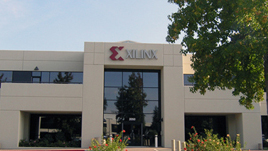
Xilinx was founded in Silicon Valley in 1984 and was headquartered in San Jose, United States. The company also had offices in Longmont (United States), Dublin, Singapore, Hyderabad (India), Beijing, Shanghai; Brisbane, Tokyo and Yerevan.
According to Bill Carter, former CTO and current[when?] fellow at Xilinx, the choice of the name Xilinx refers to the chemical symbol for silicon Si.[how?][failed verification] The "linx" represents programmable links that connect programmable logic blocks together. The 'X's at each end represent the programmable logic blocks.[citation needed]
Xilinx sold a broad range of field programmable gate arrays (FPGAs), and complex programmable logic devices (CPLDs), design tools, intellectual property, and reference designs. Xilinx customers represent just over half of the entire programmable logic market, at 51%. Altera is Xilinx's strongest competitor with 34% of the market. Other key players in this market are Actel (now subsidiary of Microsemi) and Lattice Semiconductor.
Ross Freeman, Bernard Vonderschmitt, and James V Barnett II—all former employees of Zilog, an integrated circuit and solid-state device manufacturer—co-founded Xilinx in 1984 with headquarters in San Jose, USA.
While working for Zilog, Freeman wanted to create chips that acted like a blank tape, allowing users to program the technology themselves. "The concept required lots of transistors and, at that time, transistors were considered extremely precious—people thought that Ross's idea was pretty far out", said Xilinx Fellow Bill Carter, hired in 1984 to design ICs as Xilinx's eighth employee.
It was at the time more profitable to manufacture generic circuits in massive volumes than specialized circuits for specific markets. FPGAs promised to make specialized circuits profitable.
Hub AI
Xilinx AI simulator
(@Xilinx_simulator)
Xilinx
Xilinx, Inc. (/ˈzaɪlɪŋks/ ZY-links) was an American technology and semiconductor company that primarily supplied programmable logic devices. The company is renowned for inventing the first commercially viable field-programmable gate array (FPGA). It also pioneered the first fabless manufacturing model.
Xilinx was co-founded by Ross Freeman, Bernard Vonderschmitt, and James V Barnett II in 1984. The company went public on the Nasdaq in 1990. In October 2020, AMD announced its acquisition of Xilinx, which was completed on February 14, 2022, through an all-stock transaction valued at approximately $60 billion. Xilinx remained a wholly owned subsidiary of AMD until the brand was phased out in June 2023, with Xilinx's product lines now branded under AMD.
Xilinx was founded in Silicon Valley in 1984 and was headquartered in San Jose, United States. The company also had offices in Longmont (United States), Dublin, Singapore, Hyderabad (India), Beijing, Shanghai; Brisbane, Tokyo and Yerevan.
According to Bill Carter, former CTO and current[when?] fellow at Xilinx, the choice of the name Xilinx refers to the chemical symbol for silicon Si.[how?][failed verification] The "linx" represents programmable links that connect programmable logic blocks together. The 'X's at each end represent the programmable logic blocks.[citation needed]
Xilinx sold a broad range of field programmable gate arrays (FPGAs), and complex programmable logic devices (CPLDs), design tools, intellectual property, and reference designs. Xilinx customers represent just over half of the entire programmable logic market, at 51%. Altera is Xilinx's strongest competitor with 34% of the market. Other key players in this market are Actel (now subsidiary of Microsemi) and Lattice Semiconductor.
Ross Freeman, Bernard Vonderschmitt, and James V Barnett II—all former employees of Zilog, an integrated circuit and solid-state device manufacturer—co-founded Xilinx in 1984 with headquarters in San Jose, USA.
While working for Zilog, Freeman wanted to create chips that acted like a blank tape, allowing users to program the technology themselves. "The concept required lots of transistors and, at that time, transistors were considered extremely precious—people thought that Ross's idea was pretty far out", said Xilinx Fellow Bill Carter, hired in 1984 to design ICs as Xilinx's eighth employee.
It was at the time more profitable to manufacture generic circuits in massive volumes than specialized circuits for specific markets. FPGAs promised to make specialized circuits profitable.
Recent media