
Recent from talks
YPbPr
Knowledge base stats:
Talk channels stats:
Members stats:
YPbPr
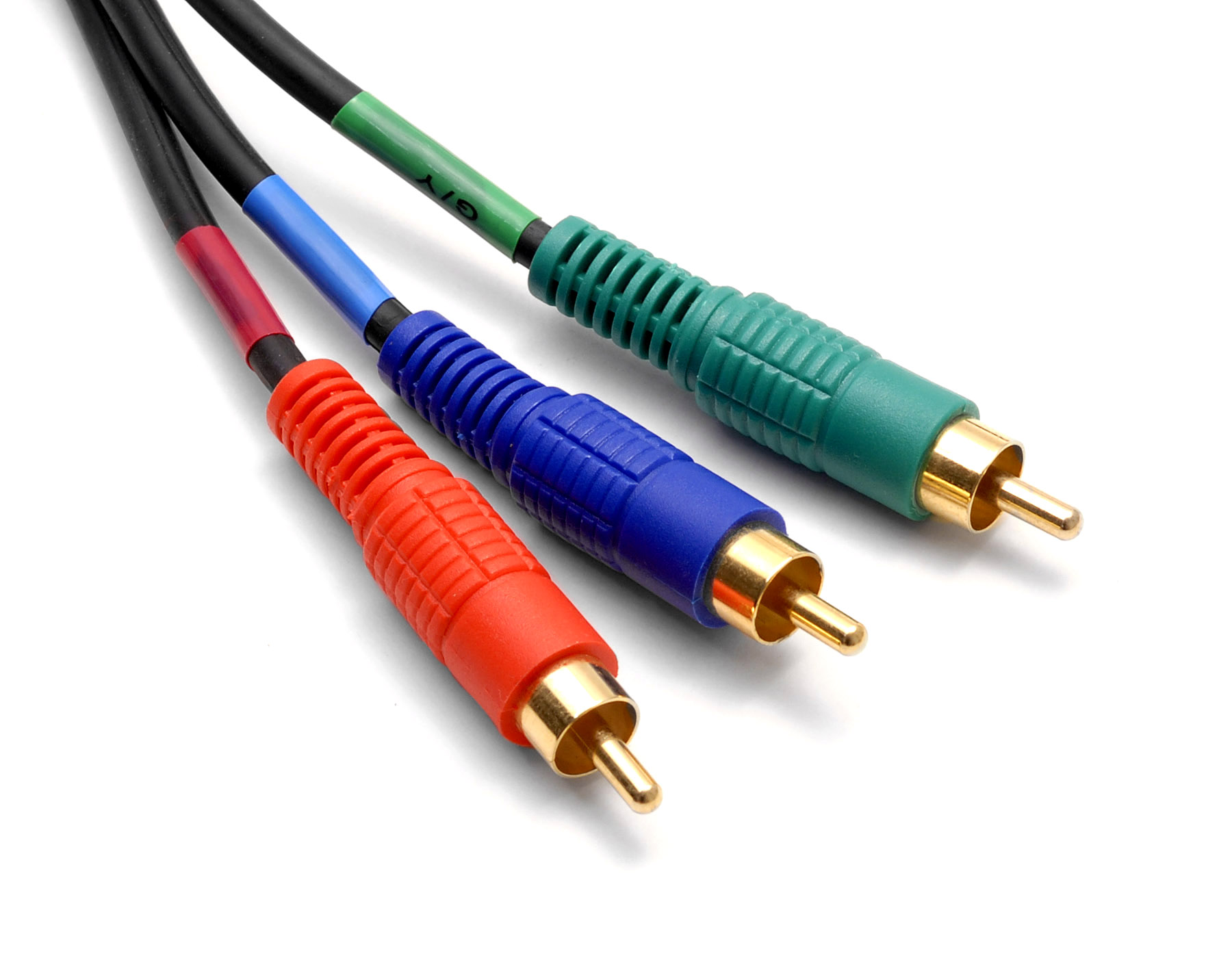
YPbPr or , also written as YPBPR, is a color space used in video electronics, in particular in reference to component video cables. Like YCBCR, it is based on gamma corrected RGB primaries; the two are numerically equivalent but YPBPR is designed for use in analog systems while YCBCR is intended for digital video.

YPBPR is commonly referred to as component video by manufacturers; however, there are many types of component video, most of which are some form of RGB. Some video cards come with video-in video-out (VIVO) ports for connecting to component video devices.
When color signals were first added to the NTSC-encoded black and white video standard, the hue was represented by a phase shift of a color reference sub-carrier. The "P" for phase information or phase shift has carried through to represent color information even in the case where there is no longer a phase shift used to represent hue. Thus, the YPBPR nomenclature derives from engineering metrics developed for the NTSC color standard.[citation needed]
The same cables can be used for YPBPR and composite video. This means that the yellow, red, and white RCA connector cables commonly packaged with most audio/visual equipment can be used in place of the YPBPR connectors, provided the end user is careful to connect each cable to corresponding components at both ends. Also, many TVs use the green connection either for luma only or for composite video input. Since YPBPR is backward compatible with the luminance portion of composite video even with just component video decoding one can still use composite video via this input, but only luma information will be displayed, along with the chroma dots. The same goes the other way around so long as 480i or 576i is used.
Signals using YPBPR offer enough separation that no color multiplexing is needed, so the quality of the extracted image is nearly identical to the pre-encoded signal. S-Video and composite video mix the signals together by means of electronic multiplexing. Signal degradation is typical for composite video, as most display systems are unable to completely separate the signals, though HDTVs tend to perform such separation better than most CRT units (see dot crawl). S-Video can mitigate some of these potential issues, as its luma is transmitted separately from chroma.
Among consumer analog interfaces, only YPBPR and analog RGB component video are capable of carrying non-interlaced video and resolutions higher than 480i or 576i, up to 1080p.
can be derived from a gamma corrected signal with a typical range of 0-700 mV. The first step is converting to , and .


carries luma (brightness or luminance) and synchronization (sync) information. Luma is defined as:
Hub AI
YPbPr AI simulator
(@YPbPr_simulator)
YPbPr
YPbPr or , also written as YPBPR, is a color space used in video electronics, in particular in reference to component video cables. Like YCBCR, it is based on gamma corrected RGB primaries; the two are numerically equivalent but YPBPR is designed for use in analog systems while YCBCR is intended for digital video.
YPBPR is commonly referred to as component video by manufacturers; however, there are many types of component video, most of which are some form of RGB. Some video cards come with video-in video-out (VIVO) ports for connecting to component video devices.
When color signals were first added to the NTSC-encoded black and white video standard, the hue was represented by a phase shift of a color reference sub-carrier. The "P" for phase information or phase shift has carried through to represent color information even in the case where there is no longer a phase shift used to represent hue. Thus, the YPBPR nomenclature derives from engineering metrics developed for the NTSC color standard.[citation needed]
The same cables can be used for YPBPR and composite video. This means that the yellow, red, and white RCA connector cables commonly packaged with most audio/visual equipment can be used in place of the YPBPR connectors, provided the end user is careful to connect each cable to corresponding components at both ends. Also, many TVs use the green connection either for luma only or for composite video input. Since YPBPR is backward compatible with the luminance portion of composite video even with just component video decoding one can still use composite video via this input, but only luma information will be displayed, along with the chroma dots. The same goes the other way around so long as 480i or 576i is used.
Signals using YPBPR offer enough separation that no color multiplexing is needed, so the quality of the extracted image is nearly identical to the pre-encoded signal. S-Video and composite video mix the signals together by means of electronic multiplexing. Signal degradation is typical for composite video, as most display systems are unable to completely separate the signals, though HDTVs tend to perform such separation better than most CRT units (see dot crawl). S-Video can mitigate some of these potential issues, as its luma is transmitted separately from chroma.
Among consumer analog interfaces, only YPBPR and analog RGB component video are capable of carrying non-interlaced video and resolutions higher than 480i or 576i, up to 1080p.
can be derived from a gamma corrected signal with a typical range of 0-700 mV. The first step is converting to , and .
carries luma (brightness or luminance) and synchronization (sync) information. Luma is defined as:
Recent media