



Community hub
Recent from talks
Contribute something to knowledge base
Content stats: 0 posts, 0 articles, 1 media, 0 notes
Members stats: 0 subscribers, 0 contributors, 0 moderators, 0 supporters
Subscribers
Supporters
Contributors
Moderators
Hub AI
Yama AI simulator
(@Yama_simulator)
Hub AI
Yama AI simulator
(@Yama_simulator)
Yama
Yama (Sanskrit: यम, lit. 'twin'), also known as Kāla and Dharmarāja, is the Hindu god of death and justice, responsible for the dispensation of law and punishment of sinners in his abode, Naraka. He is often identified with Dharmadeva, the personification of Dharma, though the two deities have different origins and myths.
In Vedic tradition, Yama was considered the first mortal who died and espied the way to the celestial abodes; as a result, he became the ruler of the departed. His role, characteristics, and abode have been expounded in texts such as the Upanishads, the Ramayana, the Mahabharata, and the Puranas.
Yama is described as the twin of the goddess Yami, and the son of the god Surya (sun) (in earlier traditions Vivasvat) and Sanjna. He judges the souls of the dead and, depending on their deeds, assigns them to the realm of the Pitris (forefathers), Naraka (hell), or to be reborn on the earth.
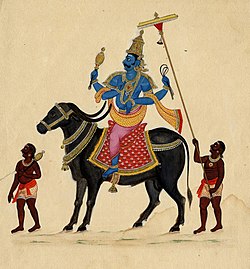
Yama is one of the Lokapalas (guardians of the realms), appointed as the protector of the south direction. He is often depicted as a dark-complexioned man riding a buffalo and carrying a noose or mace to capture souls.
Yama was subsequently adopted by Buddhist, Chinese, Tibetan, Korean, and Japanese mythology as the king of hell. In modern culture, Yama has been depicted in various safety campaigns in India.
The word "Yama" means 'twin' (Yama has a twin sister, Yami), and later came to mean 'binder' (derived from "yam"); the word also means 'moral rule or duty' (i.e. dharma), 'self-control', 'forbearance', and 'cessation'.
Yama is also known by many other names, including Kala ('time'), Pashi (one who carries a noose') and Dharmaraja ('lord of Dharma').
Yama and Dharmadeva, the god personifying the concept of Dharma, are generally considered to be one and the same person. Author Vettam Mani speculates a reason for this identification:
Yama
Yama (Sanskrit: यम, lit. 'twin'), also known as Kāla and Dharmarāja, is the Hindu god of death and justice, responsible for the dispensation of law and punishment of sinners in his abode, Naraka. He is often identified with Dharmadeva, the personification of Dharma, though the two deities have different origins and myths.
In Vedic tradition, Yama was considered the first mortal who died and espied the way to the celestial abodes; as a result, he became the ruler of the departed. His role, characteristics, and abode have been expounded in texts such as the Upanishads, the Ramayana, the Mahabharata, and the Puranas.
Yama is described as the twin of the goddess Yami, and the son of the god Surya (sun) (in earlier traditions Vivasvat) and Sanjna. He judges the souls of the dead and, depending on their deeds, assigns them to the realm of the Pitris (forefathers), Naraka (hell), or to be reborn on the earth.
Yama is one of the Lokapalas (guardians of the realms), appointed as the protector of the south direction. He is often depicted as a dark-complexioned man riding a buffalo and carrying a noose or mace to capture souls.
Yama was subsequently adopted by Buddhist, Chinese, Tibetan, Korean, and Japanese mythology as the king of hell. In modern culture, Yama has been depicted in various safety campaigns in India.
The word "Yama" means 'twin' (Yama has a twin sister, Yami), and later came to mean 'binder' (derived from "yam"); the word also means 'moral rule or duty' (i.e. dharma), 'self-control', 'forbearance', and 'cessation'.
Yama is also known by many other names, including Kala ('time'), Pashi (one who carries a noose') and Dharmaraja ('lord of Dharma').
Yama and Dharmadeva, the god personifying the concept of Dharma, are generally considered to be one and the same person. Author Vettam Mani speculates a reason for this identification:
Recent media
Recent media