Hubbry Logo
Yankee Pedlar InnYankee Pedlar InnMain
Open search
Yankee Pedlar Inn
Community hub
Yankee Pedlar Inn
logo
8 pages, 0 posts
0 subscribers
Be the first to start a discussion here.
Yankee Pedlar Inn
Yankee Pedlar Inn
from Wikipedia

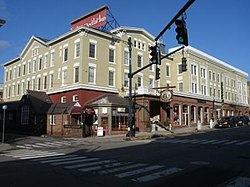
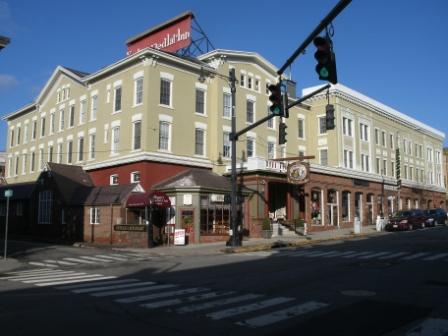
The Yankee Pedlar Inn on the corner of Main Street and Maiden Lane in Torrington, Connecticut.

The Yankee Pedlar Inn is a historic hotel located in Torrington, Connecticut, US. The inn, which now has 52 rooms, was built for its original owners, Frank and Alice Conley, in 1891. It was originally given a colonial New England architectural style.

The inn closed on 1 December 2015 for extensive renovations, which were expected to take 7–9 months to complete but subsequently stalled due to lack of funds. In September 2017, the property owner, Jayson Hospitality, said renovations would begin again that fall. "Residents and visitors will begin to see improvements to the beloved Yankee Pedlar this fall along with an anticipated re-open in the spring of 2018 under the umbrella of a Best Western Plus," a press release said.[1]

However, the inn never reopened and Jayson Hospitality was sued by the city of Torrington in order to reobtain the property. Jayson Hospitality gutted the building after it purchased it. Eventually, the city and the company came to an agreement that it must start work on its renovation project again in February 2024.[2]

History

[edit]

In November 1890, Frank Conley bought a 100 ft (30 m) by 214 ft (65 m) lot on the corner of Main Street and Maiden Lane for $8,000.[3] His wife, Alice, was a native of New England while he had immigrated to the United States from Ireland.

The couple used $40,000 to open the Conley Hotel. Alice was the manager while Frank worked as the hotel's operator. Throughout much of the first half of the 20th century, it was managed as a family business.

After the couple died, the hotel was taken over by their niece. It was later expanded and renovated after it was sold by the Conley family. Since then the inn has had many managers, owners, and employees including: Albert E.Rubens, Arthur Rubens, Carlo Pilatti, Alfred B. Siegrist and E.J. Kovak.

The business did not receive its name "The Yankee Pedlar Inn" until 1 March 1956, when the hotel was combined with the restaurant.[4] Along with the restaurant, the hotel also has a pub called Bogey's.

Paranormal activity

[edit]

The Yankee Pedlar Inn is notable for having many associations with the supernatural, particularly hauntings in various rooms of the establishment.[5] One of the inn's most haunted rooms is supposed to be room 353, where Alice Conley, the original owner, died.[6]

Due to the notoriety of the inn, the filmmaker Ti West shot the horror film The Innkeepers at the hotel.[6] The film was based entirely around the inn's supposed paranormal activity.[5]

References

[edit]

Bibliography

[edit]
Revisions and contributorsEdit on WikipediaRead on Wikipedia
from Grokipedia
The Yankee Pedlar Inn is a historic Victorian-era located at 93 Main Street in , originally constructed in 1891 as a 52-room establishment to serve as a premier lodging destination in the region's downtown area. Opened by proprietors Frank and Alice Conley under the name Conley Inn, the four-story building featured elegant colonial styling and quickly became a social hub, later expanding with a 1920 addition that functioned as a for female employees of local industries. Ownership transitioned in 1918 to the , and in 1948, the Rubens brothers acquired it, renaming it the Yankee Pedlar Inn in 1956 and managing it until 1987, during which it hosted notable figures including Admiral , actor , and musician . The inn gained further cultural prominence in the entertainment industry, serving as the primary filming location for the 2011 supernatural horror film The Innkeepers, directed by and starring and Pat Healy, which drew on the property's reputed haunted history involving ghostly apparitions and reported since the early 20th century. After continuous operation for over a century, the hotel closed in December 2015 following financial difficulties and was sold to Jayson Hospitality Group in 2014, which gutted the interior without completing promised renovations, leading to severe deterioration including roof leaks and structural damage. In July 2024, the Torrington Development Corporation assumed under state law (PA 19-92) to stabilize the , securing $60,000 for initial repairs and a $20,000 state grant for architectural assessment, with developer procurement—including the vetting of Parker Benjamin Real Estate as a prospective developer—and full revitalization plans advancing as of May 2025 to restore its role in downtown Torrington's economic revival.

Overview

Location and Setting

The Yankee Pedlar Inn is located at the corner of Main Street and Maiden Lane in Torrington, Connecticut, United States, at coordinates 41°48′09″N 73°07′18″W. This prominent urban position places it in the heart of the city's downtown commercial district, where it has long served as a visible landmark amid surrounding shops, offices, and historic buildings. Torrington, in Litchfield County, emerged as an industrial town during the 19th century, fueled by manufacturing industries that harnessed the power of the nearby Naugatuck River for mills and factories producing textiles, brass, and other goods. The area's economic expansion in the late 1800s transformed it from a small settlement into a bustling hub, with the inn's site integrating seamlessly into this vibrant commercial landscape as a hub for travelers and locals alike. The historical context of the inn's site underscores its urban significance: in November 1890, Irish immigrant Frank Conley purchased a 100-foot by 214-foot lot at this key intersection for $8,000, selecting the location for its accessibility and prominence along major thoroughfares. This strategic placement near the town's primary streets enhanced the inn's role as a central fixture in Torrington's developing , reflecting the era's growth in amid industrial prosperity.

Architectural Description

The Yankee Pedlar Inn is a three-story Victorian-style hotel constructed in using pallet brick with marble trim, exemplifying late-19th-century elegance in its design. Architect Robert Wakeman Hill designed the original structure to include 52 guest rooms and a prominent wraparound that wrapped the building's base, providing a welcoming entrance and contributing to its block-long footprint. Situated on a prominent corner at Main Street and Maiden Lane in , the inn's exterior facade is painted bright gold with white trim accents that emphasize its Victorian architectural details. Expansions completed between 1918 and 1920 approximately doubled the building's size while preserving its core historic features, including the addition of spaces originally intended for employee accommodations. The exterior retains key historical elements, such as the longstanding "Yankee Pedlar Inn" signage, which marks its identity on the corner lot.

History

Founding and Early Years

The Yankee Pedlar Inn, originally known as the Conley Inn, was established in downtown , amid the town's burgeoning industrial economy in the late . In November 1890, Irish immigrant Frank Conley acquired a lot at the corner of and Maiden Lane, where he and his wife, Alice, constructed a brick Victorian hotel designed to cater to the influx of travelers, businesspeople, and local residents drawn by Torrington's expanding manufacturing sector, including brass production and textiles. The inn opened on July 28, 1891, featuring 52 guest rooms equipped with modern amenities such as hot water, and was promoted as a first-class establishment rivaling any in the state. Under the Conley family's direct management, the inn quickly gained a reputation as a respectable and elegant destination, emphasizing New England hospitality and quality service to support the community's growth. Frank Conley served as the operator, while Alice played a pivotal role in daily management and culinary oversight, ensuring the hotel appealed to both transient visitors from nearby industries and long-term patrons. The establishment thrived in its early years, benefiting from Torrington's industrial boom that attracted workers and entrepreneurs, and it became a social hub for the area without any notable scandals, solidifying its status as a pillar of local respectability. The Conleys oversaw operations until Frank's death on March 17, 1910, followed by Alice's passing on August 22, 1910, marking the end of the founding era in the early . During this period, the inn maintained steady success, hosting a diverse clientele that reflected Torrington's economic vitality, though family management transitioned to relatives shortly after the founders' deaths. This foundational phase laid the groundwork for the property's as a key hospitality venue in northwestern .

Expansions and Renaming

In 1940, the Yankee Pedlar restaurant and bar was constructed adjacent to the existing hotel, significantly enhancing the property's role as a social and dining destination for the Torrington community and regional visitors. This addition complemented the inn's lodging facilities by providing a dedicated space for meals and gatherings, drawing in business travelers and locals alike and boosting its prominence in northwestern . The property was sold in 1956 to brothers Albert, , and Gerald Rubens, who integrated the with the nearby and renamed the combined establishment the Pedlar Inn to signify the unified operation and evoke the region's heritage. This rebranding marked a pivotal shift, solidifying the site's identity as a multifaceted venue. Throughout the 1950s and into subsequent decades, the Yankee Pedlar Inn benefited from targeted renovations that modernized its 52 rooms with updated plumbing and electrical systems. These improvements balanced contemporary functionality with the preservation of the inn's Victorian architectural features, including its brick facade and period interiors, ensuring its enduring appeal as a historic landmark.

Ownership Changes and Decline

Following the deaths of original owners Frank and Alice Conley in 1910, their niece Mary Tryon briefly managed the inn before selling it in 1912, marking the first major ownership transition after its founding as the Conley Inn. The property then changed hands multiple times in the ensuing decades, reflecting the challenges of sustaining a historic hotel in a changing economic landscape. After a in 1918, it was acquired by the , the city's largest employer, which oversaw a 1920 addition that served as a for female employees of local industries. In 1939, a group of local businessmen acquired the Conley Inn and added a called the Yankee Pedlar in 1940 to bolster its appeal. This ownership lasted until 1956, when the inn and were sold to the brothers, who formalized the name as The Yankee Pedlar Inn. The Rubens family owned and operated the inn until selling it to Baron Country Inns in 1988. During the mid-20th century under Rubens management, the property benefited from dedicated oversight, including chef Carlo Pilatti, who managed the kitchen from 1952 to 1962 and helped establish its reputation for quality dining among patrons. By the late 20th century, the inn grappled with mounting financial pressures, culminating in substantial tax delinquencies that reached over $164,000 by 1994, making it the town's top tax debtor at the time. In 1997, it was sold to Sanjay Patel and his family, who shifted focus toward attracting business travelers through updated amenities and marketing efforts to revive its status as a convenient stopover in Torrington. Entering the early , the ownership faced persistent economic headwinds, including a filing that prompted the 2014 sale to Jayson Hospitality for $650,000. The new proprietors announced plans for a affiliation and renovations to modernize the facility, but implementation faltered, leading to deferred maintenance, structural deterioration, and escalating financial strains by 2015.

Closure and Revival Efforts

The Yankee Pedlar Inn closed its doors on December 1, 2015, under the ownership of Jayson Hospitality, which had acquired the property the previous year, with plans for extensive renovations expected to last 7 to 9 months. The closure was intended to modernize the historic structure, including upgrades to meet contemporary hotel standards, but progress quickly faltered due to persistent funding shortages. By 2017, Jayson Hospitality announced that renovations would resume with a local contractor and targeted a spring 2018 reopening as a Plus franchise, but these plans never materialized amid ongoing financial difficulties. The City of Torrington initiated legal action in 2021, petitioning under a state statute for abandoned properties (PA 19-92) to appoint a receiver for stabilization and , following years of inaction that left the building gutted and deteriorating. Court proceedings included multiple extensions for the owners, such as a 2023 order granting until February 2024 to secure financing and install safety systems, but compliance remained incomplete. In July 2024, the city renewed its bid, leading to the Torrington Development Corporation (TDC) being appointed receiver later that year to oversee remediation efforts. By May 2025, the city identified a potential buyer and sought approval for the sale to facilitate revival, emphasizing preservation of the inn's historic elements while addressing blight. As of November 2025, the building remains vacant, with proceedings ongoing and no reopening achieved.

Facilities and Features

During its operational years until 2015, the Yankee Pedlar Inn featured 60 guest rooms, providing a mix of standard, deluxe, and suite accommodations. These rooms blended historical Victorian elements with modern conveniences, including antique furnishings and period decor that evoked the inn's 1891 origins. Room types varied to suit different guest needs, with options such as queen rooms, king suites equipped with sofa beds, and double rooms featuring two double beds. Standard rooms typically included , work desks, , heating, and private bathrooms with baths or showers. Suites offered additional space with seating areas and four-poster beds, while some accommodations across categories provided coffeemakers, microwaves, refrigerators, and working fireplaces for added comfort. Notable among the rooms was Room 353, a signature space with antique decor, a , and television amenities that highlighted the inn's charm. Room sizes ranged from cozy standards to more expansive deluxe options and suites, with many offering views of downtown Torrington and high ceilings characteristic of the building's . Daily and non-smoking rooms were standard, ensuring a clean and welcoming environment.

Dining and Public Spaces

The Yankee Pedlar Inn's dining facilities center around its historic restaurant, established in 1940 as an addition to the original structure, which provided fine dining options featuring American cuisine with a focus on New England influences. The restaurant served as a key venue for special occasions, including weddings and other celebrations, drawing local patrons for its elegant ambiance and menu selections that emphasized regional dishes like comfort foods prepared with fresh ingredients. Its role extended beyond daily meals to support the inn's function as a social hub in downtown Torrington. Adjacent to the main restaurant, Bogey's Pub offered a more relaxed atmosphere as the inn's casual bar space, characterized by historical decor reflecting the property's Victorian-era roots, including furnishings and period accents. The pub served drinks, light fare such as sandwiches and pub-style appetizers, and operated six days a week for and dinner, fostering a convivial setting for informal gatherings. It frequently hosted live music and entertainment, enhancing its appeal as a community spot for locals and visitors alike. The inn's public spaces also included dedicated conference rooms and banquet facilities, comprising two halls that together provided approximately 1,200 square feet of event space, capable of accommodating up to 120 guests for meetings, receptions, and larger functions. These areas underscored the Yankee Pedlar Inn's longstanding position as a versatile community venue, supporting corporate events, social banquets, and private parties within its historic framework.

Paranormal Claims

Reported Phenomena

Guests and employees at the Yankee Pedlar Inn have frequently reported electrical anomalies, such as lights and televisions turning on and off without human intervention. Doors opening and closing independently, sometimes slamming shut, have also been documented, including multiple instances observed by filmmaker during the 2011 production of The Innkeepers. Sudden cold spots in hallways and guest rooms are commonly described, often paired with an unexplained sense of unease or presence. Apparitions of indistinct figures have been sighted throughout the property, with some accounts describing sightings in mirrors or peripheral vision that vanish upon direct attention. Elevator malfunctions, including the lift operating and ascending floors without passengers or visible operators, have been recounted by staff members. Objects moving unaided, such as chairs rocking in the lobby or items shifting in rooms, contribute to poltergeist-like activity, particularly noted by employees in the kitchen and bar areas. These phenomena reportedly intensify during renovations or periods of low occupancy, when the inn falls quiet. Guest complaints and staff logs of such events date back to at least the 1970s, with many concentrated around Room 353.

Associated Ghosts and Legends

The Yankee Pedlar Inn is steeped in folklore involving several rumored spirits, with the most prominent legend centering on Alice Conley, one of the inn's original owners. According to local tradition, Conley died in Room 353 in 1910, and her apparition is frequently described as a woman in Victorian dress who appears to guests, sometimes folding linens as if maintaining the property she cherished during her lifetime. This tale portrays her as a protective figure, roaming the halls to oversee the inn's operations, a narrative that has persisted since the early 20th century and gained traction following paranormal investigations linking anomalous activity in Room 353 to the Conleys. Additional legends feature other entities tied to the inn's long history. Reports describe the of a little , said to wander in search of her mother, possibly stemming from a tragic incident involving a past guest or resident during the inn's early years. In the lobby, sightings of a man in a —potentially a representation of a formal 19th-century visitor or staff member—have been recounted, adding to the atmosphere of Victorian-era hauntings. Shadowy figures are also part of the lore in the restaurant area, often interpreted as remnants of former patrons or servants from the inn's operational peak in the mid-20th century. These hauntings are broadly attributed to the inn's age and history of tragic events, including guest deaths and the structure's evolution from the Conley Inn in 1891 to its renaming in 1956, when stories of restless spirits began to circulate more widely among locals and travelers. Legends occasionally invoke pre-Civil War influences due to the site's location in historic Torrington, though the building postdates that era, suggesting embellishments over time to emphasize otherworldly ties to Connecticut's colonial past. The folklore has evolved since the 1920s, amplified by the inn's role in popular culture and repeated paranormal probes that reinforce beliefs in lingering presences from its foundational decades.

Cultural Significance

In Film and Media

The Yankee Pedlar Inn served as the primary filming location and direct inspiration for the 2011 supernatural horror film The Innkeepers, written and directed by . Shot entirely on-site in 2010, the movie portrays the inn's final weekend of operation through the eyes of two employees obsessed with its haunted history, capturing the property's aged and rumored spectral occurrences to heighten the atmosphere of dread. West drew from personal experiences staying at the inn during production of his prior film , where staff shared tales of ghostly activity that fueled the screenplay. The inn has also featured in paranormal television programming, including investigations by teams associated with Ghost Hunters, which explored reports of apparitions and unexplained phenomena during an overnight event in 2013 that combined historical lectures, film screenings, and on-site probes. Its eerie legacy has received coverage in books and articles, such as Haunted Litchfield County by Thomas D'Agostino and Arlene Nicholson, which details persistent guest encounters with restless spirits refusing to vacate certain rooms. These portrayals amplified the inn's haunted allure, boosting pre-closure tourism via media-tied events like film screenings and paranormal gatherings that attracted filmmakers, investigators, and enthusiasts seeking immersive experiences with its lore.

Recognition and Legacy

The Yankee Pedlar Inn has gained recognition as one of America's hotels, with outlets such as i95 ROCK highlighting its reputation based on reports of ghostly activity, including self-closing doors and shadowy figures in room 353. It is frequently featured in 's haunted promotions, such as the "" series by FOX61, which in 2025 emphasized its enduring draw for visitors exploring the state's sites. This status has positioned the inn as a key stop in regional haunted trails, contributing to Litchfield County's narrative of historic eerie landmarks. Historically, the inn holds significance as a preserved local landmark within Torrington's Downtown Historic District, classified as a National Historic District in 1988, and as a contributing property in the Downtown Torrington Historic District, added to the National Register of Historic Places in 1988 for its architectural and cultural value dating back to its 1891 origins as the Conley Inn. Efforts to further integrate it into national preservation initiatives were complicated by its closure in 2015 and subsequent vacancy, which led to structural deterioration and legal challenges, including a 2024 receivership filing by the city. However, as of 2025, Torrington has pioneered the use of a new state preservation law to stabilize the building, marking the first such application in Connecticut and underscoring ongoing commitments to its historic role. In May 2025, the Torrington Development Corporation identified a potential buyer for the property and sought court approval for the sale, with the process ongoing as of November 2025. Since its 2015 closure, the inn's legacy has persisted through sustained interest from urban explorers and paranormal investigation groups, such as the Worcester Paranormal team, who accessed the site in 2021 to document reported anomalies. The abandoned property continues to attract visitors drawn to its haunted lore, as noted in 2025 media coverage, influencing local tourism by reinforcing Torrington's identity as a hub for history and heritage exploration. This enduring fascination, amplified briefly by its role as the setting for the 2011 film The Innkeepers, sustains public engagement with the site even amid its vacancy.

References

Add your contribution
Related Hubs
User Avatar
No comments yet.