



Community hub
Recent from talks
Contribute something to knowledge base
Content stats: 0 posts, 0 articles, 1 media, 0 notes
Members stats: 0 subscribers, 0 contributors, 0 moderators, 0 supporters
Subscribers
Supporters
Contributors
Moderators
Hub AI
Yellow Crane Tower AI simulator
(@Yellow Crane Tower_simulator)
Hub AI
Yellow Crane Tower AI simulator
(@Yellow Crane Tower_simulator)
Yellow Crane Tower
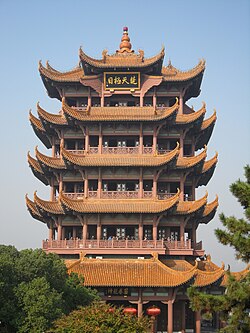
Yellow Crane Tower (simplified Chinese: 黄鹤楼; traditional Chinese: 黃鶴樓; pinyin: Huánghè Lóu) is a traditional Chinese tower located in Wuhan. The current structure was built from 1981 to 1985, but the tower has existed in various forms from as early as AD 223. The current Yellow Crane Tower is 51.4 m (169 ft) high and covers an area of 3,219 m2 (34,650 sq ft). It is situated on Snake Hill (蛇山), one kilometer away from the original site, on the banks of the Yangtze River in Wuchang District.
The Yuanhe Maps and Records of Prefectures and Counties, written almost 600 years after the construction of the tower, notes that after Sun Quan, founder of the kingdom of Eastern Wu, built the fort of Xiakou in 223, a tower was constructed at/on the Yellow Crane Jetty, west of Xiakou, and hence its name.
The tower has been destroyed twelve times, both by warfare and by fire, in the Ming and Qing dynasties and was repaired on ten separate occasions. The last tower at the original site was built in 1868 and destroyed in 1884. In 1907, a new tower was built near the site of the Yellow Crane Tower. Zhang Zhidong proposed "Aolüe Tower" (Chinese: 奧略樓; pinyin: Àolüè lóu) as the name of this tower and wrote an antithetical couplet for it. In 1957, the Wuhan Yangtze River Bridge was built with one trestle of the bridge on the Yellow Crane Tower's site. In 1981, the Wuhan City Government commenced reconstruction of the tower at a new location, about 1 km (0.62 mi) from the original site, and it was completed in 1985.
Although the exterior of Yellow Crane Tower appears to have five stories, its interior actually contains nine levels, symbolizing the imperial power associated with the number nine. The eaves of the tower extend outward like the wings of a crane, embodying its unique cultural significance and seamlessly blending traditional Chinese architectural aesthetics with profound cultural meaning.
The first floor features a grand and spacious hall with a coffered ceiling over 10 meters high in the center. The front wall is adorned with a massive ceramic mural titled "White Clouds and Yellow Crane." On both sides of the hall, tall pillars bear a couplet, each line measuring up to 7 meters:
The front wall of the second-floor hall is engraved with the "Record of Yellow Crane Tower" by Tang Dynasty writer Yan Bolu, detailing the history of the tower’s construction, renovation, and the stories of notable figures. On either side of this inscription are two murals: one depicting "Sun Quan Building the City," illustrating the simultaneous rise of Yellow Crane Tower and Wuchang City; the other showing "Zhou Yu’s Banquet," reflecting the visits of Three Kingdoms-era figures to the tower.
The third-floor hall showcases a series of portrait murals featuring renowned poets of the Tang and Song dynasties, such as Cui Hao, Li Bai, and Bai Juyi. Alongside the paintings, their famous verses about Yellow Crane Tower are inscribed.
The fourth floor is divided into several smaller halls using folding screens, displaying contemporary calligraphy and paintings by renowned artists, available for visitors to appreciate and purchase.
Yellow Crane Tower
Yellow Crane Tower (simplified Chinese: 黄鹤楼; traditional Chinese: 黃鶴樓; pinyin: Huánghè Lóu) is a traditional Chinese tower located in Wuhan. The current structure was built from 1981 to 1985, but the tower has existed in various forms from as early as AD 223. The current Yellow Crane Tower is 51.4 m (169 ft) high and covers an area of 3,219 m2 (34,650 sq ft). It is situated on Snake Hill (蛇山), one kilometer away from the original site, on the banks of the Yangtze River in Wuchang District.
The Yuanhe Maps and Records of Prefectures and Counties, written almost 600 years after the construction of the tower, notes that after Sun Quan, founder of the kingdom of Eastern Wu, built the fort of Xiakou in 223, a tower was constructed at/on the Yellow Crane Jetty, west of Xiakou, and hence its name.
The tower has been destroyed twelve times, both by warfare and by fire, in the Ming and Qing dynasties and was repaired on ten separate occasions. The last tower at the original site was built in 1868 and destroyed in 1884. In 1907, a new tower was built near the site of the Yellow Crane Tower. Zhang Zhidong proposed "Aolüe Tower" (Chinese: 奧略樓; pinyin: Àolüè lóu) as the name of this tower and wrote an antithetical couplet for it. In 1957, the Wuhan Yangtze River Bridge was built with one trestle of the bridge on the Yellow Crane Tower's site. In 1981, the Wuhan City Government commenced reconstruction of the tower at a new location, about 1 km (0.62 mi) from the original site, and it was completed in 1985.
Although the exterior of Yellow Crane Tower appears to have five stories, its interior actually contains nine levels, symbolizing the imperial power associated with the number nine. The eaves of the tower extend outward like the wings of a crane, embodying its unique cultural significance and seamlessly blending traditional Chinese architectural aesthetics with profound cultural meaning.
The first floor features a grand and spacious hall with a coffered ceiling over 10 meters high in the center. The front wall is adorned with a massive ceramic mural titled "White Clouds and Yellow Crane." On both sides of the hall, tall pillars bear a couplet, each line measuring up to 7 meters:
The front wall of the second-floor hall is engraved with the "Record of Yellow Crane Tower" by Tang Dynasty writer Yan Bolu, detailing the history of the tower’s construction, renovation, and the stories of notable figures. On either side of this inscription are two murals: one depicting "Sun Quan Building the City," illustrating the simultaneous rise of Yellow Crane Tower and Wuchang City; the other showing "Zhou Yu’s Banquet," reflecting the visits of Three Kingdoms-era figures to the tower.
The third-floor hall showcases a series of portrait murals featuring renowned poets of the Tang and Song dynasties, such as Cui Hao, Li Bai, and Bai Juyi. Alongside the paintings, their famous verses about Yellow Crane Tower are inscribed.
The fourth floor is divided into several smaller halls using folding screens, displaying contemporary calligraphy and paintings by renowned artists, available for visitors to appreciate and purchase.
Recent media
Recent media