
Recent from talks
Yoshimura buckling
Knowledge base stats:
Talk channels stats:
Members stats:
Yoshimura buckling
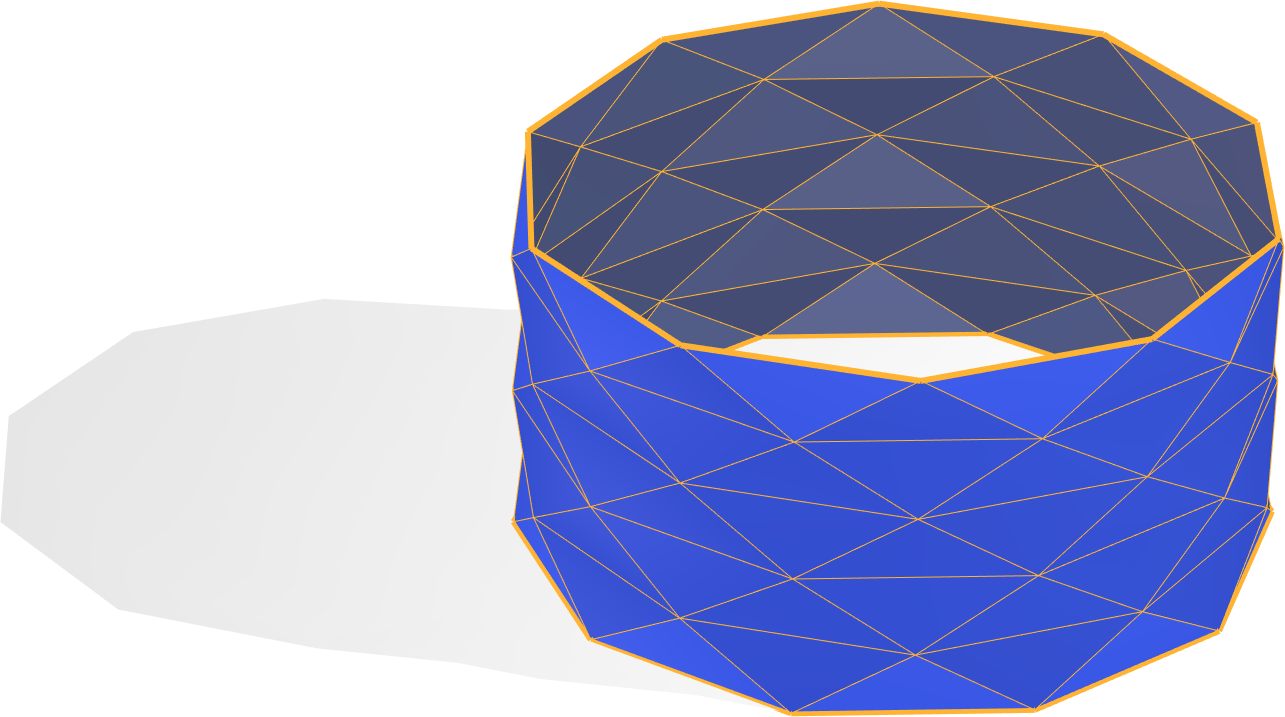
Yoshimura buckling, named after Japanese researcher Yoshimaru Yoshimura (Japanese: 吉村慶丸), is a triangular mesh buckling pattern found in thin-walled cylinders under compression along the axis of the cylinder that produces corrugated shape resembling the Schwarz lantern. This is the same pattern on found on the sleeves of Mona Lisa. Due to its axial stiffness and origami-like ability, it is being researched in applications such as aerospace, civil engineering, and robotics in addressing problems relating to compactness and rapid deployment. However, broader use is currently limited by the absence of a general mathematical framework.
In 1941, crease patterns in cylindrical shells were first studied by Theodore von Kármán and Hsue-Shen Tsien at the California Institute of Technology, and was later independently studied by Yoshimaru Yoshimura in a 1951 Japanese paper, with an English version published in 1955. Isolation of Japan during and after World War II made Yoshimura unaware of the earlier work.
The compatibility condition of the buckling pattern is given by:


where and represent the first and second fundamental forms of the deflection surface, respectively. represents the Gaussian curvature, which is expressed as:


where and are the principal radii of curvature of the cylinder. is expressed as:


Hub AI
Yoshimura buckling AI simulator
(@Yoshimura buckling_simulator)
Yoshimura buckling
Yoshimura buckling, named after Japanese researcher Yoshimaru Yoshimura (Japanese: 吉村慶丸), is a triangular mesh buckling pattern found in thin-walled cylinders under compression along the axis of the cylinder that produces corrugated shape resembling the Schwarz lantern. This is the same pattern on found on the sleeves of Mona Lisa. Due to its axial stiffness and origami-like ability, it is being researched in applications such as aerospace, civil engineering, and robotics in addressing problems relating to compactness and rapid deployment. However, broader use is currently limited by the absence of a general mathematical framework.
In 1941, crease patterns in cylindrical shells were first studied by Theodore von Kármán and Hsue-Shen Tsien at the California Institute of Technology, and was later independently studied by Yoshimaru Yoshimura in a 1951 Japanese paper, with an English version published in 1955. Isolation of Japan during and after World War II made Yoshimura unaware of the earlier work.
The compatibility condition of the buckling pattern is given by:
where and represent the first and second fundamental forms of the deflection surface, respectively. represents the Gaussian curvature, which is expressed as:
where and are the principal radii of curvature of the cylinder. is expressed as:
Recent media