Hubbry Logo
YtterbyYtterbyMain
Open search
Ytterby
Community hub
Ytterby
logo
8 pages, 0 posts
0 subscribers
Be the first to start a discussion here.
Ytterby
Ytterby
from Wikipedia
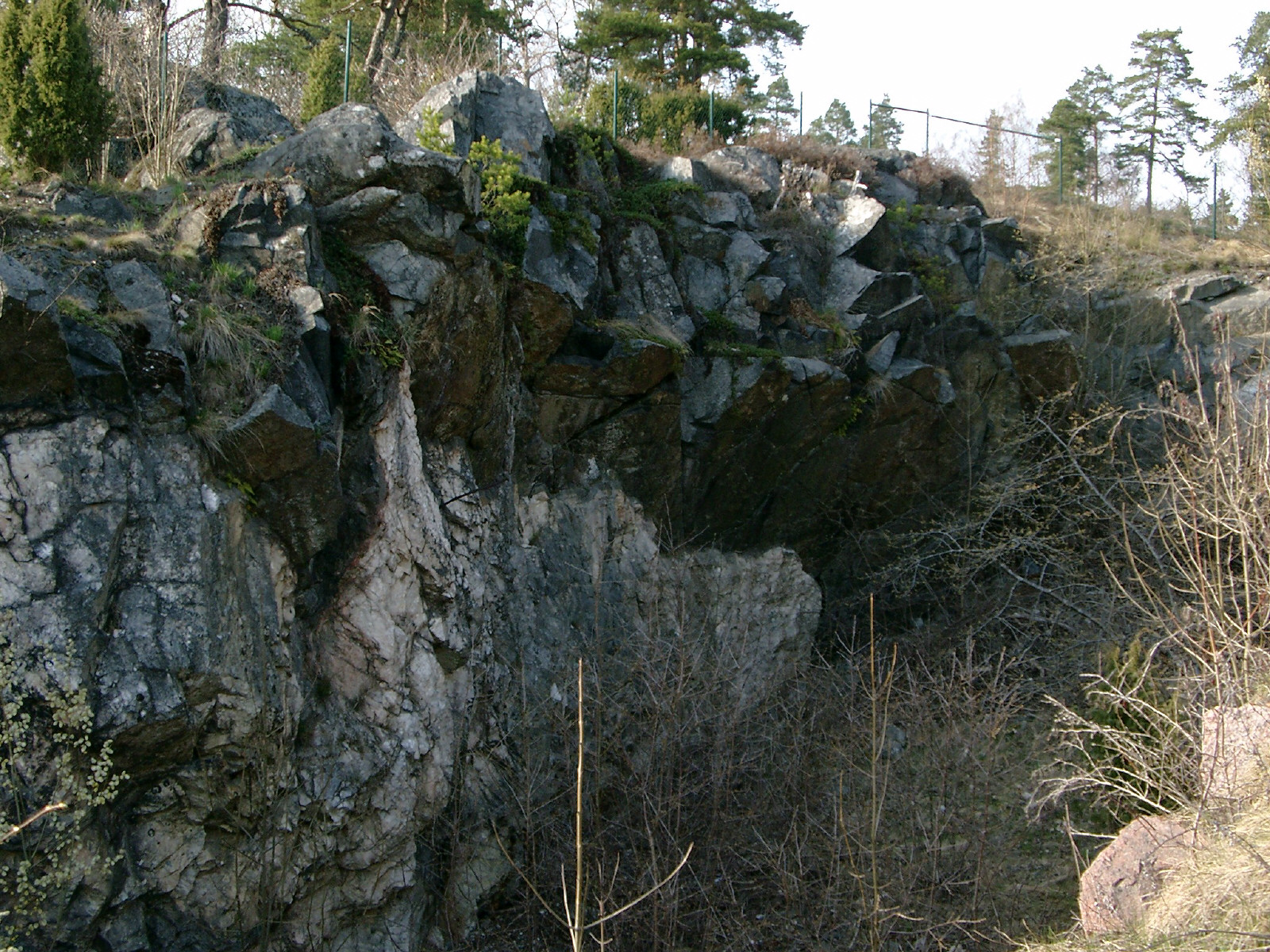
Ytterby quarry
Terbiumvägen (Terbium Road) and Gruvvägen (Mine Road) close to the Ytterby mine (59°25′35″N 18°21′13″E / 59.4265°N 18.3535°E / 59.4265; 18.3535 (Ytterby mine))

Ytterby (Swedish pronunciation: [ˈʏ̂tːɛrˌbyː]) is a village on the Swedish island of Resarö, in Vaxholm Municipality in the Stockholm archipelago. Today the residential area is dominated by suburban homes.[1]

The swedish name of the village translates literally into "outer village".[2] Ytterby is the single richest source of elemental discoveries in the world; the chemical elements yttrium (Y), terbium (Tb), erbium (Er), and ytterbium (Yb) are all named after Ytterby, and the elements holmium (Ho), scandium (Sc), thulium (Tm), tantalum (Ta), and gadolinium (Gd) were also first discovered there.

Local roads connect Ytterby to county road 274 [sv] and hence the mainland. Except for the winter months, passenger ships of the Waxholmsbolaget call at a pier in Ytterby, providing a connection to Vaxholm town and Stockholm.[1][3][4][5] Ytterby is as well served by several local bus lines of the north east SL district, connecting the area directly to Stockholms Östra station.[6]

Mine

[edit]

Quartz was mined in the area beginning in the 1600s for the ironworks in Uppland.[7] Feldspar was mined for local porcelain manufacture, such as Gustavsberg, and the porcelain trade with Britain and Poland.[8] The mine is likely the first feldspar mine in Sweden, starting in 1790. Feldspar mining was likely sporadic and based on manufacture demand. This demand increased in the 1860s, leading to deeper mining efforts at Ytterby. The mine became one of the most productive quartz and feldspar mines in the country.[9] Feldspar and quartz mining continued until 1933, when the mine was shut down. With 177 years of feldspar mining, it was the longest-mined feldspar mine in Sweden.

Towards the end of the 1940s, the Swedish state, through the REF (Riksnämnden för ekonomisk försvarsberedskap) became interested in the possible usage of the mine. In 1953, the mine was renovated and used for the storage of jet fuel, MC 77. The storage method led to contamination of the jet fuel, leading to problems in jet engines that used the fuel. The storage of jet fuel ended in 1978. It was subsequently used to store diesel. In 1995, the mine was emptied, and in the following years the area was rehabilitated.[9]

The mined quartz and feldspar are part of a pegmatite dyke that has a NNE-SSW orientation and a dip of 60° to the west.[10] The pegmatite dyke include sections of aplite and graphic granite.[10] The surrounding host rock is "gabbro-like greenstone".[10]

Chemical discoveries

[edit]
Plaque of the ASM International society at the entrance of Ytterby mine

The mine's elemental history began in 1787, when Lieutenant Carl Axel Arrhenius found an unidentified black mineral. He had previously explored the area for a potential fortification.[9] His hobby interest in chemistry led him to notice the unusually heavy black rock, which he and his friend Bengt Geijer examined with Sven Rinman. It was not until 1794 that Finnish chemist Johan Gadolin fully analysed the mineral and found that 38% of its composition was a new, unidentified earth element. Swedish chemist Anders Gustaf Ekeberg confirmed the discovery the following year and named it yttria, with the mineral named gadolinite.[11]

Many rare earth elements were discovered in the mineral gadolinite, which eventually proved to be the source of seven new elements that were named after the mineral ore and the area. These elements include yttrium (Y), erbium (Er), terbium (Tb) and ytterbium (Yb)[2] and were first described in 1794, 1843, 1843, and 1878, respectively. In 1989 the ASM International society installed a plaque at the former entrance to the mine, commemorating the mine as a historical landmark.[12]

In addition, scandium (Sc)[citation needed] and three other lanthanidesholmium (Ho, named after Stockholm), thulium (Tm, named after Thule, a mythic analogue of Scandinavia), and gadolinium (Gd, after the chemist Johan Gadolin)—can trace their discovery to the same quarry.[13] The transition metal tantalum (Ta, after the Greek mythological figure Tantalus) was also discovered in a mineral sample from Ytterby in 1802.[14]

The European Chemical Society gave the Ytterby mine and the industrial complex of ABEA, Crete, Greece its Historical Landmarks Awards for 2018.[15]

See also

[edit]

References

[edit]
[edit]
Revisions and contributorsEdit on WikipediaRead on Wikipedia
from Grokipedia
Ytterby is a small locality on the island of Resarö in Vaxholm Municipality, , , situated in the and best known for its historic mine, which served as the for the discovery of several rare earth elements between the late 18th and early 20th centuries. The mining operations at Ytterby began in the , initially extracting for use in iron production, and later shifted in the 18th and 19th centuries to , which was quarried for the ceramics and industries. The quarry remained active until 1933, after which it was repurposed by the Swedish for fuel storage until 1995, and today the site is sealed off and appears as a modest , preserved as a historical with no ongoing extraction. Ytterby's geological significance stems from its rich deposits of (originally called ytterbite), a black containing high concentrations of s, which proved exceptionally challenging to separate due to their chemical similarities. In 1787 or 1789, lieutenant Carl Axel Arrhenius discovered samples of this near the village and sent them for analysis, leading Finnish Johan Gadolin to isolate yttria (the of ) in 1794 from a specimen, marking the first identification of a ; Anders Gustaf Ekeberg subsequently confirmed the findings and renamed the mineral in Gadolin's honor. Over the following century, further separations from Ytterby gadolinite yielded additional elements, including , , and —all directly named after the locality—along with contributions to the isolation of , , , , , and (named after Gadolin). These discoveries, completed by 1907, provided crucial evidence supporting Dmitri Mendeleev's periodic table and established Ytterby as the single richest site for naturally occurring elemental discoveries on Earth, with four elements bearing its name. Today, Ytterby remains a quiet integrated into the broader Resarö community, with streets named after the elements and associated with the mine, and a nearby mineral exhibit highlights its legacy in chemistry and geology. The rare earth elements first isolated here are now essential in modern technologies, including electronics, lasers, and alloys, underscoring the site's enduring scientific impact.

Geography and Location

Archipelago Setting

Ytterby occupies a position at approximately 59°25′36″N 18°21′11″E on the of Resarö, within Municipality in the , a vast network of over 30,000 s, islets, and skerries stretching into the east of . This setting places Ytterby on the eastern headland of Resarö, a modestly sized characterized by undulating terrain shaped by glacial activity and bedrock formations. The archipelago's marine environment influences the local , with mild summers and cold, ice-prone winters that affect accessibility, while the surrounding waters contribute to a humid, temperate supporting diverse and typical of the . The name "Ytterby" derives from Old Swedish terms meaning "outer village" or "outer farmstead," reflecting its historically peripheral location relative to mainland settlements and other inner-island communities in the . This underscores Ytterby's remote yet integral role within the fragmented geography of Resarö, where the village nestles amid forested hills and rocky shores. The island's geology features greenstone as a prominent host rock, particularly gabbroic varieties that form bands across the , providing a stable foundation interspersed with veins exposed by natural and historical quarrying. Access to Ytterby relies on a combination of land and sea routes, with local roads linking the village to County Road 274 and the mainland via bridges to nearby islands. Public buses operated by provide regular service to the Ytterby stop, facilitating connections from and , though the final approach often involves a short walk along Ytterbyvägen. For maritime travel, Waxholmsbolaget ferries serve the Ytterby Brygga jetty year-round, departing from central terminals, but schedules thin out during winter months when ice cover limits operations.

Village Layout

Ytterby functions as a suburban within Municipality, characterized by a predominance of single-family homes situated on plots averaging around 1,000 square meters. This low-density arrangement fosters a serene environment in a compact, community-oriented setting that emphasizes private green spaces and minimal urban development. Ytterby is a small within Resarö, which had approximately 3,212 residents as of 2020. The village's layout centers on local roads such as Ytterbyvägen, which provide direct access to key landmarks including the historic Ytterby mine site, located just within walking distance from residential clusters. integration is facilitated by SL bus line 682, offering reliable connections from Ytterby Resarö to central , with current schedules (as of November 2025) including multiple daily departures during peak hours for commuters. Infrastructure supports everyday needs through the Ytterby (Resarö) Brygga ferry terminal, where Waxholmsbolaget operates passenger services year-round linking the village to and , though schedules are reduced during winter months due to ice cover. Residents benefit from seamless access to Vaxholm Municipality services, encompassing education at nearby schools, healthcare facilities, and essential utilities like water and waste management, ensuring the village's self-sufficiency despite its small scale.

Historical Development

Pre-Mining Period

Ytterby, a village on the island of Resarö in the , likely traces its origins to small-scale settlements dating back to the , around the 8th to 11th centuries, when communities began establishing outposts in the region for fishing and agrarian purposes. These early inhabitants relied on the surrounding waters and limited , forming part of a broader pattern of island-based subsistence economies in the archipelago. The name "Ytterby" derives from Old Swedish words "ytter," meaning "outer," and "by," meaning "village" or "farmstead," reflecting its position as a remote settlement on the periphery of the relative to the mainland. This underscores the village's cultural context within traditional Scandinavian naming conventions, which often denoted geographical isolation or distance from central areas. Prior to the , activities in Ytterby centered on subsistence fishing and small-scale agriculture, with no documented resource extraction. As part of the socio-economic fabric of the , Ytterby existed under the broader influences of nearby , a key hub for , , and later military activities that shaped from onward. This traditional island community, characterized by self-sufficient households and seasonal maritime pursuits, set the stage for gradual shifts toward resource exploitation in the .

Mining and Industrial Era

Mining in Ytterby began with extraction in the 1600s, primarily to supply and iron works, with the first reliable appearing in 1756. mining commenced around 1790, focusing on red , and continued alongside operations for over 140 years, marking the site as one of Sweden's earliest mines. The operations spanned a total of 177 years until the mine's closure in due to declining demand and economic viability. The mine served as the primary economic driver for Ytterby, employing local workers and exporting and to support Sweden's burgeoning ceramics and industries, including major producers like Rörstrand porcelain factory, which owned the site from the 1850s to 1926. Peak activity occurred in the , when exports reached notable volumes—such as approximately 85 tons of in 1873—fueling industrial growth in and manufacturing across Europe. This period transformed Ytterby from a modest settlement into a hub of industrial activity, with the mine's output integral to national export economies. Socially, the mining boom spurred significant in the village, attracting laborers and their families, while fostering development such as housing and transport links to facilitate material shipment. The closure in 1933 led to economic decline and depopulation, as alternative employment opportunities were limited in the rural setting. Following closure, the site was repurposed by the Swedish military for strategic storage, initially holding from 1953 to 1978 before switching to diesel storage until 1995. Full environmental rehabilitation, including cleanup and monitoring, was completed in the late to address contamination from industrial residues.

The Ytterby Mine

Geological Features

The Ytterby mine site is characterized by a dyke intruding into older host rocks within the . The primarily consists of coarse-grained and , with sections of finer-grained aplite and graphic , where and form intergrowths resembling writing. The surrounding host rock is a gabbro-like greenstone, part of the bedrock of the . A key mineral in the pegmatite is , a black, dense silicate rich in rare earth elements, first identified in 1787 by Swedish army lieutenant Carl Axel Arrhenius during his examination of the quarry. occurs as crystals and masses within the , often associated with and . The geological formation of the Ytterby dates to approximately 1.8 billion years ago, during the Svecofennian , when late-stage magmatic fluids from granitic intrusions concentrated rare earth elements through fractional in the archipelago's ancient crust. Samples of from the site contain up to 38% rare earth oxides, reflecting extreme enrichment from these processes. These features make Ytterby the richest known natural source for several yttrium-group rare earth elements, such as yttrium and ytterbium, establishing its prominence in mineralogy.

Mining Operations and Closure

The Ytterby mine utilized both open-pit and underground extraction methods to access its pegmatite deposits rich in quartz and feldspar, with operations beginning in the mid-18th century for quartz and expanding to feldspar around 1790. Manual labor dominated the process, involving hand tools for breaking and sorting the coarsely crystalline rock, which facilitated separation of the target minerals; this labor-intensive approach persisted until limited mechanization, such as basic drilling and hauling equipment, was introduced in the early 20th century. By the late 19th century, the mine had reached a depth of approximately 171 meters, reflecting the scale of underground development. Production focused on high-quality, low-iron prized for and ceramics, alongside for glassmaking, making Ytterby one of Sweden's most productive sites for these minerals. Between 1865 and 1911, the mine yielded a total of 30,414 tons of , with annual outputs peaking in the thousands of tons during periods of high demand. Operations generated substantial waste rock piles from the sorting process, which accumulated around the site and altered the local landscape, though the primary environmental concerns emerged later from post-mining uses. Mining conditions were harsh, characterized by manual labor in confined underground spaces and open pits, exposing workers to dust, rock instability, and physical strain typical of 19th-century Scandinavian operations; no major accidents are prominently recorded, but the workforce relied on basic safety practices of the era. The growth of Ytterby village, with its clustered housing near the mine, supported the influx of workers and their families, fostering tied to the industry's needs. The mine ceased operations in 1933 due to declining economic viability amid falling feldspar demand and resource depletion under its last major owner, Rörstrand porcelain works, which had divested in 1926. In 1953, during the , the site was repurposed by the as an underground storage facility for (MC 77) and diesel, continuing until 1995 when contamination from leaking fuel necessitated evacuation and emptying of the tunnels. Rehabilitation efforts in the 1990s focused on cleanup of the pollutants, stabilization of structures, and sealing of entrances to prevent further environmental risks, with ongoing decommissioning managed by the Swedish Fortifications Agency since 1999. More recently, as of 2023, a pilot project using fungal by MycoMine has successfully degraded hydrocarbons in contaminated water at the site, achieving 99.9% degradation.

Scientific Discoveries from the Mine

Early Mineral Analysis

In 1789, during routine inspections of the Ytterby mine near , , artillery lieutenant Carl Axel Arrhenius discovered an unusual heavy black embedded in the veins. This , later identified as , appeared distinct from the and typically extracted for production, prompting Arrhenius to collect samples for further study. Arrhenius distributed specimens of the to prominent European chemists, including Johan Gadolin at the University of Åbo in . In , Gadolin conducted a detailed analysis, employing early chemical techniques such as dissolution in acids, precipitation with bases, and calcination to separate components. He isolated a novel white "" (oxide), which he named yttria after Ytterby—the "ytter" prefix deriving from the Swedish word for "outer," reflecting the mine's position as an outer on the island. This yttria represented the first recognized rare earth compound, comprising approximately 38% of the mineral's weight, and marked a significant advancement in identifying new substances beyond the known alkalis and alkaline earths. Building on these findings, Swedish chemist Anders Gustaf Ekeberg examined similar samples from Ytterby in 1802. Using precipitation and reduction methods akin to Gadolin's, Ekeberg detected traces of a metal that resisted dissolution in acids, which he named after Tantalus from for its elusive nature. This discovery, made from yttrotantalite—a related sourced from the same locality—further highlighted the of Ytterby's ores and expanded the scope of rare earth investigations. These early analyses, reliant on rudimentary separations like with to yield insoluble oxides and to isolate "earths," ignited widespread interest among European scientists. Samples circulated to figures like Martin Klaproth in and Vauquelin in , fostering collaborative efforts that laid the groundwork for rare earth chemistry without yet resolving the full composition of these enigmatic minerals.

Rare Earth Elements

In the mid-19th century, samples from the Ytterby mine provided the foundation for isolating several lanthanide elements from yttria, the oxide initially identified in the mineral . Building on earlier analysis of yttria as a complex mixture, Swedish chemist Carl Gustaf Mosander achieved a key breakthrough in 1843 by separating it into distinct components using repeated fractional of their salts. This process exploited subtle differences in to isolate erbia (yielding ) and terbia (yielding ), revealing yttria's impurity with these chemically similar rare earth oxides. The separation was labor-intensive, requiring hundreds of recrystallizations due to the elements' near-identical chemical properties, which often resulted in incomplete purification. By the late 1870s, advances in techniques and enabled further isolations from Ytterby-derived erbia. In 1878, Swiss chemist Jean Charles Galissard de Marignac isolated ytterbia ( oxide) through fractional dissolution, heating erbium nitrate to decomposition and selectively dissolving the residue in water to separate the new component from erbia. This method highlighted the challenges of distinguishing lanthanides, as ytterbium's oxide exhibited absorption lines in that confirmed its novelty. The following year, 1879, Swedish chemist Per Teodor Cleve refined erbia samples from Ytterby minerals using similar fractional precipitation combined with spectroscopic analysis, identifying holmia ( oxide) and thulia ( oxide) as impurities. Cleve's work involved dissolving and reprecipitating the oxides repeatedly, leveraging their slight solubility variations, while revealed distinct emission lines for purity verification amid the lanthanides' overlapping spectra. In 1880, de Marignac extended spectroscopic methods to earlier Ytterby-derived preparations, detecting gadolinia (gadolinium oxide) in didymia through unidentified spectral lines not attributable to known elements. This discovery underscored spectroscopy's role in overcoming fractionation's limitations for trace separations, as gadolinium's lines emerged from complex oxide mixtures originating in . The naming of these elements directly reflected their Ytterby origins: from the village name, via "Ytterbia" for the local quarry site, with erbia and the residual yttria also derived from "Ytterby." These isolations marked a pivotal phase in chemistry, emphasizing the mine's role in unraveling the rare earths' intricate similarities. Subsequent work on Ytterby minerals contributed to additional discoveries. In 1879, Lars Fredrik Nilson identified from spectroscopic analysis of and euxenite ores from the site. Dysprosium was isolated in 1886 by from holmium preparations derived from Ytterby material. Finally, in 1907, Georges Urbain separated from using fractional crystallization, completing the series of rare earth elements traced to the Ytterby mine.

Legacy and Contemporary Significance

Impact on Chemistry

The minerals extracted from the Ytterby mine served as the for the discovery of eleven chemical elements, marking a pivotal contribution to the periodic table and the field of . These include (Y, discovered in 1794 by Johan Gadolin from the mineral ytterbite), (Ta, isolated in 1802 by Anders Gustaf Ekeberg from yttrotantalite), (Tb) and (Er, separated in 1843 by Carl Gustaf Mosander from yttria), (Yb, identified in 1878 by Jean Charles Galissard de Marignac), (Ho) and (Tm, both isolated in 1879 by Per Teodor Cleve), (Gd, discovered in 1880 by de Marignac), (Sc, found in 1879 by Lars Fredrik Nilson from related Scandinavian pegmatites), (Dy, discovered in 1886 by Paul Émile Lecoq de Boisbaudran from holmia derived from Ytterby ), and (Lu, isolated in 1907 by Georges Urbain from ytterbia). This concentration of discoveries from a single locality underscored Ytterby's exceptional geological richness in rare earth-bearing minerals, establishing it as the origin of the first rare earth elements and influencing the nomenclature and classification of the lanthanide series. Ytterby's role extended to shaping the development of the periodic table, where the rare earth elements it yielded posed significant challenges to Dmitri Mendeleev's original framework, prompting iterative refinements to accommodate their chemical similarities and atomic properties. As the source of the earliest rare earths, Ytterby-inspired analyses revealed the —a gradual decrease in ionic radii across the series—driving conceptual advancements in understanding group-like behaviors among transition and f-block elements. This intellectual legacy positioned Ytterby as the "most important village in chemistry," with its mineral samples fueling decades of spectroscopic and fractional crystallization studies that clarified sequencing, as later confirmed by Henry Moseley's work. Key scientific milestones affirm Ytterby's enduring impact, including the 1989 designation by as a historical , recognizing the mine's contributions to through its element discoveries. In , the European Chemical Society (EuChemS) awarded it a Historical plaque, honoring its unique role in naming more elements (, , , and ) than any other site and advancing rare earth science. These recognitions highlight how Ytterby's outputs not only expanded the periodic table but also laid foundational knowledge for chemistry, enabling modern applications such as yttrium-stabilized zirconia in high-temperature ceramics and yttrium in yttrium-aluminum-garnet (YAG) lasers for industrial and medical uses.

Preservation and Tourism

Following its closure in 1995, the Ytterby mine underwent significant rehabilitation efforts led by the Swedish Fortifications Agency to address contaminants from its use as a storage facility for diesel, oil, and during the era. The site was emptied of materials, and stabilization measures were implemented to ensure safety, including the removal of hazardous substances and reinforcement of structures around the open pit. Ongoing remediation has utilized innovative biological methods, such as fungi-based to break down residual oil and fuel pollutants, marking a pioneering approach in environmental cleanup that continues to this day. Tourism at the Ytterby mine centers on guided tours of the open pit, which highlight the site's history, geological features, and chemical significance without entering underground areas. These tours, lasting about one hour and conducted outdoors, are available seasonally for the public—primarily in July—with English options upon request, and private bookings year-round at a cost starting from 800 SEK plus per-person fees. Interpretive signs installed in provide self-guided information on key historical aspects, allowing visitors to explore independently at any time. Educational initiatives are supported by the Ytterby Mine Association through scholarships granted to students, researchers, and others studying the site's chemical and . These efforts foster public understanding of scientific heritage. Modern challenges include balancing preservation efforts with the mine's proximity to residential areas on Resarö island, where legacy from past storage requires continuous to prevent . The association addresses these issues through collaborative projects that ensure site stability without disrupting local communities. Visitor access is facilitated by integration with ferry routes via Waxholmsbolaget, landing at Ytterby jetty for a short walk to the site, with additional options by bus or car; details and bookings are available on the official website.

References

Add your contribution
Related Hubs
User Avatar
No comments yet.