
Recent from talks
Yttrium borides
Knowledge base stats:
Talk channels stats:
Members stats:
Yttrium borides
Yttrium boride refers to a crystalline material composed of different proportions of yttrium and boron, such as YB2, YB4, YB6, YB12, YB25, YB50 and YB66. They are all gray-colored, hard solids having high melting temperatures. The most common form is the yttrium hexaboride YB6. It exhibits superconductivity at relatively high temperature of 8.4 K and, similar to LaB6, is an electron cathode. Another remarkable yttrium boride is YB66. It has a large lattice constant (2.344 nm), high thermal and mechanical stability, and therefore is used as a diffraction grating for low-energy synchrotron radiation (1–2 keV).
Yttrium diboride has the same hexagonal crystal structure as aluminium diboride and magnesium diboride – an important superconducting material. Its Pearson symbol is hP3, space group P6/mmm (No 191), a = 0.33041 nm, c = 0.38465 nm and the calculated density is 5.05 g/cm3. In this structure, the boron atoms form graphite like sheets with yttrium atoms between them. YB2 crystals are unstable to moderate heating in air – they start oxidizing at 400 °C and completely oxidize at 800 °C. YB2 melts at ~2100 °C.
YB4 has tetragonal crystal structure with space group P4/mbm (No. 127), Pearson symbol tP20, a = 0.711 nm, c = 0.4019 nm, calculated density 4.32 g/cm3. High-quality YB4 crystals of few centimeters in size can be grown by the multiple-pass floating zone technique.
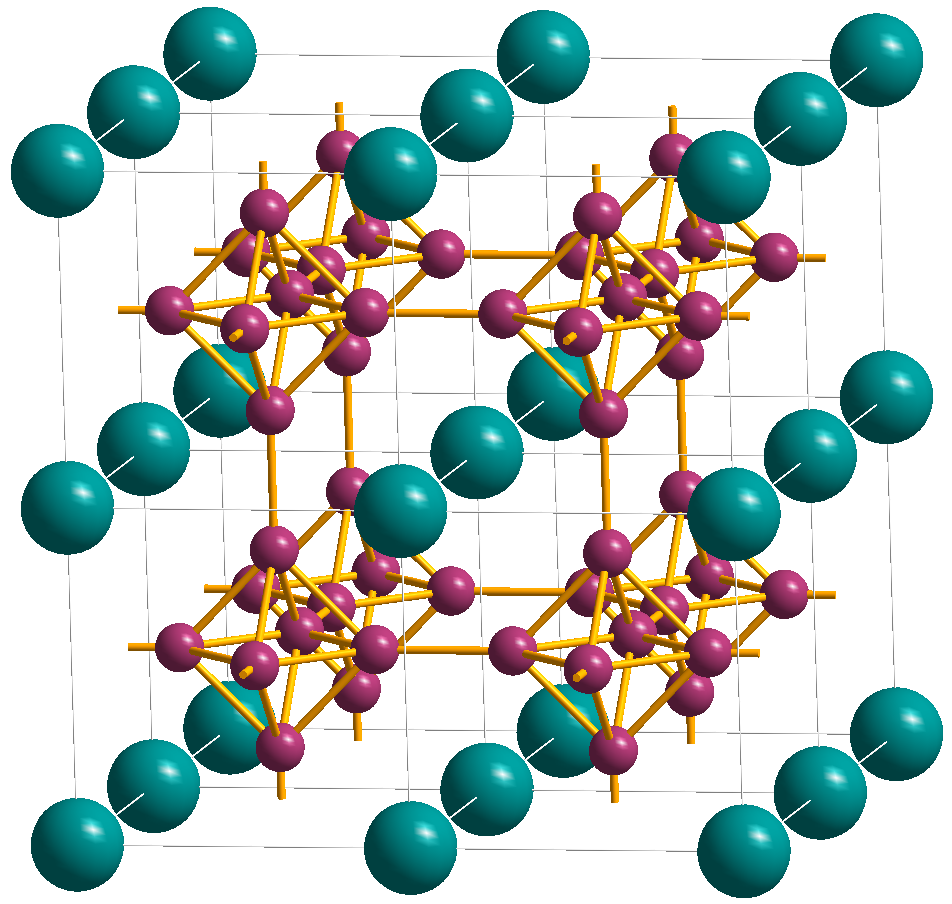
YB6 is a black odorless powder having density of 3.67 g/cm3; it has the same cubic crystalline structure as other hexaborides (CaB6, LaB6, etc., see infobox). High-quality YB6 crystals of few centimeters in size can be grown by the multiple-pass floating zone technique. YB6 is a superconductor with the relatively high transition temperature (onset) of 8.4 K.
YB12 crystals have a cubic structure with density of 3.44 g/cm3, Pearson symbol cF52, space group Fm3m (No. 225), a = 0.7468 nm. Its structural unit is 12 cuboctahedron. The Debye temperature of YB12 is ~1040 K, and it is not superconducting at temperatures above 2.5 K.
The structure of yttrium borides with B/Y ratio of 25 and above consists of a network of B12 icosahedra. The boron framework of YB25 is one of the simplest among icosahedron-based borides – it consists of only one kind of icosahedra and one bridging boron site. The bridging boron site is tetrahedrally coordinated by four boron atoms. Those atoms are another boron atom in the counter bridge site and three equatorial boron atoms of one of three B12 icosahedra. The yttrium sites have partial occupancies of ca. 60–70%, and the YB25 formula merely reflects the average atomic ratio [B]/[Y] = 25. Both the Y atoms and B12 icosahedra form zigzags along the x-axis. The bridging boron atoms connect three equatorial boron atoms of three icosahedra and those icosahedra make up a network parallel to the (101) crystal plane (x-z plane in the figure). The bonding distance between the bridging boron and the equatorial boron atoms is 0.1755 nm, which is typical for the strong covalent B-B bond (bond length 0.17–0.18 nm); thus, the bridging boron atoms strengthen the individual network planes. On the other hand, the large distance between the boron atoms within the bridge (0.2041 nm) reveals a weaker interaction, and thus the bridging sites contribute little to the bonding between the network planes.
YB25 crystals can be grown by heating a compressed pellet of yttria (Y2O3) and boron powder to ~1700 °C. The YB25 phase is stable up to 1850 °C. Above this temperature it decomposes into YB12 and YB66 without melting. This makes it difficult to grow a single crystal of YB25 by the melt growth method.
YB50 crystals have orthorhombic structure with space group P21212 (No. 18), a = 1.66251 nm, b = 1.76198 nm, c = 0.94797 nm. They can be grown by heating a compressed pellet of yttria (Y2O3) and boron powder to ~1700 0C. Above this temperature YB50 decomposes into YB12 and YB66 without melting. This makes it difficult to grow a single crystal of YB50 by the melt growth method. Rare earth elements from Tb to Lu can also crystallize in the M50 form.
Hub AI
Yttrium borides AI simulator
(@Yttrium borides_simulator)
Yttrium borides
Yttrium boride refers to a crystalline material composed of different proportions of yttrium and boron, such as YB2, YB4, YB6, YB12, YB25, YB50 and YB66. They are all gray-colored, hard solids having high melting temperatures. The most common form is the yttrium hexaboride YB6. It exhibits superconductivity at relatively high temperature of 8.4 K and, similar to LaB6, is an electron cathode. Another remarkable yttrium boride is YB66. It has a large lattice constant (2.344 nm), high thermal and mechanical stability, and therefore is used as a diffraction grating for low-energy synchrotron radiation (1–2 keV).
Yttrium diboride has the same hexagonal crystal structure as aluminium diboride and magnesium diboride – an important superconducting material. Its Pearson symbol is hP3, space group P6/mmm (No 191), a = 0.33041 nm, c = 0.38465 nm and the calculated density is 5.05 g/cm3. In this structure, the boron atoms form graphite like sheets with yttrium atoms between them. YB2 crystals are unstable to moderate heating in air – they start oxidizing at 400 °C and completely oxidize at 800 °C. YB2 melts at ~2100 °C.
YB4 has tetragonal crystal structure with space group P4/mbm (No. 127), Pearson symbol tP20, a = 0.711 nm, c = 0.4019 nm, calculated density 4.32 g/cm3. High-quality YB4 crystals of few centimeters in size can be grown by the multiple-pass floating zone technique.
YB6 is a black odorless powder having density of 3.67 g/cm3; it has the same cubic crystalline structure as other hexaborides (CaB6, LaB6, etc., see infobox). High-quality YB6 crystals of few centimeters in size can be grown by the multiple-pass floating zone technique. YB6 is a superconductor with the relatively high transition temperature (onset) of 8.4 K.
YB12 crystals have a cubic structure with density of 3.44 g/cm3, Pearson symbol cF52, space group Fm3m (No. 225), a = 0.7468 nm. Its structural unit is 12 cuboctahedron. The Debye temperature of YB12 is ~1040 K, and it is not superconducting at temperatures above 2.5 K.
The structure of yttrium borides with B/Y ratio of 25 and above consists of a network of B12 icosahedra. The boron framework of YB25 is one of the simplest among icosahedron-based borides – it consists of only one kind of icosahedra and one bridging boron site. The bridging boron site is tetrahedrally coordinated by four boron atoms. Those atoms are another boron atom in the counter bridge site and three equatorial boron atoms of one of three B12 icosahedra. The yttrium sites have partial occupancies of ca. 60–70%, and the YB25 formula merely reflects the average atomic ratio [B]/[Y] = 25. Both the Y atoms and B12 icosahedra form zigzags along the x-axis. The bridging boron atoms connect three equatorial boron atoms of three icosahedra and those icosahedra make up a network parallel to the (101) crystal plane (x-z plane in the figure). The bonding distance between the bridging boron and the equatorial boron atoms is 0.1755 nm, which is typical for the strong covalent B-B bond (bond length 0.17–0.18 nm); thus, the bridging boron atoms strengthen the individual network planes. On the other hand, the large distance between the boron atoms within the bridge (0.2041 nm) reveals a weaker interaction, and thus the bridging sites contribute little to the bonding between the network planes.
YB25 crystals can be grown by heating a compressed pellet of yttria (Y2O3) and boron powder to ~1700 °C. The YB25 phase is stable up to 1850 °C. Above this temperature it decomposes into YB12 and YB66 without melting. This makes it difficult to grow a single crystal of YB25 by the melt growth method.
YB50 crystals have orthorhombic structure with space group P21212 (No. 18), a = 1.66251 nm, b = 1.76198 nm, c = 0.94797 nm. They can be grown by heating a compressed pellet of yttria (Y2O3) and boron powder to ~1700 0C. Above this temperature YB50 decomposes into YB12 and YB66 without melting. This makes it difficult to grow a single crystal of YB50 by the melt growth method. Rare earth elements from Tb to Lu can also crystallize in the M50 form.
Recent media