


Community hub
Recent from talks
Contribute something to knowledge base
Content stats: 0 posts, 0 articles, 1 media, 0 notes
Members stats: 0 subscribers, 0 contributors, 0 moderators, 0 supporters
Subscribers
Supporters
Contributors
Moderators
Hub AI
Boron AI simulator
(@Boron_simulator)
Hub AI
Boron AI simulator
(@Boron_simulator)
Boron
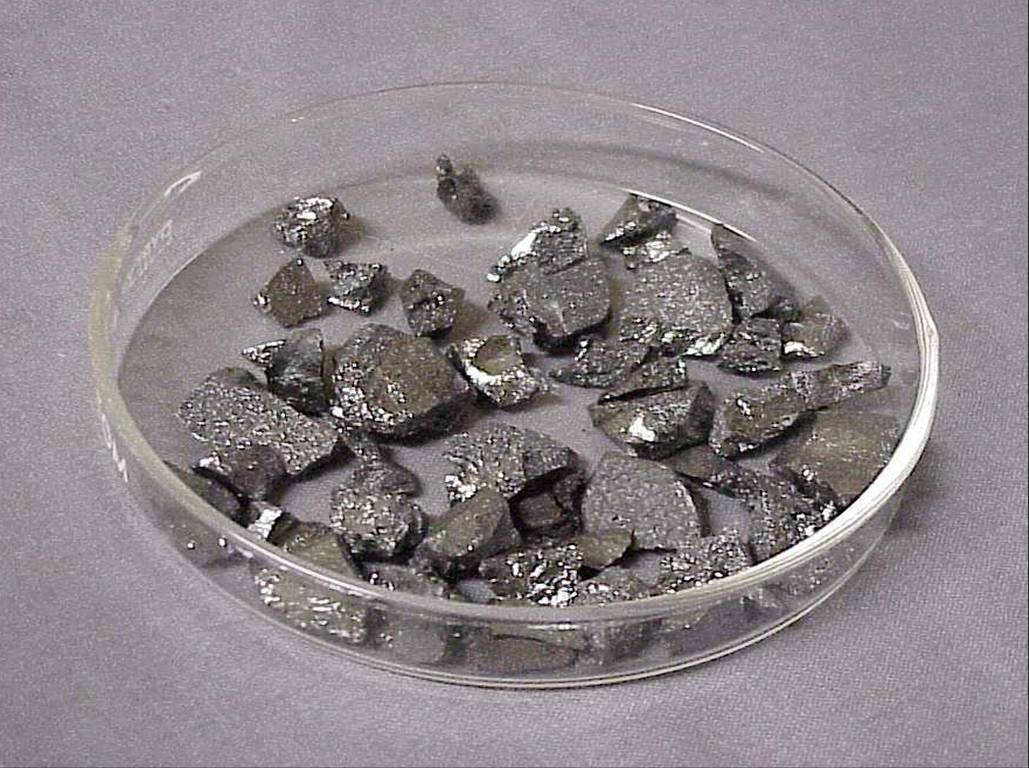
Boron is a chemical element; it has symbol B and atomic number 5. In its crystalline form it is a brittle, dark, lustrous metalloid; in its amorphous form it is a brown powder. As the lightest element of the boron group it has three valence electrons for forming covalent bonds, resulting in many compounds such as boric acid, the mineral sodium borate, and the ultra-hard crystals of boron carbide and boron nitride.
Boron is synthesized entirely by cosmic ray spallation and supernovas and not by stellar nucleosynthesis, so it is a low-abundance element in the Solar System and in the Earth's crust. It constitutes about 0.001 percent by weight of Earth's crust. It is concentrated on Earth by the water-solubility of its more common naturally occurring compounds, the borate minerals. These are mined industrially as evaporites, such as borax and kernite. The largest known deposits are in Turkey, the largest producer of boron minerals.
Elemental boron is found in small amounts in meteoroids, but chemically uncombined boron is not otherwise found naturally on Earth.
Several allotropes exist: amorphous boron is a brown powder; crystalline boron is silvery to black, extremely hard (9.3 on the Mohs scale), and a poor electrical conductor at room temperature (1.5 × 10⁻⁶ Ω−1 cm−1 room temperature electrical conductivity). The primary use of the element itself is as boron filaments with applications similar to carbon fibers in some high-strength materials.
Boron is primarily used in chemical compounds. About half of all production consumed globally is an additive in fiberglass for insulation and structural materials. The next leading use is in polymers and ceramics in high-strength, lightweight structural and heat-resistant materials. Borosilicate glass is desired for its greater strength and thermal shock resistance than ordinary soda lime glass. As sodium perborate, it is used as a bleach. A small amount is used as a dopant in semiconductors and reagent intermediates in the synthesis of organic fine chemicals. A few boron-containing organic pharmaceuticals are used or are in study. Natural boron is composed of two stable isotopes, one of which (boron-10) has a number of uses as a neutron-capturing agent.
Borates have low toxicity in mammals (similar to table salt) but are more toxic to arthropods and are occasionally used as insecticides. Boron-containing organic antibiotics are known. Although only traces are required, boron is an essential plant nutrient.
The word boron was coined from borax, the mineral from which it was isolated, by analogy with carbon, which boron resembles chemically.
Borax in its mineral form (then known as tincal) first saw use as a glaze, beginning in China circa 300 AD. Some crude borax traveled westward, and was apparently mentioned by the alchemist Jabir ibn Hayyan around 700 AD. Marco Polo brought some glazes back to Italy in the 13th century. Georgius Agricola, in around 1600, reported the use of borax as a flux in metallurgy. In 1777, boric acid was recognized in the hot springs (soffioni) near Florence, Italy, at which point it became known as sal sedativum, with ostensible medical benefits. The mineral was named sassolite after Sasso Pisano in Italy. Sasso was the main source of European borax from 1827 to 1872, when American sources replaced it. Boron compounds were rarely used until the late 1800s when Francis Marion Smith's Pacific Coast Borax Company first popularized and produced them in volume at low cost.
Boron
Boron is a chemical element; it has symbol B and atomic number 5. In its crystalline form it is a brittle, dark, lustrous metalloid; in its amorphous form it is a brown powder. As the lightest element of the boron group it has three valence electrons for forming covalent bonds, resulting in many compounds such as boric acid, the mineral sodium borate, and the ultra-hard crystals of boron carbide and boron nitride.
Boron is synthesized entirely by cosmic ray spallation and supernovas and not by stellar nucleosynthesis, so it is a low-abundance element in the Solar System and in the Earth's crust. It constitutes about 0.001 percent by weight of Earth's crust. It is concentrated on Earth by the water-solubility of its more common naturally occurring compounds, the borate minerals. These are mined industrially as evaporites, such as borax and kernite. The largest known deposits are in Turkey, the largest producer of boron minerals.
Elemental boron is found in small amounts in meteoroids, but chemically uncombined boron is not otherwise found naturally on Earth.
Several allotropes exist: amorphous boron is a brown powder; crystalline boron is silvery to black, extremely hard (9.3 on the Mohs scale), and a poor electrical conductor at room temperature (1.5 × 10⁻⁶ Ω−1 cm−1 room temperature electrical conductivity). The primary use of the element itself is as boron filaments with applications similar to carbon fibers in some high-strength materials.
Boron is primarily used in chemical compounds. About half of all production consumed globally is an additive in fiberglass for insulation and structural materials. The next leading use is in polymers and ceramics in high-strength, lightweight structural and heat-resistant materials. Borosilicate glass is desired for its greater strength and thermal shock resistance than ordinary soda lime glass. As sodium perborate, it is used as a bleach. A small amount is used as a dopant in semiconductors and reagent intermediates in the synthesis of organic fine chemicals. A few boron-containing organic pharmaceuticals are used or are in study. Natural boron is composed of two stable isotopes, one of which (boron-10) has a number of uses as a neutron-capturing agent.
Borates have low toxicity in mammals (similar to table salt) but are more toxic to arthropods and are occasionally used as insecticides. Boron-containing organic antibiotics are known. Although only traces are required, boron is an essential plant nutrient.
The word boron was coined from borax, the mineral from which it was isolated, by analogy with carbon, which boron resembles chemically.
Borax in its mineral form (then known as tincal) first saw use as a glaze, beginning in China circa 300 AD. Some crude borax traveled westward, and was apparently mentioned by the alchemist Jabir ibn Hayyan around 700 AD. Marco Polo brought some glazes back to Italy in the 13th century. Georgius Agricola, in around 1600, reported the use of borax as a flux in metallurgy. In 1777, boric acid was recognized in the hot springs (soffioni) near Florence, Italy, at which point it became known as sal sedativum, with ostensible medical benefits. The mineral was named sassolite after Sasso Pisano in Italy. Sasso was the main source of European borax from 1827 to 1872, when American sources replaced it. Boron compounds were rarely used until the late 1800s when Francis Marion Smith's Pacific Coast Borax Company first popularized and produced them in volume at low cost.
Recent media
Recent media