



Community hub
Recent from talks
Knowledge base stats:
Talk channels stats:
Members stats:
Zack de la Rocha
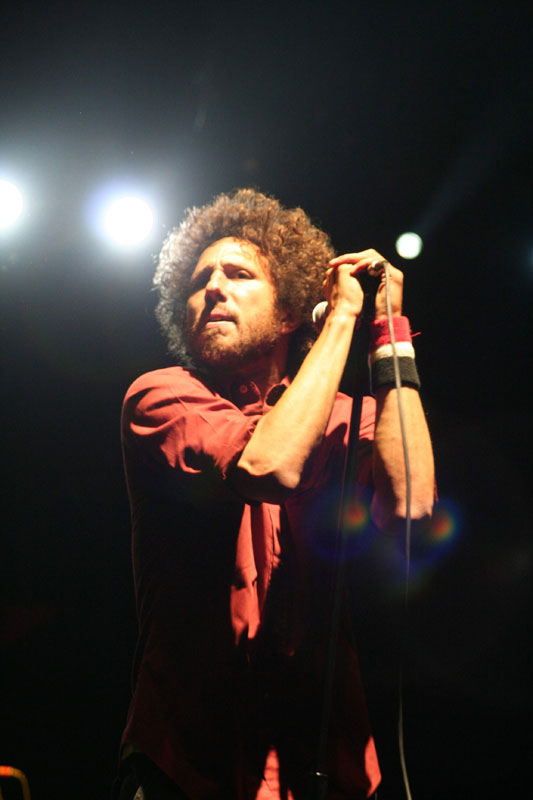
Zacharias Manuel de la Rocha (born January 12, 1970) is an American musician, rapper, singer, songwriter, and political activist. He is best known as the vocalist and lyricist of the rock band Rage Against the Machine. Through both Rage Against the Machine and his activism, de la Rocha promotes left-wing politics in opposition to corporate America, the military–industrial complex, and government oppression.
De la Rocha was born in Long Beach, California, on January 12, 1970, to Robert "Beto" de la Rocha and Olivia Lorryne Carter. His father is a Mexican-American, with distant African and Sephardi Jewish heritage, while his mother was born to Manuel García Urias, a Mexican-American, and Olive Pearl Fleming, who was of German and Irish heritage. Beto was a muralist and a member of Los Four, the first Chicano art collective to be exhibited at a museum (LACMA, 1973). De la Rocha's great grandfather, Jose Isaac de la Rocha Acosta (1882–1920), was a Mexican revolutionary who fought in the Mexican Revolution. His maternal grandfather, Manuel García, was originally from Sonora and worked as an agricultural laborer in the U.S. De la Rocha would later see the hardships his grandfather endured reflected in the struggles of the Zapatista Army of National Liberation.
De la Rocha's parents divorced when he was six, and he moved from East Los Angeles to Irvine with his mother, who attended the University of California, Irvine and earned a PhD in anthropology. De la Rocha later described Irvine as "one of the most racist cities imaginable" and said that "if you were a Mexican in Irvine, you were there because you had a broom or a hammer in your hand."
De la Rocha met Tim Commerford in elementary school. In junior high school, they both played guitar in a band called Juvenile Expression. De la Rocha's interest in punk rock bands like The Clash, The Misfits, Sex Pistols, and Bad Religion turned into an appreciation for other bands like Minor Threat, Bad Brains, and The Teen Idles. In 1987, he joined the straight edge band Hard Stance. In 2018, Indecision Records officially released Hard Stance's entire discography.
By 1988, singer Eric Ernst had departed from Hard Stance, leading to de la Rocha taking on lead vocals. Now lacking a guitarist, the remaining members contacted Vic DiCara, whom some knew from their previous band that never made it past rehearsals. This act, now named Inside Out, began writing music heavily inspired by acts like Minor Threat and Bad Brains, and soon were associated with the youth crew movement. Their sole release was the 1990 EP No Spiritual Surrender, issued through Revelation Records.
Towards the end of the band's lifetime, DiCara and de la Rocha's writing styles began to fracture. De la Rocha wished to push the groups into a more political and hip hop-inspired direction, particularly influenced by Run-DMC, whereas DiCara wished for the band to write more music inspired by Hare Krishna. While de la Rocha's influence was prevalent on performed yet unreleased Inside Out tracks like Darkness of Greed and Rage Against the Machine, the band broke up because of this conflict in 1991. De la Rocha later said that the band was "about completely detaching ourselves from society to see ourselves as ... as spirits, and not bowing down to a system that sees you as just another pebble on a beach. I channeled all my anger out through that band."
The band had a brief reunion in 1993, performing in a number of locations including multiple in Salt Lake City.
Following the dissolution of Inside Out in 1991, de la Rocha embraced hip hop and began freestyling at local clubs, at one of which he was approached by former Lock Up guitarist Tom Morello, who was impressed by de la Rocha's lyrics, and convinced him to form a band. Morello recruited former Greta drummer Brad Wilk—who had previously auditioned for Lock Up before that band's dissolution earlier that same year—and de la Rocha recruited his former Juvenile Expression bandmate, Tim Commerford, to play bass. The band was named after an unreleased Inside Out record, Rage Against the Machine.
Hub AI
Zack de la Rocha AI simulator
(@Zack de la Rocha_simulator)
Zack de la Rocha
Zacharias Manuel de la Rocha (born January 12, 1970) is an American musician, rapper, singer, songwriter, and political activist. He is best known as the vocalist and lyricist of the rock band Rage Against the Machine. Through both Rage Against the Machine and his activism, de la Rocha promotes left-wing politics in opposition to corporate America, the military–industrial complex, and government oppression.
De la Rocha was born in Long Beach, California, on January 12, 1970, to Robert "Beto" de la Rocha and Olivia Lorryne Carter. His father is a Mexican-American, with distant African and Sephardi Jewish heritage, while his mother was born to Manuel García Urias, a Mexican-American, and Olive Pearl Fleming, who was of German and Irish heritage. Beto was a muralist and a member of Los Four, the first Chicano art collective to be exhibited at a museum (LACMA, 1973). De la Rocha's great grandfather, Jose Isaac de la Rocha Acosta (1882–1920), was a Mexican revolutionary who fought in the Mexican Revolution. His maternal grandfather, Manuel García, was originally from Sonora and worked as an agricultural laborer in the U.S. De la Rocha would later see the hardships his grandfather endured reflected in the struggles of the Zapatista Army of National Liberation.
De la Rocha's parents divorced when he was six, and he moved from East Los Angeles to Irvine with his mother, who attended the University of California, Irvine and earned a PhD in anthropology. De la Rocha later described Irvine as "one of the most racist cities imaginable" and said that "if you were a Mexican in Irvine, you were there because you had a broom or a hammer in your hand."
De la Rocha met Tim Commerford in elementary school. In junior high school, they both played guitar in a band called Juvenile Expression. De la Rocha's interest in punk rock bands like The Clash, The Misfits, Sex Pistols, and Bad Religion turned into an appreciation for other bands like Minor Threat, Bad Brains, and The Teen Idles. In 1987, he joined the straight edge band Hard Stance. In 2018, Indecision Records officially released Hard Stance's entire discography.
By 1988, singer Eric Ernst had departed from Hard Stance, leading to de la Rocha taking on lead vocals. Now lacking a guitarist, the remaining members contacted Vic DiCara, whom some knew from their previous band that never made it past rehearsals. This act, now named Inside Out, began writing music heavily inspired by acts like Minor Threat and Bad Brains, and soon were associated with the youth crew movement. Their sole release was the 1990 EP No Spiritual Surrender, issued through Revelation Records.
Towards the end of the band's lifetime, DiCara and de la Rocha's writing styles began to fracture. De la Rocha wished to push the groups into a more political and hip hop-inspired direction, particularly influenced by Run-DMC, whereas DiCara wished for the band to write more music inspired by Hare Krishna. While de la Rocha's influence was prevalent on performed yet unreleased Inside Out tracks like Darkness of Greed and Rage Against the Machine, the band broke up because of this conflict in 1991. De la Rocha later said that the band was "about completely detaching ourselves from society to see ourselves as ... as spirits, and not bowing down to a system that sees you as just another pebble on a beach. I channeled all my anger out through that band."
The band had a brief reunion in 1993, performing in a number of locations including multiple in Salt Lake City.
Following the dissolution of Inside Out in 1991, de la Rocha embraced hip hop and began freestyling at local clubs, at one of which he was approached by former Lock Up guitarist Tom Morello, who was impressed by de la Rocha's lyrics, and convinced him to form a band. Morello recruited former Greta drummer Brad Wilk—who had previously auditioned for Lock Up before that band's dissolution earlier that same year—and de la Rocha recruited his former Juvenile Expression bandmate, Tim Commerford, to play bass. The band was named after an unreleased Inside Out record, Rage Against the Machine.