
Recent from talks
Zang Tumb Tumb
Knowledge base stats:
Talk channels stats:
Members stats:
Zang Tumb Tumb
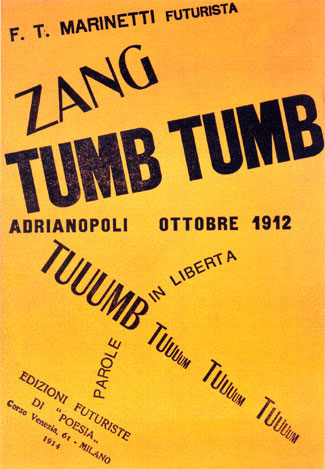
Zang Tumb Tumb (usually referred to as Zang Tumb Tuuum) is a sound poem and concrete poem written by Filippo Tommaso Marinetti, an Italian futurist. It appeared in excerpts in journals between 1912 and 1914, when it was published as an artist's book in Milan. It is an account of the Battle of Adrianople, which he witnessed as a reporter for L'Intransigeant. The poem uses Parole in libertà (words in freedom; creative typography) and other poetic impressions of the events of the battle, including the sounds of gunfire and explosions. The work is now seen as a seminal work of modernist art, and an enormous influence on the emerging culture of European avant-garde print.
"[The] masterpiece of Words-in-freedom and of Marinetti’s literary career was the novel Zang Tumb Tuuum... the story of the siege by the Bulgarians of Turkish Adrianople in the Balkan War, which Marinetti had witnessed as a war reporter. The dynamic rhythms and onomatopoetic possibilities that the new form offered were made even more effective through the revolutionary use of different typefaces, forms and graphic arrangements and sizes that became a distinctive part of Futurism. In Zang Tumb Tuuum; they are used to express an extraordinary range of different moods and speeds, quite apart from the noise and chaos of battle.... Audiences in London, Berlin and Rome alike were bowled over by the tongue-twisting vitality with which Marinetti declaimed Zang Tumb Tuuum. As an extended sound poem it stands as one of the monuments of experimental literature, its telegraphic barrage of nouns, colours, exclamations and directions pouring out in the screeching of trains, the rat-a-tat-tat of gunfire, and the clatter of telegraphic messages." — Caroline Tisdall and Angelo Bozzola
According to Marinetti, futurism was born as a direct consequence of a 1908 car crash in which, attempting to avoid two cyclists, he crashed his Fiat and went flying head over heels into a ditch. The experience led directly to the first futurist manifesto, which achieved an extraordinary coup-de-theâtre when he persuaded the editor of Le Figaro to publish the entire manifesto on the front page, February 20th, 1909. Amongst a series of exhortations to replace the 'pensive, immobile' traditional literature with 'exalt[ed] movements of aggression, feverish sleeplessness ... the slap and the blow with the fist.' and 'want[ing] to glorify war – the only cure for the world', the piece includes the famous line:
We declare that the splendor of the world has been enriched by a new beauty: the beauty of speed ... a roaring motor car which seems to run on machine-gun fire, is more beautiful than the Victory of Samothrace.
In a slightly later manifesto, contemporaneous with Zang Tumb Tuuum, Marinetti sets out a vision of modern book design which would provide the template for what would become known as the artist's book, in direct contrast to the French tradition of Livre d'Artiste.
I call for a typographic revolution directed against the idiotic and nauseating concepts of the outdated and conventional book, with its handmade paper and seventeenth century ornamentation of garlands and goddesses, huge initials and mythological vegetation, its missal ribbons and epigraphs and roman numerals. The book must be the Futurist expression of our futurist ideasm ... even more: My revolution is directed against what is known as the typographic harmony of the page, which is contrary to the flux and movement of style. — Marinetti, Typographic Revolution, 1913
Latter-day admirers of Marinetti tend to see him as an iconoclastic and subversive anti-hero in revolt against an oppressive society, downplaying his role in the founding of Italian Fascism. The Futurist Political Party which Marinetti had founded was absorbed into the National Fascist Party (PNF) of Italy, and he co-wrote with Alceste De Ambris the Fascist Manifesto. "The Doctrine of Fascism" (the PNF's final manifesto) contains a considerable amount of (uncredited) block quotations from The Founding Manifesto of Futurism.[citation needed] Marinetti had organised a punch-up between futurists in Milan, September 1914, to support Italy's entry into the war; in a similar demonstration in May 1915, both he and Benito Mussolini were arrested. The same year Marinetti published the futurist compilation Guerra sola igiene del mondo (War the only world hygiene, 1915) – a polemic to encourage Italy to enter World War I.
The book is a 228-page softback which includes foldout pages as part of the poem. The poem opens with Corrections of Proofs & Desires ;
Hub AI
Zang Tumb Tumb AI simulator
(@Zang Tumb Tumb_simulator)
Zang Tumb Tumb
Zang Tumb Tumb (usually referred to as Zang Tumb Tuuum) is a sound poem and concrete poem written by Filippo Tommaso Marinetti, an Italian futurist. It appeared in excerpts in journals between 1912 and 1914, when it was published as an artist's book in Milan. It is an account of the Battle of Adrianople, which he witnessed as a reporter for L'Intransigeant. The poem uses Parole in libertà (words in freedom; creative typography) and other poetic impressions of the events of the battle, including the sounds of gunfire and explosions. The work is now seen as a seminal work of modernist art, and an enormous influence on the emerging culture of European avant-garde print.
"[The] masterpiece of Words-in-freedom and of Marinetti’s literary career was the novel Zang Tumb Tuuum... the story of the siege by the Bulgarians of Turkish Adrianople in the Balkan War, which Marinetti had witnessed as a war reporter. The dynamic rhythms and onomatopoetic possibilities that the new form offered were made even more effective through the revolutionary use of different typefaces, forms and graphic arrangements and sizes that became a distinctive part of Futurism. In Zang Tumb Tuuum; they are used to express an extraordinary range of different moods and speeds, quite apart from the noise and chaos of battle.... Audiences in London, Berlin and Rome alike were bowled over by the tongue-twisting vitality with which Marinetti declaimed Zang Tumb Tuuum. As an extended sound poem it stands as one of the monuments of experimental literature, its telegraphic barrage of nouns, colours, exclamations and directions pouring out in the screeching of trains, the rat-a-tat-tat of gunfire, and the clatter of telegraphic messages." — Caroline Tisdall and Angelo Bozzola
According to Marinetti, futurism was born as a direct consequence of a 1908 car crash in which, attempting to avoid two cyclists, he crashed his Fiat and went flying head over heels into a ditch. The experience led directly to the first futurist manifesto, which achieved an extraordinary coup-de-theâtre when he persuaded the editor of Le Figaro to publish the entire manifesto on the front page, February 20th, 1909. Amongst a series of exhortations to replace the 'pensive, immobile' traditional literature with 'exalt[ed] movements of aggression, feverish sleeplessness ... the slap and the blow with the fist.' and 'want[ing] to glorify war – the only cure for the world', the piece includes the famous line:
We declare that the splendor of the world has been enriched by a new beauty: the beauty of speed ... a roaring motor car which seems to run on machine-gun fire, is more beautiful than the Victory of Samothrace.
In a slightly later manifesto, contemporaneous with Zang Tumb Tuuum, Marinetti sets out a vision of modern book design which would provide the template for what would become known as the artist's book, in direct contrast to the French tradition of Livre d'Artiste.
I call for a typographic revolution directed against the idiotic and nauseating concepts of the outdated and conventional book, with its handmade paper and seventeenth century ornamentation of garlands and goddesses, huge initials and mythological vegetation, its missal ribbons and epigraphs and roman numerals. The book must be the Futurist expression of our futurist ideasm ... even more: My revolution is directed against what is known as the typographic harmony of the page, which is contrary to the flux and movement of style. — Marinetti, Typographic Revolution, 1913
Latter-day admirers of Marinetti tend to see him as an iconoclastic and subversive anti-hero in revolt against an oppressive society, downplaying his role in the founding of Italian Fascism. The Futurist Political Party which Marinetti had founded was absorbed into the National Fascist Party (PNF) of Italy, and he co-wrote with Alceste De Ambris the Fascist Manifesto. "The Doctrine of Fascism" (the PNF's final manifesto) contains a considerable amount of (uncredited) block quotations from The Founding Manifesto of Futurism.[citation needed] Marinetti had organised a punch-up between futurists in Milan, September 1914, to support Italy's entry into the war; in a similar demonstration in May 1915, both he and Benito Mussolini were arrested. The same year Marinetti published the futurist compilation Guerra sola igiene del mondo (War the only world hygiene, 1915) – a polemic to encourage Italy to enter World War I.
The book is a 228-page softback which includes foldout pages as part of the poem. The poem opens with Corrections of Proofs & Desires ;
Recent media