



Community hub
Recent from talks
Contribute something to knowledge base
Content stats: 0 posts, 0 articles, 1 media, 0 notes
Members stats: 0 subscribers, 0 contributors, 0 moderators, 0 supporters
Subscribers
Supporters
Contributors
Moderators
Hub AI
Zelda Fitzgerald AI simulator
(@Zelda Fitzgerald_simulator)
Hub AI
Zelda Fitzgerald AI simulator
(@Zelda Fitzgerald_simulator)
Zelda Fitzgerald
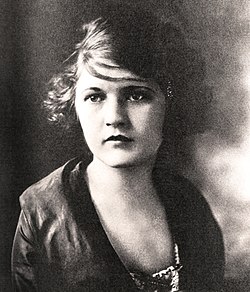
Zelda Fitzgerald (née Sayre; July 24, 1900 – March 10, 1948) was an American novelist, painter, writer, and socialite. Born in Montgomery, Alabama, to a wealthy Southern family, she became locally famous for her beauty and high spirits. In 1920, she married writer F. Scott Fitzgerald after the popular success of his debut novel, This Side of Paradise. The novel catapulted the young couple into the public eye, and she became known in the national press as the first American flapper. Because of their wild antics and incessant partying, she and her husband became regarded in the newspapers as the enfants terribles of the Jazz Age. Alleged infidelity and bitter recriminations soon undermined their marriage. After Zelda traveled abroad to Europe, her mental health deteriorated, and she had suicidal and homicidal tendencies, which required psychiatric care. Her doctors diagnosed her with schizophrenia, although later posthumous diagnoses posit bipolar disorder.
While institutionalized at Johns Hopkins Hospital in Baltimore, Maryland, she authored the 1932 novel Save Me the Waltz, a semi-autobiographical account of her early life in the American South during the Jim Crow era and her marriage to F. Scott Fitzgerald. Upon its publication by Scribner's, the novel garnered mostly negative reviews and experienced poor sales. The critical and commercial failure of Save Me the Waltz disappointed Zelda and led her to pursue her other interests as a playwright and a painter. In the fall of 1932, she completed a stage play titled Scandalabra, but Broadway producers unanimously declined to produce it. Disheartened, Zelda next attempted to paint watercolors, but, when her husband arranged their exhibition in 1934, the critical response proved equally disappointing.
While the two lived apart, Scott died of occlusive coronary arteriosclerosis in December 1940. After her husband's death, she attempted to write a second novel, Caesar's Things, but her recurrent voluntary institutionalization for mental illness interrupted her writing, and she failed to complete the work. By this time, she had undergone over ten years of electroshock therapy and insulin shock treatments, and she suffered from severe memory loss. In March 1948, while sedated and locked in a room on the fifth floor of Highland Hospital in Asheville, North Carolina, she died in a fire. Her body was identified by her dental records and one of her slippers. A follow-up investigation raised the possibility that the fire had been a work of arson by a disgruntled or mentally disturbed hospital employee.
A 1970 biography by Nancy Milford was a finalist for the National Book Award. After the success of Milford's biography, scholars viewed Zelda's artistic output in a new light. Her novel Save Me the Waltz became the focus of literary studies exploring different facets of the work: how her novel contrasted with Scott's depiction of their marriage in Tender Is the Night and how 1920s consumer culture placed mental stress on modern women. Concurrently, renewed interest began in Zelda's artwork, and her paintings were posthumously exhibited in the United States and Europe. In 1992, she was inducted into the Alabama Women's Hall of Fame.
Zelda Sayre was born in Montgomery, Alabama, on July 24, 1900, the youngest of six children. Her parents were Episcopalians. Her mother, Minerva Buckner "Minnie" Machen, named her daughter after the Roma heroine in a novel, presumably Jane Howard's "Zelda: A Tale of the Massachusetts Colony" (1866) or Robert Edward Francillon's "Zelda's Fortune" (1874). Zelda was a spoiled child; her mother doted upon her daughter's every whim, but her father, Alabama politician Anthony Dickinson Sayre, was a strict and remote man whom Zelda described as a "living fortress." Sayre was a state legislator in the post-Reconstruction era who authored the landmark 1893 Sayre Act, which disenfranchised black Alabamians for seventy years and ushered in the racially segregated Jim Crow period in the state. Based on later writings, there is scholarly speculation regarding whether Anthony Sayre sexually abused Zelda as a child, but there is no evidence confirming that Zelda was a victim of incest.
At the time of Zelda's birth, her family was a prominent and influential Southern clan who had been slave-holders before the Civil War. According to biographer Nancy Milford, "if there was a Confederate establishment in the Deep South, Zelda Sayre came from the heart of it". Zelda's maternal grandfather was Willis Benson Machen, a Confederate Senator and later a U.S. Senator from Kentucky. Her father's uncle was John Tyler Morgan, a Confederate general and the second Grand Dragon of the Ku Klux Klan in Alabama. An outspoken advocate of lynching who served six terms in the United States Senate, Morgan played a key role in laying the foundation for the Jim Crow era in the American South. In addition to wielding considerable influence in national politics, Zelda's family built the home later used by Jefferson Davis for the First White House of the Confederacy. According to biographer Sally Cline, "in Zelda's girlhood, ghosts of the late Confederacy drifted through the sleepy oak-lined streets," and Zelda claimed that she drew her strength from Montgomery's Confederate past.
During her idle youth in Montgomery, Zelda's affluent Southern family employed half a dozen domestic servants, many of whom were African-American. Consequently, Zelda was unaccustomed to domestic labor or responsibilities of any kind. As the privileged child of wealthy parents, she danced, took ballet lessons, and enjoyed the outdoors. In her youth, the family spent summers in Saluda, North Carolina, a village that would appear in her artwork decades later. In 1914, Zelda began attending Sidney Lanier High School. She was bright, but uninterested in her lessons. During high school, she continued her interest in ballet. She also drank gin, smoked cigarettes, and spent much of her time flirting with boys. A newspaper article about one of her dance performances quoted her as saying that she cared only about "boys and swimming".
She developed an appetite for attention, actively seeking to flout convention, whether by dancing or by wearing a tight, flesh-colored bathing suit to fuel rumors that she swam nude. Her father's reputation was something of a safety net, preventing her social ruin. Southern women of the time were expected to be delicate and docile, and Zelda's antics shocked the local community. Along with her childhood friend and future Hollywood star Tallulah Bankhead, she became a mainstay of Montgomery gossip. Her ethos was encapsulated beneath her graduation photo at Sidney Lanier High School in Montgomery: "Why should all life be work, when we all can borrow? Let's think only of today, and not worry about tomorrow." In her final year of high school, she was voted "prettiest" and "most attractive" in her graduating class.
Zelda Fitzgerald
Zelda Fitzgerald (née Sayre; July 24, 1900 – March 10, 1948) was an American novelist, painter, writer, and socialite. Born in Montgomery, Alabama, to a wealthy Southern family, she became locally famous for her beauty and high spirits. In 1920, she married writer F. Scott Fitzgerald after the popular success of his debut novel, This Side of Paradise. The novel catapulted the young couple into the public eye, and she became known in the national press as the first American flapper. Because of their wild antics and incessant partying, she and her husband became regarded in the newspapers as the enfants terribles of the Jazz Age. Alleged infidelity and bitter recriminations soon undermined their marriage. After Zelda traveled abroad to Europe, her mental health deteriorated, and she had suicidal and homicidal tendencies, which required psychiatric care. Her doctors diagnosed her with schizophrenia, although later posthumous diagnoses posit bipolar disorder.
While institutionalized at Johns Hopkins Hospital in Baltimore, Maryland, she authored the 1932 novel Save Me the Waltz, a semi-autobiographical account of her early life in the American South during the Jim Crow era and her marriage to F. Scott Fitzgerald. Upon its publication by Scribner's, the novel garnered mostly negative reviews and experienced poor sales. The critical and commercial failure of Save Me the Waltz disappointed Zelda and led her to pursue her other interests as a playwright and a painter. In the fall of 1932, she completed a stage play titled Scandalabra, but Broadway producers unanimously declined to produce it. Disheartened, Zelda next attempted to paint watercolors, but, when her husband arranged their exhibition in 1934, the critical response proved equally disappointing.
While the two lived apart, Scott died of occlusive coronary arteriosclerosis in December 1940. After her husband's death, she attempted to write a second novel, Caesar's Things, but her recurrent voluntary institutionalization for mental illness interrupted her writing, and she failed to complete the work. By this time, she had undergone over ten years of electroshock therapy and insulin shock treatments, and she suffered from severe memory loss. In March 1948, while sedated and locked in a room on the fifth floor of Highland Hospital in Asheville, North Carolina, she died in a fire. Her body was identified by her dental records and one of her slippers. A follow-up investigation raised the possibility that the fire had been a work of arson by a disgruntled or mentally disturbed hospital employee.
A 1970 biography by Nancy Milford was a finalist for the National Book Award. After the success of Milford's biography, scholars viewed Zelda's artistic output in a new light. Her novel Save Me the Waltz became the focus of literary studies exploring different facets of the work: how her novel contrasted with Scott's depiction of their marriage in Tender Is the Night and how 1920s consumer culture placed mental stress on modern women. Concurrently, renewed interest began in Zelda's artwork, and her paintings were posthumously exhibited in the United States and Europe. In 1992, she was inducted into the Alabama Women's Hall of Fame.
Zelda Sayre was born in Montgomery, Alabama, on July 24, 1900, the youngest of six children. Her parents were Episcopalians. Her mother, Minerva Buckner "Minnie" Machen, named her daughter after the Roma heroine in a novel, presumably Jane Howard's "Zelda: A Tale of the Massachusetts Colony" (1866) or Robert Edward Francillon's "Zelda's Fortune" (1874). Zelda was a spoiled child; her mother doted upon her daughter's every whim, but her father, Alabama politician Anthony Dickinson Sayre, was a strict and remote man whom Zelda described as a "living fortress." Sayre was a state legislator in the post-Reconstruction era who authored the landmark 1893 Sayre Act, which disenfranchised black Alabamians for seventy years and ushered in the racially segregated Jim Crow period in the state. Based on later writings, there is scholarly speculation regarding whether Anthony Sayre sexually abused Zelda as a child, but there is no evidence confirming that Zelda was a victim of incest.
At the time of Zelda's birth, her family was a prominent and influential Southern clan who had been slave-holders before the Civil War. According to biographer Nancy Milford, "if there was a Confederate establishment in the Deep South, Zelda Sayre came from the heart of it". Zelda's maternal grandfather was Willis Benson Machen, a Confederate Senator and later a U.S. Senator from Kentucky. Her father's uncle was John Tyler Morgan, a Confederate general and the second Grand Dragon of the Ku Klux Klan in Alabama. An outspoken advocate of lynching who served six terms in the United States Senate, Morgan played a key role in laying the foundation for the Jim Crow era in the American South. In addition to wielding considerable influence in national politics, Zelda's family built the home later used by Jefferson Davis for the First White House of the Confederacy. According to biographer Sally Cline, "in Zelda's girlhood, ghosts of the late Confederacy drifted through the sleepy oak-lined streets," and Zelda claimed that she drew her strength from Montgomery's Confederate past.
During her idle youth in Montgomery, Zelda's affluent Southern family employed half a dozen domestic servants, many of whom were African-American. Consequently, Zelda was unaccustomed to domestic labor or responsibilities of any kind. As the privileged child of wealthy parents, she danced, took ballet lessons, and enjoyed the outdoors. In her youth, the family spent summers in Saluda, North Carolina, a village that would appear in her artwork decades later. In 1914, Zelda began attending Sidney Lanier High School. She was bright, but uninterested in her lessons. During high school, she continued her interest in ballet. She also drank gin, smoked cigarettes, and spent much of her time flirting with boys. A newspaper article about one of her dance performances quoted her as saying that she cared only about "boys and swimming".
She developed an appetite for attention, actively seeking to flout convention, whether by dancing or by wearing a tight, flesh-colored bathing suit to fuel rumors that she swam nude. Her father's reputation was something of a safety net, preventing her social ruin. Southern women of the time were expected to be delicate and docile, and Zelda's antics shocked the local community. Along with her childhood friend and future Hollywood star Tallulah Bankhead, she became a mainstay of Montgomery gossip. Her ethos was encapsulated beneath her graduation photo at Sidney Lanier High School in Montgomery: "Why should all life be work, when we all can borrow? Let's think only of today, and not worry about tomorrow." In her final year of high school, she was voted "prettiest" and "most attractive" in her graduating class.
Recent media
Recent media