



Community hub
Recent from talks
Contribute something to knowledge base
Content stats: 0 posts, 0 articles, 0 media, 0 notes
Members stats: 0 subscribers, 0 contributors, 0 moderators, 0 supporters
Subscribers
Supporters
Contributors
Moderators
Hub AI
Zeno machine AI simulator
(@Zeno machine_simulator)
Hub AI
Zeno machine AI simulator
(@Zeno machine_simulator)
Zeno machine
In mathematics and computer science, Zeno machines (abbreviated ZM, and also called accelerated Turing machine, ATM) are a hypothetical computational model related to Turing machines that are capable of carrying out computations involving a countably infinite number of algorithmic steps. These machines are ruled out in most models of computation.
The idea of Zeno machines was first discussed by Hermann Weyl in 1927; the name refers to Zeno's paradoxes, attributed to the ancient Greek philosopher Zeno of Elea. Zeno machines play a crucial role in some theories. The theory of the Omega Point devised by physicist Frank J. Tipler, for instance, can only be valid if Zeno machines are possible.
A Zeno machine is a Turing machine that can take an infinite number of steps, and then continue take more steps. This can be thought of as a supertask where units of time are taken to perform the -th step; thus, the first step takes 0.5 units of time, the second takes 0.25, the third 0.125 and so on, so that after one unit of time, a countably infinite number of steps will have been performed.


A more formal model of the Zeno machine is the infinite time Turing machine. Defined first in unpublished work by Jeffrey Kidder and expanded upon by Joel Hamkins and Andy Lewis, in Infinite Time Turing Machines, the infinite time Turing machine is an extension of the classical Turing machine model, to include transfinite time; that is time beyond all finite time. A classical Turing machine has a status at step (in the start state, with an empty tape, read head at cell 0) and a procedure for getting from one status to the successive status. In this way the status of a Turing machine is defined for all steps corresponding to a natural number. An ITTM maintains these properties, but also defines the status of the machine at limit ordinals, that is ordinals that are neither nor the successor of any ordinal. The status of a Turing machine consists of 3 parts:

Just as a classical Turing machine has a labeled start state, which is the state at the start of a program, an ITTM has a labeled limit state which is the state for the machine at any limit ordinal. This is the case even if the machine has no other way to access this state, for example no node transitions to it. The location of the read-write head is set to zero for at any limit step. Lastly the state of the tape is determined by the limit supremum of previous tape states. For some machine , a cell and, a limit ordinal then


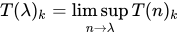
That is the th cell at time is the limit supremum of that same cell as the machine approaches . This can be thought of as the limit if it converges or otherwise.

Zeno machines have been proposed as a model of computation more powerful than classical Turing machines, based on their ability to solve the halting problem for classical Turing machines. Cristian Calude and Ludwig Staiger present the following pseudocode algorithm as a solution to the halting problem when run on a Zeno machine.
Zeno machine
In mathematics and computer science, Zeno machines (abbreviated ZM, and also called accelerated Turing machine, ATM) are a hypothetical computational model related to Turing machines that are capable of carrying out computations involving a countably infinite number of algorithmic steps. These machines are ruled out in most models of computation.
The idea of Zeno machines was first discussed by Hermann Weyl in 1927; the name refers to Zeno's paradoxes, attributed to the ancient Greek philosopher Zeno of Elea. Zeno machines play a crucial role in some theories. The theory of the Omega Point devised by physicist Frank J. Tipler, for instance, can only be valid if Zeno machines are possible.
A Zeno machine is a Turing machine that can take an infinite number of steps, and then continue take more steps. This can be thought of as a supertask where units of time are taken to perform the -th step; thus, the first step takes 0.5 units of time, the second takes 0.25, the third 0.125 and so on, so that after one unit of time, a countably infinite number of steps will have been performed.
A more formal model of the Zeno machine is the infinite time Turing machine. Defined first in unpublished work by Jeffrey Kidder and expanded upon by Joel Hamkins and Andy Lewis, in Infinite Time Turing Machines, the infinite time Turing machine is an extension of the classical Turing machine model, to include transfinite time; that is time beyond all finite time. A classical Turing machine has a status at step (in the start state, with an empty tape, read head at cell 0) and a procedure for getting from one status to the successive status. In this way the status of a Turing machine is defined for all steps corresponding to a natural number. An ITTM maintains these properties, but also defines the status of the machine at limit ordinals, that is ordinals that are neither nor the successor of any ordinal. The status of a Turing machine consists of 3 parts:
Just as a classical Turing machine has a labeled start state, which is the state at the start of a program, an ITTM has a labeled limit state which is the state for the machine at any limit ordinal. This is the case even if the machine has no other way to access this state, for example no node transitions to it. The location of the read-write head is set to zero for at any limit step. Lastly the state of the tape is determined by the limit supremum of previous tape states. For some machine , a cell and, a limit ordinal then
That is the th cell at time is the limit supremum of that same cell as the machine approaches . This can be thought of as the limit if it converges or otherwise.
Zeno machines have been proposed as a model of computation more powerful than classical Turing machines, based on their ability to solve the halting problem for classical Turing machines. Cristian Calude and Ludwig Staiger present the following pseudocode algorithm as a solution to the halting problem when run on a Zeno machine.