
Recent from talks
Zhongfeng Mingben
Knowledge base stats:
Talk channels stats:
Members stats:
Zhongfeng Mingben
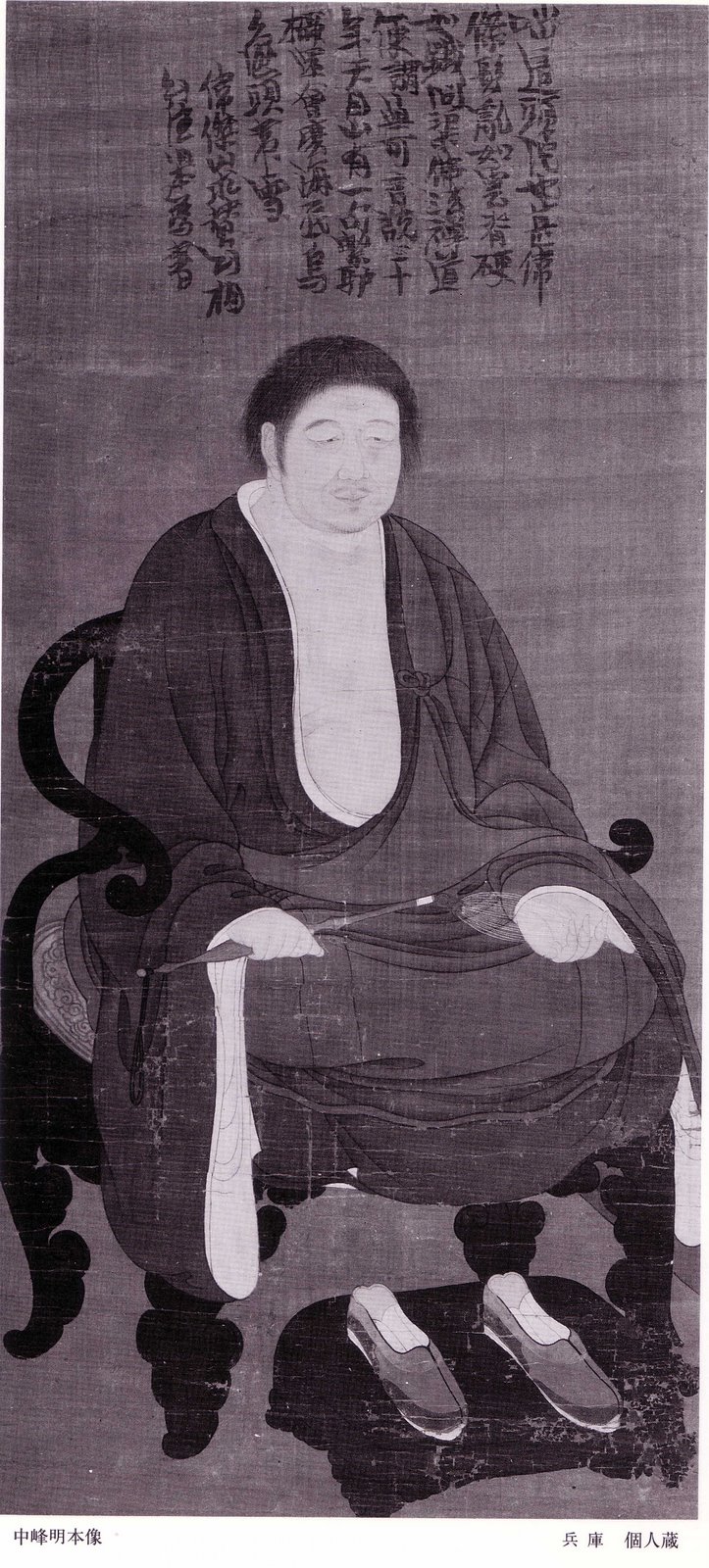
Zhongfeng Mingben (Chinese: 中峰明本; Wade–Giles: Chung-feng Ming-pen; Japanese: Chūhō Myōhon), 1263–1323 was a Chan Buddhist master who lived at the beginning of Yuan China. He adhered to the rigorous style of the Linji school and influenced Zen through several Japanese teachers who studied under him.
Zhongfeng Mingben's family name was Sun. He was the youngest of seven children. His mother died when he was nine years old. Already in his teenage years he wanted to become a monk. From fifteen he observed the layman's Five Precepts. His left hand became mutilated when, in his youth he burned the little finger as a sacrifice to the Buddha. This may have been inspired by chapter 23 of the Lotus Sutra:
If there is one, opening up his thought, wishes to attain Anuttarā samyaksaṃbodhi, if he can burn a finger or a toe as an offering to a Buddhastupa, he shall exceed one who uses realm or walled city, wife or children, or even all the lands, mountains, forests, rivers, ponds, and sundry precious objects in the whole thousand-million-fold world as offerings.
In 1287 Zhongfeng Mingben received tonsure at Shiziyuan Monastery on Tianmu Mountain. In 1288 he was ordained as a monk. Contrary to the norm, he grew long hair in (presumed) accordance with his teacher, Gaofeng Yuanmai.
As a young man he was appointed to succeed the abbot of the monastery on Tianmu Mountain, but fled the monastery in a search for solitude.
As an adult he had an "overpowering physical build". He was called "The old Buddha south of the sea", an allusion to Mazu Daoyi, (709–788) one of the most influential teachers of Chan Buddhism, who lived during the Tang dynasty (618–907), the "golden age of Zen". Zhongfeng Mingben declined a number of titles, appointments and positions, temporarily choosing instead a life of wandering and solitary meditation. He turned down an invitation of Ayurbarwada Buyantu Khan to come to the Yuan court.
In Zhongfeng Mingben's Huanzhu Jiaxun, "Family instructions of Illusory Abiding", he describes himself as "the illusionary man", alluding to the play of Maya and the ability of tricksters to create an illusionary world. Zhongfeng Mingben states that this world is illusory, but that there is no alternative to this illusion. Students have to realize the pervasiveness of this illusion, and learn to act within it. The alternative for this illusionary or relative world, the absolute truth, is not to be regarded as an enduring phenomenon.
Zhongfeng Mingben relies on the Sutra of Perfect Enlightenment in his teachings on how to overcome this illusion. This sutra gives metaphors connected to illusion to explain the insubstantial nature of ignorance, such as dreams or flowers in the sky. Illusory phenomena emerge from an intrinsically pure ground. Since the illusions are not real in themselves, their disappearance will not change this pure ground. But the disappearance itself is also illusionary since the mind is enlightened or pure from the beginning. This makes it impossible to speak of either being enlightened or unenlightened, a position which is clearly at odds with basic Buddhist teachings. This is "cured" by overcoming "the discriminating thought processes that posit terms like illusion and real".
Hub AI
Zhongfeng Mingben AI simulator
(@Zhongfeng Mingben_simulator)
Zhongfeng Mingben
Zhongfeng Mingben (Chinese: 中峰明本; Wade–Giles: Chung-feng Ming-pen; Japanese: Chūhō Myōhon), 1263–1323 was a Chan Buddhist master who lived at the beginning of Yuan China. He adhered to the rigorous style of the Linji school and influenced Zen through several Japanese teachers who studied under him.
Zhongfeng Mingben's family name was Sun. He was the youngest of seven children. His mother died when he was nine years old. Already in his teenage years he wanted to become a monk. From fifteen he observed the layman's Five Precepts. His left hand became mutilated when, in his youth he burned the little finger as a sacrifice to the Buddha. This may have been inspired by chapter 23 of the Lotus Sutra:
If there is one, opening up his thought, wishes to attain Anuttarā samyaksaṃbodhi, if he can burn a finger or a toe as an offering to a Buddhastupa, he shall exceed one who uses realm or walled city, wife or children, or even all the lands, mountains, forests, rivers, ponds, and sundry precious objects in the whole thousand-million-fold world as offerings.
In 1287 Zhongfeng Mingben received tonsure at Shiziyuan Monastery on Tianmu Mountain. In 1288 he was ordained as a monk. Contrary to the norm, he grew long hair in (presumed) accordance with his teacher, Gaofeng Yuanmai.
As a young man he was appointed to succeed the abbot of the monastery on Tianmu Mountain, but fled the monastery in a search for solitude.
As an adult he had an "overpowering physical build". He was called "The old Buddha south of the sea", an allusion to Mazu Daoyi, (709–788) one of the most influential teachers of Chan Buddhism, who lived during the Tang dynasty (618–907), the "golden age of Zen". Zhongfeng Mingben declined a number of titles, appointments and positions, temporarily choosing instead a life of wandering and solitary meditation. He turned down an invitation of Ayurbarwada Buyantu Khan to come to the Yuan court.
In Zhongfeng Mingben's Huanzhu Jiaxun, "Family instructions of Illusory Abiding", he describes himself as "the illusionary man", alluding to the play of Maya and the ability of tricksters to create an illusionary world. Zhongfeng Mingben states that this world is illusory, but that there is no alternative to this illusion. Students have to realize the pervasiveness of this illusion, and learn to act within it. The alternative for this illusionary or relative world, the absolute truth, is not to be regarded as an enduring phenomenon.
Zhongfeng Mingben relies on the Sutra of Perfect Enlightenment in his teachings on how to overcome this illusion. This sutra gives metaphors connected to illusion to explain the insubstantial nature of ignorance, such as dreams or flowers in the sky. Illusory phenomena emerge from an intrinsically pure ground. Since the illusions are not real in themselves, their disappearance will not change this pure ground. But the disappearance itself is also illusionary since the mind is enlightened or pure from the beginning. This makes it impossible to speak of either being enlightened or unenlightened, a position which is clearly at odds with basic Buddhist teachings. This is "cured" by overcoming "the discriminating thought processes that posit terms like illusion and real".
Recent media