


Community hub
Recent from talks
Contribute something
Nothing was collected or created yet.
Master System
View on Wikipedia
  | |
  
| |
| Also known as | SEGA Master System |
|---|---|
| Developer | Sega |
| Manufacturer | Sega |
| Type | Home video game console |
| Generation | Third |
| Release date | |
| Lifespan | |
| Introductory price | ¥16,800 (equivalent to ¥20,000 in 2019) US$200 (equivalent to $570 in 2024) £99.95 (equivalent to £360 in 2023) |
| Units sold | 10-13 million[10][11][a] |
| Media | ROM cartridge, Sega Card |
| CPU | Zilog Z80A @ 3.58 MHz |
| Memory | 8 KB RAM 16 KB VRAM |
| Display | 256 × 192 resolution, 32 colors on-screen |
| Sound | Texas Instruments SN76489 PSG via VDP Yamaha YM2413[b] |
| Backward compatibility | SG-1000[b] |
| Predecessor | SG-1000[b] |
| Successor | Sega Genesis |
| Related | Game Gear |
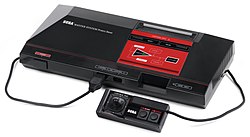
The Master System[c] is an 8-bit home video game console manufactured and developed by Sega. It was originally a remodeled export version of the Sega Mark III, the third iteration of the SG-1000 series of consoles, released in Japan in 1985. The Master System launched in North America in 1986, followed by Europe in 1987 and Brazil and Korea in 1989. A Japanese version was launched in 1987, with additions including a built-in FM audio chip, a rapid-fire switch, and a dedicated port for the 3D glasses. The Master System II, a cheaper model, was released in 1990 in North America, Australasia, and Europe.
The original Master System models use both cartridges and a credit card-sized format, Sega Cards. Accessories include a light gun and 3D glasses that work with specially designed games. The later Master System II redesign removed the card slot, turning it into a strictly cartridge-only system, and is incompatible with the 3D glasses.
As a third-generation console, the Master System was released in competition with the Nintendo Entertainment System (NES). Its library is smaller and with fewer well-reviewed games than the NES, due in part to Nintendo licensing policies requiring platform exclusivity. Though the Master System had newer, improved hardware, it failed to overturn Nintendo's market share advantage in Japan and North America. However, it attained greater success in other markets, including Europe, Brazil, South Korea, New Zealand, and Australia.
The Master System is estimated to have sold between 10-13 million units worldwide. In addition, Tectoy has sold 8 million licensed Master System variants in Brazil. Retrospective criticism has recognized its role in the development of the Sega Genesis, and a number of well-received games, particularly in PAL (including PAL-M) regions, but is critical of its limited library in the NTSC regions, which were dominated by the NES.
History
[edit]
Mark III
[edit]Sega released its first video game console, the SG-1000, in Japan on July 15, 1983,[18] the same day its competitor Nintendo launched the Family Computer (Famicom).[19] In 1984, parent company Gulf and Western Industries divested its non-core businesses including Sega,[20] and Sega president Hayao Nakayama was installed as CEO. Nakayama and Sega co-founder David Rosen later arranged a management buyout with financial backing from CSK Corporation, and installed CSK CEO Isao Okawa as chairman.[21][22]
_(1985-1997).png)
On July 31, 1984, Sega released the SG-1000 II,[23] a revised version of the SG-1000 with several hardware alterations, including detachable controllers.[19] Hoping to better compete with Nintendo,[24] Sega released the Mark III, another revision of the SG-1000,[25] in Japan on October 20, 1985 at ¥15,000.[2][3] The Mark III was engineered by the same team as the SG-1000,[26] including Hideki Sato and Masami Ishikawa, who had worked on the SG-1000 II and later led development of the Mega Drive.[27] According to Sato, the console was redesigned because of the limitations of the Texas Instruments TMS9918A graphics chip in the SG-1000, which did not have the power for the kinds of games Sega wanted to make. The Mark III's chip was designed in-house, based around the unit in Sega's System 2 arcade system board.[24]
Though its hardware was more powerful than the Famicom, the Mark III was not successful on launch. Problems arose from Nintendo's licensing practices with third-party developers, whereby Nintendo required that games for the Famicom not be published on other consoles. Sega developed its own games and obtained the rights to port games from other developers, but they did not sell well.[23]
North American release as Master System
[edit].jpg)
Though the SG-1000 had not been released in the United States,[28] Sega hoped that their console business would fare better in North America than it had in Japan.[29] To accomplish this, Sega of America was established in 1986 to manage the company's consumer products in North America. Rosen and Nakayama hired Bruce Lowry, Nintendo of America's vice president of sales. Lowry was persuaded to change companies because Sega would allow him to start his new office in San Francisco. He chose the name "Sega of America" for his division because he had worked for Nintendo of America and liked the combination of words. Initially, Sega of America was tasked with repackaging the Mark III for a Western release.[30] Sega of America rebranded the Mark III as the Master System, similar to Nintendo's reworking of the Famicom into the Nintendo Entertainment System (NES). The name was chosen by Sega of America employees throwing darts against a whiteboard of suggested names. Plans to release a cheaper console, the Base System, also influenced the decision.[31] Okawa approved of the name after being told it was a reference to the competitive nature of both the video game industry and martial arts, in which only one competitor can be the "Master".[30][31] The console's futuristic final design was intended to appeal to Western tastes.[26] The North American packaging was white to differentiate it from the black NES packaging, with a white grid design inspired by Apple computer products.[32]
The Master System was first revealed in North America at the Summer Consumer Electronics Show (CES) in Chicago in June 1986. It was later launched in September 1986 at a price of $200 (equivalent to $570 in 2024), initially sold in a package with the "Power Base" console, a light gun, two controllers, and a pack-in multicart with the games Hang-On and Safari Hunt.[33][34] Around the same time, Nintendo was exporting the Famicom to the US as the Nintendo Entertainment System, and both Sega and Nintendo planned to spend $15 million in late 1986 to market their respective consoles; Sega hoped to sell 400,000 to 750,000 consoles in 1986.[35] By the end of 1986, at least 125,000 Master System consoles had been sold, more than the Atari 7800's 100,000 but less than Nintendo's 1.1 million.[5] Other sources indicate that more than 250,000 Master System consoles were sold by Christmas 1986.[36]
As in Japan, the Master System in North America had a limited game library. Limited by Nintendo's licensing practices, Sega only had two third-party American publishers, Activision and Parker Brothers.[23] Agreements with both of those companies came to an end in 1989.[30] Sega claimed that the Master System was the first console "where the graphics on the box are actually matched by the graphics of the game",[35] and pushed the "arcade experience" in adverts.[26] However, its marketing department was run by only two people, giving Sega a disadvantage in advertising.[26] As one method of promoting the console, at the end of 1987 Sega partnered with astronaut Scott Carpenter to start the "Sega Challenge", a traveling program set up in recreational centers where kids were tested on non-verbal skills such as concentration and the ability to learn new skills. Out Run and Shooting Gallery were two games included in the challenge.[37]
In 1987, amid struggling sales in the US,[30] Sega sold the US distribution rights for the Master System to toy company Tonka, which had no experience with electronic entertainment systems.[23] Sega had made the deal in order to leverage Tonka's knowledge of the American toy market, since Nintendo had marketed the NES as a toy to great success in North America.[30] The announcement was made shortly after the 1987 Summer CES.[38] During this time, much of Sega of America's infrastructure shifted from marketing and distribution to focus on customer service, and Lowry departed the company.[30] Tonka blocked localization of several popular Japanese games,[23] and during 1988 were less willing to purchase EPROMs needed for game cartridge manufacture during a shortage. They also became less willing to invest in video games after taking massive loans in purchasing Kenner Toys in 1987, followed by poor holiday season sales and financial losses.[30][23]
On October 18, 1987, the Mark III was re-released as the Master System in Japan for ¥16,800,[6] but still sold poorly.[23] Neither model posed a serious challenge to Nintendo in Japan,[12] and, according to Sato, Sega was only able to attain 10% of the Japanese console market.[24]
Europe, Brazil, and other markets
[edit]The Master System was launched in Europe in August 1987,[4] distributed by Mastertronic in the United Kingdom, Master Games in France, and Ariolasoft in West Germany,[39] the latter of whom had initially purchased UK distribution rights.[40][41][42] As Ariolasoft could not agree to a pricing agreement with Sega, Mastertronic signed a deal in 1987 to take control of UK distribution, and announced the deal at the 1987 Summer CES. The company announced the release of 12 titles by autumn.[43] Mastertronic advertised the Master System as "an arcade in the home" and launched it at £99 (equivalent to £350 in 2023). Advance orders from retailers were high, but Sega proved unable to deliver inventory until Boxing Day on December 26, causing many retailers to cancel their orders. Mastertronic and Master Games entered financial crises and Ariolasoft vowed never to work with Sega again. Mastertronic had already sold a minority interest to the Virgin Group to enter the console business, and sold the remainder to avoid bankruptcy. The newly rebranded Virgin Mastertronic took over all European distribution in 1988.[39]
Virgin Mastertronic focused marketing the Master System on ports of Sega's arcade games and positioning it as a superior video game alternative to the Commodore 64 and the ZX Spectrum computers. As a result of this marketing, coupled with Nintendo's less effective early approaches in Europe, the Master System began to attract European developers.[44] The Master System held a significant part of the video game console market in Europe until the release of Sega's succeeding console, the Mega Drive.[d][23][44] In 1989, Virgin Mastertronic began offering rentals of the Master System console and 20 games. The United Kingdom also hosted a Sega video games national championship, with the winner competing against Japanese and American champions on the British television show Motormouth. Players competed in a variety of games, including Astro Warrior, platform games, and sports games.[45] During the late 1980s, the Master System was outselling the NES in the United Kingdom.[46]
The Master System was successful in Europe, becoming the best-selling console in the region by 1990; by that time, however, the NES was beginning to have a fast-growing user base in the UK.[47] In 1990 alone, Virgin Mastertronic sold 150,000 Master Systems in the United Kingdom, greater than the 60,000 Mega Drives and Nintendo's 80,000 consoles sold in the same period. In the whole of Europe that year, Sega sold a combined 918,000 consoles, greater than Nintendo's 655,000.[48]
The Master System was also successful in Brazil, where launched in September 1989[8] and was distributed by Tectoy,[23][44] a Brazilian toy company startup focused on electronic toys. Tectoy had reached out to Sega about distributing their products and, despite Sega's hesitation given their situation with Tonka in the US, was eventually given liberty to manage Sega products in Brazil. Their success distributing Sega's laser tag gun based on the anime Zillion gave Sega the confidence to allow Tectoy to distribute the Master System.[49] By the end of 1990, the installed base in Brazil was about 280,000 units.[50] Tectoy introduced a telephone service with game tips, created a Master System club, and presented the program Master Tips during commercial breaks of the television show Sessão Aventura on Rede Globo.[8] Nintendo did not arrive in Brazil until 1993,[51] and were unable to officially compete, as clones of the NES dominated the Brazilian market.[52] Tectoy claimed 80% of the Brazilian video game market.[49]
In South Korea, the Sega Mark III was released by Samsung under the name "Gam*Boy" in April 1989, followed by the Master System II, under the name "Aladdin Boy", in 1992.[7] By 1993, it had sold 720,000 units in South Korea, outselling the NES (released in the region by Hyundai Group as the "Comboy") and becoming the best-selling console in the region until 1993.[15] The Master System was also popular in New Zealand[53] and Australia; in the latter country, it was more successful than the NES,[54] with 250,000 units sold there during 1990 alone.[55] By November 1994, 650,000 units had been sold in Australia.[16]
Decline
[edit]


Although the Master System was a success in Europe, and later in Brazil, it failed to ignite significant interest in the Japanese or North American markets, which, by the mid-to-late 1980s, were both dominated by Nintendo,[21][56][57] who held 83 percent of the North American video game market by 1988.[58] With Sega continuing to have difficulty penetrating the home market, Sega's console R&D team, led by Ishikawa and supervised by Sato,[59] began work on a successor to the Master System almost immediately after the system's launch.[60][61] Another competitor in Japan arose in 1987, when Japanese computer giant NEC released the PC Engine (later released in North America as the TurboGrafx-16) amid great publicity.[62]
Sega released its next console, the 16-bit Mega Drive, in Japan on October 29, 1988.[63] The final licensed release for the Master System in Japan was Bomber Raid in 1989.[23] That same year, Sega was preparing to release the new Mega Drive as the Sega Genesis in North America. Displeased with Tonka's handling of the Master System, Sega reacquired the marketing and distribution rights to the Master System for the United States. In 1990, Sega released the remodeled Master System II, designed as a lower-cost version without the Sega Card slot.[23][34] Sega promoted the new model, but it sold poorly.[23] By early 1992, production of the Master System had ceased in North America, having sold between 1.5 million and 2 million units,[13][64] behind both Nintendo and Atari, which controlled 80 percent and 12 percent of the market respectively.[65] The last licensed Master System release in North America was Sonic the Hedgehog (1991).[23][66]
In Europe, where the Master System was the best-selling console up until 1990,[47][48] the NES caught up with and narrowly overtook the Master System in Western Europe during the early 1990s; however, the Master System maintained its lead in several markets such as the UK, Belgium, and Spain.[67] In 1993, the Master System's estimated active installed user base in Europe was 6.25 million units, larger than that of the Mega Drive's 5.73 million that year but less than the NES's 7.26 million.[14] Combined with the Mega Drive, Sega represented the majority of the European console market that year.[68] The Master System II was also successful and helped Sega to sustain their significant market share. Releases in Europe continued into the 1990s, including Mercs, Sonic the Hedgehog 2 (both 1992), and Streets of Rage 2 (1994).[23]
The Master System has had continued success in Brazil, where dedicated "plug and play" consoles emulating the original hardware continue to be sold by Tectoy, including portable versions. These systems include the Master System Compact[23] and the Master System III,[69] and Tectoy has also received requests to remake the original Master System.[49] In 2012, UOL reported that Tectoy re-releases of the Master System and Mega Drive combined sold around 150,000 units per year in Brazil.[70][71] By 2016, Tectoy said they had sold 8 million units of Master System branded systems in Brazil.[17]
Technical specifications
[edit]The Master System's main CPU is an 8-bit Zilog Z80A rated for 4 MHz, but runs at 3.58 MHz. It has 8 KB of ROM, 8 KB of RAM and 16 KB of video RAM (VRAM). Video is provided through an RF switch (though Model 1s with an AV port can also output composite and even RGB video) and displays at a resolution of 256 × 192 pixels and up to 32 colors at one time from a total palette of 64 colors;[6] the Video Display Processor (VDP) graphics chip was designed by Sega for the Mark III.[24] The Master System measures 365 mm × 170 mm × 70 mm (14.4 in × 6.7 in × 2.8 in),[6] while the Mark III measures 318 mm × 145 mm × 52 mm (12.5 in × 5.7 in × 2.0 in).[2] Both consoles use two slots for game input: one for Mega Cartridges and one for Sega Cards, along with an expansion slot and two controller ports.[6][2] Sound is provided by the Texas Instruments SN76489 PSG built into the VDP, which can provide three square wave channels and one noise channel. The Japanese version also integrates the Yamaha YM2413 FM chip,[6] an optional feature on the Mark III. With few exceptions, Master System hardware is identical to the hardware in the Mark III. Games for the console are playable on the Sega Genesis using the Power Base Converter accessory,[23] and on the Game Gear using the Master Gear Converter.[72] Compared to the base NES, the Master System has four times as much system memory, eight times as much video memory, and a higher CPU clock rate.[26]
Sega produced several iterations of the Master System. The Master System II, released in 1990, removed a number of components to reduce cost: the Sega Card slot, reset button, power light, expansion port, and startup music and logo.[34] In most regions, the Master System II's A/V port was omitted, leaving only RF output available; this was reversed in France, where the local version of the Master System II had only A/V video output available and omitted the RF hardware.[73] In Brazil, Tectoy released several licensed variations; the Master System Super Compact functions wirelessly with an RF transmitter, and the Master System Girl, molded in bright pink plastic, was targeted at girls. The Master System 3 Collection, released in 2006, contains 120 built-in games.[69] Handheld versions of the Master System were released under several brands, such as Coleco in 2006.[74]
Accessories
[edit] |
 |
 |
Master System controllers |
Light Phaser |
SegaScope 3-D glasses
|
A number of cross-compatible accessories were created for the Mark III and Master System. The controller consists of a rectangle with a D-pad and two buttons. Sega also introduced additional Mark III controllers, such as a paddle controller.[75] A combination steering wheel and flight stick, the Handle Controller, was released in 1989. The Sega Control Stick is an arcade-style joystick with the buttons on the opposite side as the standard controller. Unreleased in Europe, the Sega Sports Pad utilizes a trackball and is compatible with three games. Sega also created an expansion for its controller, the Rapid Fire Unit, that allows for auto-fire by holding down one of two buttons. This unit connects between the console and the controller.[76] A light gun peripheral, the Light Phaser,[34] was based on the weapon of the same name from the Japanese anime Zillion.[69] It is compatible with 13 games and released exclusively in the West.[76]
A pair of 3D glasses, the SegaScope 3-D, were created for games such as Space Harrier 3-D, although Mark III users need an additional converter to use them. The SegaScope 3-D works via an active shutter 3D system, creating a stereoscopic effect.[77] The glasses need to be connected to the Sega Card slot, and thus do not function with the Master System II due to lack of the card slot. A total of eight games, including Zaxxon 3-D and OutRun 3-D, are compatible with the glasses.[76]
The Mark III has an optional RF transmitter accessory, allowing wireless play that broadcasts the game being played on a UHF television signal.[78]
Game Gear
[edit]
Developed under the name "Project Mercury"[72] and designed based on the Master System's hardware,[79] the Game Gear is a handheld game console. It was first released in Japan on October 6, 1990,[10] in North America and Europe in 1991, and in Australia and New Zealand in 1992.[72] Originally retailing at JP¥19,800 in Japan,[10] $149.99 in North America, and £99.99 in the United Kingdom,[72] the Game Gear was designed to compete with the Game Boy, which Nintendo had released in 1989.[80] There are similarities between the Game Gear and the Master System hardware; Master System games are playable on Game Gear using the Master Gear Converter accessory.[81] A large part of the Game Gear's game library consists of Master System ports. Because of hardware similarities, including the landscape screen orientation, Master System games are easily portable to the handheld.[72] In particular, many Master System ports of Game Gear games were done by Tectoy for the Brazilian market, as the Master System was more popular than the Game Gear in the region.[49]
Game library
[edit]
Master System games came in two formats: ROM cartridges held up to 4 Mbit (512 KB) of code and data, while Sega Cards held up to 256 Kbit (32 KB). Cartridges were marketed by their storage size: One Mega (1 Mbit), Two Mega (2 Mbit), and Four Mega (4 Mbit). Cards, cheaper to manufacture than the cartridges, included Spy vs. Spy and Super Tennis,[23][34] but were eventually dropped due to their small memory size.[24] The size of the release library varies based on region; North America received just over 100 games, with Japan receiving less. Europe, by contrast, received over 300 licensed games, including 8-bit ports of Genesis games and PAL-exclusive releases.[76] The first Mark III-specific cartridge was Fantasy Zone, released on June 15, 1986,[82] and Bomber Raid was the final release on February 4, 1989, a few months after the launch of the Mega Drive.[82] The final North American release was Sonic the Hedgehog in October 1991.[23][66] Games for PAL regions continued to be released until the mid-1990s.[23][76]
The Sega Mark III and the Japanese Master System[clarification needed] are backwards-compatible with SC-3000/SG-1000 cartridges, and can play Sega Card games without the Card Catcher peripheral.[2][6] However, educational and programming cartridges for the SC-3000 require the SK-1100 keyboard peripheral, which is compatible with the Mark III.[83] Mark III-specific games were initially available in card format (labelled My Card Mark III to distinguish themselves from games designed for the SC-3000/SG-1000), starting with Teddy Boy Blues and Hang-On, both released on October 20, 1985.[82]
Of the games released for the Master System, Phantasy Star is considered a benchmark role-playing game (RPG), and became a successful franchise.[84] Sega's flagship character at the time, Alex Kidd, was featured in games including Alex Kidd in Miracle World. Wonder Boy III: The Dragon's Trap was influential for its blend of platform gameplay with RPG elements.[85] Different Master System consoles included built-in games, including Snail Maze, Hang-On/Safari Hunt, Alex Kidd in Miracle World and Sonic the Hedgehog.[23] Battery-backup save game support was included in eight cartridges, including Penguin Land, Phantasy Star, Ys, and Miracle Warriors.[82]
The more extensive PAL region library includes 8-bit entries in Genesis franchises such as Streets of Rage,[76] a number of additional Sonic the Hedgehog games,[66] and dozens of PAL exclusives such as The Lucky Dime Caper Starring Donald Duck, Asterix, Ninja Gaiden, Master of Darkness, and Power Strike II.[76] Retro Gamer's Damien McFerran praised the "superb" PAL library of "interesting ports and excellent exclusives", which was richer than the North American library and provided a "drip-feed of quality titles".[23]
After the Master System was discontinued in other markets, additional games were released in Brazil by Tectoy, including ports of Street Fighter II: Champion Edition and Dynamite Headdy.[23] Tectoy created Portuguese translations of games exclusive to the region. Some of these would tie in to popular Brazilian entertainment franchises; for example, Teddy Boy became Geraldinho, certain Wonder Boy titles became Monica's Gang games, and Ghost House became Chapolim vs. Dracula: Um Duelo Assutador, based on the Mexican TV series El Chapulín Colorado. Tectoy also ported games to the Master System, including various games from the Genesis and Game Gear.[86][52] Aside from porting, the company developed Férias Frustradas do Pica-Pau after finding out that Woody Woodpecker (named Pica-Pau in Portuguese) was the most popular cartoon on Brazilian television,[86] along with at least twenty additional exclusives.[76] These titles were developed in-house by Tectoy in Brazil.[86]
Due in part to Nintendo's licensing practices, which stipulated that third-party NES developers could not release games on other platforms, few third-party developers released games for the Master System.[23] According to Sato, Sega was focused on porting its arcade games instead of building relationships with third parties.[24] According to Sega designer Mark Cerny, most of Sega's early Master System games were developed within a strict three-month deadline, which affected their quality.[87][88][89] Computer Gaming World compared new Sega games to "drops of water in the desert".[90] Games for the Master System took advantage of more advanced hardware compared to the NES; Alex Kidd in Miracle World, for example, showcases "blistering colors and more detailed sprites" than NES games.[91][92] The Master System version of R-Type was praised for its visuals, comparable to those of the TurboGrafx-16 port.[93]
In 2005, Sega reached a deal with the company AtGames to release emulated Master System software in Taiwan, Hong Kong, and China.[94] Several Master System games were released for download on Nintendo's Wii Virtual Console, beginning with Hokuto no Ken in 2008 in Japan and Wonder Boy in North America.[95] Master System games were also released via the GameTap online service.[96]
Reception and legacy
[edit]Due to the continued release of new variants in Brazil, the Master System is considered by many video gaming publications to be the longest lived gaming console in video games history, a title it took from the Atari 2600.[97][98][99] Sales of the Master System have been estimated between 10 million and 13 million units, not including later Brazil sales.[10][11] It saw much more continued success in Europe and Brazil than it did in Japan and North America.[23] In 1989, the Master System was listed in the top 20 products of NPD Group's Toy Retail Sales Tracking Service.[100] However, the Electronic Gaming Monthly 1992 Buyer's Guide indicated a souring interest in the console. Four reviewers scored it 5, 4, 5, and 5 out of a possible 10 points each, focusing on the better value of the Genesis and lack of quality games for the Master System.[101] In 1993, reviewers scored it 2, 2, 3, and 3 out of 10, noting its abandonment by Sega in North America and lack of new releases.[102] By contrast, over 34 million NES units were sold in North America alone, outselling the Master System's life time units globally nearly three times over.[103][11] According to Bill Pearse of Playthings, the NES gained an advantage through better software and more recognizable characters.[104] Sega closed the gap with Nintendo in the next generation with the release of the Genesis, which sold 30.75 million consoles compared with the 49 million Super Nintendo Entertainment System consoles.[105][106]
Retrospective feedback of the Master System praises its support toward development of the Sega Genesis, but has been critical of its small game library. Writing for AllGame, Dave Beuscher noted that the Master System "was doomed by the lack of third-party software support and all but disappeared from the American market by 1992."[34] Retro Gamer writer Adam Buchanan praised the larger PAL library as a "superb library of interesting ports and excellent exclusives".[76] Damien McFerran, also of Retro Gamer, recognized its importance to the success of the Genesis, stating, "Without this criminally undervalued machine, Sega would not have enjoyed the considerable success it had with the Mega Drive. The Master System allowed Sega to experiment with arcade conversions, original IP and even create a mascot in the form of the lovable monkey-boy Alex Kidd."[23] In 2009, the Master System was named the 20th best console of all time by IGN, behind the Atari 7800 (17th) and the NES (1st). IGN cited the Master System's small and uneven NTSC library as the major problems: "Months could go by between major releases and that made a dud on the Master System feel even more painful."[107]
Notes
[edit]References
[edit]- ^ "家庭用 컴퓨터 시판". 매일경제. October 13, 1988. Retrieved September 21, 2022.
- ^ a b c d e "Sega Mark III". Sega Hard Encyclopedia (in Japanese). Sega Corporation. Archived from the original on July 12, 2018. Retrieved February 13, 2025.
- ^ a b c Gamers High! Futabasha Super Mook (in Japanese). Futabasha. 2015. p. 55. ISBN 978-4-575-45554-0.
- ^ a b "Sega Release Schedule to November 1987 - UK" (PDF). Computer and Video Games. No. 73. November 1987. p. 132.
- ^ a b "Comparing the New Videogame Systems". Computer Entertainer. Vol. 5, no. 11. February 1987. p. 13.
- ^ a b c d e f g "Master System". Sega Hard Encyclopedia (in Japanese). Sega Corporation. Archived from the original on July 12, 2018. Retrieved February 13, 2025.
- ^ a b Derboo, Sam (July 13, 2010). "A History of Korean Gaming: Part 1". Hardcore Gaming 101. Retrieved December 4, 2021.
- ^ a b c "Master System completa 20 anos de vida no Brasil". Universo Online (in Portuguese). Grupo Folha. September 4, 2009. Archived from the original on February 27, 2014. Retrieved February 21, 2014.
- ^ "The SEGA Master System in Brazil: History of a Forgotten Video Game Console". Munib Rezaie: Media Blog and Academic Portfolio. January 25, 2022. Archived from the original on September 22, 2022. Retrieved September 21, 2022.
- ^ a b c d Forster, Winnie (2005). The Encyclopedia of Game Machines: Consoles, Handhelds, and Home Computers 1972–2005. Magdalena Gniatczynska. p. 139. ISBN 3-00-015359-4.
- ^ a b c Buchanan, Levi (March 20, 2009). "Genesis vs. SNES: By the Numbers". IGN. Ziff Davis. Archived from the original on March 2, 2014. Retrieved March 31, 2014.
- ^ a b Nihon Kōgyō Shinbunsha (1986). "Amusement". Business Japan. 31 (7–12). Nihon Kogyo Shimbun: 89. Retrieved January 24, 2012.
- ^ a b Sheff, David (1993). Game Over (1st ed.). New York, New York: Random House. p. 349. ISBN 0-679-40469-4. Retrieved January 16, 2012.
- ^ a b "Sega Consoles: Active installed base estimates". Screen Digest. Screen Digest Ltd.: 60 March 1995.
- ^ a b 게임월드 [Game World] (in Korean). 1994.
- ^ a b "Sega's Secrets". Sega MegaZone. Australia: Mason Stewart Publishing Pty Ltd. November 1994. p. 23.
- ^ a b Azevedo, Théo (May 12, 2016). "Console em produção há mais tempo, Master System já vendeu 8 mi no Brasil" [Console in production for a longer time, Master System has sold 8 million in Brazil]. Universo Online (in Portuguese). Grupo Folha. Archived from the original on May 14, 2016. Retrieved May 13, 2016.
Comercializado no Brasil desde setembro de 1989, o saudoso Master System já vendeu mais de 8 milhões de unidades no país, segundo a Tectoy.
- ^ "SG-1000". Sega Hard Encyclopedia (in Japanese). Sega Corporation. Archived from the original on July 11, 2018. Retrieved February 13, 2025.
- ^ a b Kohler, Chris (October 2009). "Playing the SG-1000, Sega's First Game Machine". Wired. Condé Nast Publications. Archived from the original on January 1, 2014. Retrieved October 5, 2009.
- ^ "G&W Wins Cheers $1 Billion Spinoff Set". The Miami Herald. August 16, 1983. Archived from the original on November 10, 2013. Retrieved October 10, 2013 – via NewsBank.
- ^ a b Kent, Steven L. (2001). The Ultimate History of Video Games: The Story Behind the Craze that Touched our Lives and Changed the World. Roseville, California: Prima Publishing. pp. 303, 343, 360. ISBN 0-7615-3643-4.
- ^ Pollack, Andrew (July 4, 1993). "Sega Takes Aim at Disney's World". The New York Times. pp. 3–1. Archived from the original on May 26, 2015. Retrieved May 7, 2015.
- ^ a b c d e f g h i j k l m n o p q r s t u v w x y McFerran, Damien. "Retroinspection: Master System". Retro Gamer (44). London, UK: Imagine Publishing: 48–53. ISSN 1742-3155.
- ^ a b c d e f Sato, Hideki; Famitsu DC (February 15, 2002). "Interview: The Witness of History". セガ・コンシューマー・ヒストリー [Sega Consumer History]. Famitsu Books (in Japanese). Enterbrain. pp. 22–25. ISBN 978-4-75770789-4. (Translation by Shmuplations. Archived 2020-08-14 at the Wayback Machine).
- ^ Plunkett, Luke (February 27, 2012). "The Story of Sega's First Ever Home Console". Kotaku. Gawker Media. Archived from the original on September 15, 2014. Retrieved September 14, 2014.
- ^ a b c d e Parkin, Simon (June 2, 2014). "A history of video game hardware: Sega Master System". Edge. Future plc. Archived from the original on June 5, 2014. Retrieved September 13, 2014.
- ^ Sato (September 18, 2013). "Sega's Original Hardware Developer Talks About The Company's Past Consoles". Siliconera. Curse LLC. Archived from the original on December 2, 2013. Retrieved November 23, 2013.
- ^ Plunkett, Luke (January 19, 2017). "The Story of Sega's First Console, Which Was Not The Master System". Kotaku. Gizmodo Media Group. Archived from the original on March 6, 2017. Retrieved March 3, 2017.
- ^ Wolf, Mark (2012). Encyclopedia of Video Games: The Culture, Technology, and Art of Gaming · Volume 1. Greenwood Publishing Group. p. 553. ISBN 9780313379369.
- ^ a b c d e f g Horowitz, Ken (2016). Playing at the Next Level: A History of American Sega Games. McFarland & Company. pp. 4–15. ISBN 9781476625577.
- ^ a b "Bruce Lowry: The Man That Sold the NES". Game Informer. Vol. 12, no. 110. GameStop. June 2002. pp. 102–103.
- ^ Horowitz, Ken (2016). Playing at the Next Level: A History of American Sega Games. McFarland & Company. pp. 6–15. ISBN 9781476625577.
- ^ "New, Advanced Videogame Systems Revealed". Computer Entertainer. Vol. 5, no. 3. June 1986. p. 1.
- ^ a b c d e f Beuscher, David. "Sega Master System – Overview". AllGame. All Media Network. Archived from the original on January 2, 2010. Retrieved March 31, 2014.
- ^ a b Takiff, Jonathan (June 20, 1986). "Video Games Gain In Japan, Are Due For Assault On U.S." The Vindicator. p. 2. Archived from the original on April 3, 2017. Retrieved April 10, 2012.
- ^ Advokat, Stephen (January 30, 1987). "Consumers eat up successors to Pac-Man; video games being gobbled up". Detroit Free Press. p. 2B. Archived from the original on September 30, 2021. Retrieved December 31, 2020 – via Newspapers.com.
Sega came on the scene late, offering its Master System ($150) in late September. Even so, it sold more than 250,000 units by Christmas.
- ^ Sharpe, Roger (December 26, 1987). "Sega Challenge Travels Cross-Country Promoting Video". Cashbox. Vol. 51, no. 27. p. 126.
- ^ Sharpe, Roger (August 22, 1987). "Sega Makes News with Tonka Toy Announcement". Cashbox. pp. 35–36.
- ^ a b Hewison, Richard. "From the Archives: Virgin Games, Part 1". Retro Gamer (84). London, UK: Imagine Publishing: 50–55. ISSN 1742-3155.
- ^ "Ariola Sega link". Popular Computing Weekly. Vol. 5, no. 37. September 11, 1986. p. 6.
- ^ "News". Computer and Video Games. No. 62. December 1986. p. 9.
- ^ "The master". Your Computer. Vol. 6, no. 12. December 1986. p. 19.
- ^ "Mastertronic Ends Sega Saga". Popular Computing Weekly. Vol. 6, no. 22. June 5, 1987. p. 10.
- ^ a b c McFerran, Damien (July 22, 2014). "Hardware Classics: Sega Master System". Nintendo Life. Archived from the original on September 14, 2014. Retrieved September 13, 2014.
- ^ "Rent a Sega". New Computer Express. No. 56. December 2, 1989. p. 2.
- ^ "The rise and rise of Nintendo". New Computer Express. No. 39 (5 August 1989). August 3, 1989. p. 2.
- ^ a b "The Complete Machine Guide". Computer + Video Games: Complete Guide to Consoles. Vol. 4. November 1990. pp. 7–23.
- ^ a b "Segas sell better than Nintendos - official!". Sega Power. No. 18. May 1991. p. 6.
- ^ a b c d Sponsel, Sebastian (November 16, 2015). "Interview: Stefano Arnhold (Tectoy)". Sega-16. Ken Horowitz. Archived from the original on November 22, 2015. Retrieved November 30, 2015.
- ^ "Tec Toy lança no País o videogame Mega Drive". O Estado de S.Paulo (in Portuguese). Vol. 111, no. 35513. São Paulo: Grupo Estado. November 22, 1990. p. 81. ISSN 1516-2931. Archived from the original on March 4, 2016.
- ^ "Estrela e Gradiente trazem jogos Nintendo". Folha de S.Paulo (in Portuguese). Vol. 73, no. 23360. São Paulo: Grupo Folha. March 18, 1993. pp. 2–13. ISSN 1414-5723. Archived from the original on March 3, 2016.
- ^ a b Szczepaniak, John (November 2006). "Company Profile: Tec Toy". Retro Gamer. No. 30. Imagine Publishing. pp. 50–53. ISSN 1742-3155.
- ^ VIDEO GAMES AROUND THE WORLD EDITED BY MARK J.P. WOLF, Published by MIT Press, 2015, P.388
- ^ Biggs, Tim (July 11, 2017). "Nintendo's NES launched 30 years ago this month in Australia, or did it?". The Sydney Morning Herald. Retrieved October 5, 2021.
- ^ Cantlon, Gavin (November 17, 1991). "Cut-throat selling in video games". The Sydney Morning Herald. Archived from the original on September 30, 2021. Retrieved December 29, 2020 – via Newspapers.com.
Ozi Soft, [sic] has been distributing Sega video games since 1988 and also offers computer games. Christina Caddy, the company's public relations manager, said that last year it sold 250,000 units of the Sega Master system [sic], which carried an eight-bit console, at a recommended retail price of $99.
- ^ McGill, Douglas C. (December 4, 1988). "Nintendo Scores Big". The New York Times. Archived from the original on May 24, 2013. Retrieved March 27, 2009.
- ^ "How Sega Built the Genesis". Polygon. Vox Media. February 3, 2015. Archived from the original on November 3, 2015. Retrieved November 23, 2015.
- ^ Harris, Blake J. (2014). Console Wars: Sega, Nintendo, and the Battle That Defined a Generation. New York, New York: HarperCollins. p. 386. ISBN 978-0-06-227669-8.
- ^ Sato (September 18, 2013). "Sega's Original Hardware Developer Talks About The Company's Past Consoles". Siliconera. Curse LLC. Archived from the original on December 2, 2013. Retrieved November 23, 2013.
- ^ Fahs, Travis (April 21, 2009). "IGN Presents the History of Sega (page 4)". IGN. Ziff Davis. Archived from the original on February 21, 2014. Retrieved October 5, 2013.
- ^ Sczepaniak, John (2006). "Retroinspection: Mega Drive". Retro Gamer (27). London, UK: Imagine Publishing: 42–47. ISSN 1742-3155.
- ^ "16-Bit Hits – New video games offer better graphics, action". Minneapolis Star Tribune. October 15, 1991. Archived from the original on November 10, 2013. Retrieved April 7, 2014 – via NewsBank.
- ^ "Company News; Nintendo Suit by Atari Is Dismissed". The New York Times. May 16, 1992. Archived from the original on October 23, 2014. Retrieved September 19, 2014.
- ^ a b c Thorpe, Nick (March 22, 2014). "The History of Sonic on the Master System". Retro Gamer (179): 46–51.
- ^ "Finance & Business". Screen Digest. March 1995. pp. 56–62. Retrieved May 23, 2021.
- ^ "Total 8-bit and 16-bit Cartridge Consoles: Active installed base estimates". Screen Digest. Screen Digest Ltd.: 61 March 1995. (cf. here [1] Archived March 24, 2017, at the Wayback Machine and here [2] Archived March 24, 2017, at the Wayback Machine)
- ^ a b c Szczepaniak, John (2006). "Company Profile: Tec Toy". Retro Gamer (30). London, UK: Imagine Publishing: 50–53. ISSN 1742-3155.
- ^ Azevedo, Theo (July 30, 2012). "Vinte anos depois, Master System e Mega Drive vendem 150 mil unidades por ano no Brasil" [Twenty years later, Master System and Mega Drive sell 150,000 units a year in Brazil]. UOL (in Portuguese). Retrieved July 16, 2023.
- ^ Smith, Ernie (July 27, 2015). "Brazil Is An Alternate Video Game Universe Where Sega Beat Nintendo". Atlas Obscura. Archived from the original on June 21, 2017. Retrieved December 11, 2017.
- ^ a b c d e "Retroinspection: Sega Game Gear". Retro Gamer (41). London, UK: Imagine Publishing: 78–85. 2009. ISSN 1742-3155.
- ^ "SMS 2 RGB". www.smspower.org.
- ^ Ransom-Wiley, James (October 26, 2006). "Coleco Tiptoes Back with Sega-filled Handheld". Joystiq. AOL. Archived from the original on April 7, 2014. Retrieved April 22, 2010.
- ^ "Sega Mark III Controllers". Sega Hard Encyclopedia (in Japanese). Sega Corporation. Archived from the original on August 3, 2014. Retrieved February 12, 2014.
- ^ a b c d e f g h i Buchanan, Adam (July 2013). "The Collector's Guide: Sega Master System". Retro Gamer. pp. 20–31.
- ^ "SegaScope 3-D". Sega Hard Encyclopedia (in Japanese). Sega Corporation. Archived from the original on April 7, 2014. Retrieved February 12, 2014.
- ^ "Telecon Pack". Sega Hard Encyclopedia (in Japanese). Sega Corporation. Archived from the original on August 3, 2014. Retrieved February 12, 2014.
- ^ Buchanan, Levi (October 9, 2008). "Remember Game Gear?". IGN. Ziff Davis. Archived from the original on April 23, 2010. Retrieved March 29, 2009.
- ^ Beuscher, David. "Sega Game Gear – Overview". AllGame. All Media Network. Archived from the original on November 14, 2014. Retrieved July 8, 2013.
- ^ Dandumont, Pierre (November 26, 2017). "Ces jeux Game Gear qui sont en fait des jeux Master System". journaldulapin.com (in French). Archived from the original on September 30, 2021. Retrieved July 7, 2020.
- ^ a b c d "Software List". Sega Hard Encyclopedia (in Japanese). Sega Corporation. Archived from the original on June 21, 2019. Retrieved May 15, 2023.
- ^ "SK-1100". Sega Hard Encyclopedia (in Japanese). Sega Corporation. Archived from the original on February 22, 2014. Retrieved February 12, 2014.
- ^ Semrad, Steve (February 2, 2006). "The Greatest 200 Videogames of Their Time, Page 8". 1UP.com. Archived from the original on January 18, 2014. Retrieved December 11, 2016.
- ^ Mott, Tony (2013). 1001 Video Games You Must Play Before You Die. New York, New York: Universe Publishing. p. 177. ISBN 978-0-7893-2090-2.
- ^ a b c Sponsel, Sebastian (November 16, 2015). "Interview: Stefano Arnhold (Tectoy)". Sega-16. Ken Horowitz. Archived from the original on November 22, 2015. Retrieved November 30, 2015.
- ^ Horowitz, Ken (December 5, 2006). "Interview: Mark Cerny". Sega-16. Ken Horowitz. Archived from the original on October 17, 2014. Retrieved April 16, 2014.
- ^ Parkin, Simon (September 13, 2013). "Sonic the Hedgehog: past, present and future". The Guardian. Archived from the original on June 25, 2014. Retrieved June 6, 2014.
They made 40 games in this way ...But by my judgment only two were really worth playing.
- ^ Totilo, Stephen (March 10, 2014). "A Candid Talk With Mark Cerny, Who Designed The PS4, Among Other Things". Kotaku. Gizmodo Media Group. Archived from the original on June 4, 2014. Retrieved June 6, 2014.
- ^ Kunkel, Bill; Worley, Joyce; Katz, Arnie (November 1988). "Video Gaming World". Computer Gaming World. p. 54. ISSN 0744-6667. Archived from the original on April 5, 2016.
- ^ Buchanan, Levi (January 25, 2008). "Alex Kidd in Miracle World Review". IGN. Ziff Davis. Archived from the original on March 11, 2014. Retrieved March 31, 2014.
- ^ Mott, Tony (2013). 1001 Video Games You Must Play Before You Die. New York, New York: Universe Publishing. p. 108. ISBN 978-0-7893-2090-2.
- ^ "Retro Reviews: R-Type". Game Informer. Vol. 12, no. 114. GameStop. October 2002. p. 114.
- ^ "Sega expands distribution in Greater China". Screen Digest. Screen Digest Ltd. March 1, 2005. Archived from the original on September 21, 2014. Retrieved September 13, 2014.
- ^ "Cruis'n USA and Wonder Boy Now Available on Wii Shop Channel!". Nintendo. Archived from the original on July 23, 2008. Retrieved March 15, 2010.
- ^ Leupold, Tom (February 3, 2006). "Games on tap, or 'History of the Gaming World, Part I'". Oakland Tribune. Archived from the original on September 24, 2014.
- ^ "5 Consoles That Lasted The Longest (& 5 That Lasted The Shortest)". Game Rant. January 11, 2020. Archived from the original on September 30, 2021. Retrieved September 22, 2020.
- ^ "The 5 longest console lifespans". IGN Africa. January 17, 2014. Archived from the original on September 30, 2021. Retrieved September 22, 2020.
- ^ Adams, Kara Jane (July 26, 2020). "Sega Master System". Medium. Archived from the original on September 30, 2021. Retrieved September 22, 2020.
- ^ Leccesse, Donna (May 5, 1989). "Retailers say video is a dream come true; Nintendo is leading the way to better sales". Playthings. Sandow Media LLC. Archived from the original on September 21, 2014. Retrieved September 13, 2014.
- ^ Steve; Ed; Martin; Sushi-X (January 1992). "EGM Rates The Systems Of 1992!!!". Electronic Gaming Monthly. Sendai Publishing. p. 74.
- ^ Steve; Ed; Martin; Sushi-X (January 1993). "Electronic Gaming Monthly's Buyer's Guide". Electronic Gaming Monthly. Sendai Publishing. p. 32.
- ^ "Consolidated Sales Transition by Region" (PDF). Nintendo. March 2016. Archived (PDF) from the original on April 27, 2016. Retrieved September 12, 2022.
- ^ Pearse, Bill (January 1, 1992). "Nintendo and Sega gear up for battle. (Nintendo of America Inc. and Sega Inc. compete for 16-bit video game market; includes related articles) (Industry Overview)". Playthings. Sandow Media LLC. Archived from the original on October 28, 2014. Retrieved September 13, 2014.
- ^ Zackariasson, Peter; Wilson, Timothy L.; Ernkvist, Mirko (2012). "Console Hardware: The Development of Nintendo Wii". The Video Game Industry: Formation, Present State, and Future. Routledge. p. 158. ISBN 978-1-138-80383-1.
- ^ "Sonic Boom: The Success Story of Sonic the Hedgehog". Retro Gamer — the Mega Drive Book. London, UK: Imagine Publishing: 31. 2013. ISSN 1742-3155.
- ^ "Top 25 Videogame Consoles of All Time: SEGA Master System is Number 20". IGN. Ziff Davis. 2009. Archived from the original on February 22, 2014. Retrieved March 31, 2014.
| Arcade systems |  | |
|---|---|---|
| Video game consoles | ||
| Portable devices | ||
| Dual systems | ||
| Licensed consoles | ||
| Online gaming services | ||
| Accessories | ||
| Amusement venues | ||
| Related | ||


Master System
View on GrokipediaDevelopment and Release History
Japanese Origins as Mark III
Following the modest success of the SG-1000 and its SG-1000 II iteration in Japan, Sega sought to strengthen its position in the burgeoning home video game market by developing a more competitive console against Nintendo's dominant Family Computer (Famicom). The Mark III represented Sega's third-generation entry, building on the Z80-based architecture of its predecessors while incorporating enhancements to address the Famicom's superior graphics and sound capabilities. Engineered by Sega's internal hardware team, the console's development began in early 1985, with an announcement that year highlighting its cartridge compatibility and arcade-inspired features.[7][8] The Sega Mark III launched in Japan on October 20, 1985, priced at ¥15,000, making it a direct challenger to the Famicom in terms of affordability and performance. Initial sales were promising, with over one million units sold in Japan during its first year on the market by the end of 1986, though it still trailed far behind Nintendo's dominance. Sega's marketing emphasized backward compatibility with SG-1000 titles via a built-in card slot and promoted the system through bundles with popular arcade ports, leveraging the company's established reputation in coin-operated games to appeal to Japanese consumers.[7][9] Technically, the Mark III upgraded the SG-1000's core Z80 CPU, clocked at 3.58 MHz, with 8 KB of main RAM and 16 KB of video RAM for smoother gameplay. The standout improvement was the custom video display processor (VDP, model 315-5124), an evolution of the TMS9918A that supported resolutions up to 256x192 pixels, 16 colors on screen from a palette of 64, and up to 64 hardware sprites—features designed to rival the Famicom's visual fidelity. Audio was handled by the built-in Texas Instruments SN76489 programmable sound generator for four-channel PSG output, with an expansion slot allowing the optional FM Sound Unit featuring Yamaha's YM2413 chip for FM synthesis.[10][11] Launch titles underscored Sega's strategy of arcade-to-home transitions, including Hang-On, a motorcycle racing simulation, and TeddyBoy, a puzzle-platformer, both released on October 20, 1985, to showcase the system's capabilities in action-oriented gameplay. These games, available in both cartridge and Sega Card formats, helped drive early adoption by offering familiar experiences from Sega's arcade lineup. In 1987, Sega re-released an enhanced version in Japan as the Sega Master System, featuring built-in YM2413 FM sound support. The Mark III would later form the basis for international releases under the rebranded Master System name.[12][7]North American Launch
In 1986, Sega licensed the North American distribution rights for its Master System console—originally developed as the Mark III in Japan—to toy manufacturer Tonka Corporation, leveraging the company's established retail network to enter the competitive U.S. video game market. The console launched in September 1986 at a price of $200, bundled with a Control Stick joystick and repackaged versions of Mark III titles such as Hang-On and Safari Hunt.[13][1] Sega's marketing campaign highlighted the Master System's superior graphics and sound capabilities compared to the dominant Nintendo Entertainment System (NES), featuring television advertisements that positioned it as a more advanced gaming option. Despite these efforts, initial sales were modest, with only 125,000 units sold in the first four months amid Nintendo's overwhelming market control.[14][1] By 1989, U.S. sales had reached under 2 million units, severely hampered by the NES's dominance and restrictive third-party licensing agreements that limited Sega's game library. Key launch titles included adaptations like Alex Kidd in Miracle World, which served as a built-in game in certain U.S. models to attract buyers with immediate playable content.[1][15]International Expansion
The Sega Master System launched in Europe in 1987, managed by Sega Europe with initial distribution handled by regional partners such as Mastertronic in the United Kingdom and Master Games in France. Priced at approximately £100 in the UK, the console benefited from aggressive marketing and a diverse software library that appealed to the region's established home computer gaming culture. It achieved strong initial sales, particularly in the UK and France, where it outperformed competitors like the NES in several markets, ultimately selling approximately 7 million units across Western Europe by 1993.[8][16][1] Region-specific titles, such as the arcade port R-Type developed by Compile and published by Sega, highlighted Europe's focus on high-quality shoot-'em-ups, contributing to the console's enduring popularity in arcades and homes.[17] In Brazil, the Master System found its greatest success outside Japan through a licensing deal with TecToy, established in 1987 and leading to local manufacturing and distribution from 1989 onward. TecToy adapted the console for the Brazilian market with affordable pricing and innovative bundles, including promotions tied to popular media like Globo TV, where sponsored segments such as "Master Dicas" provided gameplay tips to boost engagement. This strategy cemented the Master System's dominance, making it the leading console in Brazil for over a decade and enabling ongoing production variants even into the 21st century.[18][19][5] South Korea saw the Master System released under license to Samsung as the Gam*Boy in 1989, later rebranded as the Aladdin Boy with hardware modifications to suit local preferences and compatibility standards. These variants included built-in games and cosmetic changes, helping the console penetrate a market initially dominated by imported systems.[20][21] Australia received an official Master System release in September 1987 via distributor Ozisoft, which handled Sega's representation in the region. However, the market remained small, with many units and games imported from Europe to supplement limited local stock, reflecting broader trends in Oceania where the console competed against entrenched home computing.[22][23]Market Decline
The Sega Master System faced intensifying competition in North America from Nintendo's Entertainment System (NES), which dominated the market through exclusive licensing agreements that limited third-party developer support for rival consoles. By the late 1980s, Nintendo's stronghold—bolstered by a vast library of games and aggressive distribution—marginalized the Master System, resulting in stagnant sales and a shift in Sega's focus toward its next-generation Mega Drive (known as Genesis in the US).[24] In the United States, the console's decline culminated in its discontinuation in 1990 following dismal holiday sales, with Sega clearing remaining inventory through deep discounts on the redesigned Master System II model. Production had effectively ceased by early 1992, after approximately 1.5 to 2 million units sold domestically, far short of Nintendo's figures. Economic pressures exacerbated the situation, including high production and cartridge costs that deterred broader adoption and third-party investment compared to the more affordable NES ecosystem.[8] Europe offered a brighter outlook, where the Master System maintained popularity longer due to weaker NES penetration and Sega's sustained marketing efforts, achieving cumulative sales of about 6.95 million units by 1993 before official support waned. Globally, the arrival of the Mega Drive further accelerated the phase-out, with European discontinuation around 1993 amid the rise of 16-bit systems. In Brazil, however, licensee TecToy has continued support through localized production into the 21st century, with variants still available as of 2025, mitigating import tariffs and sustaining sales in a market initially underserved by Nintendo.[1][5] Overall, the Master System's worldwide production is estimated at around 20 million units, with Brazil accounting for roughly 8 million thanks to TecToy's ongoing adaptations, though global momentum faded as Sega prioritized newer hardware. High cartridge pricing—often equivalent to half a month's minimum wage in emerging markets like Brazil—combined with dwindling third-party titles, underscored the console's vulnerabilities against entrenched competitors.[25][26]Hardware Design
Core Specifications
The Sega Master System's central processing unit is a Zilog Z80A, an 8-bit microprocessor clocked at 3.579545 MHz in NTSC regions and 3.546895 MHz in PAL/SECAM regions.[10] It is supported by 8 KB of main RAM for program execution and 16 KB of video RAM (VRAM); some models use a 32 KB VRAM chip, though only 16 KB is addressable, for a total of up to 40 KB physical RAM across configurations.[10][27] This setup enables the console to handle game logic, input processing, and basic system operations efficiently for its era. The graphics processing is handled by Sega's custom Video Display Processor (VDP), designated as the 315-5124, which is derived from the Texas Instruments TMS9918A architecture.[10] It supports resolutions of 256×192 pixels in NTSC/PAL modes or 256×240 in PAL/SECAM, with a 64-color palette allowing up to 32 colors on screen simultaneously (16 for background tiles and 16 for sprites).[10] Sprite capabilities include up to 64 sprites per frame, limited to 8 per scanline, each sized at 8×8 or 8×16 pixels, facilitating smooth animation in games like Alex Kidd in Miracle World.[10] Audio output is generated by the Texas Instruments SN76489 Programmable Sound Generator (PSG), integrated into the VDP chip, providing four channels: three for square waves and one for noise generation, suitable for chiptune-style music and effects.[10] In Japanese models and certain regional variants, an optional FM synthesis expansion via the Yamaha YM2413 chip adds nine additional channels for richer soundscapes, as seen in titles like Fantasy Zone.[10] Media input consists of a primary cartridge slot compatible with ROM cartridges up to 4 Mbit in capacity, alongside a Sega Card slot in Japanese and early international models for compact, flash-based game cards holding up to 256 Kbit.[10] Video and audio are output via composite AV ports or an integrated RF modulator for television connectivity. The console requires a 9–10 V DC power supply at 500–850 mA, depending on the regional model, with internal regulation to 5 V for core components.[28] Physical dimensions vary by model: the original Power Base Converter (Model 1) measures approximately 365 mm wide, 170 mm deep, and 66 mm high, while the slimmer Master System II (Model 2) is 256 mm wide, 172 mm deep, and 81.5 mm high.[6][28]Peripherals and Accessories
The Sega Master System featured several official controllers as core peripherals, with the initial model bundled with the Sega Control Stick, a joystick-style controller connected via the console's 9-pin controller ports for intuitive navigation in arcade-style games. Later revisions and bundles included the Sega Control Pad, a more ergonomic D-pad controller with two action buttons, offering better precision for platforming and action titles; both types interfaced directly with the system's I/O controller chip for low-latency input across all compatible software.[3] The Sega Light Phaser served as the official light gun accessory, plugging into a controller port to enable shooting mechanics in dedicated titles such as Gangster Town and Marksman Shooting & Trap Shooting. Utilizing photosensitive technology optimized for CRT televisions, it detected light pulses from the screen to register hits with high accuracy, and was often packaged with the console in North American markets to demonstrate its capabilities. For immersive experiences, Sega released the SegaScope 3D glasses, a battery-powered peripheral that created stereoscopic 3D effects by alternating images between left and right eyes via LCD shutters synchronized with the console's video output. Compatible with a small library of titles including Space Harrier 3D and Out Run 3D, the glasses connected through the card slot on Western models or a dedicated 3.5mm jack on Japanese variants, requiring CRT displays for proper functionality.[3] Audio enhancement came via the FM Sound Unit, an official expansion module that integrated the Yamaha YM2413 chip to provide nine channels of FM synthesis, significantly improving sound quality for supported games like Fantasy Zone. Primarily released for the Japanese Mark III and embedded in domestic Master System models, it attached to the expansion slot and was sought after by international users through imports or modifications.[3] Sega's Rapid Fire Unit (model 3046) was an official inline accessory that inserted between a controller and the console port, automating rapid button presses to simulate continuous fire in shoot 'em ups such as R-Type and Fantasy Zone II. Adjustable via a dial for fire rate, it addressed the limitations of manual input on the system's two-button controllers and was particularly useful for arcade ports demanding high-speed shooting.[29] Backward compatibility with earlier Sega hardware was achieved through the Power Base Converter, an official adapter that plugged into the console's card slot to enable playback of SG-1000 and SC-3000 Sega Card titles. This peripheral emulated the necessary hardware mapping for the older 32KB card format, expanding the library to over 70 additional games while maintaining full compatibility with Master System controllers and peripherals.[30] Third-party developers contributed accessories like multitaps, which expanded the two controller ports to support up to four or more simultaneous players for multiplayer-focused games such as International Soccer. These devices, often produced by European publishers like Codemasters, multiplexed input signals to enable broader party play without official Sega support.[31]Related Products
Game Gear Integration
The Sega Game Gear, launched on October 6, 1990, in Japan, represented a portable evolution of the Master System's hardware design, incorporating the same Zilog Z80 CPU, Texas Instruments 9938 VDP graphics processor, and SN76489 PSG sound chip to facilitate shared development efforts.[32] This architectural similarity enabled backward compatibility, allowing most Master System cartridges to be played on the Game Gear via the official Master Gear Converter adapter, which plugged into the handheld's cartridge slot and activated a built-in compatibility mode.[33] However, certain Master System titles, such as those relying on light gun peripherals or Sega Cards, were incompatible due to the Game Gear's hardware limitations and lack of controller ports.[34] This integration extended to home entertainment setups, where the Game Gear could output video and audio to a television using its optional AV cable, enabling Master System games—loaded via the converter—to be enjoyed on a larger screen for stationary play. Conversely, while Game Gear titles were not natively playable on the Master System without third-party adapters, the shared ecosystem encouraged cross-platform ports, such as Sonic the Hedgehog (1991 on Master System, 1991 on Game Gear), which featured optimizations like simplified visuals and controls suited to the handheld's 160x144-pixel color LCD screen.[33] These adaptations prioritized the conceptual portability of the Master System library while maintaining core gameplay fidelity. The Game Gear's notorious battery life, lasting approximately 3 to 5 hours on six AA batteries due to its power-hungry backlit screen and comparable processing demands to the Master System, highlighted the trade-offs of portability.[35] The Master System's role as a stationary console mitigated these limits by offering unlimited runtime via AC power, allowing users to seamlessly switch between handheld mobility and home-based extended sessions within the same software ecosystem. In markets like Brazil, where licensee TecToy continued producing Master System hardware into the 2020s, including the Master System Evolution in 2023, this integration bolstered sales of peripherals such as controllers and light guns by leveraging the Game Gear's portable appeal to sustain interest in the 8-bit lineup.[24][5]Regional Variants
The Sega Mark III, released in Japan in 1985 as the precursor to the international Master System, featured distinct hardware adaptations tailored to the domestic market. It included a dedicated card slot for Sega Card media, allowing for smaller, cheaper game formats compared to the cartridge-only design of export Master Systems. Additionally, the Mark III supported optional peripherals like the FM Sound Unit for enhanced audio synthesis using the Yamaha YM2413 chip, which provided three operators for richer soundtracks in compatible titles, and a built-in port for 3D glasses without needing an adapter. Later Japanese Master System models, released in 1987, integrated FM sound directly into the hardware, along with a rapid-fire switch, but omitted the card slot to align with global cartridge standards.[7][11] In Brazil, licensee TecToy produced several customized Master System variants starting in 1989 to suit local manufacturing and market preferences. The Master System III Compact, launched in 2008 exclusively in the Mercosur region (Brazil, Argentina, Paraguay, and Uruguay), incorporated 131 emulated built-in games with no cartridge slot, emphasizing accessibility for budget-conscious consumers and extending the console's lifespan through ongoing production into the 2020s, including the Master System Evolution as of 2025. Earlier models, such as the 1993 Master System Super Compact, featured a smaller form factor and bundled titles like Alex Kidd in Miracle World, while maintaining core compatibility with standard cartridges. These adaptations helped sustain the Master System's popularity in Brazil, where it outperformed competitors due to affordable pricing and localized support.[36][37][38][5] South Korean variants, distributed by Samsung under license, diverged in aesthetics and bundling to appeal to local audiences. The initial GamBoy (released in 1989) adopted a black-and-red casing larger than the standard Master System, with a uniquely shaped controller and Korean labeling, but lacked built-in FM sound support. Subsequent models like the GamBoy II and Aladdin Boy (from 1990 onward) introduced color variations, including blue editions, and often bundled multicart software with up to 75 games to combat software scarcity. These consoles, codenamed SPC-100 and later iterations, prioritized visual distinctiveness while preserving hardware fidelity to the original Z80-based architecture.[39][40][41] In Europe, third-party clones of the Master System were limited, but official regional releases served as de facto variants with cosmetic and bundling tweaks post-1990 discontinuation in core markets. For instance, the Master System II in countries like Greece, Portugal, and Spain featured localized packaging and bundled games such as Sonic the Hedgehog, with minor aesthetic changes like simplified labeling to extend market reach. These adaptations reflected Europe's strong Master System adoption, where it captured significant share through aggressive pricing and third-party support from developers like Codemasters.[42] Regional variants generally maintained backwards compatibility with SG-1000 software via adapters or slots where present, but BIOS differences introduced challenges; for example, early Brazilian TecToy units struggled with later Codemasters cartridges due to revised memory mapping, requiring firmware updates or region-specific revisions for full global software interoperability. Japanese models with built-in FM offered superior audio for compatible titles but could cause glitches in non-Japanese games lacking FM code, while Korean and Brazilian versions prioritized emulation for built-ins over hardware expansions, impacting performance in unmodified international libraries.[6][40]Software Ecosystem
Built-in Software
The Sega Master System incorporated built-in software directly into its hardware, primarily in the form of embedded games accessible upon powering on the console, which provided users with immediate entertainment without requiring separate purchases. These early built-ins were later supplemented or replaced in revised models, such as original international variants released in 1986, where a hidden mini-game called Snail Maze could be accessed via specific controller inputs during boot-up.[43] Subsequent iterations, including the North American and European Master System II released in 1990, shifted to including Alex Kidd in Miracle World, a side-scrolling platformer originally released as a Sega Card title in 1986, as the primary built-in game to align with Sega's mascot efforts at the time.[6] In some later budget models, such as the 1991 Brazilian and European releases, Sonic the Hedgehog appeared as a built-in title, marking an early hardware integration of the character.[6] Brazilian variants produced by TecToy, Sega's local distributor, expanded this concept significantly, with later compact models like the Master System 3 featuring over 120 built-in games, including exclusives such as Circus Fever, a puzzle-action title, to cater to regional preferences and affordability.[18] These inclusions played a crucial role in marketing, positioning the console as offering "free" games that boosted perceived value and encouraged impulse buys, particularly in competitive markets.[44] Technically, the built-in software was stored on dedicated ROM chips within the console, with capacities varying from 8 KB for basic BIOS functions to 256 KB for full games, allowing seamless execution without cartridge insertion.[10] This implementation contrasted with the expandable cartridge library by providing fixed, non-swappable content optimized for quick access. However, these built-ins had notable limitations, lacking battery-backed save functionality; games like Alex Kidd in Miracle World relied on password systems for progress retention, while arcade-style titles such as Hang-On required restarting from the beginning upon failure.[15]Cartridge Library
The Sega Master System's cartridge library comprises over 350 official titles released worldwide across its lifespan from 1985 to the early 1990s, encompassing a diverse array of genres with notable arcade ports such as Out Run and Fantasy Zone that adapted coin-op experiences to home play.[45] These games highlighted Sega's emphasis on high-energy action, bringing faithful recreations of popular arcade hits to the console and contributing to its appeal in regions outside North America.[44] Games were distributed primarily through two formats: standard ROM cartridges, which ranged in size from 128 KB to 4 MB (with advanced mappers), and the Japan-exclusive Sega Card format, a compact card-based medium limited to a maximum of 32 KB per title.[46] [3] The cartridge design allowed for expansive content, enabling complex levels and graphics in titles like the shooter Fantasy Zone II, while Sega Cards facilitated quicker, lower-cost releases for simpler games in the Japanese market.[47] The library demonstrated particular strengths in shooters and platformers, genres where the system's hardware excelled in delivering smooth scrolling and vibrant visuals; standout examples include the multidirectional shooter Fantasy Zone series and the side-scrolling platformer Wonder Boy, which showcased fluid controls and innovative level design.[48] [44] In contrast, RPGs were underrepresented, with fewer deep narrative-driven titles compared to contemporary competitors, limiting the console's depth in that category.[44] Regional variations enriched the overall catalog, with approximately 114 official releases in the United States focusing on core Sega and third-party ports, while Europe and other markets saw exclusives tailored to local audiences, such as Pro Wrestling, a tag-team grappling game emphasizing international leagues and unique wrestler duos.[49] [50] Worldwide, the library expanded to over 350 titles when including unlicensed releases, particularly in Brazil where local publishers like TecToy produced additional content.[45]Development and Publishing
Sega relied heavily on its internal development teams to create software for the Master System, given the competitive landscape dominated by Nintendo's restrictive licensing policies. One key internal studio was Sega R&D 2, which handled ambitious projects like the role-playing game Phantasy Star in 1987. Led by designer Kotaro Hayashida and programmer Yuji Naka, the team of about ten members innovated with features such as wireframe 3D dungeon rendering to differentiate the title from contemporary Famicom RPGs.[51][52] Other internal efforts focused on porting Sega's arcade hits, ensuring a core library of first-party exclusives that showcased the console's capabilities. Third-party involvement was limited, particularly in North America, where Nintendo's agreements deterred most publishers, leaving Sega with only Activision and Parker Brothers as key partners. Activision handled ports like Ghostbusters and Impossible Mission II, while Parker Brothers (later acquired by Tonka) contributed titles such as Montezuma's Revenge. In total, over 50 developers across regions supported the platform, with European publishers like US Gold, Grandslam, Mirrorsoft, and Titus joining after 1990 to expand the ecosystem through licensed deals.[1][53] Development tools for Master System software were rudimentary, centered on low-level Z80 assembly language programming due to the era's hardware constraints. Programmers used Z80 assemblers like those integrated into emulators or custom setups for compiling code, often paired with text editors customized for syntax highlighting. Sprite creation involved manual coding or basic editors to define attributes like position, tile indexing, and palettes for the Video Display Processor (VDP), enabling efficient hardware sprite handling.[54][3] Porting arcade games to the Master System presented significant challenges, as Sega's internal teams had to adapt titles originally designed for more powerful dedicated hardware. Key issues included scaling down complex graphics and animations to fit the Z80 CPU's speed and the VDP's 16-color palette limitations, often resulting in simplified visuals or altered gameplay to maintain playability. Sound conversion from arcade boards to the console's Programmable Sound Generator (PSG) required reprogramming effects, while input mapping from joysticks to the standard controller added further complexity. These efforts, though, produced notable home conversions like Hang-On and Out Run.[55][56] Publishing deals evolved regionally, with Sega licensing distribution to partners like Tonka in North America from 1987 to 1989, which included exclusive Parker Brothers content and generated $90 million in sales during its first six months. In Brazil, TecToy served as the official licensee starting in 1989, localizing games with cultural adaptations such as replacing characters in Wonder Boy with Monica's Gang figures. After Sega ceased direct support in the early 1990s, unlicensed cartridge production proliferated in Brazil due to high import tariffs and piracy, leading to clone hardware and bootleg titles that extended the console's life beyond official channels.[1][57]Reception and Cultural Impact
Contemporary Reviews
Upon its unveiling at the 1986 Summer Consumer Electronics Show (CES), the Sega Master System garnered positive early impressions from industry observers, who highlighted its potential to revive the home video game market post-1983 crash through impressive arcade-style demos of titles like Hang-On and Space Harrier.[58] Contemporary magazine reviews in the United States and Europe frequently praised the system's graphics for their vibrant colors and detailed sprites, with Electronic Games noting an average score of around 8/10 across launch titles for visual fidelity that surpassed many competitors.[59] Sound capabilities also received acclaim, as Computer & Video Games described the FM synthesis as delivering "quality audio enhancing gameplay immersion" in their December 1986 coverage. Critics, however, pointed to ergonomic shortcomings in the standard controller, describing its directional pad as "mushy and inexact" compared to the Nintendo Entertainment System's (NES) more precise D-pad, which limited responsiveness in fast-paced games.[60] The software library faced similar scrutiny for lacking depth relative to the NES, with reviewers in 1987 noting Sega's offerings as "modest and arcade-focused" but insufficient in variety and third-party support to match Nintendo's growing catalog.[60] In Europe, where the system found stronger footing, publications emphasized its value proposition, particularly for budget-conscious gamers; Mean Machines awarded Wonder Boy III: The Dragon's Trap a 95% score in 1990, lauding its expansive adventure elements and replayability as a standout example of the platform's strengths.[61] User feedback in letters to magazines like Popular Computing Weekly echoed this, highlighting the console's durability—with few moving parts ensuring long-term reliability—and its "fun factor" in arcade ports that delivered accessible, enjoyable experiences despite the competitive landscape.[62] These sentiments contributed to the system's appeal in regions where its sales briefly outpaced the NES in the late 1980s.[63]Sales Performance
The Sega Master System achieved global sales estimated between 13 and 20 million units, with the higher figure incorporating licensed production by TecToy in Brazil.[1][25] In Japan, combined sales of the Mark III and Master System reached approximately 2.5 million units.[1] The console's performance varied significantly by region, reflecting Sega's challenges in competing against the dominant Nintendo Entertainment System (NES). In the United States, the Master System sold around 2 million units, severely underperforming compared to the NES, which exceeded 30 million units domestically and dominated the market with an 86-93% share.[1][25] Factors such as limited marketing by distributor Tonka and the NES's established library contributed to this disparity, with initial U.S. sales reaching only 125,000 units in the first four months after launch.[1] Europe represented the Master System's strongest market outside Brazil, with approximately 7 million units sold by 1993, surpassing the NES's 6 million units in the region during the same period.[1] Sales were bolstered by aggressive price reductions, such as a drop to £59 in the UK in April 1991, which helped the console capture a leading position in Western Europe by 1990.[1] In Brazil, TecToy's local manufacturing led to over 8 million units sold by 2016, accounting for a substantial portion of the console's worldwide total due to import tariffs favoring domestic production, with production and sales continuing as of 2025.[5] Bundling strategies, including packs with multiple games and accessories, boosted hardware adoption but resulted in lower attach rates compared to the NES's higher attach rates.[1] These bundles improved accessibility in price-sensitive markets like Europe but diluted per-unit software revenue.| Console | Global Sales (millions) | Source |
|---|---|---|
| NES/Famicom | 61.91 | IGN |
| Sega Master System | 20 | IGN |
| Atari 7800 | ~4 | Sega Retro |