
Recent from talks
Zombie apocalypse
Knowledge base stats:
Talk channels stats:
Members stats:
Zombie apocalypse
Zombie apocalypse is a subgenre of apocalyptic and post-apocalyptic fiction in which society collapses due to overwhelming swarms of zombies. Usually, only a few individuals or small bands of human survivors are left living.
There are many different causes of a zombie apocalypse in fiction. In some versions, the reason the dead rise and attack humans is unknown; in others, a parasite or infection is the cause - framing the film like a plague. Some stories have every corpse zombify regardless of the cause of death, whereas others require exposure to the infection, most commonly in the form of a bite.
The genre originated in the 1968 American horror film Night of the Living Dead, which was directed by George A. Romero, who took inspiration from the 1954 novel I Am Legend by Richard Matheson. Romero's film introduced the concept of the flesh-eating zombie and spawned numerous other fictional works, including films, video games, and literature.
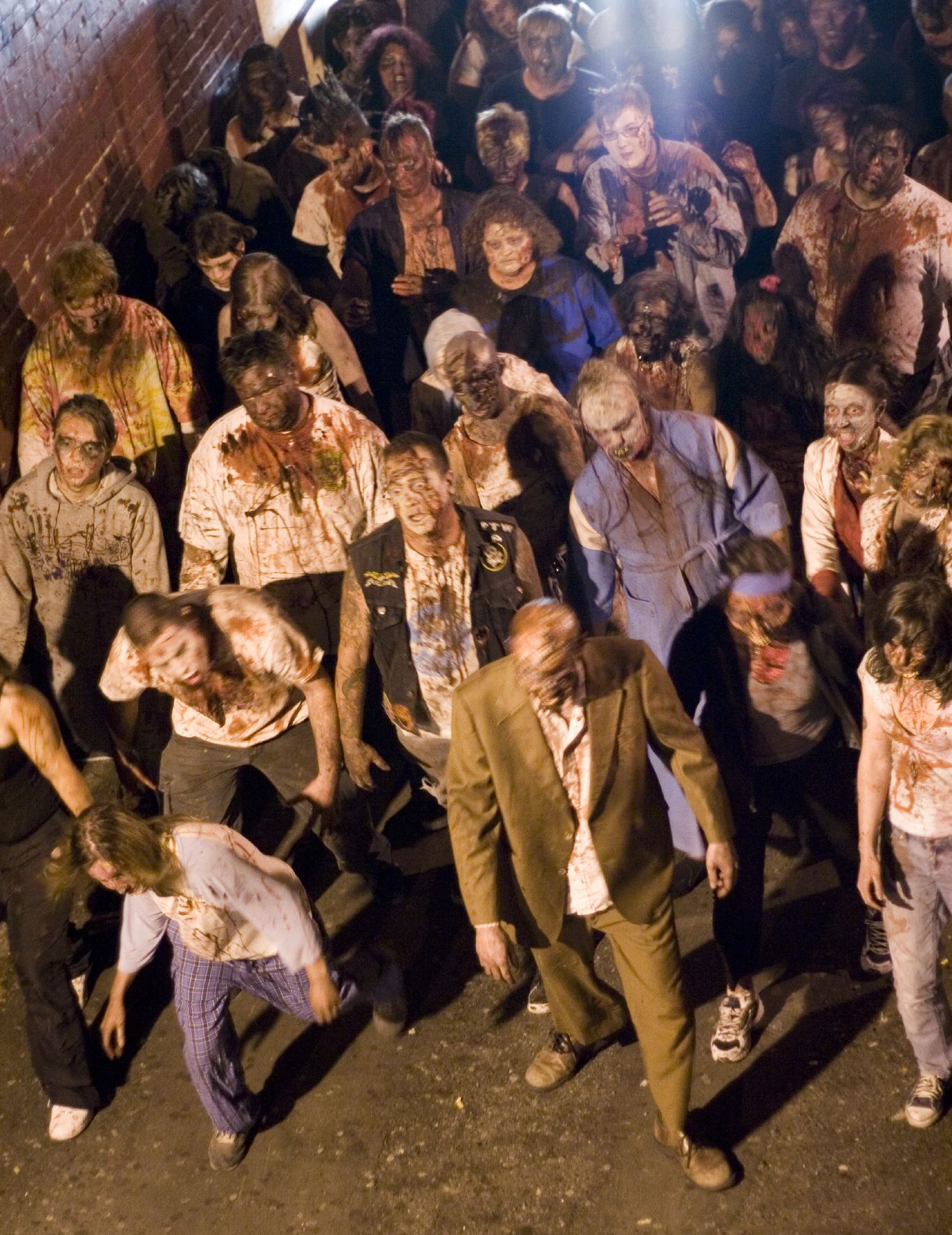
The zombie apocalypse has been used as a metaphor for various contemporary fears, such as global contagion, the breakdown of society, and the end of the world. It has repeatedly been referenced in the media and has inspired various fan activities such as zombie walks, making zombie apocalypse a dominant genre in popular culture.
The myth of the zombie originated in Haiti in the 17th and 18th centuries when African slaves were brought in to work on sugar plantations under the rule of France. The slaves believed that if they ended their own lives by suicide they would be condemned to spend eternity trapped in their own bodies as the undead. This myth evolved in the Voodoo religion into the Haitian belief that corpses were reanimated by shamans. The zombie concept eventually infiltrated western culture with the publication of the first example of zombie fiction in 1927, which was a book titled The Magic Island written by William Seabrook. The book was later adapted for cinema as the 1932 film White Zombie. Directed by Victor Halperin and starring Bela Lugosi, it was the first feature-length zombie film, establishing the sub genre of zombies and paving the way for the zombie apocalypse in cinema.
An early inspirational work of the genre was Richard Matheson's novel I Am Legend (1954), which features a lone survivor named Robert Neville waging a war against a human population transformed into vampires. The novel has been adapted into several screenplays, including The Last Man on Earth (1964), starring Vincent Price, The Omega Man (1971), starring Charlton Heston and I Am Legend (2007) starring Will Smith. George A. Romero took inspiration from Matheson and developed the idea with his apocalyptic feature Night of the Living Dead (1968), but for vampires he substituted shuffling ghouls. Romero stated, "I confessed to him that I basically ripped the idea off from I Am Legend. He forgave me because we didn't make any money. He said, 'Well, as long as you didn't get rich, it's okay.'" Romero said that he never referred to the monsters in his film as "zombies". Instead, the term appeared in an article in Cahiers du Cinéma. Romero commented that earlier depictions of zombies in film, "were very Caribbean and it was all to do with voodoo". By contrast his versions were flesh-eating monsters returned from the grave: "We thought up very few rules or powers for them. The idea was they are your neighbours in a different state. One of the few early ideas we did have was that you have to shoot them in the head to kill them".
Several themes and tropes commonly appear in zombie-apocalypse films:
Generally, films have depicted zombies as the slow, lumbering, and unintelligent kind first popularized in the 1968 film Night of the Living Dead. Zombies were repeatedly shown in slow-walking groups demonstrating herd behavior and overwhelming victims by strength of numbers. In the 2000s, several films featured zombies that are depicted as more agile, vicious, intelligent, and stronger than the traditional zombie. In many cases of these "fast" zombies, e.g., 28 Days Later, Zombieland, Dying Light, The Last of Us, and Left 4 Dead, the plot involves not re-animated corpses but living humans infected with a pathogen. Improved CGI technology and the rise of first-person shooter video games resulted in the herd behavior being replaced by zombies capable of running, jumping, and attacking as individuals.
Hub AI
Zombie apocalypse AI simulator
(@Zombie apocalypse_simulator)
Zombie apocalypse
Zombie apocalypse is a subgenre of apocalyptic and post-apocalyptic fiction in which society collapses due to overwhelming swarms of zombies. Usually, only a few individuals or small bands of human survivors are left living.
There are many different causes of a zombie apocalypse in fiction. In some versions, the reason the dead rise and attack humans is unknown; in others, a parasite or infection is the cause - framing the film like a plague. Some stories have every corpse zombify regardless of the cause of death, whereas others require exposure to the infection, most commonly in the form of a bite.
The genre originated in the 1968 American horror film Night of the Living Dead, which was directed by George A. Romero, who took inspiration from the 1954 novel I Am Legend by Richard Matheson. Romero's film introduced the concept of the flesh-eating zombie and spawned numerous other fictional works, including films, video games, and literature.
The zombie apocalypse has been used as a metaphor for various contemporary fears, such as global contagion, the breakdown of society, and the end of the world. It has repeatedly been referenced in the media and has inspired various fan activities such as zombie walks, making zombie apocalypse a dominant genre in popular culture.
The myth of the zombie originated in Haiti in the 17th and 18th centuries when African slaves were brought in to work on sugar plantations under the rule of France. The slaves believed that if they ended their own lives by suicide they would be condemned to spend eternity trapped in their own bodies as the undead. This myth evolved in the Voodoo religion into the Haitian belief that corpses were reanimated by shamans. The zombie concept eventually infiltrated western culture with the publication of the first example of zombie fiction in 1927, which was a book titled The Magic Island written by William Seabrook. The book was later adapted for cinema as the 1932 film White Zombie. Directed by Victor Halperin and starring Bela Lugosi, it was the first feature-length zombie film, establishing the sub genre of zombies and paving the way for the zombie apocalypse in cinema.
An early inspirational work of the genre was Richard Matheson's novel I Am Legend (1954), which features a lone survivor named Robert Neville waging a war against a human population transformed into vampires. The novel has been adapted into several screenplays, including The Last Man on Earth (1964), starring Vincent Price, The Omega Man (1971), starring Charlton Heston and I Am Legend (2007) starring Will Smith. George A. Romero took inspiration from Matheson and developed the idea with his apocalyptic feature Night of the Living Dead (1968), but for vampires he substituted shuffling ghouls. Romero stated, "I confessed to him that I basically ripped the idea off from I Am Legend. He forgave me because we didn't make any money. He said, 'Well, as long as you didn't get rich, it's okay.'" Romero said that he never referred to the monsters in his film as "zombies". Instead, the term appeared in an article in Cahiers du Cinéma. Romero commented that earlier depictions of zombies in film, "were very Caribbean and it was all to do with voodoo". By contrast his versions were flesh-eating monsters returned from the grave: "We thought up very few rules or powers for them. The idea was they are your neighbours in a different state. One of the few early ideas we did have was that you have to shoot them in the head to kill them".
Several themes and tropes commonly appear in zombie-apocalypse films:
Generally, films have depicted zombies as the slow, lumbering, and unintelligent kind first popularized in the 1968 film Night of the Living Dead. Zombies were repeatedly shown in slow-walking groups demonstrating herd behavior and overwhelming victims by strength of numbers. In the 2000s, several films featured zombies that are depicted as more agile, vicious, intelligent, and stronger than the traditional zombie. In many cases of these "fast" zombies, e.g., 28 Days Later, Zombieland, Dying Light, The Last of Us, and Left 4 Dead, the plot involves not re-animated corpses but living humans infected with a pathogen. Improved CGI technology and the rise of first-person shooter video games resulted in the herd behavior being replaced by zombies capable of running, jumping, and attacking as individuals.
Recent media