Hubbry Logo
GhoulGhoulMain
Open search
Ghoul
Community hub
Ghoul
logo
8 pages, 0 posts
0 subscribers
Be the first to start a discussion here.
Ghoul
Ghoul
from Wikipedia

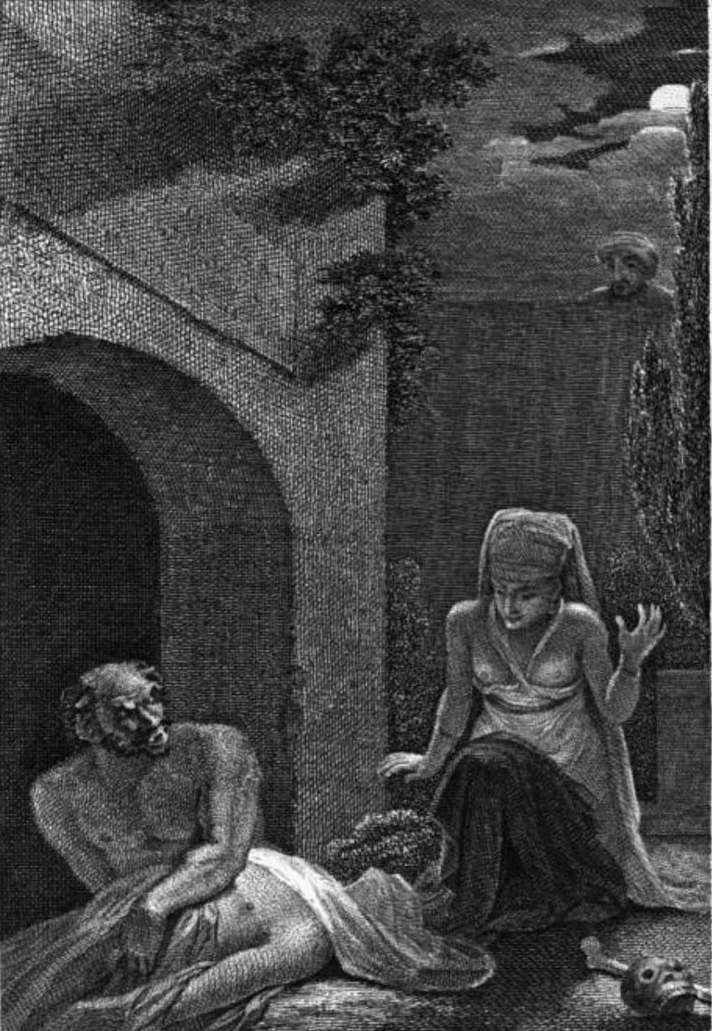
"Amine Discovered with the Goule", from the story of Sidi Nouman in the One Thousand and One Nights

In folklore, a ghoul (from Arabic: غول, ghūl) is a demon-like being or monstrous humanoid, often associated with graveyards and the consumption of human flesh. The concept of the ghoul originated in pre-Islamic Arabian religion.[1] Modern fiction often uses the term to label a specific kind of monster.

By extension, the word "ghoul" is also used in a derogatory sense to refer to a person who delights in the macabre or whose occupation directly involves death, such as a gravedigger or graverobber.[2]

Etymology

[edit]

The English word ghoul is from the Arabic غُول (ghūl), from غَالَ (ghāla) 'to seize'.[3][4][a] The term was first used in English literature in 1786 in William Beckford's Orientalist novel Vathek,[6] which describes the ghūl of Arabic folklore. This definition of the ghoul has persisted into modern times, with ghouls appearing in popular culture.[2]

In early Arabic, the term is treated as a feminine word. Later, the term became treated as a masculine word, and ghouls became perceived as masculine creatures with Sila as feminine counterpart.[7]

Folklore

[edit]

In Arabic folklore, the ghul is said to dwell in cemeteries and other uninhabited places. A male ghoul is referred to as ghul while the female is called ghulah.[8] Scholar Dwight F. Reynolds identifies the Arabic ghoul as a female creature – sometimes called "Mother Ghoul" (ʾUmm Ghulah), "Our Aunt Ghoul", or a similar relational term – in tales told to girls and young women. In these tales, the ghoul appears to men as a long-lost female relative or an unassuming old woman; she uses this glamor[b] to lure the hapless characters, who are usually husbands or fathers, into her home, where she can eat them. The male characters' female relatives can often see through the illusion and warn them of the danger; the men survive if they believe the women (and are eaten if they do not).[10]

An example of this can be found in a Syrian folktale, The Woodcutter's Wealthy Sister or The Woodcutter's Weary Wife, which was adapted into an animated story in the series Britannica's Tales Around the World. A poor, arrogant and spiteful woodcutter encounters a beautiful, wealthy princess who claims to be his long-lost sister, even though he had no sisters at all. The woodcutter accepts the mysterious princess's invitation to bring him, his abused wife and their numerous children to her palace to live in luxury. However, the wife discovers that the "princess" is in fact a female ghoul (simply referred to as a "monster" in the Britannica adaptation) who is planning to eat the woodcutter and his family. After narrowly escaping the ghoul's attempts to eat them, the wife and her children flee the palace in the night and leave the woodcutter to be devoured by the ghoul.[11]

The ghoul is said to lure unwary people into the desert wastes or abandoned places to slay and devour them. The creature also preys on young children, drinks blood, steals coins, eats the dead,[12] and takes the form of the person most recently eaten. One of the narratives identified a ghoul named Ghul-e Biyaban, a particularly monstrous character believed to be inhabiting the wilderness of Afghanistan and Iran.[13] A hyena who attacked a woman in Mecca in 1667 was referred to by locals as a ghul, possibly due to a perceived similarity to the creature of folklore.[14]

Al-Dimashqi describes the ghoul as cave-dwelling animals who only leave at night and avoid the light of the sun. They would eat both humans and animals.[15]

It was not until Antoine Galland translated One Thousand and One Nights into French that the Western concept of ghouls was introduced into European society.[2] Galland depicted the ghoul as a monstrous creature that dwelled in cemeteries, feasting upon corpses.

Similar creatures

[edit]

In ancient Mesopotamia, there were demonic entities known as Gallu, which scholar Ahmed Al-Rawi believes may have influenced the Arabic ghoul via early contact between Bedouin traders and Akkadians.[c] The Gallu was an Akkadian underworld demon, associated with the stories of Dumuzid and Inanna.[17][5][16]

Arabic and Islamic literature

[edit]

Ghouls belong to the jinn attested in pre-Islamic Arabic poetry.[18] A famous poem narrates about a fight between Ta'abbata Sharra and a ghoul.[18] Belief in ghouls was not universally accepted in Islam; the Mu'tazilites denied their existence.[18] Al-Jahiz denounced Ta'abbata Sharra for boasting about his victory over the ghoul.[18]

Although not mentioned in the Quran, ghouls appear in hadith. Al-Masudi reports that on his journey to Syria, Umar slew a ghoul with his sword.[19] In one[which?] hadith it is said, lonely travelers can escape a ghoul's attack by reciting the adhan (call to prayer).[20] Unlike demons, a ghoul may convert to Islam when reciting the Throne Verse.[21]

The ghoul could appear in male and female shape, but usually appeared female to lure male travelers to devour them.[19] According to History of the Prophets and Kings, the rebellious (maradatuhum) among the devils and the ghouls have been chased away to the deserts and mountains and valleys a long time ago.[22]

Modern ghoul

[edit]

The word ghoul entered the English tradition and was further identified as a grave-robbing creature that feeds on dead bodies and children. In the West, ghouls have no specific shape and have been described by Edgar Allan Poe as "neither man nor woman... neither brute nor human."[23]

Illustration of a ghoul from "Pickman's Model"

In "Pickman's Model", a short story by H. P. Lovecraft, ghouls are members of a subterranean race. Their diet of dead human flesh mutated them into bestial humanoids able to carry on intelligent conversations with the living. The story has ghouls set underground with ghoul tunnels that connect ancient human ruins with deep underworlds. Lovecraft hints that the ghouls emerge in subway tunnels to feed on train wreck victims.[24]

Lovecraft's vision of the ghoul, shared by associated authors Clark Ashton-Smith and Robert E. Howard, has heavily influenced the collective idea of the ghoul in American culture. Ghouls as described by Lovecraft are dog-faced and hideous creatures but not necessarily malicious. Though their primary (perhaps only) food source is human flesh, they do not seek out or hunt living people. They are able to travel back and forth through the wall of sleep. This is demonstrated in Lovecraft's "The Dream Quest of Unknown Kadath" in which Randolph Carter encounters Pickman in the dream world after his complete transition into a mature ghoul.

Ghouls in this vein are also changelings in the traditional way. The ghoul parent abducts a human infant and replaces it with one of its own. Ghouls appear entirely human as children but begin to take on the "ghoulish" appearance as they age past adulthood. The fate of the replaced human children is not entirely clear but Pickman offers a clue in the form of a painting depicting mature ghouls as they encourage a human child while it cannibalizes a corpse. This version of the ghoul appears in stories by authors such as Neil Gaiman, Brian Lumley, and Guillermo del Toro.

See also

[edit]

Notes

[edit]

References

[edit]
Revisions and contributorsEdit on WikipediaRead on Wikipedia
from Grokipedia
A ghoul (Arabic: غُول, ghūl) is a mythical demon-like creature rooted in pre-Islamic Arabian folklore, particularly among Bedouin nomads, where it is portrayed as a shape-shifting monster that inhabits desolate deserts and graveyards, preying on unwary travelers by luring them to their deaths and devouring human flesh or corpses. In Islamic tradition, ghouls are considered a diabolical class of jinn. The term derives from the Arabic verb ghāla, meaning "to seize" or "to snatch," underscoring the creature's predatory habit of abruptly capturing and consuming its victims. The ghoul's origins trace back to ancient Mesopotamian mythology, where it may have evolved from the Akkadian demon , an underworld entity associated with abduction and , which influenced Arabian culture through trade and proximity in the region. In traditional accounts, ghouls are often depicted as female entities—sometimes called ghulah—capable of assuming alluring human forms, such as a beautiful , to deceive and ensnare prey, though variants also appear in some tales. These beings are tied to themes of isolation and the dangers of the , serving as cautionary figures in oral traditions to warn against straying into forbidden areas. Despite the advent of in the , belief in ghouls persisted and integrated into Islamic cultural narratives, with references in hadiths attributing to the Prophet Muhammad encounters with such entities, often repelled by recitation of Quranic verses like Ayat al-Kursi. Ghouls feature prominently in medieval , including (Arabian Nights), where they embody moral and existential fears, evolving from purely malevolent demons to multifaceted symbols that sometimes offer supernatural aid or wisdom in regional variants, such as Libyan folktales. This enduring presence highlights the ghoul's role as a cultural , blending pre-Islamic pagan elements with monotheistic frameworks to instill fear, enforce social norms, and explore human vulnerability.

Etymology and Origins

Etymology

The term "ghoul" derives from the Arabic "ghūl" (غول), referring to a demon or shape-shifting entity that seizes or snatches its victims, stemming from the verb "ghāla" (غالَ), meaning "to seize" or "to snatch." This root is part of the Semitic language family, with connections to the Akkadian "gallu," a demonic figure from ancient Mesopotamian mythology associated with the underworld and abduction of souls. The word entered European languages through 18th-century translations of Arabic folklore, particularly Antoine Galland's French rendition of One Thousand and One Nights (1704–1717), where he rendered "ghūl" as "goule," depicting it as a graveyard-haunting demon that devours corpses. English adaptations followed soon after, with the term appearing as "goul" in early 18th-century versions of the tales, evolving to "ghoul" by the late 1700s. One of the earliest documented uses in English literature is in William Beckford's 1786 novel Vathek, which portrays ghouls as desert demons in an Orientalist context. Variations in spelling and pronunciation appear across related languages, such as Persian "ghul" (غول) or "ḡul," denoting a similar monstrous being in Perso-Arabic lore, and "ghul" (غول) or "gul," often extended to "gulyabani" for a wild, ghoul-like spirit. These adaptations reflect the term's transmission through trade, conquest, and cultural exchange in the and beyond.

Historical and Cultural Origins

The concept of ghoul-like entities first emerged in pre-Islamic Arabian culture, where they manifested as malevolent spirits linked to grave-robbing and the hazards of nomadic life in vast deserts, symbolizing the terror of untamed wilderness and isolation from settled communities. These beliefs arose among nomadic tribes who traversed arid expanses, using tales of such spirits to caution against the dangers of straying into remote areas, thereby reinforcing survival strategies in harsh environments. Influences from earlier Mesopotamian mythologies significantly shaped these Arabian conceptions, with notable parallels to the gallu demons documented in Babylonian texts dating to approximately 2000 BCE. These demons were depicted as underworld figures that haunted ruins, desolate places, and grave sites, dragging victims into the abyss and embodying chaos in abandoned locales. Nomadic Arabs, through centuries of trade and migration into Mesopotamian regions, likely absorbed and adapted these motifs, transforming them into localized spirits tied to the Arabian Peninsula's own barren landscapes. In oral traditions, ghoul narratives functioned primarily as moral and practical warnings, deterring ventures into forbidding deserts such as the Rub' al-Khali, where the entities were said to lurk in mirages and shadows to prey on the unwary. Textual evidence from ancient Near Eastern sources, including Akkadian incantations against gallu demons, provides the earliest non-linguistic attestations of such beings, with rituals aimed at warding them off from ruins and wastelands preserved in cuneiform tablets from the Old Babylonian period.

Traditional Descriptions in Folklore

Physical Appearance and Abilities

In traditional folklore, ghouls are often depicted as grotesque, female demons or monsters with distorted human-like features, such as a hunched posture, pale skin, and the ability to move on all fours like a beast despite their two-legged form. A distinctive trait in many accounts is their hoof-like feet, which contribute to their eerie, animalistic gait, while early descriptions portray them as hairy and dog-like in overall build. These beings are characterized as ugly and defected, embodying a monstrous that preys on the unwary. Ghouls possess remarkable shape-shifting abilities, allowing them to alter their form to deceive victims, most commonly appearing as beautiful women to lure travelers in remote areas. They can also assume animal guises, such as dogs, , cats, , , or snakes, or even hybrid forms like a man with donkey legs or multiple heads, enhancing their elusive and predatory nature. Complementing this versatility is their , enabling them to overpower and carry off human prey with ease, as well as to influence fates through curses or rewards in some Libyan variants of the lore. Variations in ghoul depictions include size and form ranging from small, dog-like creatures to more imposing hybrid monsters, though they lack a fixed giant stature in authentic traditions. Their nocturnal and elusive habits are emphasized by descriptions of them lurking in , often in desolate deserts or graveyards, where their shape-shifting aids in ambushing victims under cover of night.

Behaviors and Habitat

In Arabic folklore, ghouls are primarily associated with remote and uninhabited regions such as deserts and wilderness areas, where they roam at night to encounter and prey upon solitary travelers. These desolate habitats provide the ghouls with opportunities to exploit the isolation of their victims, reflecting the cultural context in which such beliefs originated. Ghouls engage in deceptive behaviors to ensnare humans, often using shape-shifting abilities to appear as familiar or alluring figures, such as a woman, in order to abduct children or lead travelers astray into harm. Once lured, they attack and consume human flesh, sometimes spoiling food supplies like dates to further torment their targets, as recounted in narratives where ghouls frighten and devour people in the open wilds. In one traditional account, a ghoul disguised itself to kidnap a boy, illustrating their predatory tactics against the vulnerable. These actions underscore the ghoul's role as a nocturnal predator that embodies the perils of wandering in untamed landscapes. Regarding their lifecycle, pre-Islamic traditions describe ghouls as originating from a split egg of a , positioning them as offspring within a broader demonic hierarchy rather than arising from human curses. Some accounts suggest that certain ghouls could be slain but might revive if struck multiple times, implying a resilient yet not immortal existence tied to their infernal parentage. Ghouls are vulnerable to decisive physical strikes, such as a single sword blow, which can kill them outright, and in Islamic contexts, they flee from recitations of Quranic verses like Ayat al-Kursi. Their presence in often signals impending danger or evil, serving as cautionary omens for those venturing into forsaken territories.

Representations in Arabic and Islamic Traditions

In Pre-Islamic Arabian Folklore

In pre-Islamic Arabian , ghouls (ghūl) figured prominently in the of the period (pre-7th century CE), where they were depicted as menacing desert predators that embodied the perils of the wilderness. Renowned poets like Taʾabbaṭa Sharran immortalized encounters with ghouls in their verses, portraying them as shape-shifting demons that ambushed lone travelers under the cover of night. In his famous poem "How I Met the Ghul" (also known as the Qit'a Nuniyya), Taʾabbaṭa Sharran narrates a perilous confrontation with a ghul during a journey through desolate lands, highlighting the creature's ferocity and the poet's cunning survival. Similarly, alluded to ghouls in his works, evoking them amid stormy desert landscapes as omens of chaos and isolation, reinforcing their role as symbols of the unforgiving Arabian environment. Tribal lore among communities preserved vivid accounts of ghoul encounters, often shared around campfires to caution against venturing alone into the wastes. These stories described ghouls as female entities lurking in ruins and graveyards, capable of assuming forms—typically alluring women—to deceive and devour victims, a motif that underscored the dangers of isolation in nomadic life. To counter such threats, Bedouins incorporated protective rituals into their traditions, such as encircling camps with fire, believed to repel these nocturnal predators drawn to the scent of presence. One recurring tale warned of a ghul disguising itself as a prospective in remote settlements, luring unwary suitors into forbidden unions that ended in tragedy, serving as a against hasty or illicit marriages in tribal . Ghouls were deeply intertwined with the animistic beliefs of pre-Islamic , who viewed the natural world and as teeming with unseen spirits; these creatures represented chaotic forces of the —storms, mirages, and untimely —manifesting the unpredictable wrath of the environment and the spirits beyond. In this polytheistic and animistic framework, ghouls were not mere monsters but embodiments of the liminal spaces between , influencing tribal practices that sought harmony with such entities through incantations and offerings.

In Islamic Literature and Theology

In Islamic tradition, the ghul is regarded as a type of , a supernatural being created by God from smokeless fire, as described in the for jinn generally ( 55:15). Although not explicitly named in the , the ghul appears in collections, where it is portrayed as a shape-shifting desert demon that preys on travelers by assuming deceptive forms to lead them astray or devour them. A notable in recounts the Prophet Muhammad rejecting pre-Islamic superstitions, including belief in the "ghoul," while affirming the reality of as accountable creatures subject to alongside humans on the Day of ( 6:130). In Quranic (), scholars like interpret the ghul as a nocturnal manifestation of , emphasizing its malevolent intent but ultimate subordination to God's will, thereby integrating pre-Islamic into a monotheistic framework where such entities test human faith rather than possessing independent power. Depictions of ghouls in classical , such as "," reinforce their role as demonic tempters who exploit human vulnerabilities in desolate places, often appearing as alluring women or animals to ensnare victims. In stories like those involving desert wanderers, ghouls attempt to devour or deceive protagonists, but they are thwarted by invocations of faith, such as prayers or divine intervention, underscoring the triumph of piety over evil—though the specific tale "" features an rather than a ghul, similar motifs appear in ghul encounters where the creature's schemes collapse before righteous resolve. These narratives blend entertainment with moral instruction, portraying ghouls as punished entities whose defeat affirms Islamic tenets of (divine unity) and reliance on God. Theologically, ghouls function as trials of , challenging believers to uphold amid threats and thereby strengthening spiritual resilience, much like other jinn-related adversities in Islamic doctrine. practices, known as ruqya, address ghul disturbances through recitation of protective Quranic verses, with Ayat al-Kursi (Quran 2:255) prominently used for its emphasized safeguarding against evil influences, including jinn variants like the ghul, as it declares God's over all creation. In the evolution of Sufi mysticism, ghouls evolve into symbolic representations of worldly illusions and ego-driven deceptions that obscure , which the mystic overcomes via (remembrance of ) and inner purification to attain spiritual enlightenment. This allegorical interpretation appears in medieval Sufi works, transforming horrors into metaphors for the soul's journey.

Similar Creatures in Other Cultures

In , the upyr represents a vampire-like entity that emerges from the grave to feed on the flesh and of the living or recently deceased, sharing the ghoul's association with necrophagy and grave desecration, though the upyr emphasizes blood consumption over outright corpse consumption. These creatures are often depicted as reanimated corpses with swollen or skeletal forms, haunting rural areas and targeting family or , which parallels the ghoul's predatory nocturnal habits but diverges in its vampiric thirst rather than pure scavenging. The Jewish golem, an animated figure crafted from clay and brought to life through mystical incantations in Kabbalistic traditions, serves as a guardian against persecution, contrasting sharply with the ghoul's malevolent, self-serving nature despite both involving the manipulation of lifeless matter. Originating in medieval Jewish lore, particularly the 16th-century legend of the of created by Judah Loew to protect the , this entity obeys its creator without independent will, embodying protection rather than the ghoul's deceptive predation. While ghouls exploit corpses for sustenance, the golem's underscores themes of divine imitation and communal defense in . In Philippine , the embodies a shape-shifting monster that preys on humans by exhuming and consuming corpses or targeting the vulnerable, mirroring the ghoul's cannibalistic tendencies and graveyard affinity. These beings, often appearing as ordinary villagers by day before revealing their monstrous form at night, use their elongated tongues or claws to devour organs or fetuses, with certain variants classified as "ghoul aswang" that specifically feed on carrion from graves. This shared motif of body desecration and transformation highlights cross-cultural fears of the undead disrupting the boundary between , though aswang lore integrates colonial influences from Spanish accounts in the . Hindu mythology features the , a spirit that possesses and animates corpses in cremation grounds, akin to the ghoul's hauntings of burial sites and manipulation of the dead for mischievous or malevolent ends. Central to the 11th-century Sanskrit collection (Twenty-Five Tales of the Vetala), these entities are depicted hanging upside down from trees like bats, reanimating bodies to converse or torment, as seen when a vetala challenges King with riddles during his quest to capture one. Unlike the ghoul's solitary predation, vetalas often engage in intellectual trickery, but both draw from ancient fears of restless spirits violating the sanctity of death. Ghouls differ from vampires primarily in their dietary habits and origins. While vampires are characterized by a thirst for blood and often depicted as aristocratic beings from , ghouls consume human flesh, particularly from graves, without any compulsion for blood or transformation into undeath through biting. This distinction is rooted in the ghoul's association with isolated graveyards in traditions, contrasting the vampire's nocturnal, seductive predation in more urban or forested European settings. In relation to jinn, ghouls represent a specific subclass of these entities in Islamic and pre-Islamic Arabian mythology. are ethereal spirits created from smokeless fire, capable of , shape-shifting across realms, and sometimes granting wishes or possessing humans, but ghouls are earth-bound, demonic jinn focused on cannibalistic acts and inhabiting desolate places like burial grounds. Unlike the broader jinn's potential for benevolence or ethereal freedom, ghouls embody unrelenting malice, often described as offspring of Iblīs, the Islamic equivalent of the devil, and lack the wish-granting or transcendent qualities of general jinn. Ghouls also stand apart from werewolves through their fixed demonic essence and methods of operation. Werewolves, originating in , undergo cyclical transformations into wolf-like forms under lunar influence, often reverting to human identity with rage-driven attacks on the living. In contrast, ghouls possess a permanent, non-transformative demonic nature without lunar ties or human reversion, emphasizing cunning deception—such as shape-shifting into alluring figures to mislead travelers—over uncontrolled fury. A hallmark of ghouls is their emphasis on psychological torment via disorientation and illusion, setting them apart from zombies' brute physical predation. In Arabic folklore, ghouls lure and confuse desert wanderers through shape-shifting and mirage-like deceptions, inducing fear and isolation before consumption, rather than the mindless, horde-based assaults typical of zombies from Haitian Vodou traditions. This shared motif of grave-robbing appears in both ghoul and zombie lore, but ghouls' intelligent, predatory psychology amplifies the victim's mental anguish.

Evolution in Literature and Art

Classical and Medieval Depictions

In the compilations of , known as the Arabian Nights, spanning from the 8th to 14th centuries, ghouls appear as malevolent antagonists within the frame narrative of Scheherazade's tales, often shape-shifting demons that lure and devour travelers in desolate places. Medieval European literature adapted motifs from tales, incorporating elements of deceptive and predatory figures influenced by exchanges. Artistic representations in medieval illuminated manuscripts often depicted demonic entities in as hybrid beasts—part human, part animal—symbolizing . In Islamic manuscripts, similar nightmarish demons appear in borders, emphasizing their role as shape-shifting threats in folklore-derived .

19th- and 20th-Century Literature

In the 19th century, Western literature drew on Orientalist tropes to portray the exotic and monstrous East, with Edgar Allan Poe's gothic tales incorporating atmospheric horror influenced by Arabian motifs, as in "The Thousand-and-Second Tale of Scheherazade" (1845), which parodies the Nights and reflects broader stereotypes of the Middle East. By the early 20th century, H.P. Lovecraft reimagined ghouls in his Cthulhu Mythos as anthropophagic humanoids—gaunt, dog-faced creatures that devour the dead and can interbreed with humans—transforming them from mere folklore demons into cosmic horrors lurking in subterranean realms. This depiction is central to "Pickman's Model" (1927), where the artist Richard Upton Pickman paints hyper-realistic scenes of ghouls feasting on corpses in Boston's sewers, revealing his own partial ghoul heritage and blurring the line between human and monster. Lovecraft's ghouls, influenced by Arabic origins but infused with xenophobic dread, symbolize degeneration and the intrusion of the otherworldly into modern urban life. The influence extended to fantasy literature, where Clark Ashton Smith portrayed ghouls in vivid, macabre detail during the 1930s, often in exotic or prehistoric settings that echoed their roots while adding decadent horror. In "The Ghoul" (), set in ancient Arabia, the creature is a ravenous, seductive that devours travelers and lovers alike, emphasizing themes of forbidden desire and inevitable doom; Smith drew on to craft a tale of a young man sacrificing his bride to appease the ghoul, highlighting moral corruption in a Hyperborean-inspired archaic world. Smith's ghouls, like Lovecraft's, evolved the motif into symbols of primal savagery, influencing pulp fantasy's darker strains.

Modern Interpretations

In film, ghouls have been portrayed as mischievous, demonic entities summoned through occult rituals. The 1984 horror-comedy Ghoulies, directed by Luca Bercovici, centers on a young man who inherits a mansion and unwittingly revives small, grotesque demons known as ghoulies during a satanic ceremony tied to his childhood trauma. These creatures, depicted as slimy, puppet-like imps that terrorize partygoers, embody a campy take on folklore ghouls as grave-dwelling pests. The film spawned a franchise, including sequels like Ghoulies II (1987), which continued the theme of summoning malevolent ghouls for chaotic destruction. Another cinematic example appears in the 1999 adventure-horror The Mummy, directed by Stephen Sommers, where hordes of undead minions—reanimated by the ancient priest Imhotep—emerge from the desert sands of Hamunaptra to pursue treasure hunters. These skeletal, flesh-hungry warriors, often likened to ghoulish desert specters in their relentless pursuit and decay-ravaged forms, draw on Egyptian mythology to evoke ghoul-like grave robbers rising en masse. On television, ghouls frequently appear as shape-shifting predators in supernatural procedurals. The long-running series Supernatural (2005–2020), created by Eric Kripke, introduces ghouls in season 4's episode "Jump the Shark," portraying them as cannibalistic monsters that consume human flesh and mimic their victims' appearances to lure prey. Subsequent episodes, such as season 7's "Of Grave Importance" and season 12's "The Raid," expand on this by showing ghouls as intelligent, pack-hunting beings vulnerable to decapitation, blending horror with the show's monster-of-the-week format. In comics, ghouls manifest as mutated horrors intertwined with environmental and mythological themes. DC Comics' , debuting in 1971 under writer and artist , features ghoulish mutants like the Un-Men—grotesque, lab-created abominations engineered by the villainous to battle the plant-based protagonist. These flesh-warped creatures, recurring from the 1970s through modern runs, symbolize ecological decay and in the series' gothic swamp setting. Similarly, Marvel's , launched in 1980 by and , ties ghouls to Egyptian lore in stories where the moon god Khonshu-empowered vigilante confronts undead scavengers. A notable instance occurs in the 2022 anthology Moon Knight: Black, White & Blood #1, where and battle spectral ghouls guarding an ancient scarab, echoing pharaonic curses and grave-desecration myths. Anime and manga offer a reimagined, sympathetic lens on ghouls through Tokyo Ghoul (2011–2014), written and illustrated by Sui Ishida. The series follows Ken Kaneki, a college student transformed into a half-ghoul hybrid after a ghoul attack, forcing him to navigate a hidden society of flesh-eating humanoids who wield kagune—predatory organs manifesting as versatile, tentacle-like appendages for combat and hunting. This portrayal shifts ghouls from mere monsters to tragic figures persecuted by human authorities, emphasizing themes of identity and survival in a dystopian Tokyo. The manga's influence extended to an anime adaptation by Studio Pierrot (2014–2018), amplifying its visceral depictions of ghoul physiology and societal conflict.

Contemporary Variations and Adaptations

In video games, ghouls have been reinterpreted as post-human survivors afflicted by radiation, particularly in the Fallout series, where they exhibit extended lifespans, decayed appearances, and resistance to radiation while facing societal prejudice. This adaptation diverges from traditional grave-robbing demons by emphasizing themes of mutation and endurance in a post-apocalyptic world, with Fallout 76 adding playable ghoul characters in March 2025 via the "Ghoul" update, allowing players to mutate their characters after completing the "Leap of Faith" quest at level 50. Separately, the December 2025 "Burning Springs" update introduced the NPC "The Ghoul," voiced by Walton Goggins from the 2024 Fallout TV series, as a bounty-hunting quest giver in a New Vegas-inspired area. The Fallout TV series itself (2024) prominently features The Ghoul (Cooper Howard), a 200-year-old irradiated gunslinger portrayed by Goggins, blending Western and horror elements in its depiction of ghouls as resilient survivors in a nuclear wasteland. Similarly, the Tokyo Ghoul franchise, originating from Sui Ishida's 2011 manga, portrays ghouls as humanoid flesh-eaters who blend into society, influencing games like Tokyo Ghoul: Dark War (2017) and Tokyo Ghoul: re Call to Exist (2019), where combat mechanics highlight their predatory instincts and internal conflicts. On the , ghouls appear in narratives as elusive, flesh-consuming entities lurking in abandoned places, often blending with urban legends of modern "ghoul hunts" in online horror communities. Stories such as "Ghoul" on platforms describe them as grotesque, humanoid predators with a single eye and jagged jaws, evoking psychological dread through encounters in desolate settings like graveyards or forgotten buildings. These tales frequently crossover with other horrors, including Slender Man-inspired scenarios from the , where ghouls join faceless stalkers in multiplayer games and , amplifying fears of isolation and pursuit in digital . Global adaptations incorporate ghouls into diverse cultural contexts, such as the 2018 Indian miniseries Ghoul, which reimagines the creature as a shape-shifting summoned during interrogation, drawing on origins while addressing themes of and in a contemporary South Asian setting. In African media, blends ghoul-like entities with local spirits, as seen in graphic novels influenced by where undead flesh-eaters merge with ancestral ghosts, though direct representations remain sparse compared to Western undead tropes. Bollywood horror films like Raaz () indirectly evoke ghoul elements through vengeful spirits that haunt and possess, adapting graveyard-dwelling monsters into romantic thrillers with predation. Post-2020 trends leverage technology to reimagine ghouls as figures, with AI-generated art tools like producing surreal depictions of ghouls as shadowy, introspective predators inspired by aesthetics, often shared on platforms for Halloween-themed content. In , experiences such as Zero Latency's Haunted (2024) transform ghoul-like entities into immersive, mind-bending antagonists within shifting haunted houses, emphasizing mental unraveling over physical chases to heighten existential terror. These digital evolutions adapt core traits of and consumption into interactive, player-driven narratives that explore modern anxieties like identity loss and .

References

Add your contribution
Related Hubs
User Avatar
No comments yet.