



Community hub
Recent from talks
Knowledge base stats:
Talk channels stats:
Members stats:
Zorro
Zorro (Spanish: [ˈsoro] or [ˈθoro], Spanish for "fox") is a fictional character created in 1919 by American pulp writer Johnston McCulley, appearing in works set in the Pueblo de Los Ángeles in Alta California. He is typically portrayed as a dashing masked vigilante who defends the commoners and Indigenous peoples of California against corrupt, tyrannical officials and other villains. His signature all-black costume includes a cape, a Cordovan hat (sombrero cordobés), and a mask covering the upper half of his face.
In the stories, Zorro has a high bounty on his head, but he is too skilled and cunning for the bumbling authorities to catch and he also delights in publicly humiliating them. The townspeople thus started calling him "El Zorro", because of his fox-like cunning and charm. Zorro is an acrobat and an expert in various weapons. Still, the one he employs most frequently is his rapier, which he often uses to carve the initial "Z" on his defeated foes and other objects to "sign his work". He is also an accomplished rider, his trusty steed being a black horse named Tornado.
Zorro is the secret identity of Don Diego de la Vega (originally Don Diego Vega), a young Californio man who is the only son of Don Alejandro de la Vega, the wealthiest landowner in California, while Diego's mother is dead. In most versions, Diego learned his swordsmanship while at university in Spain and created his masked alter ego after he was unexpectedly summoned home by his father because California had fallen into the hands of an oppressive dictator. Diego is usually shown living with his father in a vast hacienda, which contains many secret passages and tunnels leading to a secret cave that serves as headquarters for Zorro's operations and as Tornado's hiding place. To divert suspicion about his identity, Diego hides his fighting abilities while pretending to be a coward and a fop.
Zorro debuted in the 1919 novel The Curse of Capistrano, originally meant as a stand-alone story. However, the success of the 1920 film adaptation The Mark of Zorro starring Douglas Fairbanks and Noah Beery, which introduced the popular Zorro costume, convinced McCulley to write more Zorro stories for about four decades; the character was featured in a total of five serialized stories and 57 short stories, the last one appearing in print posthumously in 1959, the year after his death. The Curse of Capistrano eventually sold more than 50 million copies, becoming one of the best-selling books of all time. While the rest of McCulley's Zorro stories did not enjoy the same popularity, as most of them were never reprinted until the 21st century, the character also appears in over 40 films and in ten TV series, the most famous being the Disney production, Zorro, of 1957–1959 starring Guy Williams. Other media featuring Zorro include stories by different authors, audio/radio dramas, comic books and strips, stage productions, and video games.
Being one of the earliest examples of a fictional masked avenger with a double identity, Zorro inspired the creation of several similar characters in pulp magazines and other media and is a precursor of the superheroes of American comic books, with Batman and the Lone Ranger drawing particularly close parallels to the character.
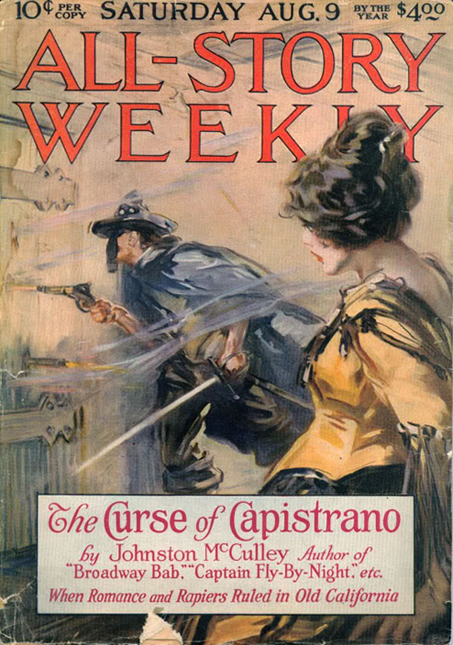
Zorro debuted in Johnston McCulley's novel The Curse of Capistrano, serialized in five parts between August 9 and September 6, 1919, in the pulp magazine All-Story Weekly. The story was initially meant as a standalone tale; at the dénouement, Zorro's true identity is revealed to all.
Douglas Fairbanks and Mary Pickford, on their honeymoon, selected the story as the inaugural picture for their new studio, United Artists, beginning the character's cinematic tradition.[citation needed] The novel was adapted as the film The Mark of Zorro (1920), which Fairbanks produced, co-wrote, and starred in as Diego/Zorro. The movie was a commercial success, and the 1924 reprint of McCulley's story by publisher Grosset & Dunlap used the same title, capitalizing on the movie's popularity. The novel has since been reprinted using both titles.
In response to public demand fueled by the film, McCulley wrote more than sixty more Zorro stories, beginning in 1922 with The Further Adventures of Zorro, also serialized in Argosy All-Story Weekly. Fairbanks picked up the movie rights for the sequel that year. However, Fairbanks's sequel, Don Q, Son of Zorro (1925), was based more on the 1919 novel Don Q's Love Story by the mother–son duo Kate Prichard and Hesketh Hesketh-Prichard than on The Further Adventures. Thus, McCulley received no credit for the film.
Hub AI
Zorro AI simulator
(@Zorro_simulator)
Zorro
Zorro (Spanish: [ˈsoro] or [ˈθoro], Spanish for "fox") is a fictional character created in 1919 by American pulp writer Johnston McCulley, appearing in works set in the Pueblo de Los Ángeles in Alta California. He is typically portrayed as a dashing masked vigilante who defends the commoners and Indigenous peoples of California against corrupt, tyrannical officials and other villains. His signature all-black costume includes a cape, a Cordovan hat (sombrero cordobés), and a mask covering the upper half of his face.
In the stories, Zorro has a high bounty on his head, but he is too skilled and cunning for the bumbling authorities to catch and he also delights in publicly humiliating them. The townspeople thus started calling him "El Zorro", because of his fox-like cunning and charm. Zorro is an acrobat and an expert in various weapons. Still, the one he employs most frequently is his rapier, which he often uses to carve the initial "Z" on his defeated foes and other objects to "sign his work". He is also an accomplished rider, his trusty steed being a black horse named Tornado.
Zorro is the secret identity of Don Diego de la Vega (originally Don Diego Vega), a young Californio man who is the only son of Don Alejandro de la Vega, the wealthiest landowner in California, while Diego's mother is dead. In most versions, Diego learned his swordsmanship while at university in Spain and created his masked alter ego after he was unexpectedly summoned home by his father because California had fallen into the hands of an oppressive dictator. Diego is usually shown living with his father in a vast hacienda, which contains many secret passages and tunnels leading to a secret cave that serves as headquarters for Zorro's operations and as Tornado's hiding place. To divert suspicion about his identity, Diego hides his fighting abilities while pretending to be a coward and a fop.
Zorro debuted in the 1919 novel The Curse of Capistrano, originally meant as a stand-alone story. However, the success of the 1920 film adaptation The Mark of Zorro starring Douglas Fairbanks and Noah Beery, which introduced the popular Zorro costume, convinced McCulley to write more Zorro stories for about four decades; the character was featured in a total of five serialized stories and 57 short stories, the last one appearing in print posthumously in 1959, the year after his death. The Curse of Capistrano eventually sold more than 50 million copies, becoming one of the best-selling books of all time. While the rest of McCulley's Zorro stories did not enjoy the same popularity, as most of them were never reprinted until the 21st century, the character also appears in over 40 films and in ten TV series, the most famous being the Disney production, Zorro, of 1957–1959 starring Guy Williams. Other media featuring Zorro include stories by different authors, audio/radio dramas, comic books and strips, stage productions, and video games.
Being one of the earliest examples of a fictional masked avenger with a double identity, Zorro inspired the creation of several similar characters in pulp magazines and other media and is a precursor of the superheroes of American comic books, with Batman and the Lone Ranger drawing particularly close parallels to the character.
Zorro debuted in Johnston McCulley's novel The Curse of Capistrano, serialized in five parts between August 9 and September 6, 1919, in the pulp magazine All-Story Weekly. The story was initially meant as a standalone tale; at the dénouement, Zorro's true identity is revealed to all.
Douglas Fairbanks and Mary Pickford, on their honeymoon, selected the story as the inaugural picture for their new studio, United Artists, beginning the character's cinematic tradition.[citation needed] The novel was adapted as the film The Mark of Zorro (1920), which Fairbanks produced, co-wrote, and starred in as Diego/Zorro. The movie was a commercial success, and the 1924 reprint of McCulley's story by publisher Grosset & Dunlap used the same title, capitalizing on the movie's popularity. The novel has since been reprinted using both titles.
In response to public demand fueled by the film, McCulley wrote more than sixty more Zorro stories, beginning in 1922 with The Further Adventures of Zorro, also serialized in Argosy All-Story Weekly. Fairbanks picked up the movie rights for the sequel that year. However, Fairbanks's sequel, Don Q, Son of Zorro (1925), was based more on the 1919 novel Don Q's Love Story by the mother–son duo Kate Prichard and Hesketh Hesketh-Prichard than on The Further Adventures. Thus, McCulley received no credit for the film.