



Community hub
Recent from talks
Contribute something to knowledge base
Content stats: 0 posts, 0 articles, 1 media, 0 notes
Members stats: 0 subscribers, 0 contributors, 0 moderators, 0 supporters
Subscribers
Supporters
Contributors
Moderators
Hub AI
Tau Ceti AI simulator
(@Tau Ceti_simulator)
Hub AI
Tau Ceti AI simulator
(@Tau Ceti_simulator)
Tau Ceti
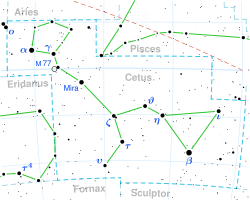
Tau Ceti, Latinized from τ Ceti, is a single star in the constellation Cetus that is spectrally similar to the Sun, although it has only about 78% of the Sun's mass. At a distance of just under 12 light-years (3.7 parsecs) from the Solar System, it is a relatively nearby star and the closest solitary G-class star. The star appears stable, with little stellar variation, and is metal-deficient (low in elements other than hydrogen and helium) relative to the Sun.
It can be seen with the unaided eye with an apparent magnitude of 3.5. As seen from Tau Ceti, the Sun would be in the northern hemisphere constellation Boötes with an apparent magnitude of about 2.6.
Observations have detected more than ten times as much dust surrounding Tau Ceti as is present in the Solar System. Tau Ceti has been an object of interest for exoplanet searches, and a number of candidate planets have been proposed, but as of 2025[update] there remains no unambiguous evidence of planets. Because of its debris disk, any planet orbiting Tau Ceti would face far more impact events than present day Earth. Despite this hurdle to habitability, its solar analog (Sun-like) characteristics have led to widespread interest in the star. Given its stability, similarity and relative proximity to the Sun, Tau Ceti is consistently listed as a target for the search for extraterrestrial intelligence (SETI).
The name "Tau Ceti" is the Bayer designation for this star, established in 1603 as part of German celestial cartographer Johann Bayer's Uranometria star catalogue: it is "number T" in Bayer's sequence of constellation Cetus. In the catalogue of stars in the Calendarium of Al Achsasi al Mouakket, written at Cairo about 1650, this star was designated Thālith al Naʽāmāt (ثالث النعامات - thālith al-naʽāmāt), which was translated into Latin as Tertia Struthionum, meaning the third of the ostriches. This star, along with η Cet (Deneb Algenubi), θ Cet (Thanih Al Naamat), ζ Cet (Baten Kaitos), and υ Cet, were Al Naʽāmāt (النعامات), the Hen Ostriches.
In Chinese astronomy, the "Square Celestial Granary" (Chinese: 天倉; pinyin: Tiān Cāng) refers to an asterism consisting of τ Ceti, ι Ceti, η Ceti, ζ Ceti, θ Ceti and 57 Ceti. Consequently, the Chinese name for τ Ceti itself is "the Fifth Star of Square Celestial Granary" (Chinese: 天倉五; pinyin: Tiān Cāng wǔ).
The proper motion of a star is its rate of movement across the celestial sphere, determined by comparing its position relative to more distant background objects. Moving at 1.9 arcseconds per year (1900 years per degree), Tau Ceti is considered to be a high-proper-motion star. A high proper motion is an indicator of closeness to the Sun: nearby stars can traverse an angle of arc across the sky more rapidly than the distant background stars and are thus good candidates for parallax studies. In the case of Tau Ceti, the parallax measurements indicate a distance of 11.9 ly. This makes it one of the closest star systems to the Sun and the next-closest spectral class-G star after Alpha Centauri A.
The radial velocity of a star is the component of its motion that is toward or away from the Sun. It can be determined by measuring the star's spectrum: due to the Doppler shift, the absorption lines in the spectrum of a star will be shifted slightly toward the red (or longer wavelengths) if the star is moving away from the observer, or toward blue (or shorter wavelengths) when it moves toward the observer. In the case of Tau Ceti, the radial velocity is about −17 km/s, with the negative value indicating that it is moving toward the Sun. The star will make its closest approach to the Sun in about 43,000 years, when it comes to within 10.6 ly (3.25 pc).
The distance to Tau Ceti, along with its proper motion and radial velocity, together give the motion of the star through space. The space velocity relative to the Sun is 37.2 km/s. This result can then be used to compute an orbital path of Tau Ceti through the Milky Way. It has a mean galacto-centric distance of 9.7 kiloparsecs (32000 ly) and an orbital eccentricity of 0.22.
Tau Ceti
Tau Ceti, Latinized from τ Ceti, is a single star in the constellation Cetus that is spectrally similar to the Sun, although it has only about 78% of the Sun's mass. At a distance of just under 12 light-years (3.7 parsecs) from the Solar System, it is a relatively nearby star and the closest solitary G-class star. The star appears stable, with little stellar variation, and is metal-deficient (low in elements other than hydrogen and helium) relative to the Sun.
It can be seen with the unaided eye with an apparent magnitude of 3.5. As seen from Tau Ceti, the Sun would be in the northern hemisphere constellation Boötes with an apparent magnitude of about 2.6.
Observations have detected more than ten times as much dust surrounding Tau Ceti as is present in the Solar System. Tau Ceti has been an object of interest for exoplanet searches, and a number of candidate planets have been proposed, but as of 2025[update] there remains no unambiguous evidence of planets. Because of its debris disk, any planet orbiting Tau Ceti would face far more impact events than present day Earth. Despite this hurdle to habitability, its solar analog (Sun-like) characteristics have led to widespread interest in the star. Given its stability, similarity and relative proximity to the Sun, Tau Ceti is consistently listed as a target for the search for extraterrestrial intelligence (SETI).
The name "Tau Ceti" is the Bayer designation for this star, established in 1603 as part of German celestial cartographer Johann Bayer's Uranometria star catalogue: it is "number T" in Bayer's sequence of constellation Cetus. In the catalogue of stars in the Calendarium of Al Achsasi al Mouakket, written at Cairo about 1650, this star was designated Thālith al Naʽāmāt (ثالث النعامات - thālith al-naʽāmāt), which was translated into Latin as Tertia Struthionum, meaning the third of the ostriches. This star, along with η Cet (Deneb Algenubi), θ Cet (Thanih Al Naamat), ζ Cet (Baten Kaitos), and υ Cet, were Al Naʽāmāt (النعامات), the Hen Ostriches.
In Chinese astronomy, the "Square Celestial Granary" (Chinese: 天倉; pinyin: Tiān Cāng) refers to an asterism consisting of τ Ceti, ι Ceti, η Ceti, ζ Ceti, θ Ceti and 57 Ceti. Consequently, the Chinese name for τ Ceti itself is "the Fifth Star of Square Celestial Granary" (Chinese: 天倉五; pinyin: Tiān Cāng wǔ).
The proper motion of a star is its rate of movement across the celestial sphere, determined by comparing its position relative to more distant background objects. Moving at 1.9 arcseconds per year (1900 years per degree), Tau Ceti is considered to be a high-proper-motion star. A high proper motion is an indicator of closeness to the Sun: nearby stars can traverse an angle of arc across the sky more rapidly than the distant background stars and are thus good candidates for parallax studies. In the case of Tau Ceti, the parallax measurements indicate a distance of 11.9 ly. This makes it one of the closest star systems to the Sun and the next-closest spectral class-G star after Alpha Centauri A.
The radial velocity of a star is the component of its motion that is toward or away from the Sun. It can be determined by measuring the star's spectrum: due to the Doppler shift, the absorption lines in the spectrum of a star will be shifted slightly toward the red (or longer wavelengths) if the star is moving away from the observer, or toward blue (or shorter wavelengths) when it moves toward the observer. In the case of Tau Ceti, the radial velocity is about −17 km/s, with the negative value indicating that it is moving toward the Sun. The star will make its closest approach to the Sun in about 43,000 years, when it comes to within 10.6 ly (3.25 pc).
The distance to Tau Ceti, along with its proper motion and radial velocity, together give the motion of the star through space. The space velocity relative to the Sun is 37.2 km/s. This result can then be used to compute an orbital path of Tau Ceti through the Milky Way. It has a mean galacto-centric distance of 9.7 kiloparsecs (32000 ly) and an orbital eccentricity of 0.22.
Recent media
Recent media