

Recent from talks
Proper motion
Knowledge base stats:
Talk channels stats:
Members stats:
Proper motion
Proper motion is the angular speed of a celestial object, such as a star, as it moves across the sky. It is an astrometric measure, giving an object's change in angular position over time relative to the center of mass of the Solar System. This parameter is measured relative to the distant stars or a stable reference such as the International Celestial Reference Frame (ICRF). Patterns in proper motion reveal larger structures like stellar streams, the general rotation of the Milky Way disk, and the random motions of stars in the Galactic halo.
The components for proper motion in the equatorial coordinate system (of a given epoch, often J2000.0) are given in the direction of right ascension (μα) and of declination (μδ). Their combined value is computed as the total proper motion (μ). It has dimensions of angle per time, typically arcseconds per year or milliarcseconds per year.
Knowledge of the proper motion, distance, and radial velocity allows calculations of an object's motion from the Solar System's frame of reference and its motion from the galactic frame of reference – that is motion in respect to the Sun, and by coordinate transformation, that in respect to the Milky Way.
Over the course of centuries, stars appear to maintain nearly fixed positions with respect to each other, so that they form the same constellations over historical time. As examples, both Ursa Major in the northern sky and Crux in the southern sky, look nearly the same now as they did hundreds of years ago. However, precise long-term observations show that such constellations change shape, albeit very slowly, and that each star has an independent motion.
This motion is caused by the movement of the stars relative to the Sun and Solar System. The Sun travels in a nearly circular orbit (the solar circle) about the center of the galaxy at a speed of about 220 km/s at a radius of 8,000 parsecs (26,000 ly) from Sagittarius A* which can be taken as the rate of rotation of the Milky Way itself at this radius.
Any proper motion is a two-dimensional vector (as it excludes the component as to the direction of the line of sight) typically defined by its position angle and its magnitude. The first is the direction of the proper motion on the celestial sphere (with 0 degrees meaning the motion is north, 90 degrees meaning the motion is east, (left on most sky maps and space telescope images) and so on), and the second is its magnitude, typically expressed in arcseconds per year (symbols: arcsec/yr, as/yr, ″/yr, ″ yr−1) or milliarcseconds per year (symbols: mas/yr, mas yr−1).
Proper motion may alternatively be defined by the angular changes per year in the star's right ascension (μα) and declination (μδ) with respect to a defined epoch.
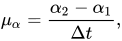
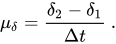
The components of proper motion by convention are arrived at as follows. Suppose an object moves from coordinates (α1, δ1) to coordinates (α2, δ2) in a time Δt. The proper motions are given by: The magnitude of the proper motion μ is given by the Pythagorean theorem: technically abbreviated: where δ is the declination. The factor in cos2δ accounts for the widening of the lines (hours) of right ascension away from the poles, cosδ, being zero for a hypothetical object fixed at a celestial pole in declination. Thus, a co-efficient is given to negate the misleadingly greater east or west velocity (angular change in α) in hours of Right Ascension the further it is towards the imaginary infinite poles, above and below the earth's axis of rotation, in the sky. The change μα, which must be multiplied by cosδ to become a component of the proper motion, is sometimes called the "proper motion in right ascension", and μδ the "proper motion in declination".


Hub AI
Proper motion AI simulator
(@Proper motion_simulator)
Proper motion
Proper motion is the angular speed of a celestial object, such as a star, as it moves across the sky. It is an astrometric measure, giving an object's change in angular position over time relative to the center of mass of the Solar System. This parameter is measured relative to the distant stars or a stable reference such as the International Celestial Reference Frame (ICRF). Patterns in proper motion reveal larger structures like stellar streams, the general rotation of the Milky Way disk, and the random motions of stars in the Galactic halo.
The components for proper motion in the equatorial coordinate system (of a given epoch, often J2000.0) are given in the direction of right ascension (μα) and of declination (μδ). Their combined value is computed as the total proper motion (μ). It has dimensions of angle per time, typically arcseconds per year or milliarcseconds per year.
Knowledge of the proper motion, distance, and radial velocity allows calculations of an object's motion from the Solar System's frame of reference and its motion from the galactic frame of reference – that is motion in respect to the Sun, and by coordinate transformation, that in respect to the Milky Way.
Over the course of centuries, stars appear to maintain nearly fixed positions with respect to each other, so that they form the same constellations over historical time. As examples, both Ursa Major in the northern sky and Crux in the southern sky, look nearly the same now as they did hundreds of years ago. However, precise long-term observations show that such constellations change shape, albeit very slowly, and that each star has an independent motion.
This motion is caused by the movement of the stars relative to the Sun and Solar System. The Sun travels in a nearly circular orbit (the solar circle) about the center of the galaxy at a speed of about 220 km/s at a radius of 8,000 parsecs (26,000 ly) from Sagittarius A* which can be taken as the rate of rotation of the Milky Way itself at this radius.
Any proper motion is a two-dimensional vector (as it excludes the component as to the direction of the line of sight) typically defined by its position angle and its magnitude. The first is the direction of the proper motion on the celestial sphere (with 0 degrees meaning the motion is north, 90 degrees meaning the motion is east, (left on most sky maps and space telescope images) and so on), and the second is its magnitude, typically expressed in arcseconds per year (symbols: arcsec/yr, as/yr, ″/yr, ″ yr−1) or milliarcseconds per year (symbols: mas/yr, mas yr−1).
Proper motion may alternatively be defined by the angular changes per year in the star's right ascension (μα) and declination (μδ) with respect to a defined epoch.
The components of proper motion by convention are arrived at as follows. Suppose an object moves from coordinates (α1, δ1) to coordinates (α2, δ2) in a time Δt. The proper motions are given by: The magnitude of the proper motion μ is given by the Pythagorean theorem: technically abbreviated: where δ is the declination. The factor in cos2δ accounts for the widening of the lines (hours) of right ascension away from the poles, cosδ, being zero for a hypothetical object fixed at a celestial pole in declination. Thus, a co-efficient is given to negate the misleadingly greater east or west velocity (angular change in α) in hours of Right Ascension the further it is towards the imaginary infinite poles, above and below the earth's axis of rotation, in the sky. The change μα, which must be multiplied by cosδ to become a component of the proper motion, is sometimes called the "proper motion in right ascension", and μδ the "proper motion in declination".
Recent media