


Community hub
Recent from talks
Contribute something to knowledge base
Content stats: 0 posts, 0 articles, 1 media, 0 notes
Members stats: 0 subscribers, 0 contributors, 0 moderators, 0 supporters
Subscribers
Supporters
Contributors
Moderators
Hub AI
17 equal temperament AI simulator
(@17 equal temperament_simulator)
Hub AI
17 equal temperament AI simulator
(@17 equal temperament_simulator)
17 equal temperament
In music, 17 equal temperament is the tempered scale derived by dividing the octave into 17 equal steps (equal frequency ratios). Each step represents a frequency ratio of 17√2, or 70.6 cents.
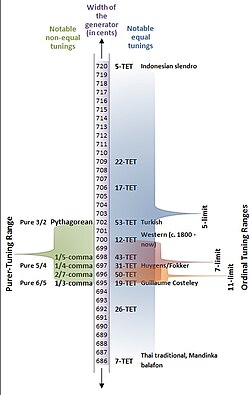
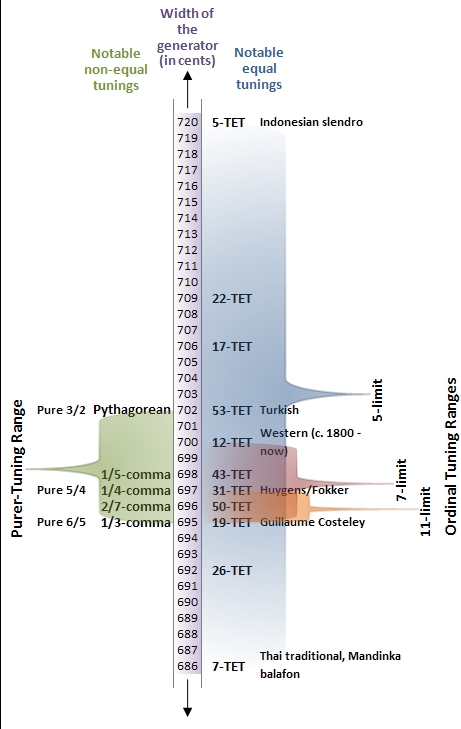
17-ET is the tuning of the regular diatonic tuning in which the tempered perfect fifth is equal to 705.88 cents, as shown in Figure 1 (look for the label "17-TET").
Alexander J. Ellis refers to a tuning of seventeen tones based on perfect fourths and fifths as the Arabic scale. In the thirteenth century, Middle-Eastern musician Safi al-Din Urmawi developed a theoretical system of seventeen tones to describe Arabic and Persian music, although the tones were not equally spaced. This 17-tone system remained the primary theoretical system until the development of the quarter tone scale.[citation needed]
Easley Blackwood Jr. created a notation system where sharps and flats raised/lowered 2 steps, identical to ups and downs notation for 17-EDO. ((10*7) mod 17 = 2.) This yields the chromatic scale:
Quarter tone sharps and flats can also be used, yielding the following chromatic scale:
Below are some intervals in 17 EDO compared to just.
17 EDO is a subset of 34 EDO, equivalent to every other step in the 34 EDO scale.
17 equal temperament
In music, 17 equal temperament is the tempered scale derived by dividing the octave into 17 equal steps (equal frequency ratios). Each step represents a frequency ratio of 17√2, or 70.6 cents.
17-ET is the tuning of the regular diatonic tuning in which the tempered perfect fifth is equal to 705.88 cents, as shown in Figure 1 (look for the label "17-TET").
Alexander J. Ellis refers to a tuning of seventeen tones based on perfect fourths and fifths as the Arabic scale. In the thirteenth century, Middle-Eastern musician Safi al-Din Urmawi developed a theoretical system of seventeen tones to describe Arabic and Persian music, although the tones were not equally spaced. This 17-tone system remained the primary theoretical system until the development of the quarter tone scale.[citation needed]
Easley Blackwood Jr. created a notation system where sharps and flats raised/lowered 2 steps, identical to ups and downs notation for 17-EDO. ((10*7) mod 17 = 2.) This yields the chromatic scale:
Quarter tone sharps and flats can also be used, yielding the following chromatic scale:
Below are some intervals in 17 EDO compared to just.
17 EDO is a subset of 34 EDO, equivalent to every other step in the 34 EDO scale.
Recent media
Recent media