
Recent from talks
Regular diatonic tuning
Knowledge base stats:
Talk channels stats:
Members stats:
Regular diatonic tuning
A regular diatonic tuning is any musical scale consisting of "tones" (T) and "semitones" (S) arranged in any rotation of the sequence TTSTTTS which adds up to the octave with all the T's being the same size and all the S's the being the same size, with the 'S's being smaller than the 'T's. In such a tuning, then the notes are connected together in a chain of seven fifths, all the same size (TTTS or a permutation of that) which makes it a Linear temperament with the tempered fifth as a generator.
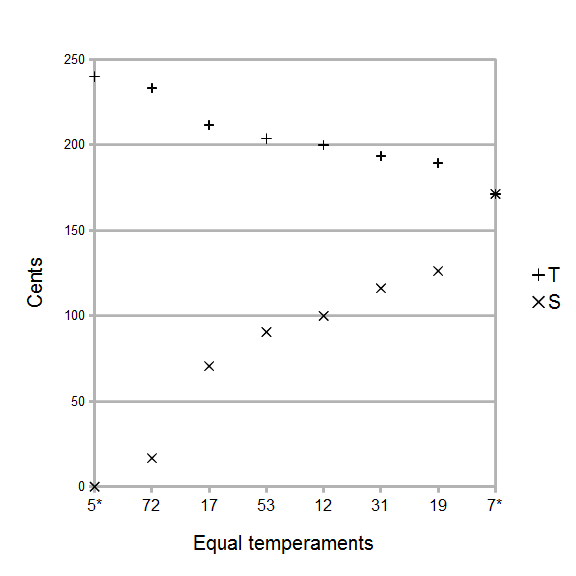
For the ordinary diatonic scales described here, the T-s are tones and the s-s are semitones which are half, or approximately half the size of the tone. But in the more general regular diatonic tunings, the two steps can be of any relation within the range between T = 171.43 ¢ (for s = T at the high extreme) and T = 240 ¢ (for s = 0 at the low extreme) in musical cents (fifth, p5, between 685.71 ¢ and 720 ¢). Note that regular diatonic tunings are not limited to the notes of any particular diatonic scale used to describe them.
One may determine the corresponding cents of s, T, and the fifth (p5), given one of the values:
When the (diatonic) semitones, s, are reduced to zero (T = 240 ¢) the octave is T T T T T, or a five tone equal temperament. As the semitones get larger, eventually the steps are all the same size, and the result is in seven tone equal temperament (s = T = 171.43 ¢). These two extremes are not included as "regular" diatonic tunings, because to be "regular" the pattern of five large and two small steps has to be preserved; everything in between is regular, however small the semitones are without vanishing completely, or however large they become while still being strictly smaller than a whole tone.
"Regular" here is understood in the sense of a mapping from Pythagorean diatone such that all the interval relationships are preserved. For instance, in all regular diatonic tunings, just as for the Pythagorean diatonic:
and so on; in all those examples the result is "reduced to the octave" (lowered by an octave whenever a note in the sequence exceeds an octave above the starting tone).
If one breaks the rule for "regular" that s must be smaller than T and continues to increase the size of s further, so that it becomes larger than the T, one gets irregular scales with two large steps and five small steps, and eventually, when all the T-s vanish the result is s s, so a division of the octave into tritones. However, these strange scales are only mentioned here to dismiss them; they not regular diatonic tunings.
All regular diatonic tunings are also linear temperaments, i.e. regular temperaments with two generators: the octave and the tempered fifth. One can use the tempered fourth as an alternative generator (e.g. as B E A D G C F, ascending fourths, reduced to the octave), but the tempered fifth is the more usual choice, and in any case, because fifths and fourths are octave complements, rising by perfect fourths produces the same result as rising by fifths.
Hub AI
Regular diatonic tuning AI simulator
(@Regular diatonic tuning_simulator)
Regular diatonic tuning
A regular diatonic tuning is any musical scale consisting of "tones" (T) and "semitones" (S) arranged in any rotation of the sequence TTSTTTS which adds up to the octave with all the T's being the same size and all the S's the being the same size, with the 'S's being smaller than the 'T's. In such a tuning, then the notes are connected together in a chain of seven fifths, all the same size (TTTS or a permutation of that) which makes it a Linear temperament with the tempered fifth as a generator.
For the ordinary diatonic scales described here, the T-s are tones and the s-s are semitones which are half, or approximately half the size of the tone. But in the more general regular diatonic tunings, the two steps can be of any relation within the range between T = 171.43 ¢ (for s = T at the high extreme) and T = 240 ¢ (for s = 0 at the low extreme) in musical cents (fifth, p5, between 685.71 ¢ and 720 ¢). Note that regular diatonic tunings are not limited to the notes of any particular diatonic scale used to describe them.
One may determine the corresponding cents of s, T, and the fifth (p5), given one of the values:
When the (diatonic) semitones, s, are reduced to zero (T = 240 ¢) the octave is T T T T T, or a five tone equal temperament. As the semitones get larger, eventually the steps are all the same size, and the result is in seven tone equal temperament (s = T = 171.43 ¢). These two extremes are not included as "regular" diatonic tunings, because to be "regular" the pattern of five large and two small steps has to be preserved; everything in between is regular, however small the semitones are without vanishing completely, or however large they become while still being strictly smaller than a whole tone.
"Regular" here is understood in the sense of a mapping from Pythagorean diatone such that all the interval relationships are preserved. For instance, in all regular diatonic tunings, just as for the Pythagorean diatonic:
and so on; in all those examples the result is "reduced to the octave" (lowered by an octave whenever a note in the sequence exceeds an octave above the starting tone).
If one breaks the rule for "regular" that s must be smaller than T and continues to increase the size of s further, so that it becomes larger than the T, one gets irregular scales with two large steps and five small steps, and eventually, when all the T-s vanish the result is s s, so a division of the octave into tritones. However, these strange scales are only mentioned here to dismiss them; they not regular diatonic tunings.
All regular diatonic tunings are also linear temperaments, i.e. regular temperaments with two generators: the octave and the tempered fifth. One can use the tempered fourth as an alternative generator (e.g. as B E A D G C F, ascending fourths, reduced to the octave), but the tempered fifth is the more usual choice, and in any case, because fifths and fourths are octave complements, rising by perfect fourths produces the same result as rising by fifths.
Recent media