


Community hub
Recent from talks
Contribute something
Nothing was collected or created yet.
1914 Ottoman census
View on Wikipedia
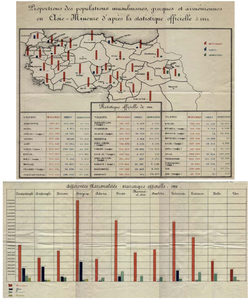
The 1914 Ottoman census was published as the Memalik-i-Osmaniyyenin 1330 Senesi Nütus Istatistiki.[a][1] According to the introduction, the statistics were derived from data collected during the 1905–06 Ottoman census, adjusted to reflect demographic and territorial changes.[1]
The 1914 census data reflected major changes in the territorial boundaries and administrative divisions of the Ottoman state.[2] The 1914 Ottoman general election provided a significant source of population data. The Empire's total population in the census was recorded as 18,520,015.[2] The grand total for 1914 showed a "net gain" of 1,131,454 people from the 1905-06 Ottoman census survey. The data reflected the loss of territory and population in Europe due to the Balkan Wars, as the total net gain within the Ottoman state’s population was 3,496,068.[2]
The census underestimated non-Muslim populations.[3][4] For example, in Diyarbekir, the Armenian population was reported at 73,226 in the 1914 Ottoman census, but in September 1915, Reshid Bey announced that he had deported 120,000 Armenians from the province.[5][6]
Census data
[edit]| Vilayet | Muslims | Greek Orthodox | Armenian Orthodox | Jews | Greek Catholics | Armenian Catholics | Protestants | Latins | Syriacs | Chaldeans | Jacobites | Maronites | Samarians | Nestorians | Yazidis | Gypsies | Druze | Cossacks | Serbs | Wallachians | Total | |
|---|---|---|---|---|---|---|---|---|---|---|---|---|---|---|---|---|---|---|---|---|---|---|
| Balkans | ||||||||||||||||||||||
| Çatalca1 | 20,048 | 36,797 | 842 | 1,480 | - | - | - | ? | 59,756 | |||||||||||||
| Edirne | 360,417 | 224,459 | 19,725 | 22,515 | 21 | 48 | 115 | ? | 631,094 | |||||||||||||
| Constantinople | 560,434 | 205,375 | 72,962 | 52,126 | 387 | 9,918 | 1,213 | 2,905 | ? | 909,978 | ||||||||||||
| Anatolia | ||||||||||||||||||||||
| Adana | 341,903 | 8,537 | 50,139 | 66 | 437 | 2,511 | 5,036 | ? | 411,023 | |||||||||||||
| Ankara | 877,285 | 20,226 | 44,507 | 1,026 | 14 | 7,069 | 2,381 | ? | 953,817 | |||||||||||||
| Antalya1 | 235,762 | 12,385 | 630 | 250 | - | - | - | ? | 249,686 | |||||||||||||
| Aydın | 1,249,067 | 299,096 | 19,395 | 35,041 | 1 | 892 | 479 | ? | 1,608,742 | |||||||||||||
| Bitlis | 309,999 | - | 114,704 | - | - | 2,788 | 1,640 | ? | 437,479 | |||||||||||||
| Bolu1 | 399,281 | 5,146 | 2,961 | 20 | 5 | 9 | 2 | ? | 408,648 | |||||||||||||
| Canik1 | 265,950 | 98,739 | 27,058 | 27 | - | 261 | 1,257 | ? | 393,302 | |||||||||||||
| Diyarbekir | 492,101 | 1,822 | 55,890 | 2,085 | 113 | 9,960 | 7,376 | ? | 619,825 | |||||||||||||
| Erzurum | 673,297 | 4,859 | 125,657 | 10 | 5 | 8,720 | 2,241 | ? | 815,432 | |||||||||||||
| Eskişehir1 | 140,578 | 2,613 | 8,276 | 728 | - | 316 | 215 | ? | 152,726 | |||||||||||||
| İçil1 | 102,034 | 2,500 | 341 | 10 | 7 | - | - | ? | 105,194 | |||||||||||||
| İzmit1 | 226,859 | 40,048 | 55,403 | 428 | - | 449 | 1,937 | ? | 325,153 | |||||||||||||
| Kale-i Sultaniye1 | 149,903 | 8,541 | 2,474 | 3,642 | 9 | - | 67 | ? | 165,815 | |||||||||||||
| Karahisar-i Sahip1 | 277,659 | 632 | 7,437 | 7 | - | 2 | 9 | ? | 285,820 | |||||||||||||
| Karesi1 | 359,804 | 97,497 | 8,544 | 362 | - | 109 | 51 | ? | 472,970 | |||||||||||||
| Kastamonu | 737,302 | 20,958 | 8,959 | 8 | - | - | - | ? | 767,227 | |||||||||||||
| Kayseri1 | 184,292 | 26,590 | 48,659 | - | - | 1,515 | 2,018 | ? | 263,074 | |||||||||||||
| Konya | 750,712 | 25,071 | 12,971 | 4 | 79 | - | 254 | ? | 789,308 | |||||||||||||
| Kütahya1 | 303,348 | 8,755 | 3,910 | - | - | 638 | - | ? | 316,894 | |||||||||||||
| Mamuret-ül-Aziz | 446,379 | 971 | 76,070 | - | - | 3,751 | 8,043 | ? | 538,227 | |||||||||||||
| Maraş1 | 152,645 | 11 | 27,842 | 251 | 23 | 4,480 | 6,111 | ? | 192,555 | |||||||||||||
| Menteşe1 | 188,916 | 19,923 | 12 | 1,615 | - | - | - | ? | 210,874 | |||||||||||||
| Niğde1 | 227,100 | 58,312 | 4,890 | - | - | 45 | 769 | ? | 291,117 | |||||||||||||
| Sivas | 939,735 | 75,324 | 143,406 | 344 | - | 3,693 | 4,575 | ? | 1,169,443 | |||||||||||||
| Trabzon | 921,128 | 161,574 | 37,549 | 8 | - | 1,350 | 1,338 | ? | 1,122,947 | |||||||||||||
| Urfa1 | 149,384 | 2 | 15,161 | - | 865 | 1,557 | 1,652 | ? | 170,988 | |||||||||||||
| Van Vilayet | 179,380 | 1 | 67,792 | 1,383 | - | - | - | ? | 259,141 | |||||||||||||
| Levant | ||||||||||||||||||||||
| Beyrut | 648,314 | 87,244 | 1,188 | 15,052 | 24,210 | 277 | 3,823 | ? | 824,873 | |||||||||||||
| Halep | 576,320 | 13,772 | 35,104 | 12,193 | 8,182 | 5,739 | 8,643 | ? | 667,790 | |||||||||||||
| Kudüs-i Şerif | 266,044 | 26,035 | 1,310 | 21,259 | 1,086 | - | 1,733 | ? | 328,168 | |||||||||||||
| Suriye | 791,582 | 60,978 | 413 | 10,140 | 27,662 | 247 | 1,873 | ? | 918,409 | |||||||||||||
| Zor1 | 65,770 | 18 | 67 | 2 | 27 | 215 | 1 | ? | 66,294 | |||||||||||||
| Total | 15,044,846 | 1,729,738 | 1,161,169 | 187,073 | 62,468 | 67,838 | 65,844 | 24,845 | 54,750 | 4,133 | 13,211 | 6,932 | 47,406 | 164 | 8,091 | 6,957 | 11,169 | 7,385 | 1,006 | 14,908 | 82 | 18,520,016 |
As a result of the substantial territorial losses in Europe suffered during the Balkan Wars, the total population of the Empire fell to 18,520,016, of whom, an even larger percentage than before—15,044,846—were counted as Muslim, with 1,729,738 as Greek Orthodox, 1,161,169 as Armenian Gregorian, 187,073 as Jewish, 68,838 as Armenian Catholic, 65,844 as Protestant, and 62,468 as Greek Catholic. No separate figures were given for Franks.[7]
The capital, Constantinople (Istanbul) was an important location due to expulsions from the Balkan Wars. According to the 1914 census, its population increased slightly to 909,978, excluding Franks, with 560,434 Muslims, 205,375 Greek Orthodox, 72,963 Armenian Gregorian, 52,126 Jews, 9,918 Armenian Catholics, 2,905 Roman Catholics, 1,213 Protestants, and 387 Greek Catholics.[7]
- 1 Sanjak
Notes
[edit]- ^ Population statistics of the Ottoman state in the year 1914 in Istanbul, 1919
References
[edit]- ^ a b Karpat 1985, p. 189
- ^ a b c Karpat 1985, p. 190
- ^ Gaunt, David (2006). Massacres, Resistance, Protectors: Muslim-Christian Relations in Eastern Anatolia During World War I. Gorgias Press. p. 19. ISBN 978-1-59333-301-0.
Both the Armenian and the Assyro-Chaldean leaders ignored the official Ottoman census of 1914, which gave figures for non-Muslims that were thoroughly misleading and inaccurate. As a token of the confused nature of the official census-taking and the lack of coordination between the local correspondents, the Syriac Orthodox population is shown in three separate categories: Süryaniler, Eski Süryaniler, and Jakobiler. Under-registration of minorities was a fact of life in Ottoman statistics.
- ^ Kévorkian, Raymond (2011). The Armenian Genocide: A Complete History. Bloomsbury Publishing. p. 266. ISBN 978-0-85771-930-0.
From the day the Armenian question was posed, the Armenians' demographic weight in the population became a political problem and was treated as such. Thus, it is not surprising that the Ottoman authorities systematically falsified their own censuses.
- ^ Kévorkian, Raymond (2011). The Armenian Genocide: A Complete History. Bloomsbury Publishing. p. 271. ISBN 978-0-85771-930-0.
- ^ Gaunt 2006, pp. 69, 301.
- ^ a b Shaw 1978, p. 335
Bibliography
[edit]- Karpat, K.H. (1985). Ottoman population, 1830–1914: demographic and social characteristics. Madison: University of Wisconsin Pres. pp. 189–190, 242. ISBN 9780299091606.
- Shaw, Stanford J. (1978). "The Ottoman Census System and Population, 1831–1914". International Journal of Middle East Studies. 9 (3): 325–338. doi:10.1017/s0020743800033602.
| Demographics | |
|---|---|
| Special Cases | |

1914 Ottoman census
View on GrokipediaThe 1914 Ottoman census, formally designated as the Memâlik-i Osmaniye population register, constituted the Ottoman Empire's concluding systematic demographic assessment before its involvement in the First World War, tallying an official total of 18,520,015 inhabitants within its residual territories encompassing Anatolia, the Arab provinces, and Thrace after Balkan War losses.[1] This figure, derived principally from extrapolations and updates to the preceding 1905–1906 census via records of births, deaths, migrations, and registrations, furnished granular data by administrative unit (vilayet) on attributes including gender, age cohorts, religious affiliation, and ethnic nationality, underscoring a preponderantly Muslim populace numbering 15,044,846 (84%) alongside non-Muslim minorities totaling 3,353,815, including Rum (1,729,738), Armenian Gregorians (1,161,169), Jews (187,073), and smaller groups such as Protestants (65,844), Syriacs (54,850), and various Catholics.[2][3] Intended primarily for fiscal, military conscription, and administrative imperatives amid escalating geopolitical strains, the enumeration nonetheless exhibited inherent constraints characteristic of Ottoman vital statistics systems, such as underreporting of females, juveniles, pastoral nomads, and non-Muslim groups prone to evading obligatory service through non-registration.[2] Scholarly exegeses, notably by Kemal H. Karpat in his compilation of archival census materials, affirm the dataset's foundational empirical value while advocating corrections for these omissions to approximate a more veridical aggregate nearing 21 million, thereby furnishing critical evidentiary ballast against inflated contemporary appraisals from partisan or extraterritorial observers.[1] These records have since anchored causal analyses of the empire's ethnic mosaic and demographic vicissitudes precipitating its dissolution, often contesting narratives reliant on uncorroborated minority advocacy statistics that diverge markedly from state tallies.[4]
Historical Context
Evolution of Ottoman Census Practices
The initial modern Ottoman census efforts began with the 1831 count, which constituted a rudimentary enumeration primarily targeting adult males for military conscription and tax assessment.[5] This survey, conducted amid Tanzimat reforms, focused on healthy men over 15 years deemed taxable, employing local officials and religious leaders but often excluding women, children, and non-taxable groups such as nomads.[6] A follow-up in 1845 extended to revenue-based surveys (temettuat), incorporating broader economic data alongside population tallies to support fiscal administration, though still limited in scope and reliant on decentralized reporting.[7] By the 1880s, Ottoman practices evolved toward more systematic population registers known as nufus defters, shifting from episodic male-only counts to ongoing household-based records that included family members, such as children and women after 1882.[8] These defters, initiated around 1876-1881, served dual military and administrative purposes, tracking vital events like births, deaths, and migrations through local mukhtars and census teams, thereby enabling periodic updates rather than one-off surveys.[9] The 1881-1893 census phase formalized this approach, deploying multi-stage registrations across provinces with specialized defters for different categories, enhancing coverage of settled populations while beginning to address nomadic undercounts through targeted inclusions.[10] Further refinements in the 1890s and early 1900s emphasized ethnic and religious classifications within these registers, integrating data on affiliations to refine governance and resource allocation.[11] The 1905-1906 census acted as an immediate precursor, standardizing vilayet-level methodologies with breakdowns by sex, age, religion, and nationality, which provided the structural template for subsequent revisions by improving archival integration and verification processes.[12] Archival records indicate persistent challenges, such as nomadic mobility leading to incomplete tallies in early phases and evasion tactics by certain minority groups to avoid conscription, though these were mitigated through iterative register updates.[10]Political and Military Motivations Leading to 1914
The Committee of Union and Progress (CUP) government, consolidating power after the 1913 coup, prioritized military reorganization following the Ottoman Empire's catastrophic defeats in the Balkan Wars of 1912–1913, which resulted in the loss of approximately 83% of European territories and 69% of the European population, alongside heavy manpower casualties.[13] These reversals, including the expulsion and influx of over 400,000 Muslim refugees into Anatolia, underscored the inadequacy of prior population registers—primarily from the 1905–1906 census—for sustaining conscription, as inaccurate data had long impeded universal male military service. The 1914 census thus served as a pragmatic mechanism to enumerate eligible Muslim males aged 20–45, enabling targeted recruitment to rebuild an army depleted to under 200,000 effectives by early 1914, while systematically recording non-Muslim exemptions via the bedel-i askerî tax to optimize fiscal and human resource allocation amid fiscal strain. Geopolitical pressures amplified this drive, as European powers, particularly Russia, intensified demands for administrative reforms in eastern provinces with Armenian concentrations, culminating in the February 1914 Russo-German agreement for international inspectors to oversee reforms, which the CUP viewed as a prelude to territorial encroachments.[13] Concurrently, simmering Arab discontent—manifest in clandestine societies like al-Fatat and decentralized revolts in Yemen and Albania—necessitated granular demographic mapping to preempt insurgencies and redistribute garrisons, reflecting a causal imperative for centralized intelligence over fragmented provincial reports.[14] These motivations positioned the census not as an instrument of ethnic homogenization, but as an empirical tool for state preservation, prioritizing quantifiable manpower assessments to counter existential threats from both external revisionism and internal fragmentation, in line with the CUP's centralizing ethos post-1908. Such imperatives derived from first-principles statecraft: amid imperial contraction, accurate population data facilitated causal chains from registration to levy enforcement, averting the haphazard drafts that had yielded uneven mobilization in prior conflicts like the 1897 Greco-Turkish War. This focus on military utility, rather than ideological exclusion, is evidenced by the census's inception in late 1913—prior to Ottoman entry into World War I—targeting all subjects for administrative efficiency, though practical emphasis fell on Muslim cohorts to address the disproportionate burden of defense borne by them historically.[15]Methodology
Data Collection and Update Process
The compilation of the 1914 Ottoman census relied on updating the comprehensive 1905–1906 census baseline through systematic aggregation of local vital statistics, including births, deaths, migrations, and new registrations reported from administrative units across the empire.[16][12] Local officials known as nüfus memurları (population registrars), stationed at village, nahiye (subdistrict), and kaza (district) levels, cross-referenced entries in ongoing nüfus defterleri (population registers) to track changes since 1905, forwarding periodic summaries to provincial governors and ultimately the central Nüfus İdaresi (Census Department) in Istanbul.[16][8] This update process drew on the empire's established registration infrastructure, established under the 1881 census reforms and refined by 1905, whereby registrars recorded events in household-based ledgers rather than conducting door-to-door enumerations anew.[17] Emphasis was placed on male population data to support military conscription needs, with female and child figures incorporated partially from existing records where available, reflecting the administrative priority of taxable and mobilizable subjects over exhaustive demographic canvassing.[16] The effort spanned several months in late 1913 and early 1914, culminating in centralized tabulation before the outbreak of World War I, as annual reports from provinces ceased issuance after 1910 but resumed ad hoc updates for policy purposes.[18] Ottoman administrative documentation highlighted the system's orientation toward practical governance, with built-in mechanisms like address change notifications intended to address mobility, though officials pragmatically noted persistent challenges from unregistered movements and deliberate non-compliance in remote or nomadic areas.[16]Categories and Classifications Used
The 1914 Ottoman census retained the millet-based structure inherited from prior Ottoman practices, with religious affiliation serving as the foundational category for demographic enumeration. Muslims formed the overarching group, aggregating speakers of Turkish, Arabic, Kurdish, and other languages without uniform ethnic sub-classification in core records, prioritizing fiscal and military administrative needs over granular identity parsing.[19][2] Non-Muslim populations were delineated by confessional millets, including Greek Orthodox (Rum), Armenian Gregorian, Catholic variants (such as Armenian Catholic and Syrian Catholic), Protestant, and Jewish communities, reflecting the empire's longstanding organization of religious minorities under clerical oversight.[19][11] Influenced by the Committee of Union and Progress (CUP) regime's modernization agenda, the census introduced limited linguistic notations—particularly for Muslim subgroups like Arabic or Kurdish speakers—marking a partial evolution from purely confessional tracking toward proto-ethnic awareness, though this served pragmatic governance rather than strict nationalist reconfiguration.[20][19] Entries derived from self-declarations corroborated by millet representatives and local authorities, emphasizing communal verification over imposed modern ethnic or biological criteria.[2][20]Key Findings
Overall Population Totals
The 1914 Ottoman census, conducted as an update to the 1905–1906 registers rather than a full recount, recorded a total registered population of 18,520,016 individuals across the remaining empire territories.[21] This aggregate figure reflected adjustments for births, deaths, migrations, and significant territorial contractions following the Balkan Wars of 1912–1913, which resulted in the loss of European provinces and associated populations.[2] Ottoman archival records, including population ledgers (nüfus defterleri), formed the basis for these totals, with data compiled centrally in Istanbul for administrative purposes.[18] Relative to the 1905–1906 census total of approximately 17,388,561, the 1914 figure indicated a net growth of 1,131,455 persons over the intervening period.[16] This increment arose from demographic expansion via higher birth rates among Muslim communities and the resettlement of muhacir refugees fleeing Balkan hostilities, which partially compensated for outflows and wartime casualties without alterations in census methodology.[12] Salnames, the official Ottoman provincial yearbooks, corroborated these aggregates through annual statistical summaries derived from local registration updates.[22] The overall totals underscored a stabilizing core population in Anatolia and adjacent regions amid imperial contraction.[19]Religious and Ethnic Distributions
The 1914 Ottoman census primarily categorized the population by religious affiliation under the millet system, with Muslims encompassing the overwhelming majority at approximately 84% of the enumerated residents in the empire's core territories post-Balkan Wars.[16] This figure included Sunni Muslims as the predominant sect, alongside smaller numbers of heterodox groups such as Alevis and heterodox Kurds, though the census did not always distinguish sects exhaustively. Non-Muslim communities were recorded separately, reflecting administrative priorities for taxation, conscription exemptions, and communal governance rather than ethnic homogeneity within groups.[23] Armenian Gregorians, the largest Catholicos-affiliated Christian millet, totaled 1,161,169 individuals according to official records, constituting roughly 5-6% of the population—a figure that contrasted sharply with contemporaneous missionary and patriarchal estimates often exceeding 2 million.[16] These higher claims, frequently cited in Western diplomatic reports, likely incorporated unenumerated nomadic elements, emigrants, or inflated counts for fundraising and advocacy purposes, as Ottoman enumerators relied on household registrations that systematically undercounted females and children but provided consistent male adult baselines. Greek Orthodox adherents, including Rum communities, accounted for 1,729,738 (about 9%), with the census distinguishing them from other Orthodox subgroups like Bulgarians where territorial losses had already separated such populations.[23] Smaller millets included Armenian Catholics (67,838), Protestants (65,844), Jews (187,073), Syriacs (54,850), and assorted Catholic and Latin groups (around 87,313), each under 1%.[16] Ethnic distributions were secondary to religious classifications, with limited systematic breakdowns except via language or tribal identifiers in supplemental registers. Within the Muslim category, Turks formed the core sedentary population in Anatolia and Rumelia remnants, while Kurds—primarily Sunni and numbering around 1.194 million—were noted in eastern and southeastern districts through nomadic and semi-nomadic tallies.[16] Arabs, Circassians, and other Muslim ethnicities (e.g., Bosniaks, Albanians) comprised significant but unquantified proportions, often aggregated due to shared legal status under Islamic law, though local surveys occasionally separated them for military mobilization. Non-Muslim ethnic nuances, such as Hellenized or Slavic elements within Greek Orthodox or Armenian Gregorians, were not disaggregated, prioritizing confessional over linguistic identity in official data. This approach yielded an administrative snapshot emphasizing loyalty and fiscal utility over granular ethnic mapping.[12]Geographic Breakdown by Vilayets and Sanjaks
The 1914 Ottoman census documented pronounced regional disparities in population distribution and density across the empire's vilayets and sanjaks, with central and western Anatolian units featuring overwhelmingly Muslim majorities and higher overall densities, while eastern vilayets displayed more heterogeneous compositions and sparser settlements.[18] In core Anatolian areas such as the Aidin and Angora vilayets, Muslim populations constituted over 80% of inhabitants, reflecting long-established settlement patterns amid fertile plains and urban centers.[18] Eastern provinces, by contrast, showed elevated minority shares, particularly Armenians, in mountainous sanjaks like those of Van and Bitlis, where local densities reached 20-30% for Armenians amid nomadic and sedentary Muslim groups.[18] Sanjak-level granularity within vilayets underscored these variances; for instance, in the Diyarbekir vilayet, Armenians numbered 73,226 out of a total population of 619,825, concentrated in urban sanjaks like Diyarbekir city, against a Muslim majority of 492,101.[18] Similarly, the Erzurum vilayet's sanjaks, such as Erzurum and Hasankale, hosted 136,618 Armenians within 815,432 total residents, comprising roughly 17% amid 673,297 Muslims.[18] The following table summarizes key eastern vilayet data from updated 1914 census registers, highlighting compositional densities:| Vilayet | Total Population | Muslims | Armenians | Others |
|---|---|---|---|---|
| Van | 259,141 | 179,380 | 67,792 | 11,969 |
| Erzurum | 815,432 | 673,297 | 136,618 | 5,517 |
| Diyarbekir | 619,825 | 492,101 | 73,226 | 54,498 |
| Bitlis | 437,479 | 309,999 | 119,132 | 8,348 |