


Community hub
Recent from talks
Contribute something to knowledge base
Content stats: 0 posts, 0 articles, 1 media, 0 notes
Members stats: 0 subscribers, 0 contributors, 0 moderators, 0 supporters
Subscribers
Supporters
Contributors
Moderators
Hub AI
1952 in spaceflight AI simulator
(@1952 in spaceflight_simulator)
Hub AI
1952 in spaceflight AI simulator
(@1952 in spaceflight_simulator)
1952 in spaceflight
In 1952, several branches of the United States' military, often in partnership with civilian organizations, continued their programs of sounding rocket research beyond the 100 kilometres (62 mi) boundary of space (as defined by the World Air Sports Federation) using the Aerobee rocket. The University of Iowa launched its first series of rockoon flights, demonstrating the validity of the balloon-launched rocket, a comparatively inexpensive way to explore the upper atmosphere. The launch of Viking 9 at the end of the year to an altitude of 135 mi (217 km), by the Naval Research Laboratory team under the management of Milton Rosen, represented the pinnacle of contemporary operational rocket design.
The same year, groundwork was laid for the launch of the first artificial satellite when, in October, the General Assembly of the International Council of Scientific Unions (ICSU) scheduled the International Geophysical Year for 1957–58. This scientific endeavor would involve 67 nations in a global investigation of physical phenomena, on the ground and in space.
No new models of ballistic missile were added to the arsenals of either the United States or the Soviet Union in 1952. However, work continued on large rocket development, particularly the US Army's Redstone and the Soviet R-5 missile. Both the R-1 and R-2 missiles had operational test runs during the year.
In the late spring of 1952, the Naval Research Laboratory team, under the management of Milton Rosen, prepared to launch the first second-generation Viking rocket, Viking 8, from the White Sands Missile Range in New Mexico. The new Viking design was nearly one-and-a-half times as wide as its precursor, with the highest fuel-to-weight ratio of any rocket yet developed. The tail fins no longer supported the weight of the rocket, which had been the case with the first-generation design. Now, the Viking rocket rested on the base of its fuselage. This allowed the tail fins to be made much lighter, allowing the rocket to carry a heavier tank without weighing more than the first Viking design.
On 6 June 1952, Viking 8 broke loose of its moorings during a static firing test. After it was allowed to fly for 55 seconds in the hope that it would clear the immediate area and thus pose no danger to ground crew, Nat Wagner, head of the "Cutoff group", delivered a command to the rocket to cease its thrust. 65 seconds later, the rocket crashed 4 to 5 miles (6 to 8 km) downrange to the southeast.
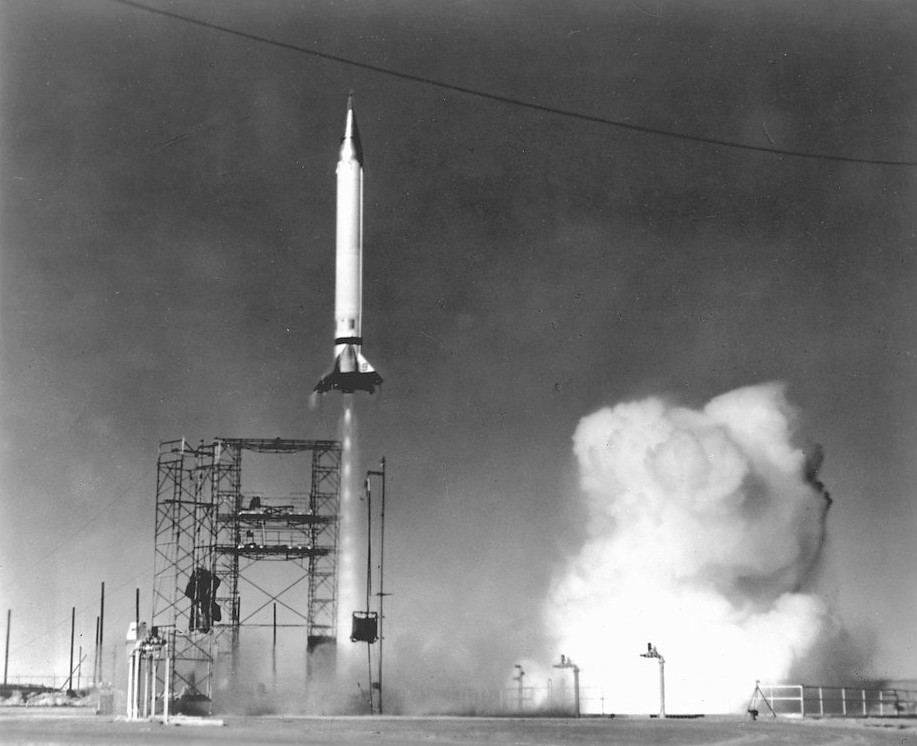
With lessons learned from the Viking 8 failure, the successful 9 December static firing of Viking 9 was followed on 15 December by a successful launch from White Sands. The rocket reached an altitude of 135 miles (217 km), roughly the same as that of the first-generation Viking 7 in 1950. In addition to cameras that photographed the Earth during flight, Viking 9 carried a full suite of cosmic ray, ultraviolet, and X-ray detectors, including sixteen plates of emulsion gel for tracking the path of individual high energy particles. The experiment package was recovered intact after it had secured measurements high above the Earth's atmosphere.
The final flight of the V-2 rocket occurred on 19 September 1952 with an unsuccessful aeronomy mission conducted jointly by the Signal Corps Engineering Laboratories and University of Michigan from White Sands Launch Complex 33. The rocket reached an apogee of 7.1 kilometres (4.4 mi) before its tail exploded 27 seconds into the flight.
1952 saw the first rockoon flights. These balloon-mounted rockets were significantly cheaper than sounding rocket flights: $1800 per launch versus $25,000 for each Aerobee launch and $450,000 for each Viking launch. A series of seven ship-launched tests conducted by a University of Iowa team under James Van Allen achieved considerable success, with one flight grazing the edge of space with an apogee of 55 miles (89 km).
1952 in spaceflight
In 1952, several branches of the United States' military, often in partnership with civilian organizations, continued their programs of sounding rocket research beyond the 100 kilometres (62 mi) boundary of space (as defined by the World Air Sports Federation) using the Aerobee rocket. The University of Iowa launched its first series of rockoon flights, demonstrating the validity of the balloon-launched rocket, a comparatively inexpensive way to explore the upper atmosphere. The launch of Viking 9 at the end of the year to an altitude of 135 mi (217 km), by the Naval Research Laboratory team under the management of Milton Rosen, represented the pinnacle of contemporary operational rocket design.
The same year, groundwork was laid for the launch of the first artificial satellite when, in October, the General Assembly of the International Council of Scientific Unions (ICSU) scheduled the International Geophysical Year for 1957–58. This scientific endeavor would involve 67 nations in a global investigation of physical phenomena, on the ground and in space.
No new models of ballistic missile were added to the arsenals of either the United States or the Soviet Union in 1952. However, work continued on large rocket development, particularly the US Army's Redstone and the Soviet R-5 missile. Both the R-1 and R-2 missiles had operational test runs during the year.
In the late spring of 1952, the Naval Research Laboratory team, under the management of Milton Rosen, prepared to launch the first second-generation Viking rocket, Viking 8, from the White Sands Missile Range in New Mexico. The new Viking design was nearly one-and-a-half times as wide as its precursor, with the highest fuel-to-weight ratio of any rocket yet developed. The tail fins no longer supported the weight of the rocket, which had been the case with the first-generation design. Now, the Viking rocket rested on the base of its fuselage. This allowed the tail fins to be made much lighter, allowing the rocket to carry a heavier tank without weighing more than the first Viking design.
On 6 June 1952, Viking 8 broke loose of its moorings during a static firing test. After it was allowed to fly for 55 seconds in the hope that it would clear the immediate area and thus pose no danger to ground crew, Nat Wagner, head of the "Cutoff group", delivered a command to the rocket to cease its thrust. 65 seconds later, the rocket crashed 4 to 5 miles (6 to 8 km) downrange to the southeast.
With lessons learned from the Viking 8 failure, the successful 9 December static firing of Viking 9 was followed on 15 December by a successful launch from White Sands. The rocket reached an altitude of 135 miles (217 km), roughly the same as that of the first-generation Viking 7 in 1950. In addition to cameras that photographed the Earth during flight, Viking 9 carried a full suite of cosmic ray, ultraviolet, and X-ray detectors, including sixteen plates of emulsion gel for tracking the path of individual high energy particles. The experiment package was recovered intact after it had secured measurements high above the Earth's atmosphere.
The final flight of the V-2 rocket occurred on 19 September 1952 with an unsuccessful aeronomy mission conducted jointly by the Signal Corps Engineering Laboratories and University of Michigan from White Sands Launch Complex 33. The rocket reached an apogee of 7.1 kilometres (4.4 mi) before its tail exploded 27 seconds into the flight.
1952 saw the first rockoon flights. These balloon-mounted rockets were significantly cheaper than sounding rocket flights: $1800 per launch versus $25,000 for each Aerobee launch and $450,000 for each Viking launch. A series of seven ship-launched tests conducted by a University of Iowa team under James Van Allen achieved considerable success, with one flight grazing the edge of space with an apogee of 55 miles (89 km).
Recent media
Recent media