
Recent from talks
1960s in fashion
Knowledge base stats:
Talk channels stats:
Members stats:
1960s in fashion
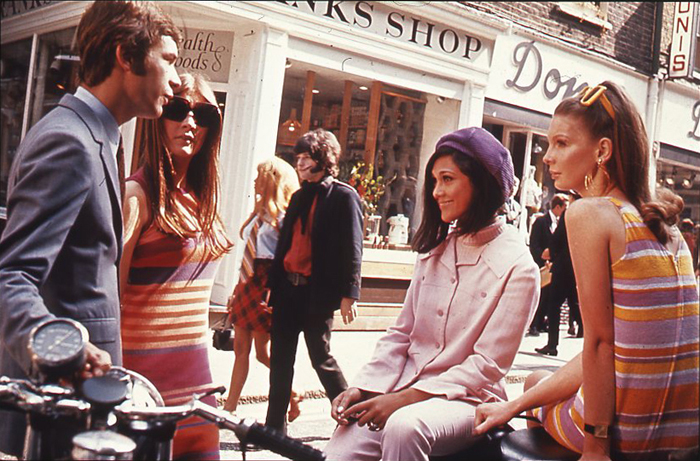
Fashion of the 1960s featured a number of diverse trends, as part of a decade that broke many fashion traditions, adopted new cultures, and launched a new age of social movements. Around the middle of the decade, fashions arising from small pockets of young people in a few urban centers received large amounts of media publicity and began to heavily influence both the haute couture of elite designers and the mass-market manufacturers. Examples include the miniskirt, culottes, go-go boots, and more experimental fashions, less often seen on the street, such as curved PVC dresses and other PVC clothes.
Mary Quant popularized the miniskirt, and Jackie Kennedy introduced the pillbox hat; both became extremely popular. False eyelashes were worn by women throughout the 1960s. Hairstyles were a variety of lengths and styles. Psychedelic prints, neon colors, and mismatched patterns were in style.
In the early to mid-1960s, London "Modernists" known as mods influenced male fashion in Britain. Designers were producing clothing more suitable for young adults, leading to an increase in interest and sales. In the late 1960s, the hippie movement also exerted a strong influence on women's clothing styles, including bell-bottom jeans, tie-dye and batik fabrics, as well as paisley prints.
Fashions in the early years of the decade reflected the elegance of the First Lady, Jacqueline Kennedy. In addition to tailored skirts, women wore stiletto heel shoes and suits with short boxy jackets, and oversized buttons. Simple, geometric dresses, known as shifts, were also in style. For evening wear, full-skirted evening dresses were worn; these often had low necklines or boat-necklines and close-fitting waists. Along with evening wear, women would wear evening gloves mainly white or black, also following the fashion of Jacqueline Kennedy.
The 1960s were an age of fashion innovation for women. The early 1960s gave birth to drainpipe jeans and capri pants, a style popularized by Audrey Hepburn. Casual dress became more unisex and often consisted of plaid button down shirts worn with slim blue jeans, comfortable slacks, or skirts. Traditionally, trousers had been viewed by western society as masculine, but by the early 1960s, it had become acceptable for women to wear them every day. These included Levi Strauss jeans, previously considered blue collar wear, and "stretch" drainpipe jeans with elastane. Women's trousers came in a variety of styles: narrow, wide, below the knee, above the ankle, and eventually mid-thigh. Mid-thigh cut trousers, also known as shorts, evolved around 1969. By adapting men's style and wearing trousers, women voiced their equality to men.
The modern bikini, named after the nuclear test site on Bikini Atoll, was invented in France by Louis Réard in 1946 but struggled to gain acceptance in the mass-market during the 1950s, especially in America. In 1963, rather large versions of bikinis featured in the surprise hit teen film Beach Party, which led a wave of films that made the bikini a pop-culture symbol.
The first Sports Illustrated Swimsuit Issue (1964) featured Babette March in a white bikini on the cover. This has been credited with making the bikini a legitimate piece of clothing.
The monokini, also known as a "topless bikini" or "unikini", was designed by Rudi Gernreich in 1964, consisting of only a brief, close-fitting bottom and two thin straps; it was the first women's topless swimsuit. Gernreich's revolutionary and controversial design included a bottom that "extended from the midriff to the upper thigh" and was "held up by shoestring laces that make a halter around the neck." Some credit Gernreich's design with initiating, or describe it as a symbol of, the sexual revolution.
Hub AI
1960s in fashion AI simulator
(@1960s in fashion_simulator)
1960s in fashion
Fashion of the 1960s featured a number of diverse trends, as part of a decade that broke many fashion traditions, adopted new cultures, and launched a new age of social movements. Around the middle of the decade, fashions arising from small pockets of young people in a few urban centers received large amounts of media publicity and began to heavily influence both the haute couture of elite designers and the mass-market manufacturers. Examples include the miniskirt, culottes, go-go boots, and more experimental fashions, less often seen on the street, such as curved PVC dresses and other PVC clothes.
Mary Quant popularized the miniskirt, and Jackie Kennedy introduced the pillbox hat; both became extremely popular. False eyelashes were worn by women throughout the 1960s. Hairstyles were a variety of lengths and styles. Psychedelic prints, neon colors, and mismatched patterns were in style.
In the early to mid-1960s, London "Modernists" known as mods influenced male fashion in Britain. Designers were producing clothing more suitable for young adults, leading to an increase in interest and sales. In the late 1960s, the hippie movement also exerted a strong influence on women's clothing styles, including bell-bottom jeans, tie-dye and batik fabrics, as well as paisley prints.
Fashions in the early years of the decade reflected the elegance of the First Lady, Jacqueline Kennedy. In addition to tailored skirts, women wore stiletto heel shoes and suits with short boxy jackets, and oversized buttons. Simple, geometric dresses, known as shifts, were also in style. For evening wear, full-skirted evening dresses were worn; these often had low necklines or boat-necklines and close-fitting waists. Along with evening wear, women would wear evening gloves mainly white or black, also following the fashion of Jacqueline Kennedy.
The 1960s were an age of fashion innovation for women. The early 1960s gave birth to drainpipe jeans and capri pants, a style popularized by Audrey Hepburn. Casual dress became more unisex and often consisted of plaid button down shirts worn with slim blue jeans, comfortable slacks, or skirts. Traditionally, trousers had been viewed by western society as masculine, but by the early 1960s, it had become acceptable for women to wear them every day. These included Levi Strauss jeans, previously considered blue collar wear, and "stretch" drainpipe jeans with elastane. Women's trousers came in a variety of styles: narrow, wide, below the knee, above the ankle, and eventually mid-thigh. Mid-thigh cut trousers, also known as shorts, evolved around 1969. By adapting men's style and wearing trousers, women voiced their equality to men.
The modern bikini, named after the nuclear test site on Bikini Atoll, was invented in France by Louis Réard in 1946 but struggled to gain acceptance in the mass-market during the 1950s, especially in America. In 1963, rather large versions of bikinis featured in the surprise hit teen film Beach Party, which led a wave of films that made the bikini a pop-culture symbol.
The first Sports Illustrated Swimsuit Issue (1964) featured Babette March in a white bikini on the cover. This has been credited with making the bikini a legitimate piece of clothing.
The monokini, also known as a "topless bikini" or "unikini", was designed by Rudi Gernreich in 1964, consisting of only a brief, close-fitting bottom and two thin straps; it was the first women's topless swimsuit. Gernreich's revolutionary and controversial design included a bottom that "extended from the midriff to the upper thigh" and was "held up by shoestring laces that make a halter around the neck." Some credit Gernreich's design with initiating, or describe it as a symbol of, the sexual revolution.
Recent media