
Recent from talks
Tie-dye
Knowledge base stats:
Talk channels stats:
Members stats:
Tie-dye
Tie-dye is a term used to describe a number of resist dyeing techniques and the resulting dyed products of these processes. The process of tie-dye typically consists of folding, twisting, pleating, or crumpling fabric or a garment, before binding with string or rubber bands, followed by the application of dye or dyes. The manipulations of the fabric before the application of dye are called resists, as they partially or completely prevent ('resist') the applied dye from coloring the fabric. More sophisticated tie-dye may involve additional steps, including an initial application of dye before the resist, multiple sequential dyeing and resist steps, and the use of other types of resists (stitching, stencils) and discharge.
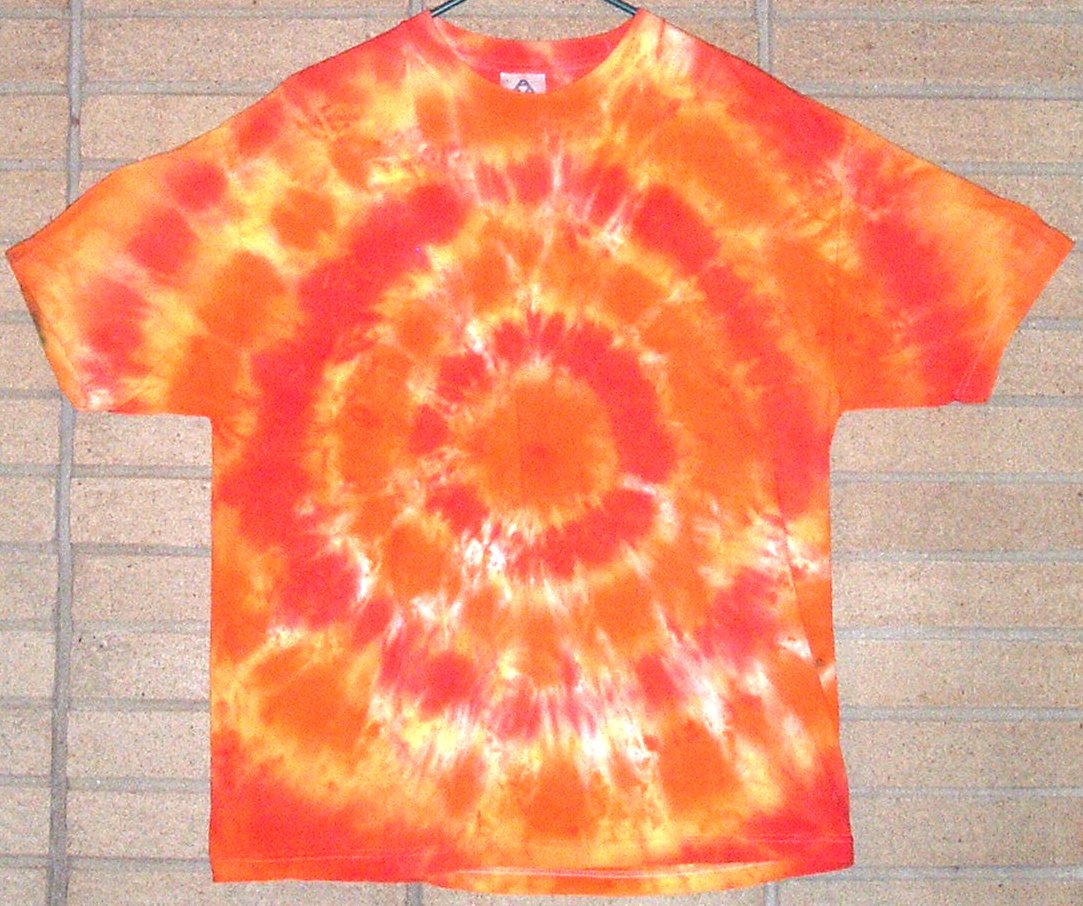
Unlike regular resist-dyeing techniques, modern tie-dye is characterized by the use of bright, saturated primary colors and bold patterns. These patterns, including the spiral, mandala, and peace sign, and the use of multiple bold colors, have become widely recognized as symbols of the 1960s and 1970s counterculture movement. However tie-dye wasn't as pronounced in fashion even among the counterculture as it would be in later years and the present day. The vast majority of tie-dye garments and objects produced for wholesale distribution use these designs, with many being mass-produced.
In the 21st century, a revived interest in more 'sophisticated' tie-dye techniques emerged in the fashion and hobby industry, characterized by simple motifs, monochromatic color schemes, a focus on fashionable garments and fabrics other than cotton, and the pursuit of tie-dye as an art form, rather than a commodity.
A variety of dyes are used in tie-dyeing, including household, fiber reactive, acid, and vat dyes. Most early (1960s) tie-dyes were made with retail household dyes, particularly those made by Rit. These dyes were designed for use on a number of different fibre types, and consisted of several different dyes, making them less effective[how?] and less colourfast than purely fiber-reactive dyes.
Most tie-dyes are now dyed with fiber-reactive dyes, a class of dyes effective on cellulose fibers such as cotton, hemp, rayon, and linen. This class of dyes reacts with fibers at alkaline (high) pH, forming a wash-fast, permanent bond. Soda ash (sodium carbonate) is the most common agent used to raise the pH and initiate the reaction, and is either added directly to the dye or in a solution of water in which garments are soaked before dyeing. Fiber-reactives dyes are relatively safe and simple to use, and are the same dyes used commercially to color cellulosic fabrics.
Protein-based fibers such as silk, wool, and feathers, as well as the synthetic polyamide fiber nylon, can be dyed with acid dyes. Acid dyes are effective at acidic (low) pH, where they form ionic bonds with the fiber. Acid dyes are also relatively safe (some are used as food dyes) and simple to use. Vat dyes, including indigo, are a third class of dyes that are effective on cellulose fibers and silk. Vat dyes are insoluble in water in their unreduced form, and must be chemically reduced before they can be used to color fabric. This is accomplished by heating the dye in a strongly basic solution of sodium hydroxide (lye) or sodium carbonate (caustic potash) containing a reducing agent such as sodium hydrosulfite or thiourea dioxide. The fabric is immersed in the dye bath, and after removal, the dye oxidizes to its insoluble form, binding with high wash-fastness to the fiber. However, vat dyes, and especially indigo, must be treated after dyeing by 'soaping' to prevent the dye from rubbing (crocking) off. Vat dyes can be used to simultaneously dye the fabric and to remove underlying fiber-reactive dye (i.e., can dye a black cotton fabric yellow) because of the bleaching action of the reducing bath. The extra complexity and safety issues (particularly when using strong bases such as lye) restrict the use of vat dyes in tie-dye to experts.[citation needed]
Discharge agents are used to bleach color from the previously dyed fabrics and can be used as a reverse tie-dye, where the application of the agent results in loss of color rather than its application. Household bleach (sodium hypochlorite) can be used to discharge fiber-reactive dyes on bleach-resistant fibers such as cotton or hemp, but not on wool or silk, though the results are variable, as some fiber-reactive dyes are more resistant to bleach than others. It is important to bleach as long as required to obtain the desired shade (which will be lighter than observed on wet, unwashed fabric), and to neutralize the bleach with agents such as sodium bisulfite, to prevent damage to the fibers. Thiourea dioxide is another commonly used discharge agent that can be used on cotton, wool, or silk. A thiourea dioxide discharge bath is made with hot water made mildly basic with sodium carbonate. The results of thiourea dioxide discharge differ significantly from bleach discharge due to the nature of the reaction. Since thiourea dioxide only bleaches in the absence of oxygen, and the fabric to be bleached retains oxygen, a fractal pattern of bleaching will be observed. This is in distinct contrast with household bleach discharge, where the bleaching agent penetrates fabric easily (particularly in bleach formulations containing detergent). For example, pleating fabric multiple times and clamping on a resist will yield a clear design after outlining the resist with household bleach, but discharge with reducing agents will only partially penetrate the resisted area.
In general, discharge techniques, particularly using household bleach, are a readily accessible way to tie-dye without the use of often messy and relatively expensive dyes. It is particularly easy to put a design on cloth using stencils and sprayed-on solutions of household bleach, but the intricate and unintended results of discharge using reducing agents often surpass the results of oxidizing discharge techniques.
Hub AI
Tie-dye AI simulator
(@Tie-dye_simulator)
Tie-dye
Tie-dye is a term used to describe a number of resist dyeing techniques and the resulting dyed products of these processes. The process of tie-dye typically consists of folding, twisting, pleating, or crumpling fabric or a garment, before binding with string or rubber bands, followed by the application of dye or dyes. The manipulations of the fabric before the application of dye are called resists, as they partially or completely prevent ('resist') the applied dye from coloring the fabric. More sophisticated tie-dye may involve additional steps, including an initial application of dye before the resist, multiple sequential dyeing and resist steps, and the use of other types of resists (stitching, stencils) and discharge.
Unlike regular resist-dyeing techniques, modern tie-dye is characterized by the use of bright, saturated primary colors and bold patterns. These patterns, including the spiral, mandala, and peace sign, and the use of multiple bold colors, have become widely recognized as symbols of the 1960s and 1970s counterculture movement. However tie-dye wasn't as pronounced in fashion even among the counterculture as it would be in later years and the present day. The vast majority of tie-dye garments and objects produced for wholesale distribution use these designs, with many being mass-produced.
In the 21st century, a revived interest in more 'sophisticated' tie-dye techniques emerged in the fashion and hobby industry, characterized by simple motifs, monochromatic color schemes, a focus on fashionable garments and fabrics other than cotton, and the pursuit of tie-dye as an art form, rather than a commodity.
A variety of dyes are used in tie-dyeing, including household, fiber reactive, acid, and vat dyes. Most early (1960s) tie-dyes were made with retail household dyes, particularly those made by Rit. These dyes were designed for use on a number of different fibre types, and consisted of several different dyes, making them less effective[how?] and less colourfast than purely fiber-reactive dyes.
Most tie-dyes are now dyed with fiber-reactive dyes, a class of dyes effective on cellulose fibers such as cotton, hemp, rayon, and linen. This class of dyes reacts with fibers at alkaline (high) pH, forming a wash-fast, permanent bond. Soda ash (sodium carbonate) is the most common agent used to raise the pH and initiate the reaction, and is either added directly to the dye or in a solution of water in which garments are soaked before dyeing. Fiber-reactives dyes are relatively safe and simple to use, and are the same dyes used commercially to color cellulosic fabrics.
Protein-based fibers such as silk, wool, and feathers, as well as the synthetic polyamide fiber nylon, can be dyed with acid dyes. Acid dyes are effective at acidic (low) pH, where they form ionic bonds with the fiber. Acid dyes are also relatively safe (some are used as food dyes) and simple to use. Vat dyes, including indigo, are a third class of dyes that are effective on cellulose fibers and silk. Vat dyes are insoluble in water in their unreduced form, and must be chemically reduced before they can be used to color fabric. This is accomplished by heating the dye in a strongly basic solution of sodium hydroxide (lye) or sodium carbonate (caustic potash) containing a reducing agent such as sodium hydrosulfite or thiourea dioxide. The fabric is immersed in the dye bath, and after removal, the dye oxidizes to its insoluble form, binding with high wash-fastness to the fiber. However, vat dyes, and especially indigo, must be treated after dyeing by 'soaping' to prevent the dye from rubbing (crocking) off. Vat dyes can be used to simultaneously dye the fabric and to remove underlying fiber-reactive dye (i.e., can dye a black cotton fabric yellow) because of the bleaching action of the reducing bath. The extra complexity and safety issues (particularly when using strong bases such as lye) restrict the use of vat dyes in tie-dye to experts.[citation needed]
Discharge agents are used to bleach color from the previously dyed fabrics and can be used as a reverse tie-dye, where the application of the agent results in loss of color rather than its application. Household bleach (sodium hypochlorite) can be used to discharge fiber-reactive dyes on bleach-resistant fibers such as cotton or hemp, but not on wool or silk, though the results are variable, as some fiber-reactive dyes are more resistant to bleach than others. It is important to bleach as long as required to obtain the desired shade (which will be lighter than observed on wet, unwashed fabric), and to neutralize the bleach with agents such as sodium bisulfite, to prevent damage to the fibers. Thiourea dioxide is another commonly used discharge agent that can be used on cotton, wool, or silk. A thiourea dioxide discharge bath is made with hot water made mildly basic with sodium carbonate. The results of thiourea dioxide discharge differ significantly from bleach discharge due to the nature of the reaction. Since thiourea dioxide only bleaches in the absence of oxygen, and the fabric to be bleached retains oxygen, a fractal pattern of bleaching will be observed. This is in distinct contrast with household bleach discharge, where the bleaching agent penetrates fabric easily (particularly in bleach formulations containing detergent). For example, pleating fabric multiple times and clamping on a resist will yield a clear design after outlining the resist with household bleach, but discharge with reducing agents will only partially penetrate the resisted area.
In general, discharge techniques, particularly using household bleach, are a readily accessible way to tie-dye without the use of often messy and relatively expensive dyes. It is particularly easy to put a design on cloth using stencils and sprayed-on solutions of household bleach, but the intricate and unintended results of discharge using reducing agents often surpass the results of oxidizing discharge techniques.
Recent media