Hubbry Logo
Levi StraussLevi StraussMain
Open search
Levi Strauss
Community hub
Levi Strauss
logo
23 pages, 0 posts
0 subscribers
Be the first to start a discussion here.
Levi Strauss
Levi Strauss
from Wikipedia

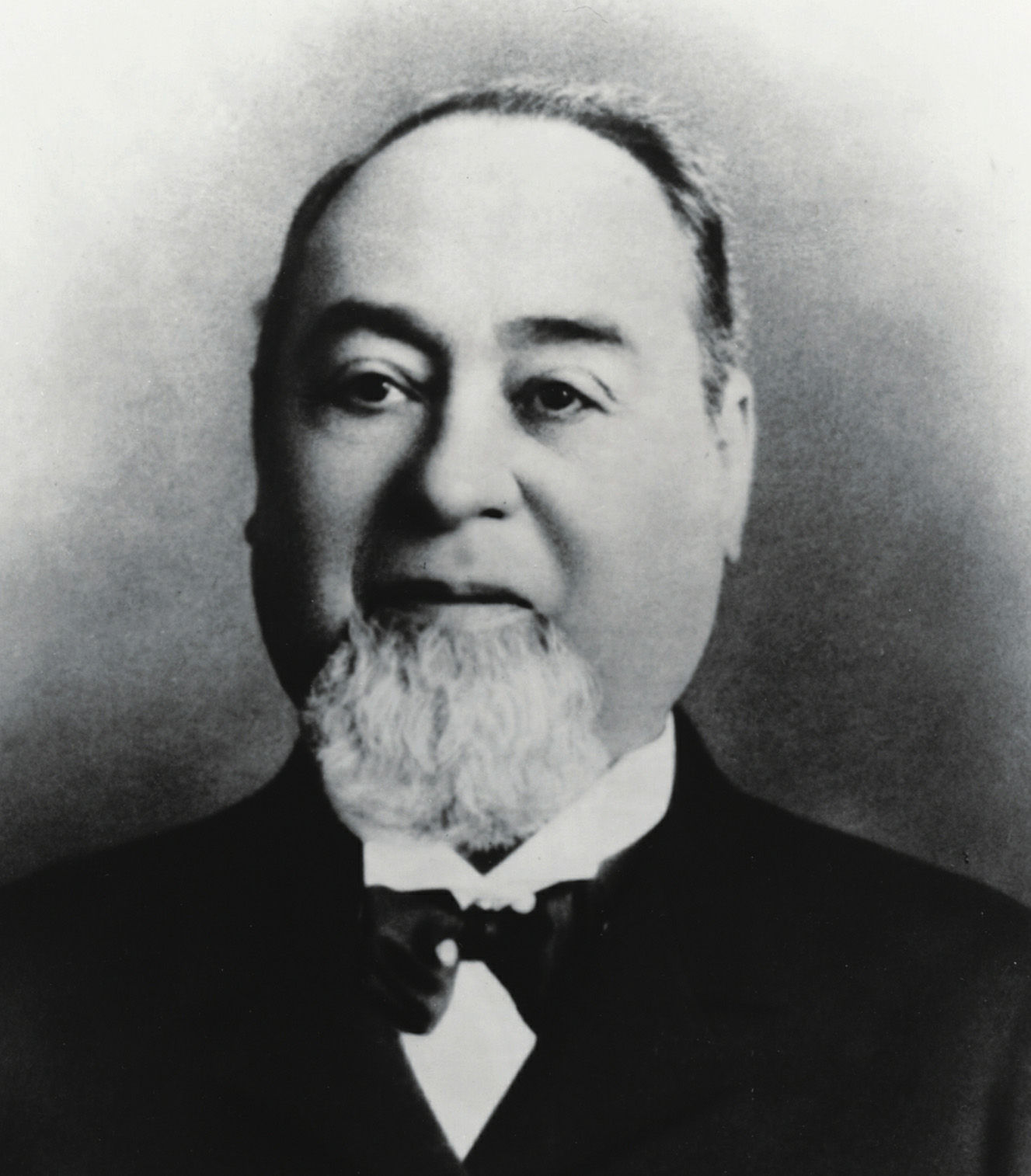
Levi Strauss (/ˈlv ˈstrs/ LEE-vy STROWSS; born Löb Strauß, German: [løːp ˈʃtʁaʊs]; February 26, 1829 – September 26, 1902) was a German-born American businessman who founded the first company to manufacture blue jeans. His firm of Levi Strauss & Co. (Levi's) began in 1853 in San Francisco, California.[1][2]

Key Information

Early life

[edit]
Birthplace of Levi Strauss

Levi Strauss was born to a Jewish family in Buttenheim on February 26, 1829, in the Franconia region of the Kingdom of Bavaria in the German Confederation.[3][4] He was the son of Hirsch Strauss and Hirsch’s second wife, Rebecca Strauss (née Haas).[5][6]

In 1847, aged 18, Strauss travelled with his mother and two sisters to the United States to join his brothers Jonas and Louis, who had begun a wholesale dry goods business in New York City called J. Strauss Brother & Co., at 108 Liberty Street in Manhattan.[7][8][9] After arriving in New York, Strauss worked as an itinerant peddler of goods from his brother's store: kettles, blankets and sewing goods.[8][9]

Business career

[edit]

Levi's sister Fanny and her husband David Stern moved to St. Louis, Missouri, while Levi went to live in Louisville, Kentucky, and sold his brothers' supplies there.[10] Levi became an American citizen in January 1853.[11]

The family decided to open a West Coast branch of their dry goods business in San Francisco, which was the commercial hub of the California gold rush.[12] Levi was chosen to represent them, and he took steamships for San Francisco via Panama,[13] where he arrived in early March 1854 and joined his sister's family.[14]

Strauss opened his wholesale business as Levi Strauss & Co. and imported fine dry goods from his brothers in New York, including clothing, bedding, combs, purses, and handkerchiefs.[15] He made tents and later jeans while he lived with Fanny's growing family.[16] Tailor Jacob W. Davis of Reno, Nevada, was one of his customers; in 1871, having invented a way to strengthen work pants using rivets, he went into business with Strauss to mass-produce them.[17] The next year, Davis asked Strauss to help him apply for a patent, and the patent (one-half assigned to Levi Strauss & Co.) was issued in 1873.[18]

Death

[edit]

Levi Strauss was never married, and died on September 26, 1902 in San Francisco.[19] His estate was worth about $30 million (equivalent to $877 million in 2024).[1] Levi's nephew Sigmund Stern's only child, Elise Fanny Stern,[20] married Walter A. Haas, the son of Abraham Haas, whose descendants are the current owners of Levi Strauss & Co.[21]

Dramatizations

[edit]

In 1960, the anthology series television series Death Valley Days broadcast "The Million Dollar Pants", in which Strauss travels to San Francisco and establishes his business. The episode featured a likely fictional romantic interest, Yvonne Benet. In addition, the episode portrayed a likely fictional character, Patrick Mahoney, that was substituted for Jacob W. Davis.

Legacy

[edit]

Levi Strauss, a member of the Reform branch of Judaism, helped establish Congregation Emanu-El, the first Jewish synagogue in the city of San Francisco.[22] He also gave money to several charities, including special funds for orphans. The Levi Strauss Foundation started with an 1897 donation to the University of California, Berkeley, that provided the funds for 28 scholarships.[23][24]

The Levi Strauss museum in Buttenheim, Germany is located in the 1687 house where Strauss was born.[25] There is also a visitors center at Levi Strauss & Co. headquarters in San Francisco, which features historical exhibits.

In 1994, he was inducted into the Hall of Great Westerners of the National Cowboy & Western Heritage Museum.[26]

References

[edit]
[edit]
Revisions and contributorsEdit on WikipediaRead on Wikipedia
from Grokipedia
Levi Strauss (February 26, 1829 – September 26, 1902) was a German-American dry goods merchant and entrepreneur best known for founding Levi Strauss & Co. and co-inventing the riveted blue jeans that revolutionized workwear and casual fashion worldwide. Born Löb Strauss in Buttenheim, Bavaria, to Jewish parents Hirsch Strauss, a cattle trader, and Rebecca Haas Strauss, he was the youngest of seven children in a family facing economic hardship and anti-Semitic restrictions under Bavarian law. In 1848, at age 18, Strauss immigrated to the United States with his mother and two sisters, arriving in New York City between April and October amid the European revolutions and family business opportunities; his two older brothers, Jonas and Louis, had already settled there and operated a dry goods wholesale business. He worked in the family enterprise while becoming a U.S. citizen on January 31, 1853, and soon after, in March 1853, traveled by ship around Cape Horn to San Francisco during the California Gold Rush to establish his own dry goods business, initially named "Levi Strauss," catering to miners and merchants with supplies like canvas, denim, and clothing. The company, renamed Levi Strauss & Co. in 1863 and headquartered at 14-16 Battery Street from 1866, expanded rapidly as a West Coast distributor. Strauss's defining innovation came in 1872 when tailor Jacob Davis approached him with the idea of using copper rivets to reinforce pants at stress points for greater durability; they jointly this design on May 20, 1873 (U.S. No. 139,121), launching the first riveted —branded as "waist "—made from imported French serge de Nimes () in shades of blue. Davis relocated to to oversee production, and the product quickly gained popularity among laborers, evolving into the iconic Levi's 501 by 1890. Strauss never married and had no children, leaving his nearly $6 million estate upon his death to four nephews, who continued running the company through challenges like the . His included funding 28 scholarships at the in 1897 and donations to Jewish charities, cementing his legacy as an immigrant success story and pioneer of .

Early Years

Birth and Family

Löb Strauss (later known as Levi Strauss) was born on February 26, 1829, in , a small town in the region of the Kingdom of Bavaria (present-day ), to Hirsch Strauss and his second wife, Rebecca Haas Strauss. Strauss grew up in a Jewish family amid the economic and social restrictions imposed on Jewish communities in 19th-century , where his father, a cattle trader who later worked as a , sold such as cloth, supplies, textiles, and household items. These communities faced significant hardships, including suppressed peddling rights under the 1813 Edict Concerning the Jews, declining rural crafts, and widespread food shortages during the "Hungry Forties" of the 1840s, which exacerbated poverty and limited opportunities for Jewish families like the Strausses. He was the youngest of seven children, with four brothers—Jacob, Jonas (also known as Jonathan), Louis (also known as Lippmann), and himself—and three sisters, including Fanny (also known as Vögele); these strong family ties later influenced his business partnerships with Jonas and Louis. Strauss's early childhood was shaped by these familial bonds and the observant Jewish traditions of his household, where religious practices were central despite external pressures. Due to the family's modest circumstances and the ongoing restrictions on Jewish access to education in Bavaria—though public schooling had been permitted since 1804—Strauss received only limited formal , focusing instead on practical skills within the home and community.

Immigration and Settlement

Following the death of his father, Hirsch Strauss, from in 1846, Levi Strauss, then 17, faced economic hardship in Buttenheim, , amid rising anti-Jewish restrictions. In 1848, at age 19, he to the with his mother, Rebecca, and two sisters, Fanny and Maila, to join his older half-brothers, Jonas and Louis, who had established a business in . The family endured a grueling transatlantic voyage in class, arriving amid the challenges of adapting to urban and the Yiddish-speaking Jewish enclave of the . Upon arrival, Strauss contributed to his brothers' firm, J. Strauss Brother & Co., initially working as an itinerant selling such as sewing notions, blankets, and hardware door-to-door in New York and surrounding areas. This role honed his entrepreneurial skills in a competitive immigrant economy, where he navigated bustling streets and built customer relationships in a city swelling with European arrivals. By 1850, records listed him as a "pedlar" in , reflecting his early immersion in wholesale trade. The of 1849 prompted Strauss's westward relocation in early 1853, when he sailed from New York via the route—crossing by rail and steamer—to reach by March, bypassing the longer passage taken by his merchandise shipments. He arrived with a of , including bolts of canvas originally intended for miners' tents and wagon covers, though popular legend attributes its repurposing into durable pants—a story later embellished in company lore but unverified in primary records. Settling in the chaotic , Strauss initially lodged in modest waterfront accommodations, likely a amid the transient population of prospectors and merchants. San Francisco's environment presented formidable challenges, transforming from a village of tents into a multicultural metropolis of over 50,000 by 1853, teeming with immigrants from , , , and beyond. Strauss contended with inflated prices, lawlessness, frequent fires, and supply shortages in this raw, rowdy port city, where diverse groups vied for opportunity in a feverish economy driven by gold seekers. As a Jewish immigrant, he found support in the established Bay Area Jewish community, attending services at Temple Emanu-El and leveraging ethnic networks to establish his foothold.

Business Development

Founding Levi Strauss & Co.

Levi Strauss founded his business in 1853 in San Francisco, California, as a wholesale operation at the height of the . Having previously worked in his family's operation in New York, he established the company to supply essential goods to the burgeoning Western markets, initially importing textiles and other supplies tailored to the needs of miners and settlers. The business, later renamed in 1863, began operations from a waterfront location, capitalizing on San Francisco's role as a key port for commerce. A critical element of the company's early success was the involvement of Strauss's brothers, Jonas and Louis, who managed the family's established firm, J. Strauss Brother & Co., in . This partnership created a vital coast-to-coast , allowing the San Francisco business to source materials from the East and distribute them efficiently to the West via ships around . Jonas and Louis handled and from New York, enabling the San Francisco branch to focus on local distribution and respond quickly to regional demands. The early product lines centered on practical suited to the rugged environment, as well as , , and fabrics used for , , and other essentials. Strauss expanded operations to serve merchants in remote camps, stocking items like boots, hats, , and pants that withstood harsh conditions. By leveraging family networks for reliable sourcing and tapping into the explosive economic boom of the —driven by an influx of over 300,000 prospectors—the company achieved rapid growth, establishing itself as a key supplier in the West within its first few years.

Invention and Patent of Riveted Jeans

In 1871, , a in , developed the concept of reinforcing pants at stress points, particularly pocket corners, by using copper rivets to prevent tearing, inspired by customer complaints about the durability of for miners and laborers. Unable to afford the fees alone, Davis contacted his fabric supplier, Levi Strauss, in late 1872, proposing a to commercialize the invention. Strauss, whose business already distributed sturdy fabrics to Western workers, agreed to the collaboration, recognizing the potential for a more robust product line. On May 20, 1873, the U.S. Patent and Trademark Office granted U.S. Patent No. 139,121 to Jacob W. Davis and Levi Strauss & Co. for an "Improvement in Fastening Pocket-Openings," which specifically described the use of metal rivets to secure pocket edges and seams on pants made from heavy-duty fabric. This co-invention marked the birth of riveted denim work pants, initially produced using brown cotton duck canvas before transitioning to blue denim sourced from the Amoskeag Manufacturing Company mill in Manchester, New Hampshire, known for its high-quality, indigo-dyed serge. The pants, dubbed "waist overalls," were marketed exclusively to laborers such as miners, cowboys, and railroad workers, emphasizing their superior strength and longevity compared to standard trousers. Following the patent, integrated Davis into operations as a superintendent, relocating production to to scale manufacturing and meet growing demand from . By , the company had begun mass-producing these riveted overalls, with the design evolving to include the iconic Levi's 501 model—designated by lot number in the late —as a standard shrink-to-fit variant. Early branding efforts culminated in 1886 with the introduction of the "Two Horse" trademark, a patch depicting two horses pulling apart a pair of to demonstrate their unyielding durability, which became a hallmark of authenticity on the garments.

Later Life

Philanthropy and Community Role

Levi Strauss, a devout member of the Jewish community, played a significant role in supporting San Francisco's early Jewish institutions, reflecting his commitment to religious and cultural preservation amid era's challenges. Upon arriving in 1853, he quickly became an active supporter of Congregation Emanu-El, established in 1850 as one of the first synagogues on the West Coast. Strauss contributed financially to its construction and operations, including annual donations of a gold medal to the top-performing student in the congregation's , thereby promoting religious education among Jewish youth. His involvement extended to serving as a prominent within the synagogue, helping to foster a sense of belonging for Jewish immigrants in the burgeoning city. Strauss also extended his philanthropy to aid Jewish immigrants through support for key relief organizations, such as the Eureka Benevolent Society and the Hebrew Board of Relief, which provided essential assistance to newcomers facing economic hardship and integration difficulties in . These contributions helped fund emergency support, including loans and welfare services, embodying the Jewish principle of (charitable giving). Although not the founder of the Hebrew Free Loan Association, which began operations in 1897, his broader backing of similar interest-free lending and aid initiatives underscored his dedication to empowering fellow immigrants from his native and beyond. In the realm of education, Strauss made a lasting impact by endowing 28 annual scholarships at the , in 1897, matching funds from the legislature to create the state's first endowed higher education awards. These scholarships supported deserving students, particularly those from modest backgrounds, enabling access to university studies and reflecting Strauss's belief in as a pathway to opportunity. Half of the initial awards were designated for women, promoting gender equity in academia at a time when such access was limited. Beyond Jewish-specific causes, Strauss engaged in wider civic , donating early in his career to the San Francisco Orphan Asylum Society (now Edgewood Center for Children and Families) as one of his first charitable acts in 1854. He later supported the Pacific Hebrew Orphan Asylum and other institutions aiding vulnerable children, driven by his childless personal life and a strong family-oriented ethos that emphasized communal care. These efforts, sustained throughout his lifetime, highlighted his role as a pillar of 's social fabric, prioritizing support for orphans and educational advancement over personal legacy.

Death and Estate Distribution

Levi Strauss died on September 26, 1902, at his home on Leavenworth Street in , at the age of 73, after a brief illness that began the previous week. He had never married and was childless, leaving no direct heirs. His estate was valued at nearly $6 million (equivalent to approximately $226 million in 2025 dollars), consisting primarily of shares in In his will, Strauss bequeathed the bulk of the estate, including control of the company, to his four nephews—, , Louis, and Abraham Stern, sons of his sister Fanny and her husband —who had been working in the firm and assumed upon his death, ensuring the continuation of operations under family management. Additional provisions included donations to several charitable organizations, such as the Pacific Hebrew Orphan Asylum, the Home for Aged Israelites, the Roman Catholic and Protestant Orphan Asylums, the Eureka Benevolent Society, and the Emanu-El Sisterhood. Strauss's funeral was conducted on September 29, 1902, following simple Jewish rites, with a eulogy delivered by Jacob Voorsanger at his home. His casket was escorted by company employees to the Southern Pacific railway station en route to burial at the Home of Peace Cemetery in Colma; while local businesses temporarily closed in respect and his death made headline news, there was no elaborate public mourning.

Cultural and Historical Impact

Dramatizations and Media Portrayals

Levi Strauss has been depicted in a limited number of fictional and semi-fictional media works, primarily focusing on his role in the invention of riveted pants during the . One of the earliest and most notable dramatizations is the 1960 episode "The Million Dollar Pants" from the anthology series , where portrayed Strauss as a resourceful immigrant entrepreneur who single-handedly creates durable work pants for miners after his initial shipment fails. The episode, which aired on April 13, 1960, as season 8, episode 28, blends historical events with dramatic embellishments, such as substituting a fictional character named Patrick Mahoney for Strauss's real-life partner Jacob Davis in the patent process. In 2025, the four-part German miniseries Call Me Levi (original title: Levi Strauss und der Stoff der Träume) offered a more expansive portrayal, chronicling Strauss's immigration from to America in the 1850s, his establishment in , and his collaboration with Davis to patent blue jeans amid anti-Semitism and economic hardship. Directed by Neele Leana Vollmar and starring as the young Strauss, the series premiered on ARD on January 3, 2025, emphasizing his Jewish heritage and while dramatizing era's challenges. Despite its focus on historical context, the production takes creative liberties, such as heightening personal conflicts for narrative tension. These portrayals often employ common tropes of the American rags-to-riches , depicting Strauss as a lone visionary amid adventure, which exaggerates his individual role in the ' development and overlooks the collaborative patent with Davis in 1873. Critics and historians have noted that such dramatizations blend factual elements—like Strauss's arrival in in 1853—with fictional drama, but they frequently lack depth in exploring his Jewish immigrant experiences or later philanthropic efforts, such as support for Jewish community institutions. As of 2025, no major Hollywood biopics featuring Strauss have been produced, with his story appearing mostly in minor TV episodes or documentaries rather than full-length fictional films.

Enduring Legacy

Following Levi Strauss's death in 1902, his four nephews—Jacob, Sigmund, Louis, and Abraham Stern—inherited and managed , incorporating it formally and steering its early 20th-century expansion amid growing demand for durable workwear. Under their leadership, the company navigated economic challenges, including the of the 1930s, when product demand sharply declined; however, under subsequent stewardship by the Haas family—in-laws who assumed control around 1918—executives like Sr. and later Daniel Haas maintained operations by keeping factories open, avoiding mass layoffs, and innovating with products such as women's in 1934 to sustain the workforce and market presence. This resilience enabled post-Depression recovery, with comprising about 70% of profits by the late 1920s and fueling further growth. By the mid-20th century, the firm transformed into a global brand, beginning international expansion in the through military sales during and formalizing it with the creation of an International Division in 1965, which established offices and factories across Europe and Asia to capitalize on denim's rising worldwide appeal. Levi's jeans evolved from practical for laborers and miners into a potent symbol of American individualism, embodying and frontier spirit while democratizing across social classes due to their affordability and durability. This shift accelerated in the , when the garment became intertwined with youth rebellion and , popularized through endorsements by icons like in (1953) and in (1955), which positioned jeans as emblems of nonconformity and youthful defiance. In subsequent decades, their influence permeated pop culture, from hippie movements in the to endorsements by musicians like , solidifying jeans as a universal marker of casual American style and cultural export. Strauss's contributions have been honored through dedicated institutions, including the Levi Strauss Museum in Buttenheim, —his birthplace—which opened in 2000 to chronicle his life and the origins of blue jeans through exhibits on his and innovations. In , the company's longtime features a visitors center with museum-quality pavilions showcasing denim's evolution, recently enhanced by the 2025 reopening of The Vault museum highlighting jeans' role in music and culture. Additionally, in 1994, Strauss was inducted into the National Cowboy & Western Heritage Museum's , recognizing his pivotal role in outfitting . Recent scholarship since 2023 has illuminated gaps in earlier narratives by emphasizing Strauss's archetype as a Jewish immigrant success story, detailing how his journey from Bavarian poverty to entrepreneurial triumph in Gold Rush-era San Francisco exemplified broader patterns of Jewish adaptation and economic mobility in 19th-century America. Complementing this historical reevaluation, Levi Strauss & Co. has advanced sustainable denim innovations as of 2025, including water-efficient production techniques and recycled materials, positioning the brand as a leader in eco-conscious fashion while extending Strauss's legacy of practical ingenuity.

References

Add your contribution
Related Hubs
User Avatar
No comments yet.