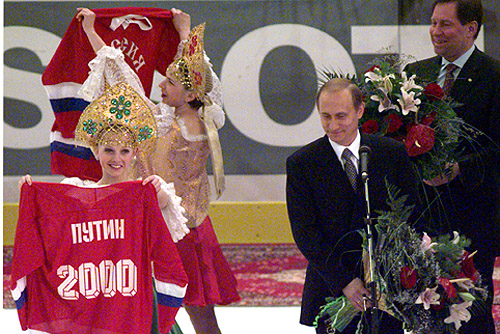

2000 IIHF World Championship
View on Wikipedia

Key Information


The 2000 IIHF World Championship was held in Saint Petersburg, Russia from 29 April to 14 May.
Qualification
[edit]This was the final year for qualifying rounds (except 'Far East'). Five teams advanced out of the eight that participated in the two European groups. The top two from each group played in the World Championship, and the third place teams played off against each other for the final spot. Both groups were played 11–14 November 1999.
Group 1 (Great Britain)
[edit]Played in Sheffield
| Pos | Team | Pld | W | D | L | GF | GA | GD | Pts |
|---|---|---|---|---|---|---|---|---|---|
| 1 |  Latvia Latvia
|
3 | 1 | 2 | 0 | 6 | 3 | +3 | 4 |
| 2 |  Ukraine Ukraine
|
3 | 1 | 2 | 0 | 5 | 4 | +1 | 4 |
| 3 |  Great Britain Great Britain
|
3 | 0 | 3 | 0 | 3 | 3 | 0 | 3 |
| 4 |  Kazakhstan Kazakhstan
|
3 | 0 | 1 | 2 | 6 | 10 | −4 | 1 |
| 11 November 1999 | Latvia | 6–3 | Kazakhstan |
| 11 November 1999 | Great Britain | 2–2 | Ukraine |
| 13 November 1999 | Ukraine | 3–2 | Kazakhstan |
| 13 November 1999 | Great Britain | 0–0 | Latvia |
| 14 November 1999 | Great Britain | 1–1 | Kazakhstan |
| 14 November 1999 | Latvia | 0–0 | Ukraine |
Group 2 (France)
[edit]Played in Amiens
| Pos | Team | Pld | W | D | L | GF | GA | GD | Pts |
|---|---|---|---|---|---|---|---|---|---|
| 1 |  Italy Italy
|
3 | 2 | 0 | 1 | 11 | 7 | +4 | 4 |
| 2 |  France France
|
3 | 1 | 1 | 1 | 10 | 10 | 0 | 3 |
| 3 |  Norway Norway
|
3 | 1 | 1 | 1 | 7 | 8 | −1 | 3 |
| 4 |  Denmark Denmark
|
3 | 1 | 0 | 2 | 9 | 12 | −3 | 2 |
| 11 November 1999 | Italy | 3–5 | Denmark |
| 11 November 1999 | France | 3–3 | Norway |
| 13 November 1999 | Italy | 4–1 | Norway |
| 13 November 1999 | France | 6–3 | Denmark |
| 14 November 1999 | Denmark | 1–3 | Norway |
| 14 November 1999 | France | 1–4 | Italy |
Playoff (Netherlands)
[edit]Played in Eindhoven
| 14 December 1999 | Great Britain | 1–2 | Norway |
Far East (Japan)
[edit]Played 3–5 September 1999 in Aomori.
| Pos | Team | Pld | W | D | L | GF | GA | GD | Pts |
|---|---|---|---|---|---|---|---|---|---|
| 1 |  Japan Japan
|
2 | 2 | 0 | 0 | 14 | 0 | +14 | 4 |
| 2 |  China China
|
2 | 1 | 0 | 1 | 4 | 7 | −3 | 2 |
| 3 |  South Korea South Korea
|
2 | 0 | 0 | 2 | 2 | 13 | −11 | 0 |
| 03 September 1999 | China | 4–2 | South Korea |
| 04 September 1999 | Japan | 9–0 | South Korea |
| 05 September 1999 | Japan | 5–0 | China |
Venues
[edit]| Saint Petersburg | Saint Petersburg | |
| Ice Palace Capacity: 12300 |
Yubileyny Capacity: 7000 | |
.png)
|

|


Preliminary round
[edit]Like the previous two years, sixteen nations played in four groups of four. However this year the format was modified so that the top three teams from each group would advance to a group of six, carrying forward the results against the teams who advanced with them. The nations from the first and fourth pools were grouped together, likewise the second and third pools. The fourth placed teams were put in a group together to contest relegation.
Group A
[edit]| Pos | Team | Pld | W | D | L | GF | GA | GD | Pts | Qualification |
|---|---|---|---|---|---|---|---|---|---|---|
| 1 |  Sweden Sweden
|
3 | 3 | 0 | 0 | 17 | 3 | +14 | 6 | Qualifying round |
| 2 | Latvia
|
3 | 2 | 0 | 1 | 9 | 7 | +2 | 4 | |
| 3 |  Belarus Belarus
|
3 | 1 | 0 | 2 | 10 | 16 | −6 | 2 | |
| 4 | Ukraine
|
3 | 0 | 0 | 3 | 6 | 16 | −10 | 0 | Relegation round |
| 30 April 2000 16:30 | Belarus | 7–3 (3–1, 3–1, 1–1) | Ukraine | Ice Palace Attendance: 3,500 |
| Game reference |
|---|
| 30 April 2000 20:30 | Latvia | 1–3 (0–2, 1–1, 0–0) | Sweden | Ice Palace Attendance: 6,500 |
| Game reference |
|---|
| 2 May 2000 16:30 | Belarus | 3–6 (0–2, 3–3, 0–1) | Latvia | Ice Palace Attendance: 7,200 |
| Game reference |
|---|
| 2 May 2000 20:30 | Sweden | 7–2 (2–1, 3–1, 2–0) | Ukraine | Ice Palace Attendance: 4,200 |
| Game reference |
|---|
| 4 May 2000 16:30 | Ukraine | 1–2 (1–0, 0–1, 0–1) | Latvia | Ice Palace Attendance: 10,800 |
| Game reference |
|---|
| 4 May 2000 20:30 | Sweden | 7–0 (4–0, 0–0, 3–0) | Belarus | Ice Palace Attendance: 7,200 |
| Game reference |
|---|
Group B
[edit]| Pos | Team | Pld | W | D | L | GF | GA | GD | Pts | Qualification |
|---|---|---|---|---|---|---|---|---|---|---|
| 1 |  Slovakia Slovakia
|
3 | 2 | 1 | 0 | 10 | 4 | +6 | 5 | Qualifying round |
| 2 |  Finland Finland
|
3 | 1 | 2 | 0 | 11 | 5 | +6 | 4 | |
| 3 | Italy
|
3 | 1 | 0 | 2 | 5 | 12 | −7 | 2 | |
| 4 |  Austria Austria
|
3 | 0 | 1 | 2 | 3 | 8 | −5 | 1 | Relegation round |
| 30 April 2000 16:30 | Slovakia | 2–0 (0–0, 0–0, 2–0) | Austria | Yubileyny Attendance: 750 |
| Game reference |
|---|
| 30 April 2000 20:30 | Italy | 0–6 (0–2, 0–4, 0–0) | Finland | Yubileyny Attendance: 3051 |
| Game reference |
|---|
| 2 May 2000 16:30 | Slovakia | 6–2 (2–1, 0–0, 4–1) | Italy | Yubileyny Attendance: 1,950 |
| Game reference |
|---|
| 2 May 2000 20:30 | Finland | 3–3 (0–0, 1–2, 2–1) | Austria | Yubileyny Attendance: 3,950 |
| Game reference |
|---|
| 4 May 2000 16:30 | Austria | 0–3 (0–1, 0–1, 0–1) | Italy | Yubileyny Attendance: 3,059 |
| Game reference |
|---|
| 4 May 2000 20:30 | Finland | 2–2 (1–1, 1–0, 0–1) | Slovakia | Yubileyny Attendance: 6,995 |
| Game reference |
|---|
Group C
[edit]| Pos | Team | Pld | W | D | L | GF | GA | GD | Pts | Qualification |
|---|---|---|---|---|---|---|---|---|---|---|
| 1 |  Czech Republic Czech Republic
|
3 | 3 | 0 | 0 | 12 | 4 | +8 | 6 | Qualifying round |
| 2 | Norway
|
3 | 2 | 0 | 1 | 13 | 7 | +6 | 4 | |
| 3 |  Canada Canada
|
3 | 1 | 0 | 2 | 10 | 6 | +4 | 2 | |
| 4 | Japan
|
3 | 0 | 0 | 3 | 3 | 21 | −18 | 0 | Relegation round |
| 29 April 2000 16:30 | Canada | 6–0 (1–0, 2–0, 3–0) | Japan | Yubileyny Attendance: 852 |
| Game reference |
|---|
| 29 April 2000 20:30 | Norway | 0–4 (0–1, 0–0, 0–3) | Czech Republic | Yubileyny Attendance: 1,600 |
| Game reference |
|---|
| 1 May 2000 16:30 | Czech Republic | 6–3 (2–1, 2–1, 2–1) | Japan | Yubileyny Attendance: 1,500 |
| Game reference |
|---|
| 1 May 2000 20:30 | Canada | 3–4 (0–0, 3–3, 0–1) | Norway | Yubileyny Attendance: 3,300 |
| Game reference |
|---|
| 3 May 2000 16:30 | Japan | 0–9 (0–4, 0–3, 0–2) | Norway | Yubileyny Attendance: 1,685 |
| Game reference |
|---|
| 3 May 2000 20:30 | Czech Republic | 2–1 (1–1, 1–0, 0–0) | Canada | Yubileyny Attendance: 5,261 |
| Game reference |
|---|
Group D
[edit]| Pos | Team | Pld | W | D | L | GF | GA | GD | Pts | Qualification |
|---|---|---|---|---|---|---|---|---|---|---|
| 1 |  United States United States
|
3 | 2 | 1 | 0 | 9 | 5 | +4 | 5 | Qualifying round |
| 2 |  Switzerland Switzerland
|
3 | 1 | 1 | 1 | 8 | 9 | −1 | 3 | |
| 3 |  Russia (H) Russia (H)
|
3 | 1 | 0 | 2 | 10 | 7 | +3 | 2 | |
| 4 | France
|
3 | 1 | 0 | 2 | 7 | 13 | −6 | 2 | Relegation round |
| 29 April 2000 16:30 | United States | 3–3 (1–1, 1–1, 1–1) | Switzerland | Ice Palace Attendance: 5,730 |
| Game reference | ||||
|---|---|---|---|---|
| 8 min | Penalties | 12 min | ||
| 22 | Shots | 25 | ||
| 29 April 2000 20:30 | Russia | 8–1 (3–1, 4–0, 1–0) | France | Ice Palace Attendance: 11,000 |
| Game reference | |||||||||||||||||||||||||||||
|---|---|---|---|---|---|---|---|---|---|---|---|---|---|---|---|---|---|---|---|---|---|---|---|---|---|---|---|---|---|
| Ilya Bryzgalov | Goalies | Patrick Rolland Fabrice Lhenry | Referee: Vladimír Šindler Linesmen: Panu Bruun Johan Norrman | ||||||||||||||||||||||||||
| |||||||||||||||||||||||||||||
| 8 min | Penalties | 20 min | |||||||||||||||||||||||||||
| 48 | Shots | 14 | |||||||||||||||||||||||||||
| 1 May 2000 16:30 | Switzerland | 2–4 (0–0, 2–2, 0–2) | France | Ice Palace Attendance: 3,200 |
| Game reference | ||||
|---|---|---|---|---|
| 16 min | Penalties | 14 min | ||
| 27 | Shots | 33 | ||
| 1 May 2000 20:30 | Russia | 0–3 (0–0, 0–2, 0–1) | United States | Ice Palace Attendance: 12,350 |
| Game reference | |||||||||||
|---|---|---|---|---|---|---|---|---|---|---|---|
| Ilya Bryzgalov | Goalies | Robert Esche | Referee: Vladimír Mihálik Linesmen: Panu Bruun Johan Norrman | ||||||||
| |||||||||||
| 10 min | Penalties | 12 min | |||||||||
| 44 | Shots | 30 | |||||||||
| 3 May 2000 16:30 | France | 2–3 (0–2, 1–0, 1–1) | United States | Ice Palace Attendance: 5,500 |
| Game reference | ||||
|---|---|---|---|---|
| 16 min | Penalties | 12 min | ||
| 21 | Shots | 31 | ||
| 3 May 2000 20:30 | Switzerland | 3–2 (1–1, 2–1, 0–0) | Russia | Ice Palace Attendance: 12,300 |
| Game reference | |||||||||||||||||
|---|---|---|---|---|---|---|---|---|---|---|---|---|---|---|---|---|---|
| Reto Pavoni | Goalies | Ilya Bryzgalov | Referee: Kevin Acheson Linesmen: Pål Garsjø Christian Oswald Christian Oswald | ||||||||||||||
| |||||||||||||||||
| 10 min | Penalties | 6 min | |||||||||||||||
| 21 | Shots | 36 | |||||||||||||||
Relegation round
[edit]Group G
[edit]The relegation round is composed of the four teams that placed last in Groups A through D. They play in a round-robin fashion, with the last placed team that is not the far east qualifier, being relegated to the Division I group in next year's World Championships.
| Pos | Team | Pld | W | D | L | GF | GA | GD | Pts | Relegation |
|---|---|---|---|---|---|---|---|---|---|---|
| 1 | Austria
|
3 | 2 | 1 | 0 | 11 | 8 | +3 | 5 | |
| 2 | Ukraine
|
3 | 2 | 0 | 1 | 9 | 5 | +4 | 4 | |
| 3 | France
|
3 | 1 | 1 | 1 | 12 | 8 | +4 | 3 | Relegation to Division I |
| 4 | Japan
|
3 | 0 | 0 | 3 | 5 | 16 | −11 | 0 |
| 6 May 2000 16:30 | France | 3–3 (0–2, 2–1, 1–0) | Austria | Yubileyny Attendance: 4,168 |
| Game reference |
|---|
| 6 May 2000 16:30 | Ukraine | 4–0 (3–0, 0–0, 1–0) | Japan | Ice Palace Attendance: 5,250 |
| Game reference |
|---|
| 7 May 2000 12:30 | France | 2–3 (0–1, 0–1, 2–1) | Ukraine | Ice Palace Attendance: 5,200 |
| Game reference |
|---|
| 7 May 2000 12:30 | Austria | 5–3 (2–1, 1–1, 2–1) | Japan | Yubileyny Attendance: 4,848 |
| Game reference |
|---|
| 9 May 2000 12:30 | France | 7–2 (3–0, 1–1, 3–1) | Japan | Ice Palace Attendance: 8,050 |
| Game reference |
|---|
| 9 May 2000 12:30 | Austria | 3–2 (0–0, 0–2, 3–0) | Ukraine | Yubileyny Attendance: 5,412 |
| Game reference |
|---|
France is relegated to Division I. Japan will play together with China and Korea in 2001 IIHF World Championship Far East Qualification Tournament
Qualifying round
[edit]Group E
[edit]| Pos | Team | Pld | W | D | L | GF | GA | GD | Pts | Qualification |
|---|---|---|---|---|---|---|---|---|---|---|
| 1 | United States
|
5 | 3 | 2 | 0 | 13 | 7 | +6 | 8 | Quarterfinals |
| 2 | Switzerland
|
5 | 2 | 2 | 1 | 14 | 12 | +2 | 6 | |
| 3 | Sweden
|
5 | 2 | 1 | 2 | 16 | 11 | +5 | 5 | |
| 4 | Latvia
|
5 | 2 | 1 | 2 | 12 | 13 | −1 | 5 | |
| 5 | Belarus
|
5 | 2 | 0 | 3 | 9 | 17 | −8 | 4 | |
| 6 | Russia (H)
|
5 | 1 | 0 | 4 | 8 | 12 | −4 | 2 |
| 5 May 2000 16:30 | Latvia | 3–2 (0–0, 3–2, 0–0) | Russia | Ice Palace Attendance: 7,500 |
| Game reference | |||||||||||||||||
|---|---|---|---|---|---|---|---|---|---|---|---|---|---|---|---|---|---|
| Artūrs Irbe | Goalies | Ilya Bryzgalov Yegor Podomatsky | Referee: Peter Andersson Linesmen: John Costello Serge Carpentier | ||||||||||||||
| |||||||||||||||||
| 12 min | Penalties | 16 min | |||||||||||||||
| 26 | Shots | 39 | |||||||||||||||
| 5 May 2000 20:30 | United States | 1–0 (0–0, 1–0, 0–0) | Belarus | Ice Palace Attendance: 5,300 |
| Game reference | |||||
|---|---|---|---|---|---|
| Damian Rhodes | Goalies | Andrei Mezin | |||
| |||||
| 8 min | Penalties | 6 min | |||
| 28 | Shots | 25 | |||
| 6 May 2000 20:30 | Sweden | 1–1 (0–0, 0–0, 1–1) | Switzerland | Ice Palace Attendance: 6,800 |
| Game reference | ||||
|---|---|---|---|---|
| 14 min | Penalties | 18 min | ||
| 35 | Shots | 9 | ||
| 7 May 2000 16:30 | Russia | 0–1 (0–1, 0–0, 0–0) | Belarus | Ice Palace Attendance: 11,600 |
| Game reference | |||||
|---|---|---|---|---|---|
| Yegor Podomatsky | Goalies | Andrei Mezin Leonid Fatikov | Referee: Vladimír Šindler Linesmen: Nadir Mandioni Christian Oswald | ||
| |||||
| 8 min | Penalties | 6 min | |||
| 31 | Shots | 18 | |||
| 7 May 2000 20:30 | United States | 1–1 (0–1, 0–0, 1–0) | Latvia | Ice Palace Attendance: 3,100 |
| Game reference | ||||
|---|---|---|---|---|
| 12 min | Penalties | 12 min | ||
| 37 | Shots | 19 | ||
| 8 May 2000 16:30 | Latvia | 1–4 (0–0, 0–3, 1–1) | Switzerland | Ice Palace Attendance: 3,600 |
| Game reference | ||||
|---|---|---|---|---|
| 12 min | Penalties | 6 min | ||
| 24 | Shots | 21 | ||
| 8 May 2000 20:30 | Sweden | 3–5 (1–2, 2–2, 0–1) | United States | Ice Palace Attendance: 5,800 |
| Game reference | ||||
|---|---|---|---|---|
| 8 min | Penalties | 12 min | ||
| 23 | Shots | 22 | ||
| 9 May 2000 16:30 | Switzerland | 3–5 (3–1, 0–3, 0–1) | Belarus | Ice Palace Attendance: 5,100 |
| Game reference | ||||
|---|---|---|---|---|
| 18 min | Penalties | 30 min | ||
| 20 | Shots | 31 | ||
| 9 May 2000 20:30 | Sweden | 2–4 (1–1, 0–1, 1–2) | Russia | Ice Palace Attendance: 12,100 |
| Game reference | ||||||||||||||||||||
|---|---|---|---|---|---|---|---|---|---|---|---|---|---|---|---|---|---|---|---|---|
| Mikael Tellqvist | Goalies | Yegor Podomatsky | Referee: Pekka Haajanen Linesmen: Nadir Mandioni Christian Oswald | |||||||||||||||||
| ||||||||||||||||||||
| 16 min | Penalties | 10 min | ||||||||||||||||||
| 15 | Shots | 27 | ||||||||||||||||||
Group F
[edit]| Pos | Team | Pld | W | D | L | GF | GA | GD | Pts | Qualification |
|---|---|---|---|---|---|---|---|---|---|---|
| 1 | Czech Republic
|
5 | 4 | 0 | 1 | 25 | 11 | +14 | 8 | Quarterfinals |
| 2 | Finland
|
5 | 3 | 1 | 1 | 22 | 15 | +7 | 7 | |
| 3 | Canada
|
5 | 3 | 0 | 2 | 19 | 10 | +9 | 6 | |
| 4 | Slovakia
|
5 | 2 | 1 | 2 | 22 | 15 | +7 | 5 | |
| 5 | Norway
|
5 | 1 | 1 | 3 | 10 | 24 | −14 | 3 | |
| 6 | Italy
|
5 | 0 | 1 | 4 | 5 | 28 | −23 | 1 |
| 5 May 2000 16:30 | Finland | 1–5 (1–0, 0–1, 0–4) | Canada | Yubileyny Attendance: 6,615 |
| Game reference |
|---|
| 5 May 2000 20:30 | Czech Republic | 9–2 (2–0, 5–0, 2–2) | Italy | Yubileyny Attendance: 3,132 |
| Game reference |
|---|
| 6 May 2000 20:30 | Slovakia | 9–1 (3–0, 1–1, 5–0) | Norway | Yubileyny Attendance: 2,001 |
| Game reference |
|---|
| 7 May 2000 16:30 | Canada | 6–0 (2–0, 3–0, 1–0) | Italy | Yubileyny Attendance: 4,730 |
| Game reference |
|---|
| 7 May 2000 20:30 | Czech Republic | 4–6 (2–1, 1–2, 1–3) | Finland | Yubileyny Attendance: 7,182 |
| Game reference |
|---|
| 8 May 2000 16:30 | Norway | 4–7 (0–2, 3–4, 1–1) | Finland | Yubileyny Attendance: 4,610 |
| Game reference |
|---|
| 8 May 2000 20:30 | Czech Republic | 6–2 (1–0, 3–2, 2–0) | Slovakia | Yubileyny Attendance: 3,999 |
| Game reference |
|---|
| 9 May 2000 16:30 | Norway | 1–1 (0–0, 1–0, 0–1) | Italy | Yubileyny Attendance: 3,080 |
| Game reference |
|---|
| 9 May 2000 20:30 | Slovakia | 3–4 (1–0, 1–2, 1–2) | Canada | Yubileyny Attendance: 5,525 |
| Game reference |
|---|
Final round
[edit]Bracket
[edit]| Quarterfinals | Semifinals | Final | ||||||||||||
| E1 | United States
| 1 | ||||||||||||
| F4 | Slovakia
| 4 | ||||||||||||
| QF1 | Slovakia
| 3 | ||||||||||||
| QF4 | Finland
| 1 | ||||||||||||
| F2 | Finland
| 2 | ||||||||||||
| E3 | Sweden
| 1 | ||||||||||||
| SF1 | Slovakia
| 3 | ||||||||||||
| SF2 | Czech Republic
| 5 | ||||||||||||
| E2 | Switzerland
| 3 | ||||||||||||
| F3 | Canada
| 5 | ||||||||||||
| QF3 | Canada
| 1 | Third Place | |||||||||||
| QF2 | Czech Republic
| 2 | ||||||||||||
| F1 | Czech Republic
| 3 | SF1 | Finland
| 2 | |||||||||
| E4 | Latvia
| 1 | SF2 | Canada
| 1 | |||||||||
Quarterfinals
[edit]| 11 May 2000 16:30 | United States | 1–4 (1–0, 0–3, 0–1) | Slovakia | Ice Palace Attendance: 1,900 |
| 11 May 2000 16:30 | Finland | 2–1 (0–1, 0–0, 2–0) | Sweden | Yubileyny Attendance: 6,120 |
| 11 May 2000 20:30 | Switzerland | 3–5 (0–1, 2–1, 1–3) | Canada | Ice Palace Attendance: 3,500 |
| 11 May 2000 20:30 | Czech Republic | 3–1 (0–0, 3–1, 0–0) | Latvia | Yubileyny Attendance: 3,244 |
Semifinals
[edit]| 12 May 2000 16:30 | Slovakia | 3–1 (2–0, 1–1, 0–0) | Finland | Ice Palace Attendance: 10800 |
| 12 May 2000 20:30 | Canada | 1–2 (1–1, 0–0, 0–1) | Czech Republic | Ice Palace Attendance: 11,700 |
Bronze medal game
[edit]| 14 May 2000 14:30 | Canada | 1–2 (1–0, 0–1, 0–1) | Finland | Ice Palace Attendance: 10,700 |
| |||||||||||
Final
[edit]| 14 May 2000 18:30 | Slovakia | 3–5 (0–3, 1–0, 2–2) | Czech Republic | Ice Palace Arena, Saint Petersburg Attendance: 12,350 |
| Game reference | ||||||||||||||||||||||||||
|---|---|---|---|---|---|---|---|---|---|---|---|---|---|---|---|---|---|---|---|---|---|---|---|---|---|---|
| Ján Lašák | Goalies | Roman Čechmánek | Referee: K. Acheson Linesmen: S. Carpentier J. Costello | |||||||||||||||||||||||
| ||||||||||||||||||||||||||
| 5 min | Penalties | 10 min | ||||||||||||||||||||||||
| 33 | Shots | 15 | ||||||||||||||||||||||||
Ranking and statistics
[edit]
| 2000 IIHF World Championship winners |
|---|
 Czech Republic 3rd/9th[1] title |
Tournament Awards
[edit]- Best players selected by the directorate:
- Best Goaltender:
 Roman Čechmánek
 - Best Defenceman:
 Petteri Nummelin
 - Best Forward:
 Miroslav Šatan
 - Most Valuable Player: Martin Procházka
- Best Goaltender:
- Media All-Star Team:
- Goaltender: Roman Čechmánek
- Defence: Petteri Nummelin, Michal Sýkora
- Forwards: Jiří Dopita, Miroslav Šatan, Tomáš Vlasák
- Goaltender:
Final standings
[edit]The final standings of the tournament according to IIHF:
 |
Czech Republic
|
 |
Slovakia
|
 |
Finland
|
| 4 | Canada
|
| 5 | United States
|
| 6 | Switzerland
|
| 7 | Sweden
|
| 8 | Latvia
|
| 9 | Belarus
|
| 10 | Norway
|
| 11 | Russia
|
| 12 | Italy
|
| 13 | Austria
|
| 14 | Ukraine
|
| 15 | France
|
| 16 | Japan
|
Scoring leaders
[edit]List shows the top skaters sorted by points, then goals. If the list exceeds 10 skaters because of a tie in points, all of the tied skaters are left out.
| Player | GP | G | A | Pts | +/− | PIM | POS |
|---|---|---|---|---|---|---|---|
| Miroslav Šatan |
9 | 10 | 2 | 12 | +3 | 14 | F |
| Jiří Dopita |
9 | 4 | 7 | 11 | +8 | 16 | F |
| David Výborný |
9 | 4 | 6 | 10 | +6 | 6 | F |
| Todd Bertuzzi |
9 | 5 | 4 | 9 | +5 | 47 | F |
| Tomáš Vlasák |
9 | 4 | 5 | 9 | +4 | 0 | F |
| Trond Magnussen |
6 | 3 | 6 | 9 | +4 | 10 | F |
| Ryan Smyth |
9 | 3 | 6 | 9 | +3 | 0 | F |
| Michal Sýkora |
9 | 5 | 3 | 8 | +7 | 16 | D |
| Arnaud Briand |
6 | 4 | 4 | 8 | −2 | 8 | F |
| Maurice Rozenthal |
6 | 3 | 5 | 8 | 0 | 8 | F |
Leading goaltenders
[edit]Only the top five goaltenders, based on save percentage, who have played 40% of their team's minutes are included in this list.
| Player | MIP | SOG | GA | GAA | SVS% | SO |
|---|---|---|---|---|---|---|
| José Théodore |
478:11 | 192 | 13 | 1.63 | 93.23 | 2 |
| Reinhard Divis |
358:56 | 201 | 15 | 2.51 | 92.54 | 0 |
| Roman Čechmánek |
480:00 | 212 | 16 | 2.00 | 92.45 | 1 |
| Tommy Salo |
358:31 | 128 | 10 | 1.67 | 92.19 | 1 |
| Reto Pavoni |
299:41 | 151 | 14 | 2.80 | 90.73 | 0 |
IIHF honors and awards
[edit]The 2000 IIHF Hall of Fame induction ceremony has held in Saint Petersburg during the World Championships. Vsevolod Kukushkin of Russia was given the Paul Loicq Award for outstanding contributions to international ice hockey.[2]
IIHF Hall of Fame inductees
- Wayne Gretzky, Canada[3]
- Tomas Jonsson, Sweden[4]
- Udo Kießling, Germany[5]
- Jari Kurri, Finland[6]
- Boris Mikhailov, Russia[7]
- Peter Šťastný, Slovakia[8]
- Göran Stubb, Finland[9]
See also
[edit]Citations
[edit]- ^ If 6 World Championship titles won by Czechoslovakia are included, this total comes to 9.
- ^ "Всеволод Кукушкин". Living Library (in Russian). Retrieved 14 August 2019.
- ^ "Wayne Gretzky–2012 Order of Hockey in Canada Honouree". Hockey Canada. 2012. Retrieved 27 June 2023.
- ^ "Tomas Jonsson". Swedish Olympic Committee (in Swedish). 2023. Retrieved 27 June 2023.
- ^ "Udo Kießling # 4". Kölner Haie (in German). 2021. Retrieved 27 June 2023.
- ^ "Jari Kurri". Finnish Hockey Hall of Fame (in Finnish). 2014. Archived from the original on 3 January 2014. Retrieved 27 June 2023.
- ^ Panyshev, Pavel (6 October 2015). "Искусство Виртуоза. Борису Михайлову – 71 год". Championat (in Russian). Moscow, Russia. Retrieved 27 June 2023.
- ^ "Peter Stastny". The Hockey Writers. 2023. Retrieved 27 June 2023.
- ^ "Göran Stubb". Finnish Hockey Hall of Fame (in Finnish). 2014. Archived from the original on 14 July 2014. Retrieved 27 June 2023.
References
[edit]- Complete results at Passionhockey.com
- Podnieks, Andrew (2010). IIHF Media Guide & Record Book 2011. Moydart Press. pp. 164–5.
- Group A official results - IIHF archive
- Official results for qualifiers - IIHF archive
- 2000 IIHF World Championship - St. Petersburg Times
- 2000 IIHF World Championship - Canoe Sports
- 2000 IIHF World Championship - Official IIHF website


2000 IIHF World Championship
View on GrokipediaBackground
Host selection and organization
The hosting rights for the 2000 IIHF World Championship were awarded to Russia, with Saint Petersburg selected as the sole host city to streamline logistics and operations for the event.[8] This decision emphasized centralization, allowing for focused preparations in a single location rather than splitting across multiple cities.[8] Preparations in Saint Petersburg included significant infrastructure upgrades, notably the construction of the new Ice Palace arena specifically for the tournament, which opened in 2000 and served as a primary venue.[9] The event, running from April 29 to May 14, 2000, underscored its national importance, with Russian Prime Minister Vladimir Putin attending the opening ceremony alongside Japanese Prime Minister Yoshiro Mori.[10] The tournament drew a total attendance of 318,449 across 56 games, averaging 5,687 spectators per game, reflecting strong local interest and support from the Russian government.[11]Tournament format and rules
The 2000 IIHF World Championship featured 16 teams divided into four preliminary groups of four teams each, where every team competed in a round-robin format, playing three games against the others in their group.[12] This structure allowed for a balanced initial assessment of team strengths while keeping the preliminary phase compact, spanning from April 29 to May 4 in Saint Petersburg, Russia. The top three teams from each preliminary group advanced to the qualifying round, split into two groups (E and F) of six teams apiece, continuing with round-robin play among the advancers; results from the preliminary round against teams in the same qualifying group were carried forward. Meanwhile, the fourth-placed teams from the preliminaries entered a separate relegation round to determine promotion and relegation status for the following year.[12] From the qualifying round, the top four teams in each group progressed to the single-elimination playoff stage, including quarterfinals, semifinals, and placement games for final rankings, with seeding assigned based on qualifying round performance to ensure competitive matchups.[12] All games adhered to standard IIHF regulations, structured as three 20-minute periods totaling 60 minutes of regulation time, with ties resolved by a 10-minute sudden-death overtime period played at 5-on-5, followed by a best-of-five penalty shootout if necessary. Penalty minutes were recorded to enforce discipline, and the tournament's centralized venues in the host city facilitated efficient scheduling across phases.[13] In total, 327 goals were scored over 56 games, yielding an average of 5.84 goals per game, reflecting the competitive and offensive nature of the event.[14] For group standings, tie-breaking procedures prioritized head-to-head results between tied teams, followed by goal difference in those games, and then total goals scored if further resolution was needed; this system ensured fair and objective rankings without relying solely on points from wins and ties.[15]Qualification
The qualification for the 2000 IIHF World Championship featured European groups and a Far East qualifier to fill spots vacated by relegated teams from 1999 (Italy and Japan). This was the final year for European qualification tournaments beyond the top division, with the top two teams from each European group promoting to the top division and the bottom two to Pool B. Five teams advanced overall (four from Europe, one from Far East).[12]European Group 1 (Great Britain)
The European Group 1 qualification tournament for the 2000 IIHF World Championship was held in Sheffield, Great Britain, from November 11 to 14, 1999, featuring four teams: Great Britain, Kazakhstan, Latvia, and Ukraine.[16] The event followed a round-robin format, with the top two teams earning promotion to the top division for the 2000 tournament in Saint Petersburg, Russia. Latvia and Ukraine each secured 4 points (1 win, 2 ties), clinching promotion. Great Britain finished third with 3 points (3 ties), while Kazakhstan placed fourth with 1 point (1 tie, 2 losses). The tournament featured defensive play, with a total of 17 goals scored across six games (average 2.83 goals per match).[16]| Pos | Team | GP | W | T | L | GF | GA | GD | Pts |
|---|---|---|---|---|---|---|---|---|---|
| 1 | Latvia | 3 | 1 | 2 | 0 | 6 | 3 | +3 | 4 |
| 2 | Ukraine | 3 | 1 | 2 | 0 | 5 | 4 | +1 | 4 |
| 3 | Great Britain | 3 | 0 | 3 | 0 | 3 | 3 | 0 | 3 |
| 4 | Kazakhstan | 3 | 0 | 1 | 2 | 6 | 10 | –4 | 1 |
European Group 2 (France)
The European Group 2 qualification tournament for the 2000 IIHF World Championship was held from November 11 to 14, 1999, featuring four teams: Denmark, France, Italy, and Norway. The round-robin format saw the top two teams promote to the top division. Italy topped the group with 4 points from 2 wins and 1 loss, securing promotion. France finished second with 3 points (1 win, 1 tie, 1 loss), also advancing. Norway placed third with 3 points (1 win, 1 tie, 1 loss), and Denmark fourth with 2 points (1 win, 2 losses). Key matches included Italy's wins over Denmark and Norway, and France's tie with Norway. The tournament showcased competitive play with 37 goals across six games.[17] Italy and France's success returned them to the top division, building on their 1999 performances.European playoff (Netherlands)
No additional European playoff was held for top-division promotion; the top two teams from each European Group 1 and Group 2 advanced directly (Latvia, Ukraine, Italy, France). Lower-placed teams competed in Pool B. The Netherlands hosted unrelated lower-division events around this period but not a top-division playoff.[12]Far East qualifier (Japan)
The Far East qualifier served as the regional qualification event for Asian teams seeking promotion to the top division of the 2000 IIHF World Championship. Held in Japan from September 4 to 5, 1999, the round-robin tournament involved three nations: Japan, China, and South Korea. Following their relegation from the 1999 top division, Japan entered as favorites to reclaim their spot.[18] Japan delivered a commanding performance, winning both of their matches without conceding a goal. On September 4, they defeated South Korea 9–0, followed by a 5–0 shutout victory over China on September 5. These results propelled Japan to the top of the standings with 4 points and a +14 goal difference, earning them promotion back to the elite level. China secured second place with a 4–2 win over South Korea, claiming 2 points, while South Korea ended with 0 points and faced relegation to a lower tier. The tournament featured three matches in total, with 20 goals scored overall.[18] Japan's success marked their return to the top division, where they competed in Saint Petersburg alongside 15 other nations. This qualification format ensured ongoing representation from the Far East region in the IIHF's flagship event.[18][3]Venues
Yubileyny Sports Palace
The Yubileyny Sports Palace, situated in Saint Petersburg, Russia, functioned as the main arena for the 2000 IIHF World Championship, accommodating up to 7,000 spectators for ice hockey matches.[19][20] Built in 1967, the venue featured an ice surface measuring 60 by 30 meters, adhering to the standard dimensions specified by the International Ice Hockey Federation for international competitions.[15] This facility hosted the bulk of the tournament's preliminary round, qualifying round, and playoff contests, serving as the central hub for high-profile matchups during the event held from April 29 to May 14.[21] The opening ceremony occurred at Yubileyny on April 29, with Russian President Vladimir Putin in attendance to mark the start of the championship. Games involving the host Russian team consistently attracted strong crowds, with several matches drawing over 6,000 fans, contributing significantly to the overall tournament attendance of 318,449 across both venues.[15] Minor adjustments were made during the event to address temporary concerns with ice maintenance, ensuring smooth play throughout.[15]Ice Palace
The Ice Palace (Russian: Ледовый Дворец, Ledovy Dvorets), located in Saint Petersburg, Russia, served as a key venue for the 2000 IIHF World Championship, boasting a capacity of 12,300 spectators and functioning as the largest arena utilized during the event.[22] This made it particularly suitable for accommodating larger international crowds, contributing to the tournament's ability to host diverse matches effectively. Constructed specifically for the championship and opened in April 2000, the facility represented a modern addition to Saint Petersburg's sports infrastructure, enhancing the city's preparations for dual-venue operations alongside the Yubileyny Sports Palace.[22] The arena hosted select games from the preliminary and qualifying rounds, as well as critical playoff matches, helping to balance the overall schedule across the two sites and ensure smooth progression through the tournament stages. Its design supported improved broadcast quality through superior acoustics and spacious seating arrangements, facilitating global viewership of the event. Logistically, the Ice Palace shared ice maintenance resources with the Yubileyny Sports Palace to maintain consistent playing conditions throughout the competition, with approximately 20 games taking place there in total. These elements underscored its role as a vital secondary venue in delivering a well-organized championship.Preliminary round
Group A
Group A of the preliminary round consisted of four teams: Sweden, Latvia, Belarus, and Ukraine. The round-robin tournament took place from April 29 to May 4, 2000, at the Ice Palace in Saint Petersburg, Russia.[23] Sweden dominated the group, remaining undefeated with three wins to earn 6 points. Latvia secured second place with 4 points from two wins and one tie. Belarus earned 2 points from one win and two losses to take third. Ukraine finished last with no points after three losses. The group produced a total of 56 goals over six games.[23] Key performances included Sweden's 7–0 shutout victory over Belarus, showcasing their offensive depth. Another highlight was Latvia's 6–3 win against Belarus. The top three teams—Sweden, Latvia, and Belarus—advanced to the qualifying round, where they joined teams from other preliminary groups to compete for playoff spots. Ukraine, as the bottom team, proceeded to the relegation round to battle for survival in the top division.[23] This group exemplified the competitive mix of established European teams in the preliminary stage, contributing to the tournament's overall excitement.Group B
Group B of the preliminary round included Slovakia, Finland, Italy, and Austria, with matches taking place from April 29 to May 4, 2000, at the Yubileyny Sports Palace in Saint Petersburg.[24] Slovakia topped the group with 5 points from two wins and one tie. Finland placed second with 4 points from one win and two ties, while Italy took third with 2 points from one win and two losses. Austria finished last with 1 point from one tie and two losses.[24] Key highlights included the 2–2 tie between Slovakia and Finland in a closely contested match, and Italy's 3–0 shutout win over Austria. The top three teams—Slovakia, Finland, and Italy—advanced to the qualifying round, while Austria faced relegation.[24]Group C
Group C of the preliminary round took place at the Yubileyny Sports Palace in Saint Petersburg, Russia, from April 29 to May 4, 2000, and consisted of four teams: the Czech Republic, Norway, Canada, and Japan.[25] The teams competed in a round-robin format, with each playing three games to determine the standings. The top three teams advanced to the qualifying round, while the last-placed team proceeded to the relegation round.[25] The Czech Republic dominated, securing three victories to finish first with 6 points. Norway earned 4 points from two wins and one tie for second place. Canada took third with 2 points from one win and two losses. Japan struggled, finishing last with 0 points. The final standings were determined by points, with ties broken by goal difference.[25]| Rank | Team | GP | W | T | L | Pts | GF | GA | GD |
|---|---|---|---|---|---|---|---|---|---|
| 1 | Czech Republic | 3 | 3 | 0 | 0 | 6 | 12 | 4 | +8 |
| 2 | Norway | 3 | 2 | 0 | 1 | 4 | 13 | 7 | +6 |
| 3 | Canada | 3 | 1 | 0 | 2 | 2 | 10 | 6 | +4 |
| 4 | Japan | 3 | 0 | 0 | 3 | 0 | 3 | 21 | -18 |
Group D
Group D of the preliminary round featured the United States, Switzerland, Russia (the host nation), and France, with games played from April 29 to May 4, 2000, at the Ice Palace in Saint Petersburg, Russia. France had recently qualified for the top division.[26] The United States led the group with 5 points from two wins and one tie. Switzerland finished second with 3 points from one win, one tie, and one loss. Russia took third with 2 points from one win and two losses, while France ended last with 2 points but worse goal difference, facing relegation.[26] The standings reflected the competition in the group:| Team | GP | W | T | L | GF | GA | Pts |
|---|---|---|---|---|---|---|---|
| United States | 3 | 2 | 1 | 0 | 9 | 5 | 5 |
| Switzerland | 3 | 1 | 1 | 1 | 8 | 9 | 3 |
| Russia | 3 | 1 | 0 | 2 | 10 | 7 | 2 |
| France | 3 | 1 | 0 | 2 | 7 | 13 | 2 |
Relegation round
Relegation Group
The Relegation Group consisted of the bottom-placed teams from the preliminary round groups: Austria, Ukraine, France, and Japan.[27] This round-robin tournament took place from May 6 to 9, 2000, at the Yubileyny Sports Palace in Saint Petersburg, Russia.[27] Each team played three games, with standings determined by points (2 for a win, 1 for a tie, 0 for a loss).[27] The two lowest-ranked teams were to be relegated to Division I for the 2001 IIHF World Championship.[27] Tiebreakers were resolved by goal difference, allowing Austria and Ukraine to remain in the top division while France and Japan were relegated.[27][2]Qualifying round
Group E
The qualifying round Group E was contested from May 5 to 9, 2000, at the Ice Palace (also known as Leningrad Ice Palace) in Saint Petersburg, Russia, as part of the second stage following the preliminary round. Six teams participated: the United States, Switzerland, Sweden, Latvia, Belarus, and Russia. These squads consisted of the top three finishers from preliminary Groups A, B, C, and D, rebalanced into two qualifying groups to determine the eight teams advancing to the playoff round. The format was a single round-robin, with points awarded as two for a win, one for a tie, and zero for a loss; the top four teams progressed to the quarterfinals.[3] Competition in Group E was closely contested, particularly among the mid-table teams, with multiple ties influencing the final order. The United States demonstrated strong defensive play, securing first place with an undefeated record in regulation time and advancing as the overall fifth seed based on their preliminary round performance. Switzerland edged out Sweden and Latvia for second on goal difference, while Sweden and Latvia tied on points but Sweden took third via tiebreaker criteria. Belarus upset host Russia in a key 1-0 shutout on May 7, but faltered elsewhere, finishing fifth and facing relegation risks. Russia struggled throughout, winning only once and placing last, marking a disappointing home performance for the hosts.[3] Notable matches included the United States' 5-3 comeback win over Sweden on May 8, which solidified their group lead, and Switzerland's 4-1 victory over Latvia on May 8, crucial for their advancement. The United States also posted a 1-0 shutout against Belarus on May 5, highlighting goaltender Mike Richter's strong play. Sweden recovered from early setbacks with a 4-2 win over Russia on May 9, ensuring their playoff spot.[3] The final standings were:| Pos | Team | Pld | W | D | L | GF | GA | GD | Pts | Qualification |
|---|---|---|---|---|---|---|---|---|---|---|
| 1 | United States | 5 | 3 | 2 | 0 | 13 | 7 | +6 | 8 | Quarterfinals |
| 2 | Switzerland | 5 | 2 | 2 | 1 | 14 | 12 | +2 | 6 | Quarterfinals |
| 3 | Sweden | 5 | 2 | 1 | 2 | 16 | 11 | +5 | 5 | Quarterfinals |
| 4 | Latvia | 5 | 2 | 1 | 2 | 12 | 13 | -1 | 5 | Quarterfinals |
| 5 | Belarus | 5 | 2 | 0 | 3 | 9 | 17 | -8 | 4 | Relegation round |
| 6 | Russia | 5 | 1 | 0 | 4 | 8 | 12 | -4 | 2 | Relegation round |
Group F
The qualifying round Group F was contested from May 5 to 9, 2000, in Saint Petersburg, Russia, at the Ice Palace and Yubileyny Sports Palace, as part of the second stage following the preliminary round. Six teams participated: the Czech Republic, Finland, Canada, Slovakia, Norway, and Italy. These squads consisted of the top three finishers from preliminary Groups A, B, C, and D, rebalanced into two qualifying groups to determine the eight teams advancing to the playoff round. The format was a single round-robin, with points awarded as two for a win, one for a tie, and zero for a loss; the top four teams progressed to the quarterfinals. The Czech Republic dominated Group F, finishing first with four wins and one loss to secure top seeding in their playoff bracket. Finland claimed second with a strong performance, including a key tie and win that edged out Canada for the position. Canada took third despite losses to the top teams, while Slovakia advanced in fourth via better goal difference over Norway. Norway and Italy finished at the bottom, with Italy suffering heavy defeats throughout. Notable matches included the Czech Republic's 6–2 victory over Slovakia on May 8, which helped solidify their lead, and Finland's competitive showings against Canada and the Czechs. The top four teams—the Czech Republic, Finland, Canada, and Slovakia—advanced to the quarterfinals, with the Czech Republic seeded first and Finland second in their bracket. The final standings were:| Pos | Team | Pld | W | D | L | GF | GA | GD | Pts | Qualification |
|---|---|---|---|---|---|---|---|---|---|---|
| 1 | Czech Republic | 5 | 4 | 0 | 1 | 25 | 11 | +14 | 8 | Quarterfinals |
| 2 | Finland | 5 | 3 | 1 | 1 | 22 | 15 | +7 | 7 | Quarterfinals |
| 3 | Canada | 5 | 3 | 0 | 2 | 19 | 10 | +9 | 6 | Quarterfinals |
| 4 | Slovakia | 5 | 2 | 1 | 2 | 22 | 15 | +7 | 5 | Quarterfinals |
| 5 | Norway | 5 | 1 | 1 | 3 | 10 | 24 | -14 | 3 | Relegation round |
| 6 | Italy | 5 | 0 | 1 | 4 | 5 | 28 | -23 | 1 | Relegation round |
Playoff round
Quarterfinals
The quarterfinals of the 2000 IIHF World Championship were held on May 11 in Saint Petersburg, Russia, featuring an eight-team single-elimination format to determine the four semifinalists.[28] Pairings were determined by seeds from the qualifying groups, with top teams from Groups E and F facing off against lower-seeded opponents from the preliminary round.[15] All matches took place at the Yubileyny Sports Palace and the Ice Palace, with most games decided by narrow margins.[15] The matchups produced tense contests, beginning with Canada's 2–1 overtime victory over Switzerland at the Ice Palace.[28] In another game at the Yubileyny Sports Palace, Finland defeated Sweden 2–1 to advance.[28] The Czech Republic secured a 3–1 win against Latvia at the Yubileyny Sports Palace.[28] Slovakia earned a 4–1 victory over the United States at the Ice Palace.[29] Canada, the Czech Republic, Finland, and Slovakia advanced to the semifinals as a result of these outcomes, setting up the medal contention phase.[28]| Matchup | Score | Venue | Key Note |
|---|---|---|---|
| Canada vs. Switzerland | 2–1 (OT) | Ice Palace | Overtime win |
| Czech Republic vs. Latvia | 3–1 | Yubileyny Sports Palace | Comfortable victory |
| Finland vs. Sweden | 2–1 | Yubileyny Sports Palace | Narrow win |
| Slovakia vs. United States | 4–1 | Ice Palace | Convincing win |
Semifinals
The semifinals of the 2000 IIHF World Championship took place on May 12, 2000, at the Ice Palace in Saint Petersburg, Russia, pitting the quarterfinal winners against each other to decide the finalists. In the opening semifinal, the defending champion Czech Republic defeated Canada 2–1 in a tightly contested match. The game remained level at 1–1 after a back-and-forth first period, followed by a scoreless second, before the Czechs netted the decisive goal in the third period to secure their berth in the gold medal game.[30] Their strong defensive performance limited Canada's scoring chances, allowing goaltender Roman Čechmánek to make key saves in preserving the narrow victory.[3] The second semifinal saw Slovakia pull off a 3–1 upset over Finland, advancing to face the Czech Republic in the final. Slovakia jumped to a 2–0 lead in the opening period and added another goal in the second to match Finland's response, holding firm defensively in the third to clinch the win.[31] This result highlighted Slovakia's resilient play following their quarterfinal triumph over the United States.[32] Canada and Finland, the semifinal losers, proceeded to contest the bronze medal game the following day.[3]Bronze medal game
The bronze medal game of the 2000 IIHF World Championship took place on 14 May 2000 at the Ice Palace in Saint Petersburg, Russia, featuring the semifinal losers Canada and Finland. Canada had advanced to the semifinals after defeating Switzerland in the quarterfinals but fell 1–2 to the Czech Republic, while Finland had defeated Sweden in the quarterfinals before losing 1–3 to Slovakia.[33][4] The contest was a tightly played defensive battle, with Canada striking first in the opening period to take a 1–0 lead. Finland equalized in the second period, setting the stage for a decisive third frame where Marko Tuomainen scored the game-winning goal at 9:02, giving the Finns a 2–1 victory in regulation time. Tuomainen's tally, his second of the tournament, proved pivotal in securing bronze for Finland and denying Canada a podium finish.[34][4] The match drew an attendance of 5,261 spectators and underscored Finland's resilience in international play, marking their second straight bronze medal at the Worlds. No overtime was required, and the game highlighted the growing rivalry between the two nations in bronze medal contests.[33]Gold medal game
The gold medal game of the 2000 IIHF World Championship took place on May 14, 2000, at the Ice Palace in Saint Petersburg, Russia, pitting the Czech Republic against Slovakia in a highly anticipated matchup between the former halves of Czechoslovakia.[35] The Czechs, seeking to defend their 1999 title, dominated early, scoring three goals in the first period through Michal Sýkora (assisted by Jaroslav Procházka and František Varaďa at 6:04), Tomáš Vlasák (assisted by Roman Buček at 9:34), and Procházka (assisted by Vlasák and Robert Reichel at 12:25) to take a 3-0 lead.[4] Slovakia responded with a power-play goal by Martin Štrbák (assisted by Ľubomír Višňovský and Richard Pucher) at 27:43 of the second period, narrowing the gap to 3-1, but the Czechs extended their advantage to 4-1 early in the third when Jan Tomajko scored (assisted by Jiří Dopita and Petr Výborný) at 43:35.[35] The third period saw a late Slovak rally, with Miroslav Hlinka scoring unassisted at 55:22 and Miroslav Šatan (assisted by Ľubomír Bartečko) adding his tournament-leading 10th goal at 57:28 to make it 4-3, but Czech goaltender Roman Čechmánek preserved the win with crucial saves, including stopping 30 of 33 shots.[4] Robert Reichel sealed the 5-3 victory with an empty-net goal (assisted by Sýkora and Vincent Prospal) at 58:58.[35] The game drew an attendance of 12,350 spectators, reflecting the intense brotherly rivalry between the two nations, who had split amicably in 1993 but maintained a perfect 6-0 record for the Czechs against Slovakia in IIHF competitions since then.[36][4] The victory marked the Czech Republic's third IIHF World Championship title as an independent nation (following 1996 and 1999) and their second consecutive gold, solidifying their status as a dominant force in international hockey during the era.[4] In the ensuing ceremony, IIHF President René Fasel presented gold medals to the Czech players and staff, with the Czech national anthem echoing through the arena as captain Jaromír Jágr hoisted the championship trophy.Results and statistics
Final standings
The final standings of the 2000 IIHF World Championship, held in Saint Petersburg, Russia, reflect the outcomes of the preliminary round, playoffs, and relegation round among the 16 participating teams. The top four positions were decided in the playoff bracket, where the Czech Republic claimed gold with a 5–3 victory over Slovakia in the final, and Finland earned bronze via a 2–1 win against Canada. Positions 5 through 12 were assigned to teams eliminated in the quarterfinals or those that did not advance from the preliminary round, ranked primarily by points earned in the five-game preliminary round (with goal difference as a tiebreaker where necessary). The bottom eight teams competed in the relegation round, where the lowest two—France and Japan—were relegated to Division I for the 2001 tournament, while Austria and Ukraine survived to remain in the top division.[37][38][2] Points in the preliminary round were awarded as 2 for a regulation win, 1 for a tie (including overtime ties), and 0 for a loss; playoff games did not contribute additional points to standings beyond determining rankings. The overall table below summarizes each team's performance across all rounds, including games played (GP), wins (W), ties (T), losses (L), goals for (GF), goals against (GA), goal difference (GDF), and total points (PTS). Top teams played up to 9 games due to playoff participation, while relegation teams played 6.[38]| Rank | Team | GP | W | T | L | GF | GA | GDF | PTS |
|---|---|---|---|---|---|---|---|---|---|
| 1 | Czech Republic | 9 | 8 | 0 | 1 | 41 | 19 | +22 | 16 |
| 2 | Slovakia | 9 | 5 | 1 | 3 | 34 | 22 | +12 | 11 |
| 3 | Finland | 9 | 5 | 2 | 2 | 30 | 23 | +7 | 12 |
| 4 | Canada | 9 | 5 | 0 | 4 | 32 | 17 | +15 | 10 |
| 5 | United States | 7 | 4 | 2 | 1 | 17 | 13 | +4 | 10 |
| 6 | Switzerland | 7 | 2 | 2 | 3 | 19 | 21 | -2 | 6 |
| 7 | Sweden | 7 | 3 | 1 | 3 | 24 | 15 | +9 | 7 |
| 8 | Latvia | 7 | 3 | 1 | 3 | 15 | 17 | -2 | 7 |
| 9 | Belarus | 6 | 3 | 0 | 3 | 16 | 20 | -4 | 6 |
| 10 | Norway | 6 | 2 | 1 | 3 | 19 | 24 | -5 | 5 |
| 11 | Russia | 6 | 2 | 0 | 4 | 16 | 13 | +3 | 4 |
| 12 | Italy | 6 | 1 | 1 | 4 | 8 | 28 | -20 | 3 |
| 13 | Austria | 6 | 2 | 2 | 2 | 14 | 16 | -2 | 6 |
| 14 | Ukraine | 6 | 2 | 0 | 4 | 15 | 21 | -6 | 4 |
| 15 | France | 6 | 2 | 1 | 3 | 19 | 21 | -2 | 5 |
| 16 | Japan | 6 | 0 | 0 | 6 | 8 | 37 | -29 | 0 |
Scoring leaders
The scoring leaders at the 2000 IIHF World Championship were ranked by total points, calculated as the sum of goals and assists earned by players across all games in the tournament.[39] Miroslav Šatan of Slovakia topped the charts with 12 points from 10 goals and 2 assists in 9 games played, achieving a plus/minus rating of +3.[39][40] His exceptional goal-scoring output not only led the tournament but also played a key role in Slovakia's run to the final.[41] The following table lists the top 10 point producers, including games played (GP), goals (G), assists (A), points (PTS), plus/minus (+/-), and penalty minutes (PIM) for added context on their overall contributions.[39]| Rank | Player | Team | GP | G | A | PTS | +/- | PIM |
|---|---|---|---|---|---|---|---|---|
| 1 | Miroslav Šatan | SVK | 9 | 10 | 2 | 12 | +3 | 14 |
| 2 | Jirí Dopita | CZE | 9 | 4 | 7 | 11 | +8 | 16 |
| 3 | David Vyborny | CZE | 9 | 4 | 6 | 10 | +6 | 6 |
| 4 | Todd Bertuzzi | CAN | 9 | 5 | 4 | 9 | +5 | 47 |
| 5 | Tomáš Vlasák | CZE | 9 | 4 | 5 | 9 | +5 | 0 |
| 6 | Trond Magnussen | NOR | 6 | 3 | 6 | 9 | +4 | 10 |
| 7 | Ryan Smyth | CAN | 9 | 3 | 6 | 9 | +3 | 0 |
| 8 | Michal Sýkora | CZE | 9 | 5 | 3 | 8 | +7 | 16 |
| 9 | Arnaud Briand | FRA | 6 | 4 | 4 | 8 | -2 | 8 |
| 10 | Maurice Rozenthal | FRA | 6 | 3 | 5 | 8 | 0 | 8 |
Goaltending leaders
The goaltending leaders at the 2000 IIHF World Championship were ranked by save percentage and goals-against average (GAA), with eligibility requiring a minimum of 3 games played or 40% of the team's total minutes. Roman Čechmánek of the Czech Republic dominated the tournament, posting a .925 save percentage and 2.00 GAA across 8 games (480 minutes), while facing shots and earning 1 shutout. He was also named Best Goaltender by the IIHF Directorate. His exceptional performance, including strong showings in the playoff rounds, was pivotal to the Czech Republic's successful defense of their title.[43][38] Other notable performers included José Théodore of Canada, who recorded a .932 save percentage in 8 games. These statistics highlight the critical role of goaltending in the tournament's high-stakes matches.[43]| Rank | Player | Team | GP | Min | GA | GAA | SV% | SO |
|---|---|---|---|---|---|---|---|---|
| 1 | Roman Čechmánek | CZE | 8 | 480 | 16 | 2.00 | .925 | 1 |
| 2 | José Théodore | CAN | 8 | 478 | 13 | 1.63 | .932 | 2 |
| 3 | Artūrs Irbe | LAT | 7 | 420 | 17 | 2.43 | .906 | 0 |
| 4 | Reinhard Divis | AUT | 6 | 359 | 15 | 2.51 | .925 | 0 |
| 5 | Tommy Salo | SWE | 6 | 359 | 10 | 1.67 | .922 | 1 |
Player awards
The player awards for the 2000 IIHF World Championship were selected by an IIHF media panel after the conclusion of the tournament to recognize standout individual performances.[38] The Media All-Star Team featured goaltender Roman Čechmánek of the Czech Republic, defensemen Petteri Nummelin of Finland and Michal Sýkora of the Czech Republic, and forwards Jiří Dopita and Martin Procházka of the Czech Republic along with Miroslav Šatan of Slovakia.[38] Martin Procházka of the Czech Republic was named the tournament's Most Valuable Player for his leading contributions, including nine points in ten games, which helped secure the gold medal.[38] These awards highlighted key contributors from the champion Czech team as well as strong showings from Finland and Slovakia, reflecting the competitive balance in the final round.[38]IIHF honors
All-Star Team
The Media All-Star Team for the 2000 IIHF World Championship was selected by journalists covering the tournament to recognize outstanding individual performances across all rounds of the competition.[44][38] This selection process highlights players who demonstrated exceptional skill, consistency, and impact in key statistical categories such as goals, assists, save percentages, and defensive contributions, contributing to their teams' successes in the preliminary, qualification, and medal rounds.[44] The team consisted of one goaltender, two defensemen, and three forwards, reflecting the standard IIHF format for media-voted honors. Goaltender Roman Čechmánek of the Czech Republic anchored the lineup, earning recognition for his pivotal role in leading his nation to the gold medal with a tournament-leading performance in goals-against average and save percentage.[38] On defense, Petteri Nummelin from Finland was chosen for his steady play and offensive contributions from the blue line, while Michal Sýkora of the Czech Republic was honored for his robust defensive work and point production.[44][38] Up front, Jiří Dopita and Tomáš Vlasák, both from the Czech Republic, were selected alongside Miroslav Šatan of Slovakia; Šatan led the tournament with 12 points including ten goals, Dopita had 11 points, and Vlasák provided scoring depth in the forward lines.[38][42][39] This All-Star selection underscored the Czech Republic's dominance as champions, with three players from their roster featured, a reflection of their balanced attack and defensive solidity throughout the event hosted in Russia.[38] No players from the host nation Russia made the team, despite their strong showing in reaching the quarterfinals.[38]Most Valuable Player
The Most Valuable Player award for the 2000 IIHF World Championship, introduced the previous year in 1999, was presented to Martin Procházka of the Czech Republic following their gold medal victory.[14] Selected by accredited media members, the award recognizes the player's overall tournament impact, encompassing statistical contributions, leadership, and critical performances in high-stakes games such as the semifinals and final.[45] Procházka, a forward, exemplified these qualities by delivering clutch plays that propelled the Czech Republic to the title.[42] In nine tournament games, Procházka tallied five points with two goals and three assists, achieving a plus-five rating while logging 14 shots on goal.[39] His efforts underscored his role as a reliable offensive contributor and leader on a squad that defended their 1999 championship, blending skill with tenacity in key moments like the semifinal win over Canada. As an established NHL veteran with the Vancouver Canucks—where he had appeared in 38 games across two seasons—Procházka brought professional poise to the international stage, aiding the Czech Republic's second consecutive world title.[46]Directorate awards
The IIHF Directorate awards recognize the top performers in key positional roles at the World Championship, selected through votes cast by one representative from each participating national team, emphasizing excellence in goaltending, defense, and forward play. For the 2000 tournament in Saint Petersburg, Russia, the recipients were:- Best Goaltender: Roman Čechmánek (Czech Republic), who anchored the gold medal-winning team's defense with a strong performance in net.[14]
- Best Defenceman: Petteri Nummelin (Finland), noted for his steady defensive contributions during Finland's fourth-place finish.[14]
- Best Forward: Miroslav Šatan (Slovakia), the tournament's leading scorer with 10 goals, helping Slovakia secure the silver medal.[14][39]