



Community hub
Recent from talks
Knowledge base stats:
Talk channels stats:
Members stats:
2014 PN70
2014 PN70 (internally designated g12000JZ, g1 and PT3) is a trans-Neptunian object from the cold classical Kuiper belt located in the outermost region of the Solar System. It measures approximately 40 kilometers (25 miles) in diameter. The object was first observed by the New Horizons Search Team using the Hubble Space Telescope on 6 August 2014, and was a proposed flyby target for the New Horizons probe until 2015, when the alternative target 486958 Arrokoth was selected.
2014 PN70 was discovered by the New Horizons Search Team during an observation campaign intended to search for KBO flyby targets for the New Horizons probe. The observations started in June 2014, and more intensive ones continued in July and August. They were conducted with the help of the Hubble Space Telescope; the object's apparent magnitude of 26.4 is too faint to be observed by ground-based telescopes. 2014 PN70 was first discovered in observations on August 6, 2014, and it was designated g12000JZ at the time, nicknamed g1 for short. Its existence as a potential target of the New Horizons probe was revealed by NASA in October 2014 and it was designated PT3; its official provisional designation, 2014 PN70, was not assigned by the Minor Planet Center until March 2015 after better orbit information was available.
2014 PN70 is a trans-Neptunian object. More specifically, it is a non-resonant classical Kuiper belt object, also known as "cubewano". It orbits the Sun at a distance of 42.1–46.6 AU once every 295 years and 4 months (107,886 days; semi-major axis of 44.4 AU). Its orbit has an eccentricity of 0.05 and an inclination of 4° with respect to the ecliptic. This makes it a typical member of the "cold population" among the cubewanos in the Kuiper belt.
The body's observation arc begins with a precovery taken by the New Horizons KBO Search team with the Subaru Telescope at Mauna Kea Observatory on Hawaii, six week prior to its official first observation by Hubble.
This minor planet has not been numbered by the Minor Planet Center and remains unnamed.
2014 PN70, has a diameter approximately 35–55 km (22–34 mi), based on an estimated albedo between 0.04 and 0.10 respectively. Astronomer Marc Buie gives a similar estimate of 30–55 km (19–34 mi), and the Johnston's archive calculated a diameter of 39 km. Based on generic magnitude-to-diameter conversion, the object measures 44 km, for an absolute magnitude of 10.3 and an assumed albedo of 0.07. Hubble observations of 2014 PN70 show that it is very red in color.
Having completed its flyby of Pluto, the New Horizons space probe was to perform a flyby of at least one Kuiper belt object. Several potential targets were under consideration. 2014 PN70 (PT3) was considered a second choice after 2014 MU69 (PT1, later named 486958 Arrokoth), because more fuel was required to carry out a flyby. 2014 OS393 (PT2) was already no longer under consideration as a potential target. On 28 August 2015, the New Horizons team announced the selection of 2014 MU69 as the next flyby target.
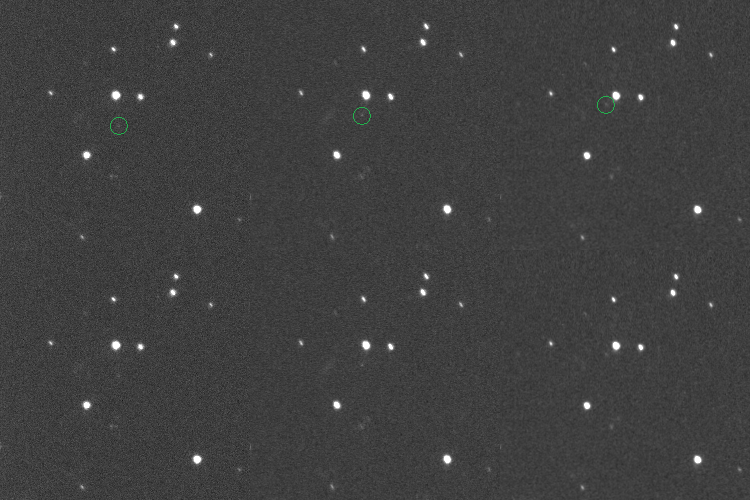
2014 PN70 is one of the objects that New Horizons observed from greater distances, as part of its extended Kuiper belt mission. The spacecraft passed 2014 PN70 in March 2019, at a distance of approximately 0.1 AU (15 million km; 9.3 million mi). This made 2014 PN70 the third closest KBO observed by New Horizons, after Arrokoth and 2014 OS393. New Horizons made its first observations of 2014 PN70 on 5 January 2019, from a distance of 92.7 million km.
Hub AI
2014 PN70 AI simulator
(@2014 PN70_simulator)
2014 PN70
2014 PN70 (internally designated g12000JZ, g1 and PT3) is a trans-Neptunian object from the cold classical Kuiper belt located in the outermost region of the Solar System. It measures approximately 40 kilometers (25 miles) in diameter. The object was first observed by the New Horizons Search Team using the Hubble Space Telescope on 6 August 2014, and was a proposed flyby target for the New Horizons probe until 2015, when the alternative target 486958 Arrokoth was selected.
2014 PN70 was discovered by the New Horizons Search Team during an observation campaign intended to search for KBO flyby targets for the New Horizons probe. The observations started in June 2014, and more intensive ones continued in July and August. They were conducted with the help of the Hubble Space Telescope; the object's apparent magnitude of 26.4 is too faint to be observed by ground-based telescopes. 2014 PN70 was first discovered in observations on August 6, 2014, and it was designated g12000JZ at the time, nicknamed g1 for short. Its existence as a potential target of the New Horizons probe was revealed by NASA in October 2014 and it was designated PT3; its official provisional designation, 2014 PN70, was not assigned by the Minor Planet Center until March 2015 after better orbit information was available.
2014 PN70 is a trans-Neptunian object. More specifically, it is a non-resonant classical Kuiper belt object, also known as "cubewano". It orbits the Sun at a distance of 42.1–46.6 AU once every 295 years and 4 months (107,886 days; semi-major axis of 44.4 AU). Its orbit has an eccentricity of 0.05 and an inclination of 4° with respect to the ecliptic. This makes it a typical member of the "cold population" among the cubewanos in the Kuiper belt.
The body's observation arc begins with a precovery taken by the New Horizons KBO Search team with the Subaru Telescope at Mauna Kea Observatory on Hawaii, six week prior to its official first observation by Hubble.
This minor planet has not been numbered by the Minor Planet Center and remains unnamed.
2014 PN70, has a diameter approximately 35–55 km (22–34 mi), based on an estimated albedo between 0.04 and 0.10 respectively. Astronomer Marc Buie gives a similar estimate of 30–55 km (19–34 mi), and the Johnston's archive calculated a diameter of 39 km. Based on generic magnitude-to-diameter conversion, the object measures 44 km, for an absolute magnitude of 10.3 and an assumed albedo of 0.07. Hubble observations of 2014 PN70 show that it is very red in color.
Having completed its flyby of Pluto, the New Horizons space probe was to perform a flyby of at least one Kuiper belt object. Several potential targets were under consideration. 2014 PN70 (PT3) was considered a second choice after 2014 MU69 (PT1, later named 486958 Arrokoth), because more fuel was required to carry out a flyby. 2014 OS393 (PT2) was already no longer under consideration as a potential target. On 28 August 2015, the New Horizons team announced the selection of 2014 MU69 as the next flyby target.
2014 PN70 is one of the objects that New Horizons observed from greater distances, as part of its extended Kuiper belt mission. The spacecraft passed 2014 PN70 in March 2019, at a distance of approximately 0.1 AU (15 million km; 9.3 million mi). This made 2014 PN70 the third closest KBO observed by New Horizons, after Arrokoth and 2014 OS393. New Horizons made its first observations of 2014 PN70 on 5 January 2019, from a distance of 92.7 million km.