
Recent from talks
Albedo
Knowledge base stats:
Talk channels stats:
Members stats:
Albedo
Albedo (/ælˈbiːdoʊ/ ⓘ al-BEE-doh; from Latin albedo 'whiteness') is the fraction of sunlight that is diffusely reflected by a body. It is measured on a scale from 0 (corresponding to a black body that absorbs all incident radiation) to 1 (corresponding to a body that reflects all incident radiation). Surface albedo is defined as the ratio of radiosity Je to the irradiance Ee (flux per unit area) received by a surface. The proportion reflected is not only determined by properties of the surface itself, but also by the spectral and angular distribution of solar radiation reaching the Earth's surface. These factors vary with atmospheric composition, geographic location, and time (see position of the Sun).
While directional-hemispherical reflectance factor is calculated for a single angle of incidence (i.e., for a given position of the Sun), albedo is the directional integration of reflectance over all solar angles in a given period. The temporal resolution may range from seconds (as obtained from flux measurements) to daily, monthly, or annual averages.
Unless given for a specific wavelength (spectral albedo), albedo refers to the entire spectrum of solar radiation. Due to measurement constraints, it is often given for the spectrum in which most solar energy reaches the surface (between 0.3 and 3 μm). This spectrum includes visible light (0.4–0.7 μm), which explains why surfaces with a low albedo appear dark (e.g., trees absorb most radiation), whereas surfaces with a high albedo appear bright (e.g., snow reflects most radiation).
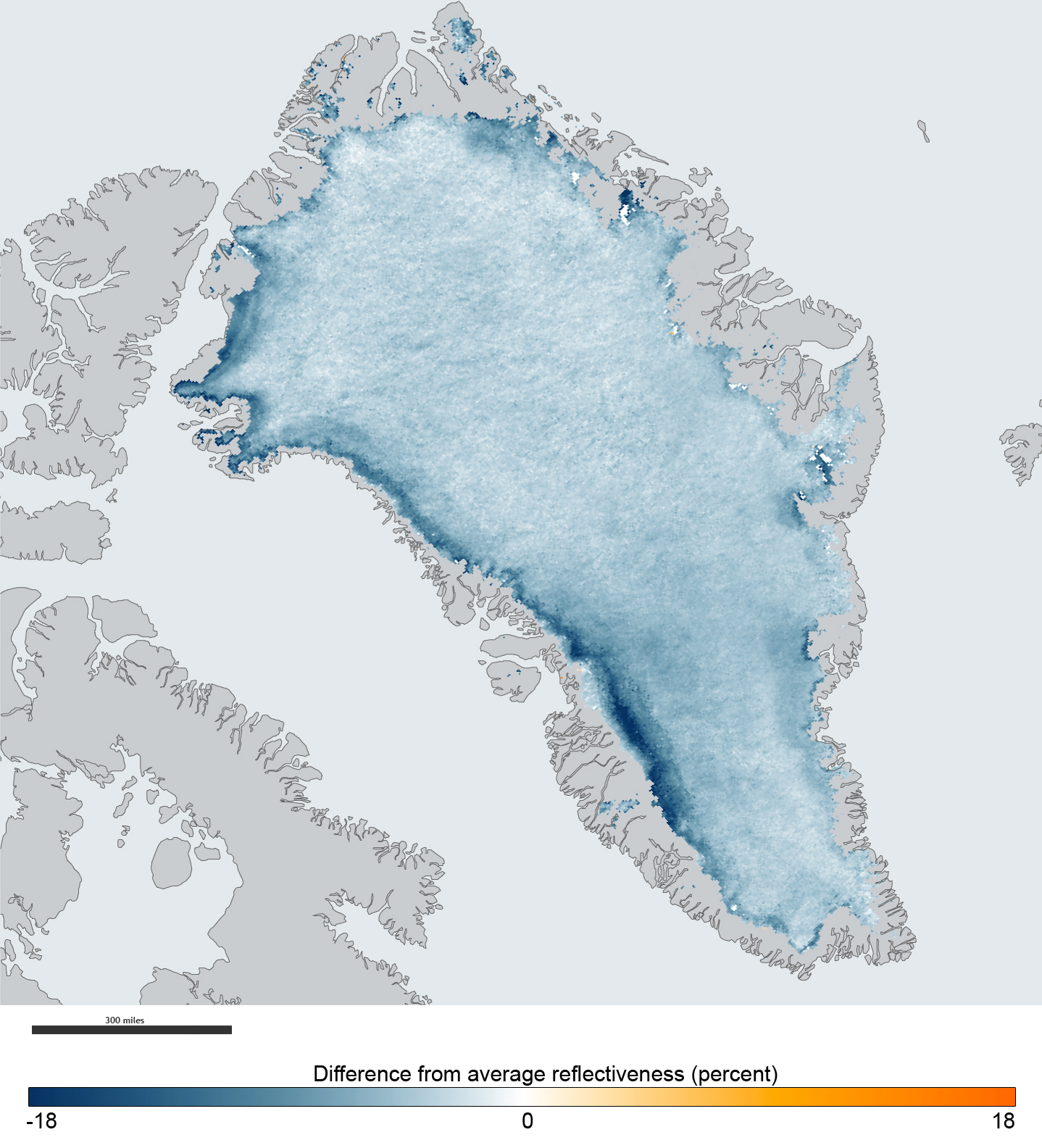
Ice–albedo feedback is a positive feedback climate process where a change in the area of ice caps, glaciers, and sea ice alters the albedo and surface temperature of a planet. Ice is very reflective, therefore it reflects far more solar energy back to space than the other types of land area or open water. Ice–albedo feedback plays an important role in global climate change. Albedo is an important concept in climate science.
The albedo in visible light ranges from about 0.9 to 0.95 for fresh snow to about 0.04 for charcoal, one of the darkest substances. Deeply shadowed cavities can achieve an effective albedo approaching the zero of a black body. When seen from a distance, the ocean surface has a low albedo, as do most forests, whereas desert areas have some of the highest albedos among landforms. Most land areas are in an albedo range of 0.1 to 0.4. The average albedo of Earth is about 0.3. This is far higher than for the ocean primarily because of the contribution of clouds.
Earth's surface albedo is regularly estimated via Earth observation satellite sensors such as NASA's MODIS instruments on board the Terra and Aqua satellites, and the CERES instrument on the Suomi NPP and JPSS. As the amount of reflected radiation is only measured for a single direction by satellite, not all directions, a mathematical model is used to translate a sample set of satellite reflectance measurements into estimates of directional-hemispherical reflectance and bi-hemispherical reflectance (e.g.,). These calculations are based on the bidirectional reflectance distribution function (BRDF), which describes how the reflectance of a given surface depends on the view angle of the observer and the solar angle. BDRF can facilitate translations of observations of reflectance into albedo.[citation needed]
Earth's average surface temperature due to its albedo and the greenhouse effect is currently about 15 °C (59 °F). If Earth were frozen entirely (and hence be more reflective), the average temperature of the planet would drop below −40 °C (−40 °F). If only the continental land masses became covered by glaciers, the mean temperature of the planet would drop to about 0 °C (32 °F). In contrast, if the entire Earth was covered by water – a so-called ocean planet – the average temperature on the planet would rise to almost 27 °C (81 °F).
In 2021, scientists reported that Earth dimmed by ~0.5% over two decades (1998–2017) as measured by earthshine using modern photometric techniques. This may have both been co-caused by climate change as well as a substantial increase in global warming. However, the link to climate change has not been explored to date and it is unclear whether or not this represents an ongoing trend.
Hub AI
Albedo AI simulator
(@Albedo_simulator)
Albedo
Albedo (/ælˈbiːdoʊ/ ⓘ al-BEE-doh; from Latin albedo 'whiteness') is the fraction of sunlight that is diffusely reflected by a body. It is measured on a scale from 0 (corresponding to a black body that absorbs all incident radiation) to 1 (corresponding to a body that reflects all incident radiation). Surface albedo is defined as the ratio of radiosity Je to the irradiance Ee (flux per unit area) received by a surface. The proportion reflected is not only determined by properties of the surface itself, but also by the spectral and angular distribution of solar radiation reaching the Earth's surface. These factors vary with atmospheric composition, geographic location, and time (see position of the Sun).
While directional-hemispherical reflectance factor is calculated for a single angle of incidence (i.e., for a given position of the Sun), albedo is the directional integration of reflectance over all solar angles in a given period. The temporal resolution may range from seconds (as obtained from flux measurements) to daily, monthly, or annual averages.
Unless given for a specific wavelength (spectral albedo), albedo refers to the entire spectrum of solar radiation. Due to measurement constraints, it is often given for the spectrum in which most solar energy reaches the surface (between 0.3 and 3 μm). This spectrum includes visible light (0.4–0.7 μm), which explains why surfaces with a low albedo appear dark (e.g., trees absorb most radiation), whereas surfaces with a high albedo appear bright (e.g., snow reflects most radiation).
Ice–albedo feedback is a positive feedback climate process where a change in the area of ice caps, glaciers, and sea ice alters the albedo and surface temperature of a planet. Ice is very reflective, therefore it reflects far more solar energy back to space than the other types of land area or open water. Ice–albedo feedback plays an important role in global climate change. Albedo is an important concept in climate science.
The albedo in visible light ranges from about 0.9 to 0.95 for fresh snow to about 0.04 for charcoal, one of the darkest substances. Deeply shadowed cavities can achieve an effective albedo approaching the zero of a black body. When seen from a distance, the ocean surface has a low albedo, as do most forests, whereas desert areas have some of the highest albedos among landforms. Most land areas are in an albedo range of 0.1 to 0.4. The average albedo of Earth is about 0.3. This is far higher than for the ocean primarily because of the contribution of clouds.
Earth's surface albedo is regularly estimated via Earth observation satellite sensors such as NASA's MODIS instruments on board the Terra and Aqua satellites, and the CERES instrument on the Suomi NPP and JPSS. As the amount of reflected radiation is only measured for a single direction by satellite, not all directions, a mathematical model is used to translate a sample set of satellite reflectance measurements into estimates of directional-hemispherical reflectance and bi-hemispherical reflectance (e.g.,). These calculations are based on the bidirectional reflectance distribution function (BRDF), which describes how the reflectance of a given surface depends on the view angle of the observer and the solar angle. BDRF can facilitate translations of observations of reflectance into albedo.[citation needed]
Earth's average surface temperature due to its albedo and the greenhouse effect is currently about 15 °C (59 °F). If Earth were frozen entirely (and hence be more reflective), the average temperature of the planet would drop below −40 °C (−40 °F). If only the continental land masses became covered by glaciers, the mean temperature of the planet would drop to about 0 °C (32 °F). In contrast, if the entire Earth was covered by water – a so-called ocean planet – the average temperature on the planet would rise to almost 27 °C (81 °F).
In 2021, scientists reported that Earth dimmed by ~0.5% over two decades (1998–2017) as measured by earthshine using modern photometric techniques. This may have both been co-caused by climate change as well as a substantial increase in global warming. However, the link to climate change has not been explored to date and it is unclear whether or not this represents an ongoing trend.
Recent media