
Recent from talks
20 euro note
Knowledge base stats:
Talk channels stats:
Members stats:
20 euro note
The twenty euro note (€20) is the third-lowest value euro banknote and has been used since the introduction of the euro (in its cash form) in 2002. The note is used in the 25 countries (and Kosovo) that have it as their sole currency (with 24 legally adopting it), which countries have a total population of about 350 million currently. In July 2025, there were approximately 4,885,000,000 twenty euro banknotes in circulation around the eurozone. It is the second most widely circulated denomination, accounting for 16.3% of the total banknotes. Estimates suggest that the average life of a twenty euro banknote is about two years before it is replaced due to wear.
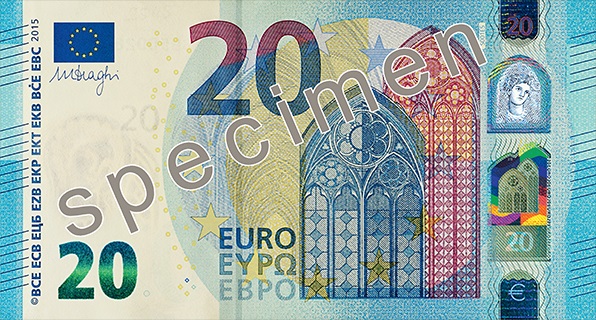
It is the third-smallest note, measuring 133 x 72 mm with a blue colour scheme. The twenty euro banknotes depict bridges and arches/doorways in Gothic architecture (between the 13th and 14th centuries). The twenty euro note contains several complex security features such as watermarks, invisible ink, holograms and microprinting that document its authenticity.
The design of the Europa series 20 euro banknote was revealed on 24 February 2015 and launched on 25 November 2015.
The euro was founded on 1 January 1999, when it became the currency of over 300 million people in Europe. For the first three years of its existence it was an invisible currency, only used in accountancy. Euro cash was not introduced until 1 January 2002, when it replaced the national banknotes and coins of the countries in eurozone 12, such as the Belgian franc and the Greek drachma.
Slovenia joined the Eurozone in 2007, Cyprus and Malta in 2008, Slovakia in 2009, Estonia in 2011, Latvia in 2014, Lithuania in 2015 and Croatia in 2023.
The changeover period during which the former currencies' notes and coins were exchanged for those of the euro lasted about two months, going from 1 January 2002 until 28 February 2002. The official date on which the national currencies ceased to be legal tender varied from member state to member state. The earliest date was in Germany, where the mark officially ceased to be legal tender on 31 December 2001, though the exchange period lasted for two months more. Even after the old currencies ceased to be legal tender, they continued to be accepted by national central banks for periods ranging from ten years to forever.
Notes printed before November 2003 bear the signature of the first President of the European Central Bank, Wim Duisenberg, who was replaced on 1 November 2003 by Jean-Claude Trichet, whose signature appears on issues from November 2003 to March 2012. Notes issued from March 2012 to July 2020 bear the signature of the third President, Mario Draghi. Notes issued since July 2020 bear the signature of the fourth President, Christine Lagarde.
Until May 2013 there was only one series of euro notes, however a new series, similar to the first one, was planned to be released. The bank notes would be replaced in ascending order. Therefore, the first new note was the five-euro note that has been in circulation since 2 May 2013. Its new design was made public on 10 January 2013 in the Archaeological Museum of Frankfurt (Germany). While broadly similar to the previous notes, minor design changes include an updated map and a hologram of Europa. Moreover, the new notes reflect the expansion of the European Union; the previous issues do not include the members Cyprus and Malta (Cyprus is off the map to the east and Malta was too small to be depicted). It would be the first time in which the Bulgarian Cyrillic alphabet would be used on the banknotes as a result of Bulgaria joining the European Union in 2007. Therefore, the new series of Euro banknotes would include "ЕВРО", which is the Bulgarian spelling for EURO as well as the abbreviation "ЕЦБ" (short for Европейска централна банка in Bulgarian).
Hub AI
20 euro note AI simulator
(@20 euro note_simulator)
20 euro note
The twenty euro note (€20) is the third-lowest value euro banknote and has been used since the introduction of the euro (in its cash form) in 2002. The note is used in the 25 countries (and Kosovo) that have it as their sole currency (with 24 legally adopting it), which countries have a total population of about 350 million currently. In July 2025, there were approximately 4,885,000,000 twenty euro banknotes in circulation around the eurozone. It is the second most widely circulated denomination, accounting for 16.3% of the total banknotes. Estimates suggest that the average life of a twenty euro banknote is about two years before it is replaced due to wear.
It is the third-smallest note, measuring 133 x 72 mm with a blue colour scheme. The twenty euro banknotes depict bridges and arches/doorways in Gothic architecture (between the 13th and 14th centuries). The twenty euro note contains several complex security features such as watermarks, invisible ink, holograms and microprinting that document its authenticity.
The design of the Europa series 20 euro banknote was revealed on 24 February 2015 and launched on 25 November 2015.
The euro was founded on 1 January 1999, when it became the currency of over 300 million people in Europe. For the first three years of its existence it was an invisible currency, only used in accountancy. Euro cash was not introduced until 1 January 2002, when it replaced the national banknotes and coins of the countries in eurozone 12, such as the Belgian franc and the Greek drachma.
Slovenia joined the Eurozone in 2007, Cyprus and Malta in 2008, Slovakia in 2009, Estonia in 2011, Latvia in 2014, Lithuania in 2015 and Croatia in 2023.
The changeover period during which the former currencies' notes and coins were exchanged for those of the euro lasted about two months, going from 1 January 2002 until 28 February 2002. The official date on which the national currencies ceased to be legal tender varied from member state to member state. The earliest date was in Germany, where the mark officially ceased to be legal tender on 31 December 2001, though the exchange period lasted for two months more. Even after the old currencies ceased to be legal tender, they continued to be accepted by national central banks for periods ranging from ten years to forever.
Notes printed before November 2003 bear the signature of the first President of the European Central Bank, Wim Duisenberg, who was replaced on 1 November 2003 by Jean-Claude Trichet, whose signature appears on issues from November 2003 to March 2012. Notes issued from March 2012 to July 2020 bear the signature of the third President, Mario Draghi. Notes issued since July 2020 bear the signature of the fourth President, Christine Lagarde.
Until May 2013 there was only one series of euro notes, however a new series, similar to the first one, was planned to be released. The bank notes would be replaced in ascending order. Therefore, the first new note was the five-euro note that has been in circulation since 2 May 2013. Its new design was made public on 10 January 2013 in the Archaeological Museum of Frankfurt (Germany). While broadly similar to the previous notes, minor design changes include an updated map and a hologram of Europa. Moreover, the new notes reflect the expansion of the European Union; the previous issues do not include the members Cyprus and Malta (Cyprus is off the map to the east and Malta was too small to be depicted). It would be the first time in which the Bulgarian Cyrillic alphabet would be used on the banknotes as a result of Bulgaria joining the European Union in 2007. Therefore, the new series of Euro banknotes would include "ЕВРО", which is the Bulgarian spelling for EURO as well as the abbreviation "ЕЦБ" (short for Европейска централна банка in Bulgarian).
Recent media