


Community hub
Recent from talks
Contribute something
Nothing was collected or created yet.
371 series
View on Wikipedia | You can help expand this article with text translated from the corresponding article in Japanese. (July 2022) Click [show] for important translation instructions.
|
| 371 series | |
|---|---|
 371 series on an Asagiri service, October 2009 | |
| In service | March 1991 – November 2014 |
| Manufacturer | Hitachi, Kawasaki Heavy Industries, Nippon Sharyo |
| Number built | 7 vehicles (1 set) |
| Formation | 7 cars |
| Fleet numbers | X1 |
| Operators | JR Central |
| Depots | Shizuoka |
| Specifications | |
| Car body construction | Steel |
| Car length | 21.250 m (69 ft 9 in) (end cars) 20.000 m (65 ft 7 in) (intermediate cars) |
| Width | 2,900 mm (9 ft 6 in) |
| Doors | Sliding plug doors (1 per side) |
| Maximum speed | 120 km/h (75 mph) |
| Traction system | Resistor control + field system superimposed field excitation control |
| Electric system(s) | 1,500 V DC |
| Current collection | C-PS27A single-arm pantograph |
| Safety system(s) | ATS-PT |
| Track gauge | 1,067 mm (3 ft 6 in) |
The 371 series (371系電車) was an electric multiple unit (EMU) train operated by Central Japan Railway Company (JR Central) in Japan between 1991 and 2014. Originally used on Asagiri limited express services in conjunction with Odakyu Electric Railway,[1] from 2012 until its withdrawal in 2014, the train was used on Gotemba Line excursion services. It was subsequently sold to the private railway operator Fuji Kyuko and rebuilt as the Fujikyu 8500 series for use on Fujisan Tokkyu services from March 2016.
Design
[edit]The lone 7-car 371 series set was built jointly by Hitachi, Kawasaki Heavy Industries, and Nippon Sharyo.[2]
Operations
[edit]
From its introduction on 16 March 1991 until 16 March 2012, the 371 series set was used alongside the two Odakyu 20000 series RSE EMUs on Asagiri services run jointly by the private railway operator Odakyu Electric Railway and JR Central between Odakyu's Tokyo terminus at Shinjuku and JR Central's Numazu Station in Shizuoka Prefecture via the Gotemba Line. In addition to the daytime Asagiri services, the train was also used on the following "Home Liner" limited-stop commuter services.[3]
- Home Liner Numazu
- Home Liner Hamamatsu
- Home Liner Shizuoka
From 17 March, the 371 series and 20000 series trains were replaced by Odakyu 60000 series MSE EMUs on Asagiri services.
From June 2012, the 371 series set was used on additional limited-stop "Rapid" services on the Gotemba Line connected with a series of hiking events.[4]
Formation
[edit]The one 7-car set, X1, was formed as follows.[3] The two Green (first class) cars, 3 and 4, were bilevel cars.[1]
| Car No. | 1 | 2 | 3 | 4 | 5 | 6 | 7 |
|---|---|---|---|---|---|---|---|
| Designation | Mc | M' | ThsD | ThsD | M | M' | Mc |
| Numbering | KuMoHa 371-101 | MoHa 370-101 | SaRoHa 371-101 | SaRoHa 371-1 | MoHa 371-201 | MoHa 370-1 | KuMoHa 371-1 |
Cars 1, 5, and 7 are each fitted with one C-PS27A single-arm pantograph.[1]
-
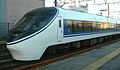 KuMoHa 371-101
 -
 MoHa 370-101
 -
 SaRoHa 371-101
 -
 SaRoHa 371-1
 -
 MoHa 371-201
 -
 MoHa 370-1
 -
 KuMoHa 371-1


Interior
[edit]Standard class cars had regular 2+2 seating. The two bilevel cars had Green (first class) accommodation on the upper decks with 2+1 seating, and standard-class accommodation on the lower decks, also with 2+1 seating.[1]
-
 Standard class car interior, February 2009
 -
 Bilevel car upper deck (Green class) accommodation, February 2009
 -
 Bilevel car lower deck (standard class) accommodation, February 2009


History
[edit]
The 371 series set entered service on 16 March 1991.[3] From 24 June 1997, car 7 was made no-smoking, and from 18 March 2007, all cars were made no-smoking.[3] From 6 November 2006, the original PS24A lozenge-type pantographs were replaced with C-PS27A single-arm pantographs.[1][3]
Withdrawal
[edit]The 371 series was withdrawn from Asagiri services following its last run on 16 March 2012. It was subsequently re-employed as a special charter train for use from autumn 2012.[5]
The train was finally withdrawn from service after a final run on 30 November 2014.[6]
Resale
[edit]
In December 2014, it was announced that the private railway operator Fuji Kyuko planned to purchase the trainset, and reform it as a three-car set for use on Fujisan Tokkyu services later in fiscal 2015.[7] The train was moved from Shizuoka to JR East's Nagano Works for rebuilding work in March 2015.[8]
References
[edit]- ^ a b c d e Jēāru zensharyō handobukku: Rail Magazine 2009 JR全車輌ハンドブック2009 [JR Rolling Stock Handbook 2009]. Japan: Neko Publishing. 2009. pp. 163–164. ISBN 978-4-7770-0836-0.
- ^ Saka, Masahiro (March 2014). JR第1世代の車両・現況と概要 [JR 1st-generation rolling stock: Current situation and overview]. Tetsudō Daiya Jōhō Magazine (in Japanese). 43 (359): 22.
- ^ a b c d e JR電車編成表 2011夏 [JR EMU Formations - Summer 2011]. Japan: Kotsu Shimbunsha. May 2010. p. 117. ISBN 978-4-330-21211-1.
- ^ JR東海371系 臨時快速に使用 [JR Central 371 series to be used on additional Rapid services]. Tetsudo Hobidas (in Japanese). Japan: Neko Publishing. 30 May 2012. Archived from the original on 2 March 2020. Retrieved 1 June 2012.
- ^ 「371系」来春引退 JR東海の特急「あさぎり」 [JR Central 371 series Asagiri limited express to be withdrawn next spring]. @Shizuoka (in Japanese). Japan: The Shizuoka Shimbun and Shizuoka Broadcasting System. 18 October 2011. Archived from the original on 20 October 2011. Retrieved 2 December 2014.
- ^ 「あさぎり号」などで活躍…371系ラストラン [Last run for the 371 series - formerly active on "Asagiri"]. Yomiuri Online (in Japanese). Japan: The Yomiuri Shimbun. 1 December 2014. Archived from the original on 2 December 2014. Retrieved 2 December 2014.
- ^ 富士急行,JR東海371系を購入 [Fuji Kyuko to purchase JR Central 371 series]. Japan Railfan Magazine Online (in Japanese). Japan: Koyusha Co., Ltd. 16 December 2014. Retrieved 16 December 2014.
- ^ 371系7輌 長野へ輸送される [371 series 7 cars moved to Nagano]. RM News (in Japanese). Japan: Neko Publishing Co., Ltd. 30 March 2015. Archived from the original on 11 March 2017. Retrieved 30 March 2015.
External links
[edit]
- JR Central 371 series information (in Japanese)
 Multiple units of Central Japan Railway Company Multiple units of Central Japan Railway Company | ||||||||||||||||||||||||
|---|---|---|---|---|---|---|---|---|---|---|---|---|---|---|---|---|---|---|---|---|---|---|---|---|
| Current |
|  | ||||||||||||||||||||||
| Future |
| |||||||||||||||||||||||
| Withdrawn |
| |||||||||||||||||||||||
371 series
View on GrokipediaDesign and Construction
Body and Structure
The 371 series trainset was jointly constructed by Hitachi (cars 1 and 2), Kawasaki Heavy Industries (cars 3 and 4), and Nippon Sharyo (cars 5 to 7) between 1990 and 1991, resulting in a single 7-car formation designated as set X1.[2] The car bodies were fabricated from stainless steel to provide durability and corrosion resistance suitable for Japanese railway operations.[3] End cars measured 21.25 m in length, with intermediate cars at 20 m, and a width of 2.9 m; single-level cars had a height of 4.05 m, while the bi-level cars reached 4.30 m.[4] The bi-level design was implemented exclusively in the Green cars (cars 3 and 4), featuring upper and lower decks to enhance passenger capacity without extending the train's footprint, a configuration that distinguished the 371 series among contemporary JR Central EMUs. The total weight of the 7-car set approximated 350 tons, supporting a maximum operational speed of 120 km/h.[5] Aerodynamic features, including a streamlined front end on the power cars, were incorporated to optimize performance for limited express services on conventional lines. These structural elements integrated with the train's electrical systems to ensure efficient high-speed travel, though detailed power integration is addressed separately.Electrical and Mechanical Systems
The 371 series employed a conventional DC traction system powered by 1,500 V overhead catenary lines, with main electric motors rated at 120 kW each installed across five powered cars in the 7-car formation (5M configuration). The motors were DC series-wound types equipped with compensating windings: C-MT61A on KuMoHa 371 and MoHa 370, and C-MT64A on MoHa 371. These were controlled via a series-parallel resistance system combined with field-adding excitation control (C-CS57A/C-CS59A), enabling precise speed regulation and regenerative braking capabilities without the use of variable frequency drives. This setup provided reliable performance for intercity services, with four motors per powered car delivering a total output of 480 kW per unit and approximately 2,400 kW across the five powered cars.[4][6] Power collection was handled by three pantographs per set, initially lozenge-style PS24A units but upgraded to aerodynamic single-arm C-PS27A types starting in November 2006 to reduce noise and improve high-speed stability.[7] The braking system integrated regenerative braking with electrically commanded air brakes (MBSA type), featuring electro-pneumatic controls, suppression speed braking, gradient start assistance, and load-responsive devices for consistent stopping power across varying terrains; this allowed a standard deceleration of 4.0 km/h/s while recovering energy during operation. Mechanical components included bolsterless bogies of the C-DT59 type for powered cars and C-TR243 for trailers, optimized for the 1,067 mm Cape gauge and supporting a maximum operating speed of 120 km/h with an acceleration rate of 2.0 km/h/s from 0 to 80 km/h.[4][8]Operations
Asagiri and Joint Services
The 371 series was introduced in 1991 for through-services on the Limited Express Asagiri, running from Shinjuku to Numazu via the Odakyu and Gotemba lines in joint operation with Odakyu Electric Railway's 20000 series RSE sets.[1][2] This partnership utilized two Odakyu RSE sets alongside the single 371 series set to meet peak tourist demand in the Mount Fuji area. The joint operation ended on 17 March 2012, when the Asagiri service was replaced by Odakyu's 60000 series MSE sets for fleet modernization and improved cost efficiency.[2][9] In service, the 371 series stopped at key stations such as Gotemba and Susono.Home Liner and Excursion Services
Following the discontinuation of joint operations with Odakyu Electric Railway on the Asagiri limited express in March 2012, the 371 series was repurposed by JR Central for secondary services, including Home Liner commuter expresses and seasonal excursion trains. These operations were based out of Shizuoka depot, with shorter routes supporting evening peak-hour demand and event-based tourism around Mount Fuji. The sets underwent minor adjustments for higher commuter volumes, such as temporary seating reallocations to accommodate standing passengers during rush hours.[1] Home Liner services utilizing the 371 series began in the early 1990s as limited-stop evening commuter expresses linking key regional hubs. Routes included the Home Liner Numazu (Shizuoka to Numazu), Home Liner Hamamatsu (Numazu to Hamamatsu), and Home Liner Shizuoka (Hamamatsu to Shizuoka), providing reserved-seating options for workers returning from Tokyo-area connections via the Tōkaidō Main Line. These runs operated primarily in the late afternoon and evening, stopping at major intermediates like Fuji and Mishima. Operations continued until March 2012, when the series shifted to non-regular duties.[10][11] From June 2012, the 371 series entered excursion service on the Gotemba Line, focusing on limited-stop "Rapid" runs tied to hiking and seasonal events near Mount Fuji. The inaugural operation was the temporary rapid "Sawayaka Walking Gotemba Liner," running one round-trip daily on June 17 and 24 from Shizuoka to Matsuda or Suruga-Oyama, serving walking events like the Kaisei Ajisai Village hike and Oyama Town centennial azalea festival. These 7-car sets (capacity 408, all reserved with a 310-yen surcharge) featured large panoramic windows ideal for scenic views, with no transfers required to event start points.[12] Excursion frequency reduced post-2012 but emphasized weekends and winter seasons, with ad-hoc charters promoting Fuji-area tourism. In February 2014 (specifically February 8–9, 15–16, and 22–23), the "Fuji Mountain Train 371" operated six round-trips from Hamamatsu to Gotemba as a temporary express, stopping at key stations like Shizuoka, Fuji, and Numazu; each 7-car train (capacity 406, all reserved) included headmarks depicting winter Fuji vistas and onboard events, with a required express surcharge and reservations starting one month prior. Services like this averaged 1–2 daily pairs on select weekends, drawing hikers and sightseers with direct access to trails from Gotemba Station.[13][14] By 2014, operations centered on the Gotemba Line's 80th anniversary, with the "Gotemba Line 80th 371" express running five round-trips from November 22–24 and 29–30 between Hamamatsu and Matsuda (stopping at 12 stations including Shizuoka and Numazu), featuring special headmarks, commemorative badges, and PR by local Fuji guides on select legs. The final charter occurred on November 30, 2014, marked by farewell ceremonies at Matsuda and Gotemba stations, after which all 371 series runs ceased. Maintenance cycles at Shizuoka supported these shorter, event-focused trips, ensuring reliability for irregular schedules. The set was then stored at Shizuoka until full deregistration in March 2015.[15][16][1]Formations and Configurations
Car Designations and Layout
The 371 series operated as a single 7-car fixed formation, designated as set X1, built in 1991 jointly by Hitachi, Kawasaki Heavy Industries, and Nippon Sharyo for JR Central. The cars were numbered 1 through 7, with the original designations reflecting their roles as control motor cars (KuMoHa), intermediate motor cars (MoHa), and bi-level saloon cars (SaRoHa). The formation emphasized a balanced distribution of powered and trailer cars to support efficient operation on the Gotemba and Tokaido lines, incorporating two bi-level SaRoHa 371 cars in positions 3 and 4 for enhanced passenger capacity through dual decks.[17][18] The layout followed a 5M2T configuration (five motor cars and two trailers), with end cars functioning as control motor cars (Mc) equipped for leading duties, intermediate cars as either motor cars (M) or trailers (T), and pantographs mounted on cars 1, 5, and 7 to distribute power collection along the train. Specifically, cars 1 and 7 were KuMoHa 371 (Mc), cars 2 and 6 were MoHa 370 (M), car 5 was MoHa 371-201 (M, single-motor unit), and cars 3 and 4 were SaRoHa 371 (T, bi-level with Green Car and standard seating on upper and lower decks). This arrangement allowed for a top speed of 120 km/h while maintaining stability, with the bi-level cars providing additional vertical space without extending the train length.[17][19] The sequential layout, from car 1 (Numazu end) to car 7 (Shinjuku end) in typical Asagiri service orientation, was as follows:| Car No. | Designation | Type | Notes |
|---|---|---|---|
| 1 | KuMoHa 371-101 | Mc | Pantograph, control equipment |
| 2 | MoHa 370-101 | M | Intermediate motor, auxiliary power |
| 3 | SaRoHa 371-101 | T | Bi-level, Green/standard seating |
| 4 | SaRoHa 371-1 | T | Bi-level, vending prep room |
| 5 | MoHa 371-201 | M | Pantograph, single-motor unit |
| 6 | MoHa 370-1 | M | Intermediate motor, compressor |
| 7 | KuMoHa 371-1 | Mc | Pantograph, control equipment |