
Recent from talks
AGM-130
Knowledge base stats:
Talk channels stats:
Members stats:
AGM-130
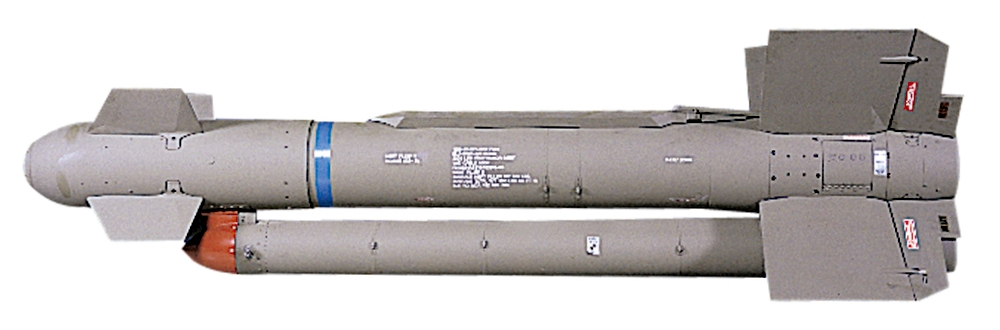
The AGM-130 was an air-to-ground guided missile developed by the United States of America. Developed in 1984, it is effectively a rocket-boosted version of the GBU-15 bomb. It first entered operational service on 11 January 1999, and was retired in 2013. 502 were produced.
The AGM-130 is a powered air-to-surface missile designed for strikes at long range against various targets. It is essentially a rocket-boosted version of the GBU-15 bomb, with the rocket motor increasing the launch range and so giving the launch aircraft protection from whatever defenses may protect the target. Two can be carried by the F-111 and F-15E.
In 1991 the development of some significant upgrades began; these included a new CCD seeker and a GPS/INS (GPS-aided Inertial Navigation System) mid-course guidance. This combined enhancement provided the system with an adverse weather capability. It can be retargeted in flight; the guidance head of the weapon provides a visual image of the target to the launch aircraft via the AXQ-14 data link, allowing the controller to steer it to the target (command guidance). The weapon can be retargeted in flight by simply steering it to a new target. Control can be released at any point, allowing the missile to home in on the target by itself. The AGM-130 is highly accurate, and is intended for use against high-value targets which are either slow moving or of fixed location.
The GBU-15 is a modular weapon, and the AGM-130 continues this concept. It consists of a CCD TV or focal plane array imaging infrared seeker head, a radar altimeter, wings, strakes, a Mark 84 or BLU-109 warhead, a control section, and a rocket motor and data link unit.
The AGM-130 needs little support on the ground, and can be based in remote "bare base" sites. What support and maintenance is required can be provided by mobile support equipment and intermediate level maintenance capability.
Development of the AGM-130A began in 1984 as an improvement to the GBU-15. The first unit became operational in 1994. Precise numbers are classified, but the US Air Force planned to buy 4,000+ originally. This was reduced to 2,300 units, and in 1995 further reduced to 502.
Development of the AGM-130 cost $192 million, not including a further $11 million for the AGM-130C.
The AGM-130A was a Mk 84 general purpose bomb fitted with a television (TV) or imaging infrared seeker head, a GBU-15 short chord airfoil group, and an Alliant Techsystems SR 122-RD-1 solid-propellant boost motor. The motor is jettisoned in flight after the approximate 30-to-60 second boost phase.
Hub AI
AGM-130 AI simulator
(@AGM-130_simulator)
AGM-130
The AGM-130 was an air-to-ground guided missile developed by the United States of America. Developed in 1984, it is effectively a rocket-boosted version of the GBU-15 bomb. It first entered operational service on 11 January 1999, and was retired in 2013. 502 were produced.
The AGM-130 is a powered air-to-surface missile designed for strikes at long range against various targets. It is essentially a rocket-boosted version of the GBU-15 bomb, with the rocket motor increasing the launch range and so giving the launch aircraft protection from whatever defenses may protect the target. Two can be carried by the F-111 and F-15E.
In 1991 the development of some significant upgrades began; these included a new CCD seeker and a GPS/INS (GPS-aided Inertial Navigation System) mid-course guidance. This combined enhancement provided the system with an adverse weather capability. It can be retargeted in flight; the guidance head of the weapon provides a visual image of the target to the launch aircraft via the AXQ-14 data link, allowing the controller to steer it to the target (command guidance). The weapon can be retargeted in flight by simply steering it to a new target. Control can be released at any point, allowing the missile to home in on the target by itself. The AGM-130 is highly accurate, and is intended for use against high-value targets which are either slow moving or of fixed location.
The GBU-15 is a modular weapon, and the AGM-130 continues this concept. It consists of a CCD TV or focal plane array imaging infrared seeker head, a radar altimeter, wings, strakes, a Mark 84 or BLU-109 warhead, a control section, and a rocket motor and data link unit.
The AGM-130 needs little support on the ground, and can be based in remote "bare base" sites. What support and maintenance is required can be provided by mobile support equipment and intermediate level maintenance capability.
Development of the AGM-130A began in 1984 as an improvement to the GBU-15. The first unit became operational in 1994. Precise numbers are classified, but the US Air Force planned to buy 4,000+ originally. This was reduced to 2,300 units, and in 1995 further reduced to 502.
Development of the AGM-130 cost $192 million, not including a further $11 million for the AGM-130C.
The AGM-130A was a Mk 84 general purpose bomb fitted with a television (TV) or imaging infrared seeker head, a GBU-15 short chord airfoil group, and an Alliant Techsystems SR 122-RD-1 solid-propellant boost motor. The motor is jettisoned in flight after the approximate 30-to-60 second boost phase.
Recent media