
Recent from talks
AV receiver
Knowledge base stats:
Talk channels stats:
Members stats:
AV receiver
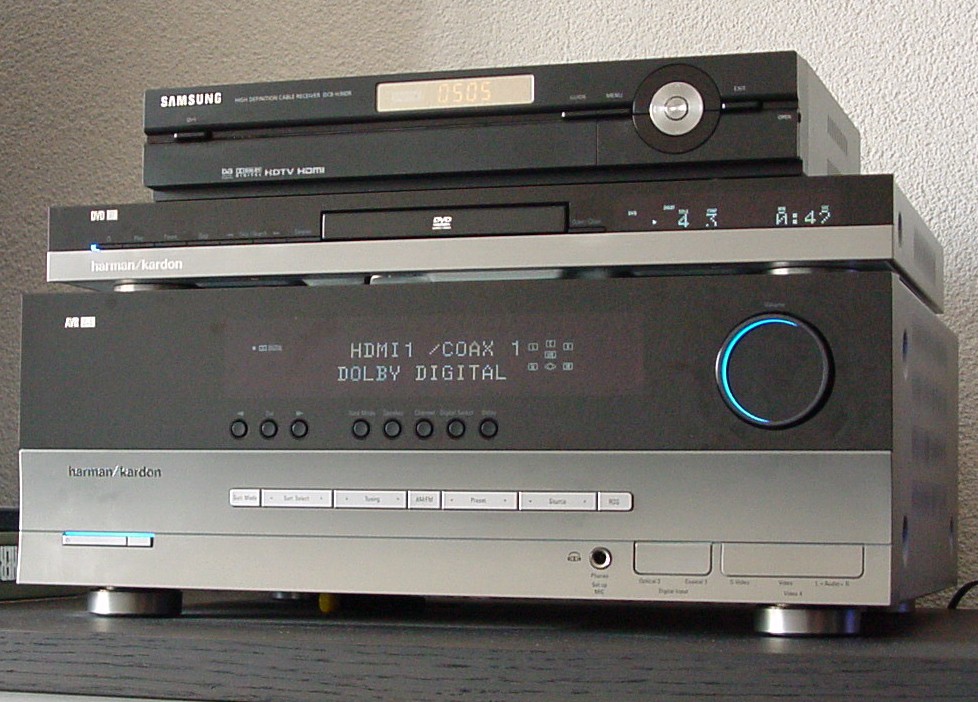
An audio/video receiver (AVR) or a stereo receiver is a consumer electronics component used in a home theater, home audio, or hi-fi system. Its purpose is to receive audio and video signals from a number of sources, and to process them and provide power amplifiers to drive loudspeakers, and/or route the video to displays such as a television, monitor or video projector. Inputs may come from a TV, FM, or AM tuner, satellite receiver, DVD players, Blu-ray Disc players, VCRs or video game consoles, among others. The AVR source selection and settings such as volume, are typically set by a remote controller.
A "receiver" in its most basic form is an amplifier, typically at least a two-channel stereo model, that has a built-in radio tuner. Over time, features were integrated that would otherwise require separate pieces of equipment, such as preamplifiers, equalizers, and multiple power amplifiers. As home entertainment options expanded in the 1980s and 1990s, so did the role of the receiver. The ability to handle a variety of digital audio signals was added. More amplifiers were added for multi-channel surround-sound playback. Video switching was added to simplify changing from one device to another, though this role diminished once TVs began supporting multiples of the same type of input connector. The term audio/video receiver (AVR) or Home Theater Receiver evolved to distinguish the multi-channel audio/video receiver (home theater receiver) from the simpler stereo receiver, though the primary function of both is amplification.
Also known as a home theater receiver, digital audio-video receiver, or digital media renderer. The basic functionality is to receive an audio signal, amplify the audio signal to drive multiple speakers and allow pass-through of the corresponding video signal to a display device such as a projector or a television. They are designed to handle five or more input channels in various configurations that are compatible with both audio and video, and typically accommodate HDMI inputs as well as support for surround sound.
Sometimes known as an audio receiver. The fundamental purpose is to take the low-level audio signal of a turntable, CD player, radio tuner, or other device and boost it to a level that can drive speakers. They are typically designed with music listeners in mind, and feature two, or sometimes four stereo channels with a focus on high fidelity music playback.
Stereo receivers have two channels of amplification (thus two separate amplifiers), while AV receivers may have more than two. The standard for AV receivers is five channels of amplification (thus five separate amplifiers), usually referred to as 5.1 receivers. This provides for a left, right, center, left surround sound and right surround sound speaker to be powered by the receiver.
In the 2010s, 7.1 receivers became more common and provided for two additional surround channels, left rear surround and right rear surround. The .1 refers to the low-frequency effects channel, the signal of which is usually sent to an amplified subwoofer unit. 5.1 and 7.1 receivers do not usually provide amplification for this channel. Instead, they provide a line level output. The user then either buys a monophonic power amp for their subwoofer or obtains a powered subwoofer cabinet containing an integrated power amplifier.
Audio amplifier power, normally specified in watts, is not always as significant as it may seem from the specification. Due to the logarithmic nature of human hearing, audio power or sound pressure level (SPL), must be increased by ten times to sound twice as loud. This is why SPL is measured on a logarithmic scale in decibels (dBs). An increase of 10dBs results in a perceived doubling of loudness. Another complication with human hearing is that as the SPL decreases the perceived volume of the low and high frequencies decreases faster than the central frequencies around 2 kHz.
There are different standards for rating amplifier power depending on country, manufacturer, and model. Other factors also come into play: distortion, headroom, and speaker efficiency. Some lower-price point manufacturers advertise an amplifier's peak power, rather than its root mean square (RMS) power. Thus, it is possible for an amplifier with a specified lower power to sound louder than an amplifier with a specified higher power. Because of these factors, it is not easy to compare the perceived loudness of amplifiers solely from their specified power in watts.
Hub AI
AV receiver AI simulator
(@AV receiver_simulator)
AV receiver
An audio/video receiver (AVR) or a stereo receiver is a consumer electronics component used in a home theater, home audio, or hi-fi system. Its purpose is to receive audio and video signals from a number of sources, and to process them and provide power amplifiers to drive loudspeakers, and/or route the video to displays such as a television, monitor or video projector. Inputs may come from a TV, FM, or AM tuner, satellite receiver, DVD players, Blu-ray Disc players, VCRs or video game consoles, among others. The AVR source selection and settings such as volume, are typically set by a remote controller.
A "receiver" in its most basic form is an amplifier, typically at least a two-channel stereo model, that has a built-in radio tuner. Over time, features were integrated that would otherwise require separate pieces of equipment, such as preamplifiers, equalizers, and multiple power amplifiers. As home entertainment options expanded in the 1980s and 1990s, so did the role of the receiver. The ability to handle a variety of digital audio signals was added. More amplifiers were added for multi-channel surround-sound playback. Video switching was added to simplify changing from one device to another, though this role diminished once TVs began supporting multiples of the same type of input connector. The term audio/video receiver (AVR) or Home Theater Receiver evolved to distinguish the multi-channel audio/video receiver (home theater receiver) from the simpler stereo receiver, though the primary function of both is amplification.
Also known as a home theater receiver, digital audio-video receiver, or digital media renderer. The basic functionality is to receive an audio signal, amplify the audio signal to drive multiple speakers and allow pass-through of the corresponding video signal to a display device such as a projector or a television. They are designed to handle five or more input channels in various configurations that are compatible with both audio and video, and typically accommodate HDMI inputs as well as support for surround sound.
Sometimes known as an audio receiver. The fundamental purpose is to take the low-level audio signal of a turntable, CD player, radio tuner, or other device and boost it to a level that can drive speakers. They are typically designed with music listeners in mind, and feature two, or sometimes four stereo channels with a focus on high fidelity music playback.
Stereo receivers have two channels of amplification (thus two separate amplifiers), while AV receivers may have more than two. The standard for AV receivers is five channels of amplification (thus five separate amplifiers), usually referred to as 5.1 receivers. This provides for a left, right, center, left surround sound and right surround sound speaker to be powered by the receiver.
In the 2010s, 7.1 receivers became more common and provided for two additional surround channels, left rear surround and right rear surround. The .1 refers to the low-frequency effects channel, the signal of which is usually sent to an amplified subwoofer unit. 5.1 and 7.1 receivers do not usually provide amplification for this channel. Instead, they provide a line level output. The user then either buys a monophonic power amp for their subwoofer or obtains a powered subwoofer cabinet containing an integrated power amplifier.
Audio amplifier power, normally specified in watts, is not always as significant as it may seem from the specification. Due to the logarithmic nature of human hearing, audio power or sound pressure level (SPL), must be increased by ten times to sound twice as loud. This is why SPL is measured on a logarithmic scale in decibels (dBs). An increase of 10dBs results in a perceived doubling of loudness. Another complication with human hearing is that as the SPL decreases the perceived volume of the low and high frequencies decreases faster than the central frequencies around 2 kHz.
There are different standards for rating amplifier power depending on country, manufacturer, and model. Other factors also come into play: distortion, headroom, and speaker efficiency. Some lower-price point manufacturers advertise an amplifier's peak power, rather than its root mean square (RMS) power. Thus, it is possible for an amplifier with a specified lower power to sound louder than an amplifier with a specified higher power. Because of these factors, it is not easy to compare the perceived loudness of amplifiers solely from their specified power in watts.
Recent media