
Recent from talks
A Trip to the Moon
Knowledge base stats:
Talk channels stats:
Members stats:
A Trip to the Moon
A Trip to the Moon (French: Le Voyage dans la Lune [lə vwajaʒ dɑ̃ la lyn], transl. "The Journey to the Moon") is a 1902 French science-fiction adventure trick film written, directed and produced by Georges Méliès. Inspired by the Jules Verne novel From the Earth to the Moon (1865) and its sequel Around the Moon (1870), the film follows a group of astronomers who travel to the Moon in a cannon-propelled capsule, explore the Moon's surface, escape from an underground group of Selenites (lunar inhabitants), and return to Earth with a captive Selenite. Méliès leads an ensemble cast of French theatrical performers as the main character Professor Barbenfouillis.
Although the film disappeared into obscurity (after Méliès's retirement from the film industry) it was rediscovered around 1930, when Méliès's importance to the history of cinema was beginning to be recognised by film devotees. An original hand-colored print was discovered in 1993, and restored in 2011.
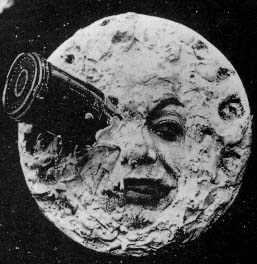
A Trip to the Moon was ranked 84th among the 100 greatest films of the 20th century by The Village Voice. The film remains Méliès' best-known, and the moment when the capsule lands (in the moon's eye) remains one of the most iconic, and frequently referenced, images in the history of cinema.
At a meeting of the Astronomy Club, its president, Professor Barbenfouillis, proposes an expedition to the Moon. After addressing some dissent, five other brave astronomers—Nostradamus, Alcofrisbas, Omega, Micromegas, and Parafaragaramus—agree to the plan. A space capsule in the shape of a bullet is built, along with a huge cannon to shoot it into space. The astronomers embark and their capsule is fired from the cannon with the help of "marines", most of whom are played by young women in sailors' outfits. The Man in the Moon watches the capsule as it approaches, and, in an iconic shot, it hits him in the eye.
Landing safely on the Moon, the astronomers get out of the capsule (without the need for space suits or breathing apparatus) and watch the Earth rise in the distance. Exhausted by their journey, they unroll their blankets and sleep. As they sleep, a comet passes, the Big Dipper appears with human faces peering out of each star, old Saturn leans out of a window in his ringed planet, and Phoebe, goddess of the Moon, appears seated in a crescent-moon swing. Phoebe causes a snowfall that awakens the astronomers, and they seek shelter in a cavern where they discover giant mushrooms. One astronomer opens his umbrella; it promptly takes root and turns into a giant mushroom itself.
At this point, a Selenite (an insectoid alien inhabitant of the Moon, named after one of the Greek moon goddesses, Selene) appears, but it is killed easily by an astronomer, as the creatures explode if they are hit with force. More Selenites appear, and it becomes increasingly difficult for the astronomers to destroy them as they are surrounded. The Selenites capture the astronomers and take them to the palace of their king. An astronomer lifts the Selenite King off his throne and throws him to the ground, causing him to explode.
The astronomers run back to their capsule while continuing to hit the pursuing Selenites, and five get inside. The sixth astronomer, Barbenfouillis himself, uses a rope to tip the capsule over a ledge on the Moon and into space. A Selenite tries to seize the capsule at the last minute. Astronomer, capsule, and Selenite fall through space and land in an ocean on Earth, where they are rescued by a ship and towed ashore. The final sequence (missing from some prints of the film) depicts a celebratory parade in honour of the travellers' return, including a display of the captive Selenite and the unveiling of a commemorative statue bearing the motto "Labor omnia vincit".
When A Trip to the Moon was made, film actors performed anonymously, and no credits were given; the practice of supplying opening and closing credits in films was a later innovation. The following cast details can be reconstructed from available evidence:
Hub AI
A Trip to the Moon AI simulator
(@A Trip to the Moon_simulator)
A Trip to the Moon
A Trip to the Moon (French: Le Voyage dans la Lune [lə vwajaʒ dɑ̃ la lyn], transl. "The Journey to the Moon") is a 1902 French science-fiction adventure trick film written, directed and produced by Georges Méliès. Inspired by the Jules Verne novel From the Earth to the Moon (1865) and its sequel Around the Moon (1870), the film follows a group of astronomers who travel to the Moon in a cannon-propelled capsule, explore the Moon's surface, escape from an underground group of Selenites (lunar inhabitants), and return to Earth with a captive Selenite. Méliès leads an ensemble cast of French theatrical performers as the main character Professor Barbenfouillis.
Although the film disappeared into obscurity (after Méliès's retirement from the film industry) it was rediscovered around 1930, when Méliès's importance to the history of cinema was beginning to be recognised by film devotees. An original hand-colored print was discovered in 1993, and restored in 2011.
A Trip to the Moon was ranked 84th among the 100 greatest films of the 20th century by The Village Voice. The film remains Méliès' best-known, and the moment when the capsule lands (in the moon's eye) remains one of the most iconic, and frequently referenced, images in the history of cinema.
At a meeting of the Astronomy Club, its president, Professor Barbenfouillis, proposes an expedition to the Moon. After addressing some dissent, five other brave astronomers—Nostradamus, Alcofrisbas, Omega, Micromegas, and Parafaragaramus—agree to the plan. A space capsule in the shape of a bullet is built, along with a huge cannon to shoot it into space. The astronomers embark and their capsule is fired from the cannon with the help of "marines", most of whom are played by young women in sailors' outfits. The Man in the Moon watches the capsule as it approaches, and, in an iconic shot, it hits him in the eye.
Landing safely on the Moon, the astronomers get out of the capsule (without the need for space suits or breathing apparatus) and watch the Earth rise in the distance. Exhausted by their journey, they unroll their blankets and sleep. As they sleep, a comet passes, the Big Dipper appears with human faces peering out of each star, old Saturn leans out of a window in his ringed planet, and Phoebe, goddess of the Moon, appears seated in a crescent-moon swing. Phoebe causes a snowfall that awakens the astronomers, and they seek shelter in a cavern where they discover giant mushrooms. One astronomer opens his umbrella; it promptly takes root and turns into a giant mushroom itself.
At this point, a Selenite (an insectoid alien inhabitant of the Moon, named after one of the Greek moon goddesses, Selene) appears, but it is killed easily by an astronomer, as the creatures explode if they are hit with force. More Selenites appear, and it becomes increasingly difficult for the astronomers to destroy them as they are surrounded. The Selenites capture the astronomers and take them to the palace of their king. An astronomer lifts the Selenite King off his throne and throws him to the ground, causing him to explode.
The astronomers run back to their capsule while continuing to hit the pursuing Selenites, and five get inside. The sixth astronomer, Barbenfouillis himself, uses a rope to tip the capsule over a ledge on the Moon and into space. A Selenite tries to seize the capsule at the last minute. Astronomer, capsule, and Selenite fall through space and land in an ocean on Earth, where they are rescued by a ship and towed ashore. The final sequence (missing from some prints of the film) depicts a celebratory parade in honour of the travellers' return, including a display of the captive Selenite and the unveiling of a commemorative statue bearing the motto "Labor omnia vincit".
When A Trip to the Moon was made, film actors performed anonymously, and no credits were given; the practice of supplying opening and closing credits in films was a later innovation. The following cast details can be reconstructed from available evidence:
Recent media