Hubbry Logo
Closing creditsClosing creditsMain
Open search
Closing credits
Community hub
Closing credits
logo
8 pages, 0 posts
0 subscribers
Be the first to start a discussion here.
Closing credits
Closing credits
from Wikipedia

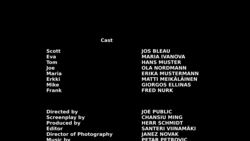
Example of closing credits
Closing credits to the open-source animated film Big Buck Bunny

Closing credits, aka end credits or end titles, are a list of the cast and crew of a particular motion picture, television show, or video game.[1] While opening credits appear at the beginning of a work, closing credits appear close to or at the very end of a work. A full set of credits can include not only the cast and crew, but also production sponsors, distribution companies, works of music licensed or written for the work, various legal disclaimers, such as copyright, and more.[citation needed]

Appearance

[edit]

Typically, the closing credits appear in white lettering on a solid black background, often with a musical background. Credits are either a series of static frames, or a single list that scrolls from the bottom of the screen to the top. Occasionally closing credits will divert from this standard form to scroll in another direction, include illustrations, extra scenes, bloopers, joke credits and post-credits scenes.[citation needed]

History

[edit]

The use of closing credits in film to list complete production crew and the cast was not firmly established in American film until the late 1960s and early 1970s. Films generally had opening credits only, which consisted of just major cast and crew, although sometimes the names of the cast and the characters they played would be shown at the end. Two of the first major films to contain extensive closing credits – but almost no opening credits – were the blockbusters Around the World in 80 Days (1956) and West Side Story (1961). West Side Story showed only the title at the beginning of the film, and Around the World in 80 Days had no opening credits at all.[citation needed]

See also

[edit]

References

[edit]
[edit]
Revisions and contributorsEdit on WikipediaRead on Wikipedia
from Grokipedia
Closing credits, also known as or tail credits, are the concluding sequences in films, television programs, and video games that list the cast, crew, and other key contributors involved in the production. These credits typically appear after the main content has concluded, often scrolling upward on a black background accompanied by music, and serve to acknowledge the collaborative effort behind the work while providing professional recognition to participants. Unlike , which may focus on major stars and titles to build audience interest, closing credits are more comprehensive, encompassing a wider range of roles from directors and producers to technical staff such as editors, sound designers, and artists. The practice of including closing credits evolved significantly over the , originating from early cinema's lack of formal acknowledgments in the pre- era, when films often featured only titles and studio logos without naming individuals. By the , fan demand led to credits for prominent actors, but these were primarily in opening sequences through the to , with closing credits remaining minimal—frequently limited to a simple "The End" card. The shift toward extensive closing credits became widespread in the , driven by the rise of auteur theory, which emphasized the director's vision and necessitated fuller crew listings, alongside the freelance "package-unit" production model that empowered labor guilds to negotiate for broader recognition. This period marked a formal separation between opening and closing credits, with the latter expanding to include roles amid growing complexity. In modern productions, closing credits follow a hierarchical order governed by industry conventions and union agreements, beginning with above-the-line personnel such as the director, writers, producers, and lead on dedicated title cards, followed by a scrolling list of supporting cast, department heads (e.g., , ), and specialized crew in areas like art, sound, and . Their length has increased notably since the —often reaching 8 to 10 minutes in effects-heavy blockbusters—due to larger teams, guild requirements for visibility to aid career advancement, and creative additions like post-credits scenes or bloopers to retain audiences. In television and video games, closing credits adapt similarly but may be shorter or integrated into episode recaps, reflecting episodic formats or interactive elements, while always prioritizing equitable acknowledgment of contributions.

Definition and Purpose

Definition

Closing credits, also referred to as , end titles, or tail credits, constitute a comprehensive list acknowledging the , , production staff, sponsors, acknowledgments, and legal disclaimers—such as notices and disclaimers—that appears at the conclusion of a media production, including , television programs, or video games. These elements serve to recognize the collaborative efforts behind the work, encompassing not only principal performers and directors but also behind-the-scenes contributors like editors, sound technicians, and teams, alongside any licensed or entities. In contrast to , which emphasize prominent talent such as lead actors, the director, and the production title to introduce the work and build audience anticipation, closing credits provide an exhaustive roster of all involved parties without prioritizing star power. They differ from mid-credits or post-credits scenes, which insert narrative extensions like teaser sequences or bonus footage amid or after the credits rather than focusing on acknowledgments. Closing credits are positioned immediately after the primary content ends, allowing viewers to depart or transition while the sequence unfolds, and they typically endure for 1 to 10 minutes, with duration varying by production scope—shorter for independent works and longer for large-scale blockbusters due to extensive personnel lists.

Purposes

Closing credits serve primarily to acknowledge the contributions of all individuals involved in a film's production, from prominent members and directors to below-the-line such as grips, editors, and production assistants. This recognition is essential for fostering collaboration and morale within the entertainment industry, as it publicly honors the collective effort required to bring a project to completion and reinforces a sense of professional community among diverse teams. In addition to acknowledgment, closing credits fulfill an informational role by detailing specific roles and responsibilities, such as "Edited by" or "Cinematography by," which educates audiences on the process and enables industry professionals to identify potential collaborators. This transparency aids career networking, as credits act as verifiable records of experience that hiring managers and producers review to assess talent for future projects, thereby facilitating opportunities in a competitive field. Closing credits also address legal and contractual obligations, particularly those mandated by unions like , which require visible on-screen billing for performers to ensure fair recognition and compliance with agreements. These requirements extend to protecting through included disclaimers, such as notices or statements clarifying adaptations, which safeguard creators' rights and mitigate potential disputes over ownership. Furthermore, closing credits provide closure by signaling the conclusion of the story, allowing viewers time to reflect on the film's themes and emotional impact as the sequence unfolds. This transitional function marks the end of the viewing experience, often accompanied by music or visuals that enhance the sense of resolution. Finally, closing credits perform a function by highlighting key personnel and collaborators, which builds audience interest in their subsequent works and promotes related projects within the industry . For instance, prominent names in the credits can draw attention to an actor's or director's portfolio, encouraging viewers to seek out future endeavors.

Format and Appearance

Structural Elements

Closing credits are typically organized into a structured sequence that prioritizes key contributors while systematically listing the full , ensuring a logical flow from creative to . This reflects industry norms for recognizing roles based on their perceived impact on the film's artistic and logistical execution. The core categories encompass the cast and crew, along with specialized acknowledgments. For the cast, credits distinguish between lead , supporting roles, and guest appearances, often listing performers in order of prominence or narrative importance to highlight their contributions to the story. Crew listings include pivotal above-the-line positions such as the director, who oversees the overall vision; writers, responsible for the ; producers and executive producers, who manage financing and development; the (director of photography), handling visual aesthetics; the editor, shaping the final cut; and the , crafting the film's physical world. Additional acknowledgments cover departments like stunt coordinators for action sequences, teams for visual enhancements, and for composed scores or licensed songs, ensuring credit for ancillary elements that support the . A clear hierarchy governs the sequencing, beginning with above-the-line personnel—creative and financial leaders like the director and producers—who receive prominent standalone cards or early placement to emphasize their foundational roles. This is followed by below-the-line crew, encompassing technical and support staff such as grips, electricians, and department assistants, listed after the supporting cast and major production heads to reflect a progression from high-level oversight to operational execution. Within departments, heads (e.g., ) appear before subordinates, maintaining a top-down order that underscores leadership. Variable inclusions extend beyond personnel to encompass studio logos, which affirm production affiliations; funding credits, acknowledging financial backers or grants; disclaimers, such as statements confirming no animals were harmed during filming, often mandated by organizations like the American Humane Association; and AI-related disclaimers, such as statements affirming no AI was used or prohibiting content use for AI training, increasingly common in 2025 productions to address ethical and legal concerns. The length of closing credits varies significantly by production scale, with blockbuster films frequently listing over 500 names—sometimes reaching 600 to 1,000 or more—to account for expansive teams in and large crews, resulting in sequences lasting 5 to 10 minutes. In contrast, independent films constrain credits to essential personnel, limiting inclusions to core cast, key crew, and basic acknowledgments to maintain brevity and focus.

Visual Presentation

Closing credits are typically presented in a straightforward format to ensure legibility, featuring white text against a solid black background. This high-contrast design facilitates readability in darkened theaters or on screens, adhering to industry guidelines that emphasize clear visibility for performer credits. Common fonts include clean typefaces such as , selected for their neutrality and ease of reading at a distance. The text scrolls upward from the bottom of the screen at a standard rate of approximately 2-3 lines per second when projected at 24 frames per second, allowing audiences sufficient time to absorb the information without rushing. This speed balances pacing with the need to fit extensive lists within a reasonable duration, typically 3-5 minutes for feature films. Technical specifications often include varying font sizes—larger for principal cast and crew (e.g., 0.5-1% of screen height for stars) and smaller for supporting roles—to highlight while maintaining overall . Dwell time, where text pauses briefly at the center of the frame, and smooth transitions like fades enhance comprehension, particularly in digital formats. Variations in motion depart from the linear to add visual interest, such as static cards for key personnel that hold for several seconds before transitioning. Diagonal scrolls or integrated animations, where text follows environmental elements like characters or scenery, create a more dynamic flow, as seen in films blending credits with lingering narrative visuals. plays a crucial role in the presentation, with end-title music often comprising variations of the film's theme or original compositions to evoke emotional closure. Creative flourishes may include bloopers, hand-drawn illustrations, or photo montages interspersed with the , extending audience engagement without overwhelming the text. Modern trends prioritize accessibility through enhanced high-contrast ratios (at least 4.5:1 for text) and adaptable speeds for diverse viewing platforms, ensuring inclusivity for viewers with visual impairments. Integration with post-credits scenes has become prevalent, where credits overlay teaser footage, maintaining momentum in franchise films while adhering to core visual principles.

Historical Development

Origins in Silent Era and Early Sound Films

In the silent era of cinema, spanning from the to the late , credits were rudimentary and predominantly appeared at the film's opening as simple title cards, often serving to identify the production's title, key personnel, and sometimes main cast members. These intertitles, which were photographic stills inserted between scenes, frequently doubled as narrative devices to convey , plot exposition, or transitions, rather than dedicated credit sequences. Closing placements were exceptionally rare due to the brevity of early films—typically lasting under 15 minutes—and the lack of standardized practices; when they occurred, they might include brief acknowledgments of the producer or director at the very end, but comprehensive lists were absent. The introduction of synchronized sound in the late 1920s marked a pivotal shift, yet early sound films from the 1930s to 1940s largely retained the dominance of opening credits to highlight studio branding, star names, and titles, capitalizing on the marketing power of celebrity in the burgeoning Hollywood studio system. For instance, Warner Bros.' (1927), widely regarded as the first feature-length part-talkie, featured elaborate opening titles crediting and director , with only minimal end acknowledgments such as a simple "The End" card and basic production notes, reflecting the transitional nature of sound integration. The studio system's emphasis on front-loading credits stemmed from its industrial model, which treated films as commodities to attract audiences through star power and brand recognition, while short runtimes—often 60 to 90 minutes—left little room for extended endings without disrupting narrative flow. However, the advent of sound technology expanded production demands, requiring larger crews for dialogue recording, set construction, and technical synchronization, which gradually increased the volume of personnel needing recognition and laid groundwork for fuller credit sequences in later decades.

Transition to End Credits (1950s-1970s)

The transition to placing credits at the end of films gained momentum in the , marking a departure from the traditional opening sequences that had dominated Hollywood since the silent era. One pioneering example was Michael Anderson's Around the World in 80 Days (1956), widely recognized as the first major feature to feature extensive end credits rather than an opening roll, with an elaborate six-minute animated sequence designed by recapping the plot and listing the cast and crew. This innovative approach allowed the film to plunge viewers directly into the narrative after a brief introductory narration by , setting a precedent for immersing audiences without delay. By the early 1960s, this practice began to evolve further, as seen in Robert Wise's (1961), which dispensed with conventional entirely in favor of a stylized aerial view of transitioning into the prologue sequence, with full acknowledgments reserved for the end. These shifts were influenced by directors' desires to prioritize storytelling immediacy, aligning with emerging auteur-driven sensibilities that valued uninterrupted narrative momentum over procedural listings at the outset. The late 1960s and 1970s solidified as the industry standard, driven by audience frustration with protracted openings that delayed the main action amid rising competition from television. Hollywood unions, including the (SAG) and (DGA), played a pivotal role through contracts mandating comprehensive listings for all crew members, which ballooned the length of credit sequences and incentivized their relocation to the film's conclusion to avoid truncating runtime at the start. This was compounded by the package-unit system of production, which emphasized freelance talent and necessitated broader on-screen recognition to highlight individual contributions in an era of declining studio control. In the New Hollywood movement of the 1970s, auteur theory further propelled this trend, as directors sought to craft seamless, immersive experiences that reflected their personal visions without the encumbrance of upfront credits. Francis Ford Coppola's (1972) exemplified this standardization, featuring minimal opening titles—limited to key cast and the director's name—followed by a comprehensive end roll that acknowledged the full production team, enhancing the film's dramatic buildup and closure. By the mid-1970s, such end placements had become ubiquitous, with closing sequences often extending several minutes to accommodate the expanded crew sizes of modern blockbusters.

Modern Innovations

In the 1980s and , closing credits began incorporating creative post-credits scenes to engage audiences, with (1986) featuring a notable example where the directly addresses viewers, urging them to leave the theater, marking an early use of in end sequences. This approach added humor and extended narrative playfulness beyond the main story. By the late , comedies introduced gag reels and outtakes during credits, as seen in Pixar's (1998), where director included animated bloopers to entertain families and highlight the production's lighthearted behind-the-scenes process. The marked a digital shift in closing credits, with (CGI) enabling more dynamic visual integrations, such as animated sequences that blended seamlessly with scrolling text in blockbusters. Faster scrolling rates emerged to accommodate growing credit lengths while maintaining pace, particularly in high-production films relying on extensive digital effects. The popularized mid- and post-credits "stingers" starting with (2008), where a scene teasing introduced interconnected storytelling, influencing franchise filmmaking by encouraging viewers to remain seated. From the 2010s onward, streaming platforms introduced shorter, accelerated closing credits to suit mobile and on-demand viewing habits, often minimizing or skipping them entirely to prioritize quick content transitions and reduce viewer drop-off on smaller screens. This trend reflected broader adaptations to fragmented attention spans, with services like speeding up crawls or shifting detailed acknowledgments to on-screen pop-ups. Modern closing credits have expanded significantly in length, often exceeding 10 minutes, due to the proliferation of (VFX) crews in contemporary blockbusters; for instance, Avengers: Endgame (2019) featured extensive blocks crediting thousands of VFX artists across multiple studios, underscoring the collaborative scale of digital-heavy productions.

Variations by Medium

Cinema

In theatrical cinema, closing credits are typically presented as extended scrolling sequences lasting five to ten minutes or longer, designed to credit the large production crews common in feature films, which can number in the hundreds or thousands. These sequences accommodate roles across departments, from principal cast and directors to technical staff like camera operators and production assistants, reflecting the collaborative scale of Hollywood productions. Credits in cinema often integrate with the film's narrative conclusion, rolling over black screens for a clean, focused presentation or occasionally over lingering final shots to extend emotional resonance. Post-credits teasers have become a hallmark in franchise films, particularly those from Marvel and DC, where brief scenes after the main credits tease future storylines and encourage prolonged audience engagement. For international distribution, closing credits in dubbed versions frequently include additional acknowledgments for voice actors who provide localized performances, ensuring recognition of region-specific contributions. In presentations, credits are formatted with expanded aspect ratios and adjusted text sizing to optimize readability on expansive screens, maintaining visual consistency with the film's large-format sequences. The length and detail of credits vary significantly by production scale: independent films often feature concise rolls limited to core team members due to smaller budgets and crews, while blockbusters—especially those reliant on —extend extensively, listing over 100 digital artists and up to thousands of VFX professionals, for example, Avengers: (2018) credited 5,109 individuals in total, including thousands in visual effects roles. This structure has cultivated a distinct in cinema, particularly for genres, where fans routinely remain seated through the credits in anticipation of teasers, transforming end sequences into anticipated extensions of the cinematic experience.

Television

In television, closing credits are adapted to the episodic format, emphasizing brevity to fit within tight broadcast schedules. These sequences typically last 30 to , listing the recurring main cast, the specific episode's writer and director, and key series producers such as executive producers and co-executive producers. They appear immediately after the episode's fade-out, often overlaid on a black screen or subtle visuals and accompanied by the show's to provide a familiar denouement. On traditional network television, these credits are commonly truncated or overlaid with commercial breaks and previews to maximize time, limiting full viewing. In contrast, streaming services enable uninterrupted playback, though many platforms automatically advance to or promotional content shortly after, reducing opportunities for complete observation. Variations in closing credits reflect genre-specific priorities. Primetime dramas feature extensive crew acknowledgments, including supervising producers, line producers, supervisors, and coordinators, underscoring the collaborative scale of serialized storytelling. Reality shows, by comparison, prominently credit on-screen participants and hosts—such as executive producers who also serve as key on-camera figures—alongside production roles, highlighting the blend of talent and logistics in formats. In syndicated programming, closing credits maintain across seasons to ensure consistency in reruns, with recurring elements like core cast and producers fixed while episode-specific details, such as guest stars, are emphasized per installment. For instance, the Friends (1994–2004) used closing credits that integrated with thematic music and visual recaps of the episode, balancing brevity with nostalgic closure.

Video Games and Streaming

In video games, closing credits are typically presented as skippable end screens featuring scrolling text that acknowledges developers, voice actors, artists, and other contributors, often structured alphabetically or by department to reflect the collaborative nature of production. This format allows players to bypass the sequence quickly after completing a game, prioritizing post-game menus or save functions over prolonged viewing. To enhance engagement, some titles incorporate or dynamic elements; for instance, Part II (2020) rewards completion on its most challenging Grounded or modes with unique audio during the credits, playing the full version of Pearl Jam's "Future Days" (Joel's earlier partial rendition) or Shawn James' "Through the Valley" (from the game's reveal trailer), rather than the standard "Wayfaring Stranger" by . Streaming platforms adapt closing credits for non-linear, on-demand consumption, making them pausable and interactive while integrating seamlessly with autoplay features to support . On , for example, credits begin rolling full-screen but shrink to a small inset window after about 10 seconds, overlaid by recommendations for or series, requiring users to actively select a "Watch Credits" option to continue viewing without interruption. This design minimizes credit duration and visibility by default, treating them as optional to accelerate content progression, though viewers can pause or rewind to access full lists of cast, crew, and production details. Shorter, condensed credits are common to align with viewer habits, reducing scroll time while still fulfilling attribution requirements. Hybrid formats, such as and (VR) experiences, further innovate by embedding interactivity directly into credits. often conclude with end screens linking to handles for creators and performers, fostering direct audience connections beyond the platform. In VR, credits may utilize 360-degree panoramas, enabling users to rotate their view around scrolling text superimposed on immersive environments, as demonstrated in production tools for 360° video editing. Examples like the adaptation of (2019–present) blend streaming credits with cross-media tie-ins, where post-credits scenes and production acknowledgments nod to the source video games, prompting reciprocal updates in titles like to include series-inspired content. Contemporary challenges in these media include optimizing credits for mobile devices with small screens, where text must use larger fonts, , and responsive layouts to ensure without overwhelming limited display space. Additionally, promoting inclusivity involves crediting diverse global teams comprehensively, as advocated by the (IGDA), which provides guidelines to attribute roles fairly across contractors, juniors, and international contributors, countering past issues of omitted or buried acknowledgments that disproportionately affect underrepresented workers; the IGDA updated its crediting guidelines in March 2023 to promote fair attribution, including for contractors and underrepresented workers, influencing modern practices as of 2025. Live events in games like (2017–present) occasionally feature concluding sequences with real-time acknowledgments, adapting credits to ephemeral, multiplayer formats while addressing these scalability and equity concerns.

Standards and Regulations

Industry Conventions for Order

In the film industry, closing credits typically follow a hierarchical order that distinguishes between above-the-line (ATL) and below-the-line (BTL) personnel, reflecting their creative and executive influence versus technical contributions. The ATL sequence begins with the director, often presented on a standalone card for prominence, followed by the writers ( and story credits if applicable), producers, and executive producers. Lead cast members are then credited, usually in order of billing importance, such as "Starring [Name]" or "And [Name] as [Role]" for the top . This structure prioritizes key decision-makers and talent who shape the film's vision. Below-the-line credits proceed in a departmental sequence, starting with core production roles like the (director of photography), editor, , , and music , each often on individual cards. Subsequent sections cover designers, supervisors, and other department heads, such as those in , , makeup, and props, with their teams listed beneath in order of seniority—assistants and support staff appearing last within each category. This progression ensures technical contributors are acknowledged systematically after the creative leadership. For the cast, progression mirrors billing : principal stars first, followed by supporting actors, and then ensemble or minor roles, often grouped as "with" or listed alphabetically if of equal prominence. Extras and background performers are typically credited en masse as "townspeople" or similar collective terms, without individual names, to maintain focus on leads. This order reinforces the film's promotional emphasis on star power while efficiently handling larger ensembles. Special cases include "special thanks" sections at the end, reserved for non-credited individuals or entities like financial backers, location providers, or personal acknowledgments who supported the without formal roles. For roles of equal status, such as multiple associate producers or assistant directors, names are listed alphabetically to denote parity. Genre-specific credits, like choreographers in musicals, may be elevated if central to the film. Global variations exist, particularly in Bollywood, where the order aligns broadly with Hollywood's ATL-BTL divide but prominently features song and music credits due to the integral role of musical sequences; lyricists, singers, and choreographers often receive dedicated sections early in the crawl to highlight these elements, reflecting cultural emphasis on song-driven narratives. Closing credits in film and television are subject to stringent legal and union requirements to ensure fair attribution, protect , and comply with international standards. Under contracts, performers' on-screen credits must be presented in a readily readable color, size, and speed to maintain visibility and equity. Billing negotiations often stipulate that ' names appear no smaller than comparable cast credits in terms of height, width, boldness, and on-screen duration, preventing diminishment of individual recognition. Additionally, prohibits false or misleading credits, such as attributing roles to non-participants, to uphold professional integrity and avoid contractual breaches. Copyright notices in closing credits, while not strictly required for protection under modern U.S. law since the Berne Convention's adoption, are standard practice to assert ownership and deter infringement; a typical includes "© [Year] [Studio or Producer Name], ." For rated films, integration of the MPAA (now MPA) rating seal or descriptor often appears in end credits to inform viewers of content suitability, as seen in productions where the rating is displayed post-feature to comply with guidelines. International treaties impose further obligations on credits. The Berne Convention's Article 6bis mandates , including the right of attribution, requiring that authors and creators of cinematographic works receive proper credit to preserve their authorship integrity, independent of economic rights. In the , the GDPR applies to processed in film productions, including participant , requiring a lawful basis such as contractual necessity. Contractual disputes frequently arise over credit omissions or inequalities, governed by "most favored nations" clauses that mandate equal billing treatment among similarly situated parties to prevent favoritism. Violations, such as failing to include negotiated credits, can lead to penalties including , damages, or lawsuits, as evidenced by historical Hollywood cases in the where actors and writers successfully challenged exclusions under union agreements. For television, the Writers Guild of America (WGA) enforces specific credit rules, requiring writing attributions to appear on a separate card immediately following the director's credit in the end titles for episodic and long-form programs, ensuring clear visibility and adherence to contribution thresholds. As of the 2023 WGA agreement, enhanced protections for credit arbitration in streaming content were introduced. Similarly, the Directors Guild of America (DGA) mandates review of end credit placements, with directors typically receiving prominent positioning—often as the first individual credit in the end credits—to reflect their creative authority, subject to contractually negotiated terms. The DGA's 2024 Basic Agreement maintains these prominence rules. These union protocols extend to notifications for writers on long-form TV projects over 90 minutes, where all participants must be informed of credit determinations in advance.

References

  1. https://en.wiktionary.org/wiki/closing_credits
Add your contribution
Related Hubs
User Avatar
No comments yet.