Hubbry Logo
AbbevillianAbbevillianMain
Open search
Abbevillian
Community hub
Abbevillian
logo
8 pages, 0 posts
0 subscribers
Be the first to start a discussion here.
Abbevillian
Abbevillian
from Wikipedia
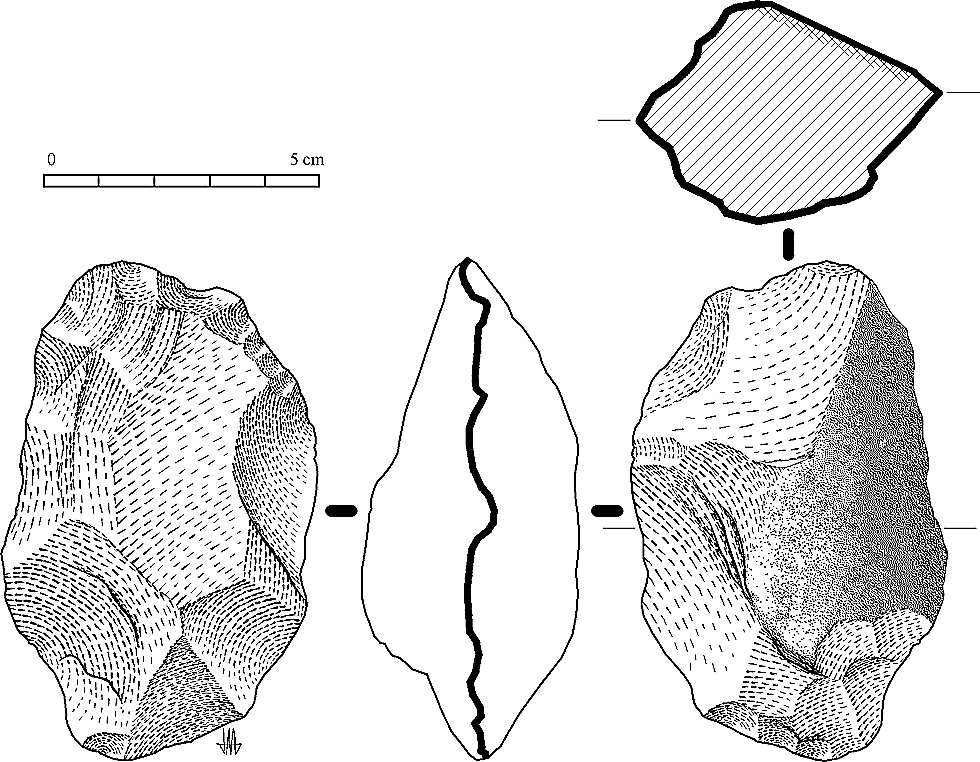
Abbevillian biface flake from the Douro river region near Valladolid, Spain. It is unretouched and is not distinguishable from Olduwan. The one small spot of smaller flaking on one edge may indicate that it is borderline between Olduwan and Acheulean. Both are found in Europe.

Abbevillian (formerly also Chellean) is a term for the oldest lithic industry found in Europe, dated to between roughly 600,000 and 400,000 years ago.

The original artifacts were collected from road construction sites on the Somme river near Abbeville by a French customs officer, Boucher de Perthes. He published his findings in 1836. Subsequently, Louis Laurent Gabriel de Mortillet (1821–1898), professor of prehistoric anthropology at the School of Anthropology in Paris, published (1882) "Le Prehistorique, antiquité de l'homme", in which he was the first to characterize periods by the name of a site.

Chellean included artifacts discovered at the town of Chelles, a suburb of Paris. They are similar to those found at Abbeville. Later anthropologists substituted Abbevillian for Chellean, the latter of which is no longer in use.

Abbevillian tool users were the first archaic humans in Europe, classified as either late Homo erectus[1] as Homo antecessor or as Homo heidelbergensis.

History

[edit]

The label Abbevillian prevailed until the Leakey family discovered older (yet similar) artifacts at Olduvai Gorge (a.k.a. Oldupai Gorge), starting in 1959, and promoted the African origin of man.[2] Olduwan (or Oldowan) soon replaced Abbevillian in describing African and Asian paleoliths. The term Abbevillian is still used, but it is now restricted to Europe. The label, however, continues to lose popularity as a scientific designation.

Mortillet had portrayed his traditions as chronologically sequential. In the Abbevillian, early Palaeolithic hominins used cores; in the Acheulian, flakes. Olduwan tools, however, indicate that in the earliest Palaeolithic, the distinction between flake and core is less clear. Consequently, there also is a tendency to view Abbevillian as an early phase of Acheulian.

Provenience of the type

[edit]

The Abbevillian type site is on the 150-foot terrace of the River Somme.[3] Tools found there are rough chipped bifacial handaxes made during the Elsterian Stage of the Pleistocene Ice Age, which covered central Europe between 478,000 and 424,000 years ago.

The Abbevillian is a phase of Olduwan that occurred in Europe near, but not at, the end of the Lower Palaeolithic (2.5 mya. – 2,500,000 years ago). Those who adopt the Abbevillian scheme refer to it as the middle Acheulian, about 600,000-500,000 years ago. Geologically it occurred in the Middle Pleistocene, younger than about 700,000 years ago.[3] It spanned the Günz-Mindel interglacial period between the Günz and the Mindel, but more recent finds of the East Anglian Palaeolithic push the date back into the Günz, closer to the 700,000 ya mark.[nb 1]

The Abbevillian culture bearers are not believed to have evolved in Europe, but to have entered it from further east. It was thus preceded by the earlier Olduwan of Homo erectus, and the Upper Acheulian, of which Clactonian and Tayacian are considered phases, supplanted it. The Acheulian there went on into the Levalloisian and Mousterian are associated with Neanderthal man.

Abbevillian sites in Europe

[edit]

To avoid the question of what culture name should be used to describe European artifacts, some, such as Schick and Toth, refer to "non-handaxe" and "handaxe" sites.[4] Handaxes came into use at about the 500,000 ya mark.[nb 2] Non-handaxe sites are often the same sites as handaxe sites, the difference being one of time, or, if geographically different, have no discernible spatial pattern. The physical evidence is summarized in the table below Note that the dates assigned vary widely after 700,000 ya and, except where substantiated by scientific methods, should be viewed as tentative and on the speculative side.

Site Notes
Arago Cave near the village of Tautavel in the Languedoc-Roussillon region of France. A community of about 100 individuals discovered over the years in the ongoing excavations of the cave by a team of the Centre Européen de Recherches Préhistoriques de Tautavel under the direction of Henry de Lumley. Excavations began in 1964, the first mandible came to light in 1969, and the first "Tautavel Man" in 1971, though in fact many subsequent Tautavel men and women appeared. The date range is a fairly secure 690,000-300,000 years ago by many methods. The prevailing view is that the fossils are intermediary to the Neanderthals. Tools were found as well.[citation needed]
Barnfield Pit near Swanscombe in Kent, England Portions of a skull excavated from a gravel pit by Alvin T. Marston in 1935-36 along with handaxes and animal bones. Two more pieces and some charcoal were found in 1955 by John Wymer. Estimated date 250,000 ya.[citation needed]
Boxgrove, outside Chichester, Great Britain. Shin bone & two teeth found in 1994 and 1996 in a quarry, with butchered animal bones and handaxes, ca. 500,000 ya.[citation needed]
Mauer near Heidelberg, Germany Mauer 1 (lower jaw & tooth) discovered 1907 in a gravel pit.[5] Dated to 600,000-250,000 ya.[citation needed]
Petralona cave in Chalcidice, Greece. Skull found in a cave with animal bones, stone tools and evidence of fire in 1960. Studied by Aris Poulianos, given various dates. ESR date range is 240,000-160,000, but all other fossils associated indicate a much older date circa 800,000.[6][7][8]
Sima de los huesos, "pit of bones", a chimney site in a cave, one of many fossil hominin sites in the hills of Atapuerca, Castile-Leon, Spain About 4,000 Hominin bones from which about 30 individuals have been reconstructed since the mid-1970s. Bones of carnivores are mixed in and a handaxe was found in 1998. Date is 500,000-350,000 ya.[citation needed]
Steinheim an der Murr, north of Stuttgart, Germany. Skull found in 1933[9] by Karl Sigrist, currently dated to about 250,000 ya.[citation needed]
Vértesszőlős,
Vértesszőlős,
near Budapest
Occipital bone and a few teeth excavated 1964-65 in a quarry site that was in the open and used for butchery by László Vértes. Human fossils were with a hearth, dwelling, tools, footprints, plant and animal fossils.[citation needed]

Notes

[edit]

Footnotes

[edit]

References

[edit]

See also

[edit]

Further reading

[edit]
[edit]
Revisions and contributorsEdit on WikipediaRead on Wikipedia
from Grokipedia
The Abbevillian is an early lithic industry in , characterized by the manufacture of crude bifacial hand axes from local flint nodules, dating from about 700,000 to 500,000 years ago. Named after the town of in the Somme Valley of northern , where the earliest examples were discovered in high terrace fluvial deposits, it represents the initial appearance of bifacial technology in the region, with the oldest dated evidence from approximately 670,000–650,000 years ago during Marine Isotope Stage 16. The term "Abbevillian" was introduced in the 1930s by French prehistorian Abbé Henri Breuil to describe assemblages of thick, minimally retouched bifaces previously termed Chellean, distinguishing them as the oldest hand-axe bearing industry in . Key sites include the Moulin Quignon, Carpentier, and Léon quarries near , where artifacts such as massive bifaces with deep percussion scars, sharp edges, and retained cortex at the base were recovered in primary context within ancient river gravels. These tools, often shaped by the natural morphology of nodules with limited flake removals, also include associated flakes and cores, indicating a technology adapted to temperate environments during the Cromerian complex. Initially regarded as a distinct precursor to the more refined industry, the Abbevillian is now widely integrated into the early techno-complex by modern researchers, reflecting gradual rather than a sharp divide. This reassessment stems from recent excavations confirming artifacts and electron spin resonance dating, which link the industry to early populations expanding into higher latitudes. Despite historical controversies over authenticity—such as a forged at Moulin Quignon in —the Abbevillian remains significant for understanding the timing and mechanisms of dispersal across , with parallels in other European sites but no clear equivalents outside the continent.

Overview

Definition

The Abbevillian is the oldest recognized bifacial handaxe industry in , representing an early phase of bifacial tool production characterized by roughly worked handaxes made primarily from flint nodules or other local stones. These tools mark the initial development of intentional bifacial shaping in the region, distinguishing the industry from preceding unifacial or minimally modified pebble-based traditions. It is now often integrated into the early as its initial bifacial phase. Abbevillian handaxes typically measure 10-16 cm in length, featuring asymmetrical profiles with thick, cortical butts and pointed working edges, achieved through limited flake removals that leave sharp, irregular margins and minimal retouch. This contrasts with the more refined symmetry and extensive flaking seen in subsequent industries, emphasizing the Abbevillian's role as a foundational bifacial tradition. The term "Abbevillian" derives from the type site at Abbeville in northern France's Somme Valley, where artifacts were first systematically identified, and was coined by prehistorian in the 1930s to describe this early bifacial facies. It supplanted the earlier "Chellean" designation proposed by Gabriel de Mortillet, which encompassed similar coarse bifaces but is now viewed as overlapping yet distinct from the more precisely defined Abbevillian.

Chronology

The Abbevillian lithic industry is dated to the early Middle Pleistocene, with an overall temporal range of approximately 700,000 to 650,000 years ago. This period corresponds to the transition from late to early Middle Pleistocene stages in , characterized by fluctuating climatic conditions that influenced hominin occupations. Key sites associate the Abbevillian with the onset of cold conditions in early Marine Isotope Stage (MIS) 16 (~676,000 years ago), within the broader Cromerian complex (MIS 17–13, ~700,000–400,000 years ago), while overlying deposits reflect warmer conditions in MIS 15 (~584,000 years ago). Dating of Abbevillian contexts relies primarily on relative methods, such as stratigraphy and fluvial terrace correlations, particularly the Somme River terrace system where higher terraces (e.g., 40 meters above the modern floodplain) preserve early deposits. These are supplemented by absolute techniques, including electron spin resonance (ESR) on quartz grains and combined ESR/uranium-series dating on associated mammalian teeth, yielding ages like 670,000–650,000 years for key Somme assemblages. Regional variations extend the lower boundary to around 700,000 years ago at southern European sites, such as the Caune d'Arago in , where stratigraphic layers span 700,000–400,000 years and contain early tool assemblages transitional to Abbevillian forms. Toward the upper end, Abbevillian technologies overlap with emerging bifacial traditions around 650,000 years ago, as seen in evolving Somme Valley sequences where crude handaxes give way to more refined forms.

Discovery and History

Initial Discoveries

The initial discoveries of what would later be recognized as Abbevillian artifacts began in 1836, when French antiquarian Jacques Boucher de Perthes, serving as director of the Abbeville customs house, started systematic excavations in gravel pits along the Somme River valley near Abbeville, France. These efforts were inspired by earlier local interests in Celtic antiquities, but Boucher de Perthes focused on deeper strata, uncovering flint tools, including roughly worked handaxes, intermingled with bones of large mammals in the ancient river gravels. Initially, he and local observers interpreted these flints as natural formations shaped by geological processes, such as water erosion, rather than human workmanship, reflecting the prevailing view that human history aligned with biblical timelines of recent creation. Boucher de Perthes' growing conviction in the human origin of the tools led to his seminal in 1847, Antiquités celtiques et antédiluviennes: Mémoire sur l'industrie primitive et les arts à leur origine, where he argued that the artifacts evidenced human activity predating the biblical Deluge, thus challenging contemporary religious and scientific assumptions about human antiquity. The detailed his collections from Somme gravel pits, emphasizing the stratigraphic association of the flints with fossilized remains of extinct animals, and posited an ancient Celtic responsible for their manufacture. Despite its innovative claims, the work received little immediate acclaim in , as it lacked rigorous stratigraphic analysis and included speculative interpretations. The discoveries faced significant skepticism from the French scientific establishment, particularly the Académie des Sciences in , which dismissed Boucher de Perthes' findings in 1847 as the fanciful notions of a provincial enthusiast, insisting that no human artifacts could predate . This doubt persisted until 1858–1859, when British geologist Hugh Falconer visited and examined the collections, followed by Joseph and John Evans, who conducted fieldwork in the Somme quarries. Their observations confirmed the in situ association of bifacially worked flints with bones of extinct species, such as Elephas antiquus, in undisturbed Pleistocene deposits, providing independent validation that revolutionized perceptions of deep human history. Key finds from the 1830s and 1840s included the first recognized bifacial picks and handaxes recovered from the 150-foot (approximately 45-meter) terrace of the Somme River at sites like Menchecourt quarry near Abbeville, where tools were embedded in high-level gravels alongside megafaunal remains. These artifacts, often almond-shaped or pointed bifaces, marked the earliest documented evidence of advanced stone-working in Europe, though their full significance emerged only after the 1859 validations.

Classification and Naming

The classification of the Abbevillian industry traces its origins to the late , when French archaeologist Gabriel de Mortillet introduced the term "Chellean" in 1882 to describe the earliest known assemblages from the period. Drawing from discoveries at the Chelles site near , de Mortillet applied this label broadly to include crude bifacial tools resembling those found at , positioning the Chellean as the initial stage in his sequential framework of cultures, which progressed from Chellean to , , and beyond. This system emphasized typological progression and was influential in establishing the as a distinct chronological division. In the early , the terminology shifted to better reflect the specific characteristics of the Abbeville assemblages, with Abbé proposing the term "Abbevillian" in 1932 to honor the at , , and to delineate it as a distinct entity preceding or transitional to the . Breuil's reclassification highlighted the Abbevillian's emphasis on large, roughly bifaced handaxes made from local flint, distinguishing it from the more refined tools that followed. This naming convention gained traction among European prehistorians, integrating the Abbevillian into refined typological schemes of the . The global perspective on early stone tools evolved significantly with African discoveries, particularly Mary Leakey's 1959 excavations at in , where she uncovered stone tool assemblages associated with early hominins, leading to the widespread adoption of the "" term for the earliest flake and chopper industries worldwide. These findings, dated to over 1.8 million years ago, demonstrated greater antiquity and broader distribution than European examples, while later African sites revealed early bifacial handaxe technologies paralleling the Abbevillian; this prompted scholars by the to view the Abbevillian as a regional European variant within the broader tradition originating in , rather than a universal stage. Throughout the 20th century, the Abbevillian underwent further refinements in Lower Paleolithic chronologies, with ongoing debates centering on its precise relationship to the Acheulean—whether it represented a pre-Acheulean phase characterized by primitive bifaces or a proto-Acheulean development marking the initial emergence of handaxe technology in Europe. In the latter half of the 20th century, processual approaches further emphasized technological continuity between African and European bifacial traditions, influencing ongoing debates. These discussions, informed by stratigraphic and comparative analyses, underscored the Abbevillian's role as a foundational industry in understanding early hominin dispersal and technological innovation, though its boundaries remain contested in modern frameworks.

Type Site

Location and Stratigraphy

The Abbeville type site comprises gravel quarries along the Somme River valley near Abbeville in the Picardy region of northern France, situated at the confluence of the Somme and Scardon rivers on the High Terrace, approximately 40–45 meters above the modern river level. This terrace forms part of a stepped fluvial system incised into Upper Cretaceous chalk bedrock, with slow tectonic uplift along the edges of the Paris Basin contributing to its preservation at elevations up to +55 meters. Key localities include Carrière Carpentier and Moulin Quignon, where early human occupations are documented within this geomorphic context. At Moulin Quignon, periglacial fluvial gravels date to MIS 16 (~670 ka), while at Carpentier, the sequence includes the White Marl (MIS 15) overlain by slope deposits dated to the end of MIS 15 or early MIS 14 (~550–500 ka). Recent studies integrate artifacts from these sites into the early Acheulean rather than viewing them as distinctly Abbevillian. Geologically, the site dates to the Middle Pleistocene, with deposits reflecting alternating glacial and cycles. For Carpentier, cold-climate slope deposits, characterized by periglacial sands, silts, and frost-shattered flint in a clayey matrix, overlie White layers formed during a warmer phase of the Cromerian Complex (Marine Isotope Stage 15, approximately 621–563 ka). The White consists of sandy silts and oncolithic sands deposited in a slow-flowing aquatic environment, rich in carbonates and biogenic structures from cyanobacterial activity. Stratigraphically, the High Terrace corresponds to Alluvial Formation VII (Renancourt Formation), beginning with basal chalky gravels on , followed by the White Marl sequence and capped by slope deposits including hillwashed sands and solifluction gravels indicative of post- cold phases. These upper layers exhibit cryogenic features such as intense gelifluction and ice-rafted blocks, linking them to periglacial conditions during the MIS 16 glacial phase (Cromerian complex, around 670–621 ka) at Moulin Quignon. The overall sequence records a transition from glacial dynamics to temperate interglacial stability, with artifacts occurring primarily in the solifluction horizons above the White Marl at Carpentier or directly in fluvial gravels at Moulin Quignon. Environmental reconstructions from the site's deposits reveal a riverine landscape under predominantly cold, periglacial influences, featuring braided channels and seasonal flooding. Fauna such as straight-tusked elephant (Palaeoloxodon antiquus) and horse (Equus cf. mosbachensis) indicate an open woodland-steppe mosaic with grassy riverbanks during warmer intervals.

Artifacts Found

The primary artifacts discovered at the Abbeville type site, particularly from 19th-century excavations at sites like Moulin Quignon and Carrière Carpentier, include large bifacial handaxes—such as picks featuring pointed ends—along with choppers and abundant flakes derived from local flint nodules. These finds, numbering in the thousands, were primarily recovered from Somme River terrace gravels during digs led by Jacques Boucher de Perthes between 1837 and 1868, highlighting the site's role in early Paleolithic tool production. Among the notable specimens is the "Perthes handaxe," a classic asymmetrical biface exemplifying the crude yet deliberate shaping typical of Abbevillian technology, with extensive cortical retention and irregular edges. Accompanying , including flakes and cores, demonstrates core reduction strategies involving unipolar and centripetal removals, as evidenced by recent analyses of both historical and new collections. Faunal remains associated with these tools include bones of the (Palaeoloxodon antiquus) and (Cervus elaphus), underscoring the contemporaneity of hominin activity with Middle Pleistocene in a fluvial environment. Many of these artifacts are preserved in the Musée Boucher-de-Perthes in and the Muséum National d'Histoire Naturelle in , though early 19th-century excavations often lacked systematic recording, resulting in limited stratigraphic context for much of the material.

Technological Characteristics

Tool Types

The Abbevillian industry is characterized by a limited repertoire of core tools, dominated by bifacial handaxes that exhibit a pointed or ovate form, often with asymmetrical outlines and minimal retouch. These handaxes, typically measuring 10-20 cm in length, were shaped through coarse bifacial flaking on large nodules, preserving significant cortex on the butt end and featuring deep percussion scars along the edges. Picks, present in Abbevillian assemblages, are elongated bifaces with thick, robust butts and pointed working ends, sometimes trihedral in cross-section, designed for heavy-duty tasks and less refined than later variants. Cleavers appear rarely in Abbevillian assemblages, distinguished by straight or slightly convex cutting edges on large flakes or cores, with limited bifacial working compared to handaxes. Accessory tools in Abbevillian sites include simple, unretouched flakes detached during core reduction, often utilized opportunistically without further modification, alongside cores that reflect basic flaking strategies for blank production. Hammerstones, typically or flint cobbles showing battering and pitting, served as percussors for and are commonly recovered from type sites. Tool manufacture relied on locally available materials sourced from river gravels in the Somme Valley, primarily flint nodules from chalk formations and occasional , with little evidence of long-distance transport leading to variability in raw material quality and size. This preference for proximate resources resulted in tools adapted to nodule morphology, often retaining natural platforms and irregular shapes, with features such as sinuous lateral edges.

Manufacturing Techniques

The core reduction strategy in Abbevillian tool production involved direct percussion using hard stone hammers on flint nodules or cobbles, yielding large, wide flakes and enabling the alternate shaping of bifaces on both faces to create massive, crudely worked forms. This method produced deep conchoidal percussion scars and preserved cortex at the base, reflecting the influence of the raw material's natural shape on the final product. Retouch patterns were characterized by irregular, invasive flaking with minimal platform preparation, resulting in sharp edges and a rough, "quarry-like" finish on the bifaces. Such limited retouch—often restricted to final edge adjustments—distinguished Abbevillian artifacts from more refined later industries, emphasizing expediency over elaboration. Technologically, the Abbevillian represents a transitional phase from the unifacial tools of Oldowan-like core-flake industries to the symmetrical bifaces of the , with evidence of planning evident in the selection of suitable blanks but no use of soft hammers for controlled thinning. This shift highlights an emerging bifacial competency around 670–650 ka at sites like Moulin Quignon, where early Acheulean traits began to appear without advanced platform management. Waste products from Abbevillian were abundant, including angular shatter and cortex-covered flakes, indicative of opportunistic reduction directly on-site with little systematic core preparation. These byproducts, often indistinguishable from natural geofacts in some contexts, underscore the industry's reliance on local, unmodified nodules for immediate tool needs.

Distribution and Key Sites

Sites in

The Abbevillian industry is primarily known from the high terrace fluvial deposits of the Somme River Valley in northern France, beyond the type locality at Abbeville. Other significant localities within this system include sites near Amiens, such as those in the 40-50 meter terraces, where crude bifaces similar to those from Abbeville have been recovered. These artifacts, dated to approximately 670,000–600,000 years ago based on electron spin resonance and stratigraphic correlation with Marine Isotope Stage 16, reflect early bifacial technology in riverine and floodplain environments. While the core Abbevillian is confined to the Somme Valley's cold glacial contexts during the Cromerian complex, southern France yields no confirmed Abbevillian sites. Earlier Mode 1 assemblages, such as at Lézignan-la-Cèbe (dated to ~1.3–1.1 Ma via cosmogenic nuclide and biochronology), predate bifacial technology, featuring simple flakes from basalt cobbles. Later Acheulean developments appear in caves like Arago at Tautavel (~450,000 years ago, MIS 11-9), with symmetrical handaxes on quartzite, but these post-date the Abbevillian phase. Abbevillian sites in are thus concentrated in the northern fluvial systems, emphasizing bifacial shaping adapted to local flint nodules in dynamic river gravels, with no verified southern extensions.

Sites in Britain and Other

In Britain, evidence of Abbevillian-like bifacial tools is sparse and debated, with the industry now viewed as part of the early techno-complex. The earliest potential bifaces appear in high terrace contexts predating MIS 13, but confirmed early examples are at sites like Boxgrove in , where in situ handaxes associated with butchered date to approximately 500,000 years ago (MIS 13). These reflect intensive and resource exploitation on stable land surfaces, using local flint. Sites like Barnham in and Swanscombe in yield bifaces from brickearth and gravel deposits dated to around 400,000 years ago (MIS 11), including soft-hammer flakes indicating on-site manufacture. These assemblages show a mix of handaxes and non-handaxe tools, transitional from earlier phases. Across , Abbevillian manifestations are rare outside northwest , limited by environmental constraints. In , bifaces at Bilshausen in from fluvial deposits date to ~500,000 years ago, pre-Elsterian glaciation. In , the Torralba site features early bifacial tools with remains in a lacustrine setting, ~400,000 years ago. The Mediterranean site of Terre Amata near , with bifaces from beach deposits (~380,000 years ago), shows temporary occupations but refined forms. These sites demonstrate local adaptations using chert and flint for rough bifaces, paralleling the gradual evolution from Abbevillian precursors.

Cultural and Biological Context

Associated Hominins

The Abbevillian industry, representing the earliest bifacial tool tradition in , is primarily associated with as the most likely hominin species responsible for its production, based on fossil evidence from contemporaneous sites. Other candidates include and late variants of , reflecting the transitional nature of Middle Pleistocene hominin dispersals into Europe. No hominin fossils have been directly recovered from the Abbeville type sites in the Somme Valley, but associations exist at nearby localities with Abbevillian-like early bifaces. At the Caune de l'Arago cave near Tautavel, , the partial cranium Arago 21, dated to approximately 450,000 years ago, exhibits features most similar to Homo heidelbergensis, including robust brow ridges and a large facial structure, and is linked to tool levels that include proto-handaxes akin to Abbevillian forms. Similarly, at Boxgrove, , a fragment and two teeth, dated to approximately 480,000 years ago, have been analyzed for their morphology. Recent studies (as of 2022) suggest the teeth likely belong to early Neanderthals, fitting within the variability of the Sima de los Huesos population, while the tibia may represent an early member of the Homo heidelbergensis/Neanderthal lineage; initial attributions were to Homo cf. heidelbergensis. The site yields Abbevillian-style handaxes and footprints indicating hominin activity. These remains suggest that Homo heidelbergensis-like populations were present in northwestern Europe during the time of Abbevillian tool manufacture. Use-wear analyses of Abbevillian tools, particularly handaxes from sites like Boxgrove, reveal traces of butchery activities, such as cutting and scraping animal hides and meat from large herbivores like , indicating systematic and processing behaviors. Evidence for is inferred from edge damage on flakes and cores consistent with shaping , as demonstrated in experimental replications of early bifacial tools, to versatile tool applications. These practices imply advanced cognitive abilities for the period, including planning and bilateral flaking techniques required for biface production, which exceed those of earlier Mode 1 industries. The hominins linked to the Abbevillian likely represent an early migration wave into around 600,000–700,000 years ago, originating from African or Near Eastern populations via , as evidenced by the earliest dated bifaces at sites like Moulin Quignon (670,000–650,000 years ago) in the Somme Valley. This dispersal aligns with climatic shifts during Marine Isotope Stage 16, allowing adaptation to temperate woodlands and open landscapes.

Relation to Other Industries

The Abbevillian industry emerged as the European counterpart to the tradition, extending its unifacial pebble-tool technology while introducing more deliberate bifacial shaping on core tools such as handaxes. This transition marked a key technological advancement, with Abbevillian assemblages retaining the simplicity of Oldowan choppers and flakes but incorporating bilateral flaking to create thicker, less refined bifaces from local flint and . As a successor, the Abbevillian evolved into the by approximately 400,000 years ago, featuring progressive refinements in biface , , and edge regularization, alongside early indications of prepared-core methods that foreshadowed Levallois techniques. This development reflects a broader intensification of strategies across , transitioning from the crude, asymmetrical handaxes of the Abbevillian to the more standardized and versatile tools of the . In parallel, the Abbevillian coexisted with the flake tradition in during the Middle Pleistocene, where Clactonian sites emphasized unretouched flakes and cores without bifacial handaxes, possibly reflecting regional adaptations to raw material availability or functional needs distinct from the core-tool focus of Abbevillian assemblages. Globally, the Abbevillian shares analogies with Africa's in bridging simple unifacial industries to bifacial ones, yet it stands out for its pronounced European emphasis on handaxe production amid diverse ecological contexts.

Debates and Modern Interpretations

Distinction from Oldowan and Acheulean

The distinction between the Abbevillian and the industries has been a point of contention among scholars, with some post-1970s interpretations viewing Abbevillian bifaces as transitional from -like technologies adapted to European contexts, featuring initial bifacial elements rather than lacking significant innovation beyond basic flaking. Some researchers argue that the bifacial elements in Abbevillian assemblages represent opportunistic bifacial retouching on cores or choppers, aligning them closely with the unifacial or simple bifacial tools of the African , and thus not warranting a separate cultural designation. Others, however, emphasize bifaciality as a meaningful technological advance, marking a departure from the predominantly unifacial flake tools and indicating early experimentation with symmetrical shaping that foreshadows later developments. Regarding the boundary with the , the Abbevillian is frequently debated as a proto-Acheulean phase due to its rough, irregularly shaped bifaces produced through direct percussion without extensive secondary trimming or refinement. Key differences lie in the absence of the thinness, symmetry, and standardized forms characteristic of classic Acheulean handaxes, with Abbevillian tools often retaining a more core-like, asymmetrical profile better suited to use rather than planned morphology. This proto-status is supported by from sites like Moulin Quignon, where early bifaces exhibit transitional traits but lack the invasive flaking and edge regularization seen in mature Acheulean assemblages. Scholarly arguments for cultural continuity, as articulated by Paola Villa in the 1990s and beyond, highlight gradual from Abbevillian to forms across , suggesting shared behavioral patterns rather than abrupt cultural shifts, with biface production reflecting persistent adaptation to local raw materials and environments. In contrast, typological analyses advocate for separation based on metrical attributes, such as lower flake scar counts and less uniform scar patterns in Abbevillian bifaces compared to ones, which show higher scar densities indicative of more controlled sequences. These metrics, derived from British assemblages, underscore Abbevillian tools as distinctly cruder, supporting their classification as a preliminary stage rather than fully integrated into the tradition.

Current Status

In contemporary , the Abbevillian is increasingly regarded as an early phase of the industry, often integrated into the early techno-complex, with the term continuing to be used in discussions of early bifacial technology in northwest despite debates over its chronocultural framework. Recent literature (as of 2025) maintains references to Abbevillian assemblages as part of a broader European variant of bifacial technology emerging around 700–500 ka, bridging Oldowan-like flake production and more refined forms. Recent research, particularly excavations in the Somme Valley from 2010 to 2019, has revitalized understanding through in situ discoveries at sites like Carrière Carpentier, Rue Léon, and Moulin Quignon. These efforts confirmed early occupations dated to 670–650 ka via electron spin resonance (ESR) and combined ESR/U-series methods, pushing back the timeline of bifacial technology in northwest by over 100,000 years. Lithic studies on tools from these contexts reveal multi-purpose functions, including cutting, scraping, and , indicating versatile adaptations to local resources rather than specialized single-use implements. Pollen records from these layers further contextualize environments associated with MIS 16, including elements of the Cromerian complex with mosaics of open grasslands, bushes, and forests supporting hominin strategies. Despite these advances, significant gaps persist, including the of associated hominin fossils at Abbevillian-linked sites, which limits direct attribution to species like Homo heidelbergensis, and insufficient functional studies to fully elucidate tool lifecycles beyond basic . Future work emphasizes expanded excavations to clarify settlement patterns during glacial-interglacial cycles, integrated climate proxy analyses (e.g., enhanced and faunal records), and interdisciplinary approaches to trace technological transmission from African origins. The Abbevillian's enduring significance lies in its representation of the earliest documented bifacial adaptation by archaic humans in , facilitating survival in mid-latitude ecosystems and marking a key dispersal event from African roots around 700 ka.

References

Add your contribution
Related Hubs
User Avatar
No comments yet.